Streamlining Biomass Supply Chains: The Critical Path to Economical Decentralized Sustainable Aviation Fuel (SAF) Production
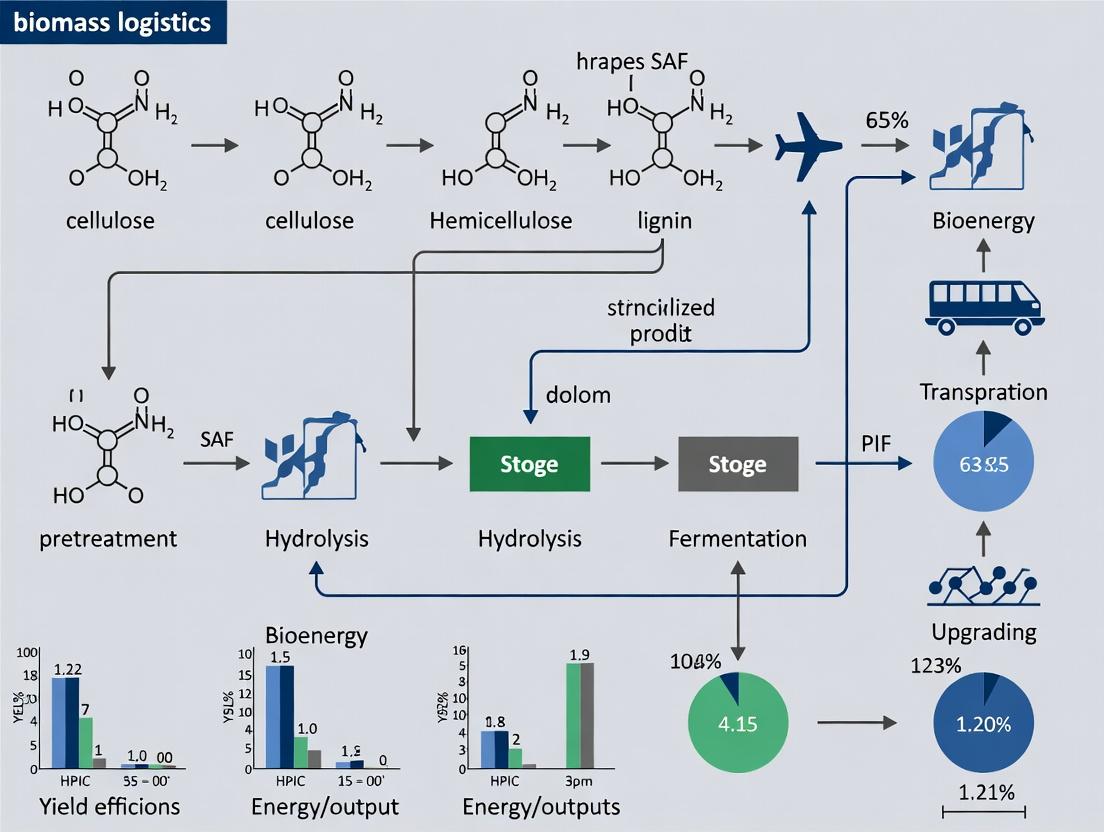
This article provides a comprehensive analysis of biomass logistics optimization strategies tailored for decentralized Sustainable Aviation Fuel (SAF) production.
Streamlining Biomass Supply Chains: The Critical Path to Economical Decentralized Sustainable Aviation Fuel (SAF) Production
Abstract
This article provides a comprehensive analysis of biomass logistics optimization strategies tailored for decentralized Sustainable Aviation Fuel (SAF) production. Targeting researchers and bioenergy professionals, we explore the foundational challenges of feedstock variability and supply chain geometry, detail methodological advances in preprocessing, transport, and digital integration, address critical troubleshooting in storage, contamination, and cost volatility, and validate approaches through techno-economic analysis and lifecycle assessment. The synthesis offers a roadmap for overcoming key logistical bottlenecks to enable scalable, cost-effective decentralized bio-refineries.
The Decentralized SAF Challenge: Understanding Biomass Logistics Bottlenecks and Feedstock Fundamentals
Technical Support Center: Troubleshooting Guides & FAQs
FAQs on Experimental Setup & Biomass Logistics
Q1: What are the critical thresholds for defining "decentralized" scale in SAF production from biomass, and how do they impact reactor design? A: Current research indicates decentralized SAF production typically ranges from 1,000 to 50,000 tons of SAF per year. This scale minimizes biomass transport radius while achieving economic viability. Key thresholds are:
- < 1,000 tons/year: Often not economically viable due to high fixed costs per unit output.
- 1,000 - 10,000 tons/year: Optimal for local agricultural or forestry waste, using modular thermochemical (e.g., pyrolysis, gasification-FT) units.
- 10,000 - 50,000 tons/year: Suitable for regional waste streams (e.g., municipal solid waste, larger agricultural residues), potentially integrating biochemical (e.g., hydroprocessed esters) pathways.
Table 1: Scale Definitions and Logistics Impact
| Production Scale (tSAF/yr) | Biomass Feedstock Radius | Recommended Conversion Pathway | Primary Economic Driver |
|---|---|---|---|
| 1,000 - 5,000 | < 50 km | Fast Pyrolysis with Upgrading | Low-CAPEX modular systems, local policy incentives |
| 5,000 - 20,000 | 50 - 100 km | Gasification-Fischer-Tropsch | Feedstock consistency, cost of hydrogen supply |
| 20,000 - 50,000 | 100 - 150 km | Hydroprocessing of Bio-Oils | Economy of scale on upgrading, offtake agreements |
Experimental Protocol: Determining Optimal Decentralized Scale via Techno-Economic Analysis (TEA)
- Define Feedstock: Characterize local biomass (e.g., moisture, ash, lipid/carbohydrate content).
- Model Logistics: Use GIS software to map feedstock density and calculate transport costs (€/ton/km) for varying plant sizes.
- Process Simulation: Use Aspen Plus or similar to model mass/energy balances for candidate pathways at multiple scales.
- Costing: Apply CAPEX scaling exponents (typically 0.6-0.7) and estimate OPEX.
- Calculate MSP: Determine the Minimum Selling Price (MSP) of SAF for each scale-scenario.
- Sensitivity Analysis: Identify key cost drivers (e.g., feedstock cost, hydrogen price, catalyst lifetime).
Q2: During lab-scale hydroprocessing of bio-oils to SAF, we observe rapid catalyst deactivation. What are the primary troubleshooting steps? A: Catalyst deactivation in hydrodeoxygenation (HDO) is commonly caused by coking, sintering, or poisoning.
- Check Feedstock Pretreatment: Ensure bio-oil is stabilized and filtered to < 0.1 µm to remove particulates. Protocol: Use vacuum filtration followed by a guard bed of silica/alumina before the main catalyst bed.
- Analyze Deactivated Catalyst: Perform Thermogravimetric Analysis (TGA) to quantify coke burn-off, and X-ray Diffraction (XRD) to check for metal sintering or phase changes.
- Adjust Process Conditions:
- Increase H₂ partial pressure (e.g., from 50 to 80 bar) to suppress coke formation.
- Lower reaction temperature (e.g., from 350°C to 320°C) if sintering is suspected.
- Introduce a catalyst regeneration step with controlled air/oxygen burn.
Q3: How do we accurately model the cost-optimal location for a decentralized SAF production facility? A: This requires a integrated logistics and facility siting model. Common errors include omitting spatial feedstock variability or infrastructure access costs. Troubleshooting Guide:
- Error: Model suggests location with highest biomass density, ignoring grid connectivity or hydrogen supply.
- Solution: Incorporate a multi-criteria analysis with weighted factors: feedstock procurement cost (60%), utility access (20%), product distribution (20%).
- Error: Transportation cost model assumes linear cost with distance, underestimating rural road premiums.
- Solution: Use region-specific transport tariffs: €0.25/ton/km for paved roads, €0.35/ton/km for unpaved roads.
Experimental Protocol: GIS-Based Facility Siting Optimization
- Data Layer Collection: Gather spatial data for biomass yield, road networks, electrical grid lines, natural gas pipelines (for H₂), and protected areas.
- Cost Raster Creation: Convert each layer to a cost raster (€/ton or €/m²) reflecting procurement or development cost.
- Weighted Overlay: Apply weights from expert judgment or Analytical Hierarchy Process to combine rasters.
- Site Selection: Identify pixels with the lowest total cost score meeting minimum area (e.g., 5 hectares) and slope (<5%) constraints.
- Validation: Perform a location-allocation analysis to ensure the selected site can minimize total transport cost for the aggregated biomass.
The Scientist's Toolkit: Research Reagent Solutions for SAF Catalysis Testing
Table 2: Essential Materials for Catalytic Upgrading Experiments
| Reagent/Material | Function | Example Vendor/Product Code |
|---|---|---|
| NiMo/Al₂O₃ Catalyst | Standard hydrotreating catalyst for deoxygenation and hydrodenitrogenation. | Sigma-Aldrich, 457849 |
| Pt/SAPO-11 Catalyst | Bifunctional catalyst for hydroisomerization to improve SAF cold-flow properties. | Alfa Aesar, 45742 |
| Simulated Bio-Oil Blend | Standardized feed for catalyst benchmarking (e.g., guaiacol, acetic acid, sorbitol in water). | Prepared in-lab per NREL protocol |
| n-Dodecane | Model hydrocarbon compound for reactor calibration and as a solvent. | Fisher Chemical, D/4120/PB17 |
| High-Purity H₂ Gas (≥99.999%) | Reactant for hydroprocessing reactions; purity critical to prevent catalyst poisoning. | Linde, H₂ GRADE 6.0 |
| SiO₂ Guard Bed Material | Protects main catalyst bed from particulates and alkali metals. | Fuji Silysia, CHROMATOSORB 60A |
Visualization: Experimental Workflow for Decentralized SAF Pathway Evaluation
Title: Workflow for Evaluating Decentralized SAF Pathways
Visualization: Common Catalyst Deactivation Pathways in HDO
Title: Hydroprocessing Catalyst Deactivation Mechanisms
Technical Support Center: Feedstock Preprocessing & Analysis
Troubleshooting Guides & FAQs
Q1: During lignocellulosic analysis of corn stover, my results for acid-insoluble lignin (AIL) are inconsistent and often exceed typical reported ranges. What could be causing this?
A: High AIL values often indicate incomplete hydrolysis of structural carbohydrates or contamination. Follow this protocol:
- Ensure Proper Particle Size: Mill feedstock to pass a 20-mesh screen (<0.85 mm). Larger particles resist hydrolysis.
- Validate Acid Concentration: Precisely prepare 72% w/w sulfuric acid. Use a calibrated densitometer. Deviation of ±0.5% can alter results.
- Control Hydrolysis Temperature: Perform primary hydrolysis in a water bath at 30°C ± 0.5°C for 60 minutes with frequent stirring.
- Secondary Hydrolysis Dilution: Dilute to 4% acid concentration with deionized water. Autoclave at 121°C for 60 minutes. Ensure consistent autoclave ramp and vent cycles.
- Filtering Protocol: Use pre-weighed, grade 4 porosity ceramic filter crucibles. Wash residue with hot DI water until pH neutral. Dry at 105°C overnight before weighing. Reagent Solution: Use NIST standard reference material 8492 (poplar biomass) to calibrate your method.
Q2: My hydrothermal liquefaction (HTL) of sewage sludge yields excessive solid bio-char (>25 wt%) and low biocrude. How can I optimize this?
A: High char formation suggests excessive repolymerization reactions. Modify your HTL protocol:
- Adjust Slurry Properties: Ensure homogeneous slurry with ≤15% solid loading. Use a high-shear mixer for 30 minutes prior to reaction.
- Incorporate a Catalyst: Add 5 wt% sodium carbonate (Na₂CO₃) as a homogeneous catalyst to suppress char pathways and promote deoxygenation.
- Optimize Temperature Profile: Rapid heating is critical. Use a preheated fluidized sand bath or direct electrical heating to reach 350°C in <15 minutes. Hold for 20 minutes.
- Employ a Reducing Atmosphere: Purge reactor headspace with nitrogen (20 bar cold fill pressure) to maintain anoxic conditions. Essential Material: Parr Series 4570 High-Pressure/High-Temperature reactor with rapid heating jacket.
Q3: When cultivating Miscanthus x giganteus as an energy crop for field trials, germination rates are poor. What is the established protocol for propagation?
A: Miscanthus has low seed viability; use rhizome propagation.
- Rhizome Selection & Preparation: Harvest dormant rhizomes from 2-3 year old plants. Cut into sections ensuring each has ≥2 healthy buds (nodes).
- Pre-Planting Treatment: Dip rhizome sections in a fungicide solution (e.g., Captan at 2 g/L) for 15 minutes to prevent rot.
- Soil Preparation: Plant in well-drained soil with pH 5.5-7.5. Apply a pre-emergent herbicide (e.g., pendimethalin) following agricultural extension guidelines.
- Planting Protocol: Plant rhizomes 10 cm deep, with 1-meter spacing between plants and rows. Initial irrigation of 25 mm is critical. Research Reagent: Use Rhizome propagation kits from specialized nurseries (e.g., New Energy Farms) for trial consistency.
Q4: My FT-IR spectra for characterizing SAF intermediates from waste oils show unresolved peaks in the 1600-1800 cm⁻¹ region. How can I improve resolution?
A: This region (C=O stretch) is critical for identifying carboxylic acids, ketones, and esters. Improve sample preparation:
- Sample Purity: Pre-purify the bio-intermediate via silica gel column chromatography using hexane/ethyl acetate gradient elution to isolate fractions.
- Thin Film Method: For liquid samples, apply a thin, uniform film between NaCl plates. Do not overtighten.
- Instrument Calibration: Perform daily background and wavelength calibration using a polystyrene standard. Ensure relative humidity in the instrument is below 40%.
- Spectral Parameters: Set resolution to 2 cm⁻¹ and accumulate 64 scans to improve signal-to-noise ratio. Reagent Solution: Use certified FT-IR calibration standards from Sigma-Aldrich (Product # IRMS01).
Table 1: Typical Biochemical Composition of Primary SAF Feedstocks (Dry Basis)
| Feedstock Type | Example | Glucan (wt%) | Xylan (wt%) | Lignin (wt%) | Ash (wt%) | Reference |
|---|---|---|---|---|---|---|
| Agricultural Residue | Corn Stover | 35-40 | 18-22 | 15-19 | 4-7 | NREL 2023 |
| Agricultural Residue | Wheat Straw | 33-38 | 20-24 | 16-20 | 6-9 | BioRes. 2024 |
| Energy Crop | Miscanthus | 42-48 | 22-25 | 20-24 | 1.5-3 | GCB Bioenergy 2023 |
| Energy Crop | Switchgrass | 32-37 | 20-23 | 17-20 | 3-5.5 | Frontiers 2024 |
| Waste Stream | Municipal Sewage Sludge | 5-10* | 2-5* | 15-25 | 30-50 | WER 2024 |
| Waste Stream | Waste Forestry Wood | 40-45 | 15-20 | 25-30 | <1 | Fuel 2023 |
Primarily cellulosic, not differentiated. *Includes non-lignin aromatic polymers.
Table 2: Decentralized Preprocessing Unit Performance Metrics
| Process Unit | Input Feedstock | Key Operational Parameter | Target Output Specification | Energy Demand (MJ/ton dry) |
|---|---|---|---|---|
| Size Reduction | Baled Residues | Hammer Mill Screen Size (mm) | 90% particles <3 mm | 50-80 |
| Torrefaction | Woody Crops | Temp: 275°C, Residence: 30 min | Mass Yield: 70%, Energy Density: >22 GJ/ton | 800-1200 |
| Fast Pyrolysis | Dry Sludge | Temp: 500°C, Vapor Residence: 2s | Bio-Oil Yield: >55 wt% | 1500-2000 (Heat Integration) |
| Pelletization | Torrefied Biomass | Die Temp: 95°C, Pressure: 150 MPa | Pellet Durability Index >97.5% | 80-120 |
Experimental Protocol: Standardized Feedstock Suitability Assessment
Title: Protocol for Determining Biomass Feedstock Suitability for Decentralized Hydroprocessing to SAF.
Objective: To provide a standardized methodology for evaluating diverse feedstocks' compatibility with decentralized hydroprocessed esters and fatty acids (HEFA) or Fischer-Tropsch (FT) conversion pathways.
Materials:
- Feedstock: 5 kg (dry weight equivalent) of milled and homogenized sample.
- Reagents: Dichloromethane (HPLC grade), deionized water (18.2 MΩ·cm), sulfuric acid (ACS grade), nitrogen gas (high purity).
- Equipment: Soxhlet extraction apparatus, bomb calorimeter (IKA C2000), TGA/DSC analyzer, CHNS/O elemental analyzer (PerkinElmer 2400), 300 mL Parr batch reactor.
Procedure:
- Preprocessing & Characterization:
- Mill feedstock to ≤2 mm. Determine moisture content (AOAC 934.01).
- Perform proximate (ASTM E870) and ultimate analysis (ASTM D5373).
- Determine higher heating value (HHV) using bomb calorimetry (ASTM D5865).
- Extractives Analysis (Critical for Waste Oils/Fats):
- Weigh 10 g of dry biomass (W₁) into a cellulose thimble.
- Perform Soxhlet extraction with 200 mL DCM for 6 hours (12 cycles/hour).
- Dry the thimble and residue at 105°C for 4 hours, cool in desiccator, and weigh (W₂).
- Calculate extractives: [(W₁ - W₂) / W₁] * 100%.
- Rotovap the extract to recover lipids/oils for FAME analysis.
- Thermochemical Conversion Screening (Micro-Reactor):
- Load 5 g of dry feedstock into the Parr reactor.
- For HEFA pathway screening, add 50 mL of co-solvent (e.g., dodecane) and 0.1 g of NiMo/Al₂O₃ catalyst.
- Purge system 3x with N₂, then pressurize to 30 bar with H₂.
- Heat to 350°C at 10°C/min, hold for 2 hours with 500 RPM stirring.
- Cool, collect gas, and separate liquid product for GC-MS analysis (ASTM D2887 mod.).
- Data Synthesis: Calculate key metrics: carbon efficiency to liquids (%), deoxygenation level (%), and energy yield (MJ output/MJ input).
The Scientist's Toolkit: Research Reagent Solutions
Table 3: Essential Materials for Biomass-to-SAF Research
| Item | Function/Application | Example Product/Specification |
|---|---|---|
| NREL Standard Biomass | Analytical calibration for compositional analysis. | NIST RM 8492 (Poplar) & 8493 (Switchgrass). |
| Certified SAF Standards | GC-MS/FID calibration for hydrocarbon fuel analysis. | Supelco SAF Paraffin Mix (C8-C20), HEFA SME Mix. |
| Solid Acid Catalyst | For catalytic fast pyrolysis or hydrolysis. | Zeolite ZSM-5 (SiO₂/Al₂O₃ = 30), <2 µm particle size. |
| Hydrotreating Catalyst | For HEFA or pyrolysis oil upgrading experiments. | NiMo/γ-Al₂O₃ (3-5 mm extrudates), pre-sulfided. |
| Lignin Model Compound | For studying depolymerization pathways. | Gualacylglycerol-β-guaiacyl ether (GGGE). |
| Stable Isotope Tracer | For tracking carbon flow in metabolic/catalytic studies. | ¹³C₆-Glucose (for energy crops), ¹³C-Palmitic Acid (for waste oils). |
| Anaerobic Digestion Inoculum | For biogas potential assays of wet waste streams. | Adapted anaerobic sludge, certified volatile solids content. |
Visualizations
Title: SAF Feedstock Assessment Workflow
Title: Decentralized Biomass Logistics Network
Technical Support Center: Troubleshooting Guides & FAQs
This support center provides solutions for common experimental challenges in biomass logistics research for decentralized Sustainable Aviation Fuel (SAF) production. The guidance is framed within the thesis: Optimizing biomass logistics for decentralized SAF production research.
FAQ Section: Common Experimental & Analytical Issues
Q1: During biomass feedstock characterization, our measured bulk density values show high variance (>15% CV) between replicates, skewing our logistics models. How can we improve measurement consistency? A: High variance is often due to non-standardized compaction methods and particle size distribution. Implement the following protocol:
- Use a standardized test cylinder (e.g., ASABE S269.5 standard: 0.2m diameter, height ≥0.3m).
- Pre-process all biomass through a defined mill screen (e.g., 3mm).
- Fill the cylinder from a set height (e.g., 0.5m) using a funnel to ensure consistent drop.
- Apply a controlled static load (e.g., 5 kg weight for 60 seconds) to simulate handling compaction.
- Weigh and calculate density (kg/m³). Conduct triplicate runs per feedstock batch.
Q2: Our GIS-based analysis for optimal pre-processing hub location is sensitive to seasonal variability in feedstock moisture content, altering the economic radius. How do we parameterize this variability? A: Integrate seasonal moisture modifiers into your GIS model using the following steps:
- Data Collection: For your region, compile historical monthly average precipitation and humidity data.
- Establish Correlation: Conduct a controlled field experiment to create a moisture uptake model for your key feedstocks (e.g., agricultural residues, energy crops).
- Protocol: Place dried samples in open mesh containers at field sites. Weigh samples weekly over 12 months. Correlate weight gain with historical weather data for that period/location.
- Apply Modifier: Use the derived seasonal moisture coefficient to adjust the effective biomass weight and bulk density in your transport cost calculations for each month.
Q3: When testing different baling/compaction technologies for low-bulk-density feedstocks (e.g., corn stover), how do we quantitatively compare the total logistical cost impact? A: Develop a standardized evaluation matrix. The key is to measure parameters that directly feed into Total Logistics Cost ($/dry ton) models. Below is a comparative framework.
| Parameter to Measure | Experimental Protocol | Unit | Impact on Cost Model |
|---|---|---|---|
| Final Bulk Density | ASABE S269.5 (see Q1) after baling. | kg/m³ | Directly affects transport cost (more kg/load). |
| Density Recovery after Decompaction | Measure density post-compaction, then after standard simulated handling (e.g., drop test). Re-measure. | % | Impacts handling losses and downstream processing uniformity. |
| Energy for Compaction | Use a load cell and energy meter on the baler press. Record kWh per ton of input biomass. | kWh/ton | Contributes to pre-processing operating cost. |
| Particle Size Reduction Post-Bale | Sieve analysis (ASTM C136/C136M) of material after bale breakup. | % fines (<3mm) | Affects conversion yield and preprocessing energy. |
| Moisture Loss/Gain during Storage | Instrument bales with moisture sensors, track over 30-90 days in controlled storage. | % point change | Impacts dry matter loss, storage cost, and conversion efficiency. |
Q4: Our life cycle analysis (LCA) for a decentralized network shows unexpected emissions hotspots from feedstock storage. What are the key experimental parameters to measure for accurate storage modeling? A: Storage emissions are driven by microbial activity. Establish a micro-scale storage simulation to measure:
- Dry Matter Loss (DML): The most critical metric.
- Protocol: Place biomass in sealed, ventilated containers at controlled temperatures (20°C, 35°C) and moisture contents (15%, 25% w.b.). Weigh initially and after 30, 60, 90 days. Use dry weight (oven-dry at 105°C for 24h) for accurate DML calculation.
- CO₂/CH₄ Off-gassing: Use a gas chromatograph to sample headspace gas in sealed storage jars weekly.
- Heat Generation: Insert temperature probes into the center of biomass piles to monitor for exothermic activity.
Experimental Protocol: Integrated Hurdle Assessment
Title: Protocol for Evaluating Geographic, Seasonal, and Density Interactions in Feedstock Logistics.
Objective: To simultaneously assess the combined impact of the three key hurdles on feedstock quality and logistics cost for a given candidate biomass.
Methodology:
- Site & Sample Selection: Select 3-5 representative collection points within a plausible geographic dispersion (e.g., 50km radius). At each point, collect ~100kg of target feedstock.
- Seasonal Sampling: Repeat collection at two key seasons: at harvest (low moisture) and post-harvest rainy season (high moisture).
- Pre-processing: Split each sample. Process one half with a standard mill (3mm screen). Process the other half with a densification method (e.g., pellet mill).
- Measurement Matrix: For each sample (Location x Season x Pre-process), measure:
- Bulk Density (ASABE S269.5)
- Moisture Content (ASABE S358.2)
- Calorific Value (ASTM D5865)
- Angle of Repose (for flowability)
- Data Integration: Input results into a centralized logistics model (e.g., a mixed-integer linear programming model) that includes transport distance from each location to a central depot, storage duration, and preprocessing cost. The model should output a normalized cost ($/GJ) for each combination.
Visualizations
The Scientist's Toolkit: Research Reagent Solutions & Essential Materials
| Item | Function in Biomass Logistics Research |
|---|---|
| Standard Test Cylinders (ASABE S269.5) | Provides a consistent volume for accurate and comparable bulk density measurements of loose or baled biomass. |
| Moisture Analyzer / Oven (ASABE S358.2) | Precisely determines feedstock moisture content on a wet or dry basis, critical for yield correction and storage modeling. |
| Portable Gas Chromatograph (GC) | Measures trace gases (CO₂, CH₄, O₂) emitted during storage experiments, quantifying decomposition and emissions factors for LCA. |
| Mechanical Sieve Shaker & Stack | Analyzes particle size distribution post-processing, which affects bulk density, flowability, and conversion efficiency. |
| GIS Software (e.g., QGIS, ArcGIS) with Network Analysis | Models geographic dispersion, calculates transport distances/costs, and optimizes facility (hub) locations based on spatial data. |
| Calorimeter (Bomb) | Measures the higher heating value (HHV) of biomass samples, allowing logistics costs to be normalized to energy content ($/GJ). |
| Data Logger with Temperature/Moisture Probes | Monitors climactic conditions within storage piles or bales over time, linking environmental factors to quality degradation. |
| Uniaxial Compaction Test Rig | A lab-scale device to simulate and measure the energy required for densification (baling, pelleting) of different feedstocks. |
Technical Support Center: Troubleshooting & FAQs
This support center addresses common experimental and modeling challenges within the context of optimizing biomass logistics for decentralized Sustainable Aviation Fuel (SAF) production. The FAQs and guides are designed for researchers and scientists conducting techno-economic analyses (TEA) and life cycle assessments (LCA) in this field.
FAQ 1: How do I accurately model the variable cost of biomass collection given fluctuating moisture content? Answer: Fluctuating moisture content (MC) directly impacts dry-ton yield, transportation weight, and preprocessing energy. Implement a dynamic correction factor in your cost model. Weigh feedstock samples (wet weight) at the field edge, then dry them in a convection oven at 105°C for 24 hours to determine dry weight. Calculate MC (%) = [(Wet Weight - Dry Weight)/Wet Weight] * 100. Apply this to adjust delivered cost per dry ton.
Table 1: Cost Impact of Biomass Moisture Content
| Moisture Content (%) | Effective Dry Ton Yield per 25-ton Load (tons) | Estimated Transport Cost Penalty (% increase over 15% baseline) |
|---|---|---|
| 10 | 22.5 | -5% |
| 15 (Baseline) | 21.25 | 0% |
| 25 | 18.75 | +15% |
| 35 | 16.25 | +35% |
FAQ 2: What is the standard protocol for determining optimal depot location using Geographic Information Systems (GIS)? Answer: Follow this multi-step protocol for locational cost optimization:
- Data Collection: Gather geospatial data on biomass fields (yield, type, harvest windows), road networks (type, tolls, weight limits), and potential depot sites (land cost, zoning).
- Buffer Analysis: Create travel-time buffers around candidate depot locations using network analysis tools (e.g., in ArcGIS or QGIS).
- Cost Allocation: Assign each biomass source to the depot with the lowest combined cost of collection and primary transportation.
- Model Iteration: Run a location-allocation model (e.g., p-median model) to minimize total system transportation cost. Validate with ground-truthed travel time samples.
Experimental Protocol: Biomass Densification Energy Measurement Objective: Quantify the specific energy consumption (kWh per dry ton) of a baling or pelleting process. Methodology:
- Preparation: Pre-weigh a batch of biomass feedstock with known moisture content.
- Instrumentation: Connect the densification equipment (e.g., baler, pellet mill) to a power analyzer (e.g., FLUKE 434 Series II) to record real-time voltage, current, and power factor.
- Process & Measure: Feed the biomass through the equipment at a controlled, steady rate. Record the total energy consumed (in kWh) from the power analyzer for the entire batch.
- Output Weighing: Weigh the total mass of densified product (bales or pellets).
- Calculation: Specific Energy (kWh/dry ton) = [Energy Consumed (kWh)] / [Output Mass (ton) * (1 - MC)]. Perform triplicate runs.
FAQ 3: Why does my sensitivity analysis show storage loss as the most critical parameter? Answer: Dry matter loss (DML) during storage has a compounding effect on all prior logistics costs. A high DML means all costs incurred for collection, transportation, and handling of the lost material are sunk. In TEA, this drastically increases the effective cost of usable feedstock. To mitigate, implement controlled storage experiments with different covering methods (tarps, breathable films) and monitor temperature/ humidity to quantify DML accurately for your specific biomass.
Table 2: Typical Dry Matter Loss Ranges by Storage Method
| Storage Method | Duration (Months) | Dry Matter Loss Range (%) | Key Cost Implication |
|---|---|---|---|
| Open Stack (no cover) | 6 | 15-25% | Very high cost amplification |
| Tarp-covered Pile | 6 | 8-15% | Moderate cost impact |
| Enclosed Shed (ventilated) | 6 | 3-8% | Lower impact, but higher capex |
| Ensiled (anaerobic) | 9 | 5-10% | Maintains moisture, alters preprocessing cost |
Biomass Logistics Cost Factor Decision Tree
The Scientist's Toolkit: Key Research Reagent Solutions
Table 3: Essential Materials for Biomass Logistics Research
| Item & Example Product | Function in Research Context |
|---|---|
| Moisture Analyzer (e.g., MX-50) | Precisely determines feedstock moisture content for yield correction and drying energy calc. |
| Portable Data Logger (e.g., HOBO) | Monitors temperature and humidity within storage piles to correlate with dry matter loss. |
| GPS Data Logger | Records route, time, and idle periods for ground-truthing transportation model assumptions. |
| Power Analyzer (e.g., FLUKE 434) | Measures real-time energy consumption of preprocessing equipment (shredders, pellet mills). |
| Density Measurement Kit (Box, Scale) | Determines bulk density before/after densification to model transport volume efficiency. |
| GIS Software (e.g., QGIS, ArcGIS Pro) | Platform for spatial analysis, depot location optimization, and route costing. |
| TEA/LCA Software (e.g., OpenLCA, Excel-based Models) | Integrates all experimental data into a full cost and environmental impact model. |
Research Integration for Logistics Optimization
Technical Support Center
FAQs & Troubleshooting for Biomass Logistics Modeling
Q1: During our simulation of a Hub-and-Spoke model, we are experiencing unrealistically high transportation costs. What could be the issue? A: This is often due to an incomplete cost parameter set. Ensure your model includes:
- Empty Return Leg Costs: Include cost for trucks returning empty from the central hub to collection points.
- Downtime/Opportunity Cost: Account for driver and asset waiting time during unloading at the hub.
- Biomass Degradation: Factor in moisture loss or quality degradation during longer storage/transport to a central hub, which reduces yield and effective $/ton.
Q2: Our feedstock quality variance in the Distributed Collection model is causing pre-processing inconsistencies at our pilot conversion facility. How can we mitigate this? A: Implement a standardized Quality Acceptance Protocol (QAP) at each collection point. Key steps:
- On-site Rapid Analysis: Use portable NIR spectrometers to measure moisture, carbohydrate, and ash content.
- Pre-processing Standardization: Apply a simple, uniform pre-processing step (e.g., single-pass shredding) at all nodes to homogenize particle size.
- Batching Logic: Create blended batches from multiple distributed nodes to average out quality fluctuations before shipment to the conversion unit.
Q3: How do we accurately model the "tipping point" where a Distributed model becomes more cost-effective than a Hub-and-Spoke model for our specific region? A: You must run a comparative Total Delivered Cost analysis with the following key variables. Use sensitivity analysis on feedstock density and conversion plant scale.
Table 1: Key Variables for Supply Chain Geometry Cost Modeling
| Variable Category | Hub-and-Spoke Model Parameters | Distributed Collection Model Parameters |
|---|---|---|
| Capital Expenditure (CapEx) | Central pre-processing facility cost, High-capacity equipment | Multiple small-scale pre-processing nodes, simpler equipment |
| Operational Expenditure (OpEx) | Primary transport to hub, Storage management cost, Energy for large processing | Transport from nodes to plant, Decentralized labor/energy costs |
| Transport Metrics | Average distance: Collection Point to Hub, Fleet type: Large trucks | Average distance: Node to Plant, Fleet type: Medium trucks |
| Feedstock Critical Factors | Biomass density (>3 dry tons/acre), Seasonal harvest window | Geographically dispersed, low-density biomass (<2 dry tons/acre) |
| Sensitivity Levers | Hub location optimization, Pre-processing technology efficiency | Number of collection nodes, Level of pre-processing at node |
Experimental Protocol: Field-to-Gate Cost Analysis for Two Geometries
Objective: Empirically compare the delivered cost per dry ton of agricultural residue (e.g., corn stover) for two supply chain configurations serving a decentralized 20 million gallon per year SAF pilot plant.
Protocol:
- Define Study Area: Select a 50-mile radius around the proposed plant location. Geospatially map all potential feedstock sources.
- Hub-and-Spoke Simulation:
- Hub Siting: Use centroid modeling or a P-median model to identify the optimal single hub location for aggregate collection.
- Data Collection: Log transport distances from 10 random source points to the hub, then hub to plant. Record simulated weights pre- and post-baling at hub.
- Cost Calculation: Apply local freight rates ($/mile/ton) separately for the two transport legs. Add modeled costs for baling and storage at the hub.
- Distributed Collection Simulation:
- Node Siting: Identify 5 existing agri-industrial facilities (e.g., co-ops, grain elevators) as potential pre-processing nodes.
- Data Collection: Log transport distances from source fields to the nearest node, then node to plant. Record simulated weights pre- and post-grinding at node.
- Cost Calculation: Apply freight rates. Add modeled costs for grinding and minimal storage at each node.
- Analysis: Calculate total cost per dry ton for each model. Perform Monte Carlo simulations (1000+ iterations) varying key inputs (distance, yield, fuel price) to generate a probabilistic cost distribution.
Experimental Workflow Diagram
Title: Biomass Supply Chain Geometry Simulation Workflow
The Scientist's Toolkit: Research Reagent Solutions
Table 2: Essential Materials for Biomass Logistics Field Research
| Item | Function / Application |
|---|---|
| Portable Near-Infrared (NIR) Analyzer | Rapid, on-site determination of biomass composition (moisture, glucan, xylan, lignin) for quality control at collection points. |
| Geographic Information System (GIS) Software | Platform for spatial analysis, optimal facility siting, and transport route mapping for scenario modeling. |
| Discrete-Event Simulation (DES) Software | Tool for dynamic modeling of supply chain operations, including queue times, equipment utilization, and stochastic variability. |
| Unmanned Aerial Vehicle (UAV / Drone) | For remote sensing of crop residue coverage and yield estimation across large or inaccessible fields. |
| Standardized Biomass Sampling Kit | Includes corers, sieves, moisture cans, and grinders for collecting representative feedstock samples for lab validation of NIR data. |
| Logistics Cost Database Template | Customizable spreadsheet for capturing and calculating all CapEx, OpEx, and transport cost components specific to biomass. |
Strategic Frameworks and Technologies for Efficient Biomass Handling and Transport
Technical Support Center: Troubleshooting Guides & FAQs
Q1: During lab-scale baling of herbaceous biomass, we achieve inconsistent bale density. What are the primary causative factors and corrective actions? A: Inconsistent bale density is commonly caused by non-uniform feedstock moisture content, improper particle size distribution, or fluctuating compression pressure.
- Troubleshooting Steps:
- Measure Moisture: Use a moisture meter to verify feedstock moisture is uniform and within the optimal range (typically 12-20% w.b. for storage). Segment and process biomass in batches based on moisture content.
- Analyze Feedstock: Sieve the pre-processed biomass. For consistent densification, the majority of material should fall within a narrow size range (e.g., 2-10 cm). Adjust shredding/chopping protocols.
- Calibrate Equipment: Verify the calibration of the hydraulic pressure gauge on the baler. Ensure the compression chamber is free of residual material that prevents full piston stroke.
Q2: Our pelletizer dies are clogging frequently when processing torrefied biomass. How can we mitigate this? A: Torrefied biomass has reduced lignin content, which acts as a natural binder, and is more abrasive. Clogging is often due to excessive heat or insufficient binding.
- Troubleshooting Steps:
- Adjust Formulation: Introduce a binder. A starch-based binder (e.g., 1-3% by weight) can restore agglomeration. For R&D, test methyl cellulose or lignosulfonates.
- Optimize Process Parameters: Reduce the pre-heating temperature of the die. The torrefied material already has low moisture; excessive heat can degrade remaining binders. Monitor amperage on the pelletizer motor to detect overloading early.
- Material Preparation: Ensure the particle size of the torrefied feedstock is very fine (<1mm). Coarse, abrasive particles increase friction and compaction within the die channels.
Q3: After torrefaction, we observe a massive loss in mass yield but the energy yield remains high. Is this expected, and how do we optimize the trade-off? A: Yes, this is characteristic of torrefaction. The process drives off volatile, low-energy components (water, light organics), concentrating carbon and thus energy, in the solid yield.
- Optimization Protocol: A Response Surface Methodology (RSM) experiment is recommended to model the trade-off.
- Variables: Set temperature (250-300°C) and residence time (10-60 min) as independent variables.
- Responses: Measure Mass Yield (%), Higher Heating Value (HHV, MJ/kg), and Energy Yield (% = Mass Yield * (HHVtorr/HHVraw) * 100).
- Goal: Use statistical software to find the parameter set that maximizes Energy Yield while meeting downstream process requirements for grindability and hydrophobicity.
Q4: For decentralized SAF production research, which densification method provides the best logistic efficiency? A: The optimal method depends on the specific supply chain model. Key quantitative comparisons are below.
Table 1: Comparative Analysis of On-site Biomass Densification Methods
| Parameter | Unit | Baling | Pelletization | Torrefaction |
|---|---|---|---|---|
| Typical Density Increase | kg/m³ | 150-250 | 500-700 | 600-800 |
| Energy Density Increase | % | 0-5 | 10-20 | 20-30 |
| Moisture Tolerance | % w.b. | High (≤25) | Medium (≤15) | Low (≤10) |
| Typical Mass Yield | % | ~98 | ~95 | 60-80 |
| Typical Energy Yield | % | ~98 | ~92 | 75-90 |
| Hydrophobicity | - | Low | Medium | High |
| Grindability Improvement | - | Low | High | Very High |
Table 2: Key Research Reagent Solutions for Biomass Preprocessing Experiments
| Reagent/Material | Function in Research Context |
|---|---|
| Starch-based Binders (e.g., Corn Starch) | Added during pelletization (1-3% wt.) to improve durability, especially for low-lignin or torrefied feedstocks. |
| Lignosulfonates | Alternative organic binder; useful for studying the impact of sulfur content on downstream catalytic SAF conversion. |
| Silica Sand (various mesh sizes) | Used for abrasion testing in durability tumblers (e.g., ASABE S269.5) to simulate handling degradation of pellets. |
| Desiccant (e.g., Indicating Silica Gel) | For creating controlled low-moisture environments to test the equilibrium moisture content and hydrophobicity of torrefied biomass. |
| Thermogravimetric Analysis (TGA) Standards (e.g., Nickel, Curie Point standards) | To calibrate TGA equipment used for proximate analysis (moisture, volatiles, fixed carbon, ash) of raw and densified samples. |
Experimental Protocols
Protocol 1: Determining Pellet Durability Index (DI) Objective: Quantify the mechanical robustness of pellets per ASABE S269.5. Materials: Pellet durability tester (tumbler), sieve (specified size), balance. Method:
- Sieve 500g of pellets to remove fines. Record mass (A).
- Load pellets into the standardized tumbler chamber.
- Rotate for 500 revolutions at 50 rpm.
- Remove pellets and sieve again using the same method. Record the mass of retained pellets (B).
- Calculation: DI (%) = (B / A) * 100.
Protocol 2: Laboratory-Scale Torrefaction Objective: Produce torrefied biomass samples at varying severities. Materials: Tubular furnace/reactor, nitrogen cylinder, sample crucibles, flow controllers. Method:
- Load 20g of dried biomass (<2mm particle size) into a crucible.
- Place crucible in reactor. Purge with N2 at 1 L/min for 5 minutes to establish inert atmosphere.
- Heat reactor to target temperature (e.g., 250, 275, 300°C) at 10°C/min under continuous N2 flow (0.5 L/min).
- Hold at target temperature for desired residence time (e.g., 30 min).
- Cool reactor under N2 flow to below 50°C. Remove sample, weigh, and calculate mass yield.
Visualizations
Troubleshooting Inconsistent Bale Density
Torrefaction Mass vs. Energy Yield Trade-off
Selecting a Densification Method for SAF Research
Technical Support Center
Troubleshooting Guides & FAQs
Q1: In our biomass transport cost model, rail consistently shows lower per-ton-mile costs than trucking, yet our simulated total logistics costs are higher for rail. What is the primary discrepancy we should investigate?
- A: The most common issue is omitting or underestimating fixed and terminal costs. Rail transport involves significant costs for transloading, railcar spotting, and drayage that are not present in direct trucking. Furthermore, low throughput volumes may not justify the fixed cost of rail sidings. Review your model for the following data points, which are often sourced from carrier quotes or industry benchmarks:
- Transloading fee per ton ($/ton)
- Drayage cost from origin to rail ramp and from destination ramp to biorefinery ($/mile)
- Railcar daily demurrage charges (for detention)
- Minimum volume commitment for cost-effective rail service
- A: The most common issue is omitting or underestimating fixed and terminal costs. Rail transport involves significant costs for transloading, railcar spotting, and drayage that are not present in direct trucking. Furthermore, low throughput volumes may not justify the fixed cost of rail sidings. Review your model for the following data points, which are often sourced from carrier quotes or industry benchmarks:
Q2: During our intermodal (truck-rail-truck) simulation, we experience "bullwhip effect" volatility in biorefinery feedstock inventory. What operational protocols can stabilize supply?
- A: Inventory volatility is often a result of inconsistent rail transit times and poor visibility. Implement the following experimental protocol:
- Data Collection Phase: Over a 12-week period, track and log the following for each shipment: (a) Gate-in time at origin rail ramp, (b) Actual departure time, (c) Actual arrival time at destination ramp, (d) Gate-out time after drayage.
- Analysis: Calculate the mean and standard deviation for each leg. You will typically find rail transit has the highest variance.
- Protocol Adjustment: Introduce a safety stock buffer calculated as:
Safety Stock = (Daily Consumption Rate) * (Standard Deviation of Total Transit Time in Days) * Z-score (e.g., 1.65 for 95% service level). Adjust procurement orders to be based on(Inventory Position) + (In-Transit Stock)rather than just on-hand inventory.
- A: Inventory volatility is often a result of inconsistent rail transit times and poor visibility. Implement the following experimental protocol:
Q3: Our geospatial analysis for decentralized SAF production sites suggests a rail-optimal location, but local infrastructure assessment finds no active rail siding. What are the key cost and feasibility experiments to run?
- A: This requires a phased capital investment analysis versus long-term operational savings.
- Feasibility & Cost Experiment: Engage with shortline railroad companies and civil engineers for a site assessment. Model the costs as per the table below.
- Sensitivity Analysis: Run your total logistics cost model under different throughput scenarios (e.g., 50k, 100k, 200k tons/year) comparing the "Truck-Only" baseline against the "Rail with Siding Investment" scenario over a 15-year horizon. The net present value (NPV) of the siding project is critical.
- A: This requires a phased capital investment analysis versus long-term operational savings.
Quantitative Data Summary
Table 1: Comparative Cost Structure for Biomass Transport Modes (Model Estimates)
| Cost Component | Truck (Direct) | Rail (Origin to Destination) | Intermodal (Truck-Rail-Truck) |
|---|---|---|---|
| Variable Cost ($/ton-mile) | 0.25 - 0.35 | 0.05 - 0.10 | 0.08 - 0.15 |
| Fixed Terminal Cost ($/ton) | 5 - 10 | 20 - 40 | 25 - 45 |
| Typical Lead Time (Days) | 1 - 3 | 7 - 14 | 5 - 10 |
| Lead Time Variability (σ in Days) | Low (0.5) | High (2-4) | Medium-High (1.5-3) |
| Optimal Shipment Size | 20 - 25 tons | 1,000 - 2,000 tons | 1,000 - 2,000 tons |
Table 2: Rail Siding Installation Cost Breakdown
| Cost Item | Estimated Range | Notes |
|---|---|---|
| Initial Engineering & Permitting | $25,000 - $75,000 | Site-specific, includes environmental review |
| Track Construction (per foot) | $300 - $500 | Includes grading, ballast, ties, rail |
| Switch Installation | $50,000 - $100,000 | Connection to mainline |
| Site Preparation (Grading, Drainage) | $50,000 - $200,000 | Highly variable |
| Total Estimated Cost | $500,000 - $1.5M+ | For a ~2,000 ft siding |
Experimental Protocols
Protocol 1: Modal Break-Even Analysis for Biomass Corridors
- Objective: Determine the minimum one-way distance where rail or intermodal costs become lower than truck-only for a given annual biomass volume.
- Methodology:
- Define a specific biomass (e.g., corn stover) with a standardized bulk density (e.g., 5.5 lb/ft³ baled).
- For distances from 50 to 500 miles in 50-mile increments, calculate total annual cost.
- Total Cost Formula:
(Variable Cost * Distance * Annual Tons) + (Fixed Terminal Cost * Annual Tons) + (Inventory Carrying Cost * Value * Lead Time). - Plot total cost vs. distance for each mode. The intersection points are the break-even distances for low, medium, and high volume scenarios.
Protocol 2: Intermodal Transloading Efficiency Experiment
- Objective: Quantify biomass density loss and throughput rate during transloading from truck to railcar.
- Methodology:
- Weigh and sample 10 truckloads of biomass (e.g., wood chips) upon arrival at transload facility.
- Transload material using a standard radial stacker/conveyor system into a covered hopper railcar.
- Weigh the loaded railcar (tare weight known) to determine mass transferred.
- Calculate transfer efficiency:
(Mass in Railcar / Total Mass from Trucks) * 100. - Record throughput:
Total Mass Transferred / Total Operator Hours. - Repeat with different material formats (bales, chips, pellets) and equipment.
The Scientist's Toolkit: Research Reagent Solutions
Table 3: Essential Materials for Biomass Logistics Optimization Research
| Item | Function in Research |
|---|---|
| Geographic Information System (GIS) Software | For spatial analysis of feedstock basins, routing, and facility siting based on transport networks. |
| Discrete-Event Simulation Software | To model stochastic logistics systems, simulating queues at transload facilities, transit times, and inventory levels. |
| Life Cycle Assessment (LCA) Database | To quantify and compare the greenhouse gas emissions (g CO2e/ton-mile) of different transport modes. |
| Bulk Density Tester | To determine the mass per unit volume of biomass formats, a critical variable for calculating transport capacity. |
| Moisture Content Analyzer | To measure wet and dry weight of samples, as moisture affects weight-based transport costs and material degradation. |
Visualizations
Title: Intermodal Biomass Logistics Workflow
Title: Transport Mode Optimization Research Methodology
Technical Support Center
This technical support center provides troubleshooting guidance for common experimental and modeling issues encountered during research into biomass logistics optimization for decentralized Sustainable Aviation Fuel (SAF) production.
Frequently Asked Questions (FAQs)
Q1: My Geographic Information System (GIS) model for hub candidate identification is yielding unrealistically high transportation costs. What could be the cause? A: This is often due to incorrect network impedance settings. Verify that your road network layer correctly distinguishes between road types (e.g., highway, secondary, tertiary) and that the associated speed or cost attributes are accurately calibrated for local biomass trucking regulations (e.g., weight limits on rural roads). Re-run the network analysis using impedance based on time (minutes) rather than pure distance (km), as this better reflects real-world conditions affecting fuel consumption.
Q2: The biomass feedstock quality (e.g., moisture content, composition) from my experimental preprocessing trials is highly variable, skewing my logistics cost model. How can I mitigate this? A: Implement a strict, documented feedstock sampling and preparation protocol (see Experimental Protocol 1 below). Variability often stems from inconsistent sampling methods or unrepresentative sub-sampling. For modeling, incorporate this variability as a stochastic parameter using Monte Carlo simulation rather than a single average value, which will provide a more robust cost distribution.
Q3: My Mixed-Integer Linear Programming (MILP) model for hub location is failing to find a feasible solution. What are the primary checks to perform? A: Perform these checks in order:
- Constraint Relaxation: Temporarily relax all capacity and demand constraints. If a solution appears, one of these is too restrictive.
- Demand-Supply Balance: Ensure total potential feedstock supply (tonnes/yr) across all collection points meets or exceeds the total demand input for your SAF biorefineries.
- Parameter Sanity Check: Verify that all cost coefficients (e.g., $/km/tonne) and capacity parameters are in logical, consistent units. A common error is mixing units (e.g., tonnes vs. kg, km vs. miles).
Q4: During Life Cycle Assessment (LCA) of the proposed network, how should I handle the allocation of environmental impacts for co-products from preprocessing (e.g., biochar)? A: Follow the ISO 14044 hierarchy. For decentralized SAF systems, system expansion (avoided burden approach) is often most appropriate. For example, if biochar is produced and used for soil amendment, the system is credited with avoiding the production and emissions of a conventional fertilizer. Document the choice of substituted product and its emission factor transparently.
Troubleshooting Guides
Issue: Inaccurate Biomass Yield Estimation from Satellite/Remote Sensing Data. Symptoms: Modeled feedstock availability at collection points does not align with ground-truthed data, leading to supply gaps. Diagnosis & Resolution:
- Calibrate the Yield Model: Use ground-truthed yield data from field plots to calibrate the vegetation indices (e.g., NDVI) from satellite data. A simple linear regression may be insufficient; consider machine learning models (Random Forest) that incorporate multiple indices and weather data.
- Account for Spatial Aggregation Error: Satellite data pixels may not align perfectly with farm boundaries. Use zonal statistics within GIS to calculate average indices per collection zone, not just a single point sample.
- Validate with Harvest Data: Partner with local agricultural cooperatives to obtain actual harvest data for calibration.
Issue: Unstable Results from Multi-Criteria Decision Analysis (MCDA) for Final Site Selection. Symptoms: Small changes in criterion weightings cause dramatic shifts in top-ranked hub locations, reducing stakeholder confidence. Diagnosis & Resolution:
- Perform Sensitivity Analysis: Systematically vary weights across a plausible range (e.g., ±10%) and observe rank stability. Present results as a set of robust candidate locations rather than a single "optimal" site.
- Check for Redundant Criteria: Use correlation analysis on your criterion performance matrix. If two criteria are highly correlated (e.g., "distance to highway" and "average travel speed to biorefinery"), remove one to avoid double-counting.
- Employ a Consensus Method: Use techniques like the Analytic Hierarchy Process (AHP) with pairwise comparisons from multiple experts to derive more stable, agreed-upon weights.
Experimental Protocols
Experimental Protocol 1: Standardized Feedstock Sampling & Preprocessing for Quality Analysis
Objective: To obtain a representative sample of biomass feedstock (e.g., agricultural residue, energy crops) for determining moisture content, bulk density, and compositional analysis (cellulose, hemicellulose, lignin).
Methodology:
- Field Sampling: For a defined plot, collect biomass from at least 5 random sub-locations using a quadrant. Combine into a composite primary sample (≥10 kg wet weight).
- Size Reduction: Use a laboratory-scale shredder to homogenize the primary sample to a particle size of <10 mm.
- Sub-sampling: Coning and quartering technique. Thoroughly mix the shredded biomass, form a cone, flatten, divide into quarters. Retain two opposite quarters, combine, and repeat until a 2-3 kg representative subsample is obtained.
- Moisture Content: Immediately weigh a portion (Mwet). Dry in a forced-air oven at 105°C for 24 hours or until constant weight (Mdry). Moisture % = [(Mwet - Mdry)/M_wet] * 100.
- Compositional Analysis: Send dried, milled subsample for standardized analysis (e.g., NREL/TP-510-42618 protocol for structural carbohydrates and lignin).
Experimental Protocol 2: Determining Optimal Preprocessing Hub Throughput Capacity
Objective: To model the relationship between capital/operating costs and throughput for a candidate preprocessing technology (e.g., pelletizer, torrefaction unit) to identify minimum viable scale.
Methodology:
- Data Collection: Gather quoted capital costs (CapEx) and operating costs (OpEx: energy, labor, maintenance) for 3-5 different equipment sizes (e.g., 1, 5, 10 dry tonnes/hour capacity).
- Cost Modeling: Fit a power law model to the CapEx data:
CapEx = a * (Capacity)^b. Typically,b < 1indicates economies of scale. - Unit Cost Calculation: Calculate unit processing cost ($/dry tonne) for each size:
Unit Cost = (Annualized CapEx + Annual OpEx) / Annual Throughput. Assume an annual operating time (e.g., 350 days * 20 hrs/day) and a capital recovery factor based on project lifespan and discount rate. - Sensitivity Analysis: Create a tornado chart showing the impact of key variables (e.g., biomass cost, energy price, annual operating hours) on the unit cost for the selected optimal scale.
Data Presentation
Table 1: Comparative Analysis of Preprocessing Technology Options for Herbaceous Biomass
| Technology | Output Product | Typical CapEx ($/tonne capacity) | Energy Consumed (GJ/tonne input) | Mass Yield (Output/Input) | Dry Matter Loss (%) | Suitability for Decentralized Micro-Depot |
|---|---|---|---|---|---|---|
| Densification (Pelleting) | Dense Pellet | 150 - 250 | 0.8 - 1.2 | ~0.95 | 1-3 | High - Modular, scalable units available. |
| Torrefaction (Mild) | Bio-coal | 300 - 500 | 1.5 - 2.0 | ~0.70 | 25-30 | Medium - Requires careful emission control. |
| Fast Pyrolysis | Bio-oil | 600 - 900 | 2.0 - 3.0 (Net) | ~0.65 (oil) | Varies | Low - Complex operation, unstable oil. |
Table 2: Sensitivity of Total Logistics Cost ($/tonne SAF) to Key Model Parameters
| Parameter | Base Value | -20% Variation | +20% Variation | Impact on Total Cost (% Change from Base) |
|---|---|---|---|---|
| Biomass Farmgate Price | $60/dry tonne | $48 | $72 | +9.2% / -8.1% |
| Average Trucking Cost | $0.30/km/tonne | $0.24 | $0.36 | +7.5% / -6.8% |
| Preprocessing Conversion Efficiency | 90% | 72% | 100%* | +11.4% / -5.2% |
| Micro-Depot Storage Loss | 5% annual | 4% | 6% | +1.3% / -1.1% |
*Represents theoretical maximum.
Visualizations
Title: Two-Stage Biomass Logistics Optimization Workflow
Title: Hub Location Model Decision Logic Flow
The Scientist's Toolkit: Research Reagent Solutions & Essential Materials
Table 3: Key Research Materials for Biomass Logistics & SAF Pathway Experiments
| Item | Function in Research Context | Example/Note |
|---|---|---|
| GIS Software (e.g., QGIS, ArcGIS Pro) | Spatial analysis for mapping feedstock, calculating transport costs, and identifying candidate hub locations via network analysis. | Open-source (QGIS) or commercial. Requires road network and land-use data layers. |
| Optimization Solver (e.g., Gurobi, CPLEX) | Solves the Mixed-Integer Linear Programming (MILP) model to determine optimal hub locations and biomass flows. | Academic licenses often available. |
| Life Cycle Inventory Database (e.g., Ecoinvent, GREET) | Provides emission factors for energy, transport, and processes used in the environmental assessment of the supply chain. | GREET model is tailored for transport fuels. |
| Proximate & Ultimate Analyzer | Determines key biomass properties (moisture, ash, volatile matter, fixed carbon, CHNS composition) critical for preprocessing design. | Essential for feedstock quality specification. |
| Pellet Durability Tester | Measures the mechanical strength of densified biomass pellets, a key quality metric for handling and storage logistics. | Simulates attrition during handling. |
| Bomb Calorimeter | Determines the higher heating value (HHV) of raw and preprocessed biomass, a direct input to logistics models (energy content per tonne). | Required for mass-to-energy calculations. |
Technical Support Center
GIS Troubleshooting Guide
Q1: My GIS software fails to accurately georeference drone-captured biomass feedstock imagery, causing misalignment with existing basemaps. How do I resolve this?
A: This is typically due to incorrect coordinate reference system (CRS) settings or insufficient ground control points (GCPs).
- Protocol: Follow this GCP collection and application protocol:
- GCP Collection: Prior to drone flight, place at least 5 high-visibility targets across the study area. Record their precise coordinates using a differential GPS (DGPS) receiver with centimeter-level accuracy (e.g., RTK-GPS).
- Software Check: In your GIS (e.g., QGIS, ArcGIS Pro), ensure the project CRS matches your DGPS data (e.g., WGS 84 / UTM zone [X]).
- Georeferencing Tool: Use the Georeferencer plugin. Load the drone image and input the collected GCP coordinates. Use a 1st-order polynomial (Affine) transformation for simple shifts, or a 2nd/3rd-order for terrain correction.
- Resampling: Select "Nearest Neighbour" for categorical data (e.g., land cover) or "Cubic Convolution" for continuous data (e.g., biomass yield models). Save the transformation.
Q2: Spatial analysis for optimal biomass collection point identification yields unrealistic "hot spots" in inaccessible areas (e.g., steep slopes, waterways). What parameters should I adjust?
A: Your suitability model lacks critical constraint layers.
- Protocol: Implement a Multi-Criteria Decision Analysis (MCDA) with constraints:
- Define Criteria: Create raster layers for key variables (e.g., biomass yield [tons/ha], distance to roads [m], slope [%]).
- Reclassify & Weight: Reclassify each layer to a common suitability scale (1-10). Assign weights using Analytic Hierarchy Process (AHP) based on expert input for SAF research. Example weights: Yield (40%), Road Distance (35%), Slope (25%).
- Apply Constraints: Create binary masks (0=excluded, 1=allowed) for absolute barriers:
Slope > 30%,Land Use ≠ Agricultural/Fallow,Proximity to Waterway < 10m. Multiply the final weighted suitability raster by all constraint masks. - Validate output against satellite imagery or field reconnaissance data.
IoT Fleet Management Troubleshooting Guide
Q3: Telematics devices on collection trucks show frequent "GPS dropout," creating gaps in route tracking for logistics optimization models.
A: Dropouts are caused by signal obstruction or power issues.
- Troubleshooting Steps:
- Verify Installation: Ensure the GPS antenna is mounted on the vehicle roof with a clear 360° view, not under metal covers.
- Check Power: Use a multimeter to test the wired connection to the vehicle's ignition-switched circuit. Voltage should be stable at ~12-24V DC. Consider adding an inline fuse.
- Diagnose via Logs: Access the device's diagnostic logs via the fleet management platform (e.g., Samsara, Geotab). Look for error codes related to power or antenna status.
- Protocol for Data Gap Interpolation: For modeling purposes, fill small gaps (<5 minutes) using linear interpolation of coordinates between known points. Flag interpolated data in your analysis.
Q4: Real-time moisture sensor data from truck-mounted probes shows erratic spikes and readings that don't correlate with lab samples, compromising feedstock quality prediction.
A: This indicates sensor calibration drift or mechanical issues.
- Calibration & Validation Protocol:
- Field Calibration: At the start of each collection day, take a representative biomass sample. Use a portable lab-grade moisture meter (e.g., Mettler Toledo) to get a reference reading (
Ref_M). - Sensor Reading: Simultaneously, record the average reading from the IoT moisture sensor (
Sensor_M) over a stable 60-second period. - Apply Offset: Calculate a daily offset:
Offset = Ref_M - Sensor_M. Apply this offset to all sensor data for that day's batch. - Mechanical Check: Inspect the probe for debris or damage. Ensure it is fully inserted into the biomass load.
- Field Calibration: At the start of each collection day, take a representative biomass sample. Use a portable lab-grade moisture meter (e.g., Mettler Toledo) to get a reference reading (
Frequently Asked Questions (FAQs)
Q: What is the minimum spatial resolution required for satellite imagery to effectively map herbaceous biomass feedstocks for decentralized SAF production?
A: For herbaceous feedstocks like switchgrass or miscanthus, a resolution of 10-30 meters per pixel (e.g., Sentinel-2) is sufficient for regional supply basin modeling. For field-level yield estimation, sub-meter to 3-meter resolution (e.g., PlanetScope, UAV imagery) is necessary to account for intra-field heterogeneity.
Q: Which IoT communication protocol (LPWAN) is most suitable for remote biomass storage sites with limited cellular coverage for monitoring silo conditions?
A: LoRaWAN is often optimal for remote, fixed asset monitoring. It offers long-range (up to 15 km rural), low-power communication, ideal for transmitting periodic data (temperature, humidity) from silo sensors to a central gateway. For mobile assets (trucks), cellular IoT (4G/LTE Cat-M1) remains the standard for reliable, continuous tracking.
Q: How do we ensure data interoperability between GIS platforms (for mapping) and IoT fleet platforms (for logistics) in our research pipeline?
A: Implement a standardized data schema and use a central data lake.
- Key Steps: 1) Define a common data model (e.g., feedstock parcels with unique GeoJSON geometry and attributes). 2) Use APIs from both platforms to push/pull data to a centralized repository (e.g., cloud SQL database). 3) Use unique identifiers (UUIDs) to link a specific GIS-mapped collection zone with the IoT data from the truck that services it.
Table 1: Comparative Analysis of Remote Sensing Platforms for Biomass Mapping
| Platform | Example Source | Spatial Resolution | Revisit Time | Key Suitability for SAF Research | Typical Cost |
|---|---|---|---|---|---|
| Satellite (Multispectral) | Sentinel-2 | 10-60 m | 5 days | Regional supply curve modeling, free | Free |
| Satellite (Commercial) | PlanetScope | 3 m | Daily | Field-level monitoring, change detection | $/km² |
| Aerial (Manned) | NAIP / Contracted | 0.5-1 m | 1-3 years | Baseline mapping, high accuracy | $$/flight |
| UAV/Drone | DJI P4 Multispectral | 2-8 cm | On-demand | Plot-level yield validation, research trials | $$$ (hardware) |
Table 2: IoT Sensor Performance Specifications for Biomass Logistics
| Sensor Parameter | Target Specification | Rationale for SAF Logistics | Typical Accuracy (Calibrated) |
|---|---|---|---|
| GPS Location | < 3m horizontal accuracy | Precise geofencing of collection zones | ±1.5 m (with GNSS) |
| Load Weight | On-board weighing scale | Mass-balance for yield calculation | ±0.5% of full scale |
| Feedstock Moisture | Capacitive or NIR probe | Critical for conversion yield prediction | ±1.5% (in range 10-30% wt) |
| Cab/Trailer Temp | Digital thermometer | Monitor feedstock spoilage risk | ±0.5°C |
| Data Transmission | Cellular + Satellite backup | Ensure data flow from remote areas | 99% uptime (cellular zone) |
Experimental Protocols
Protocol 1: Field Validation of GIS-Derived Biomass Yield Maps
- Objective: Validate remote sensing-based biomass yield estimates for a herbaceous energy crop.
- Methodology:
- Stratified Random Sampling: Using a GIS, stratify the study area into 3-5 yield zones (low, medium, high) based on the preliminary satellite-derived NDVI map.
- Plot Establishment: Randomly select 5-10 sample points per zone. At each point, establish a 1m x 1m quadrat.
- Harvest & Weigh: Harvest all above-ground biomass within the quadrat. Weigh immediately in the field to obtain fresh weight (FW).
- Sub-sample for Dry Weight: Take a ~500g sub-sample, seal in a pre-weighed dry bag, and label.
- Lab Analysis: Oven-dry sub-samples at 70°C for 48 hours or until constant weight. Record dry weight (DW).
- Calculate Yield: Compute dry matter yield per hectare (kg/ha) for each quadrat. Compare mean yield per zone to the GIS-predicted values using linear regression (R², RMSE).
Protocol 2: IoT-Enabled Route Optimization Experiment for Collection Trucks
- Objective: Minimize fuel consumption and collection time by comparing pre-planned GIS routes against real-time IoT-optimized routes.
- Methodology:
- Control Route: For a given day's collection tasks, generate a route using GIS network analysis based on static road data and collection point locations. Assign this to Truck A. Record planned distance and estimated time.
- Experimental Route: Input the same task list into a dynamic fleet management platform (e.g., using HERE or Google Roads API) with real-time traffic enabled. Assign this to Truck B.
- Data Collection: Use IoT telematics on both trucks to log: actual route (GPS track), total distance, idle time, moving time, and fuel consumption (from CAN bus or fuel sensor).
- Analysis: Conduct a paired t-test on key metrics (fuel used [L], total collection time [min], distance [km]) between Truck A and Truck B over 10-15 repeated collection days.
Diagrams
GIS Resource Mapping Workflow
IoT-Enabled Fleet Management Data Flow
The Scientist's Toolkit: Research Reagent Solutions & Essential Materials
Table 3: Key Tools for Digital Biomass Logistics Research
| Item | Function in Research | Example / Specification |
|---|---|---|
| Differential GPS (DGPS) | Provides centimeter-accuracy ground truth coordinates for validating remote sensing data and georeferencing. | Example: Trimble R12i with RTK correction. |
| Multispectral UAV/Drone | Captures high-resolution, multi-band imagery for developing and validating plot-level biomass prediction models. | Example: DJI Phantom 4 Multispectral (Blue, Green, Red, Red Edge, NIR). |
| Portable Moisture Meter | Provides rapid, accurate reference measurements for calibrating in-line IoT moisture sensors on collection trucks. | Example: Mettler Toledo HC103. |
| IoT Gateway (LoRaWAN) | Enables long-range, low-power data collection from fixed sensors in remote biomass storage or field locations. | Example: Milesight UG65 LoRaWAN Gateway. |
| GIS Software with MCDA | Performs spatial analysis, suitability modeling, and optimal location allocation for collection infrastructure. | Example: QGIS with GRASS & SAGA plugins. |
| Fleet Management API Access | Allows programmatic extraction of time-stamped logistics data (routes, fuel, loads) for integration with research models. | Example: Samsara or Geotab REST API. |
| Cloud Data Warehouse | Centralized repository for merging disparate GIS, IoT, and lab analysis datasets for holistic modeling. | Example: Google BigQuery or AWS Redshift. |
Technical Support Center: Troubleshooting Continuous Flow Biomass Logistics for SAF Research
This support center addresses common operational challenges in experimental setups for decentralized Sustainable Aviation Fuel (SAF) production from biomass. The questions and protocols are framed within the thesis context of Optimizing biomass logistics for decentralized SAF production research.
Troubleshooting Guides & FAQs
Q1: During a continuous flow pre-treatment experiment, we observe inconsistent biomass slurry viscosity, causing pump cavitation and flow interruption. What are the primary causes and corrective actions?
A: Inconsistent slurry viscosity typically stems from feedstock variability or improper preconditioning. Implement the following protocol:
- Experimental Protocol for Slurry Standardization:
- Sample & Characterize: Take a 1 kg representative sample of your biomass feedstock (e.g., agricultural residue). Determine its initial moisture content (MC) using a standardized oven-dry method (105°C for 24 hours).
- Pre-processing: Mill or chip the biomass to a uniform particle size distribution (e.g., 2-5 mm sieve fraction).
- Conditioning: For every 1 kg of dry biomass equivalent, add a calculated mass of preconditioning agent (e.g., dilute acid or alkali solution) to achieve a target solid loading of 15-20% w/w. Use a high-shear mixer for 10 minutes.
- Monitoring: Use an in-line rotational viscometer post-mixing tank. Target viscosity should be between 500-2000 cP at your process temperature (e.g., 80°C).
- Corrective Action Table:
| Symptom | Probable Cause | Immediate Action | Long-term Solution |
|---|---|---|---|
| Rising viscosity & pump overload | High solids concentration, particle agglomeration. | Dilute with preheated process water (5% increments). | Implement real-time moisture content sensor at feedstock intake to auto-adjust liquid addition. |
| Falling viscosity & settling | Low solids concentration, insufficient mixing. | Add pre-processed dry biomass. | Install an in-line static mixer before the pump inlet. |
| Periodic viscosity spikes | Feedstock heterogeneity (e.g., soil, rocks). | Stop flow, inspect and clean chopper/grinder screens. | Install a magnetic separator and de-stoner in feedstock prep line. |
Q2: Our inventory simulation for switchgrass shows frequent stock-outs, disrupting the continuous hydrothermal liquefaction (HTL) reactor runs. How can we model safety stock levels for seasonal biomass?
A: Stock-outs indicate insufficient buffer inventory. Use a (s, Q) inventory model with seasonally adjusted demand. Perform the following calculation:
Experimental Protocol for Determining Safety Stock:
- Data Collection: Over a minimum of 5 campaign cycles, record daily biomass consumption (D) and lead time (L) from harvest to on-site storage.
- Calculate Uncertainty: Determine the standard deviation of demand during lead time (σ_DL). For seasonal biomass, calculate this separately for harvest and off-harvest periods.
- Set Service Level: Choose a desired service level (probability of no stock-out). For research continuity, a 95% level is common (Z-score = 1.645).
- Calculate Safety Stock (SS): SS = Z * σ_DL.
- Calculate Reorder Point (s): s = (Average Daily Demand * Lead Time) + SS.
Example Quantitative Data Table (Hypothetical Switchgrass Data):
| Period | Avg. Daily Demand (tonnes/day) | Avg. Lead Time (days) | σ_Demand (tonnes/day) | Safety Stock (95% Level) | Reorder Point (s) |
|---|---|---|---|---|---|
| Harvest (Months 1-3) | 10 | 7 | 1.5 | 5.5 tonnes | 75.5 tonnes |
| Off-Harvest (Months 4-12) | 10 | 21 | 3.0 | 9.9 tonnes | 219.9 tonnes |
Q3: Scheduling multiple biomass batches (e.g., corn stover, forest residues) through a shared continuous pyrolysis unit is complex. How can we minimize transition time and product contamination?
A: This is a serial batch sequencing problem on a single continuous processor. Develop a changeover matrix and employ a Shortest Setup Time (SST) first heuristic when possible.
Experimental Protocol for Optimal Batch Sequencing:
- Characterize Changeover: Run controlled purge cycles between different feedstock types. Measure the time and inert gas/steam volume required to reduce cross-contamination in the product oil to below 1% (measured by GC-MS).
- Create Changeover Matrix: Document time and purge cost for each feedstock pair transition.
Feedstock Changeover Matrix Table:
| From / To | Corn Stover | Forest Residue | Energy Sorghum |
|---|---|---|---|
| Corn Stover | 0 hrs / $0 | 2.0 hrs / $120 | 1.5 hrs / $90 |
| Forest Residue | 2.5 hrs / $150 | 0 hrs / $0 | 2.2 hrs / $130 |
| Energy Sorghum | 1.0 hr / $60 | 1.8 hrs / $110 | 0 hrs / $0 |
Experimental Workflow for Biomass Logistics Optimization
Title: Workflow for Optimizing SAF Biomass Logistics
The Scientist's Toolkit: Research Reagent Solutions
| Item / Reagent | Function in SAF Biomass Logistics Research |
|---|---|
| In-line Rotational Viscometer | Measures real-time viscosity of biomass slurries to ensure stable continuous flow and prevent pump failure. |
| Portable NIR Moisture Analyzer | Rapidly determines moisture content of incoming feedstock for inventory balancing and preconditioning calculations. |
| Gas Chromatograph-Mass Spectrometer (GC-MS) | Analyzes bio-crude/oil composition to quantify cross-contamination during feedstock switches in reactors. |
| Process Simulation Software (e.g., Aspen Plus, SuperPro) | Models mass/energy balances for contracting and inventory sizing of decentralized feedstock networks. |
| Discrete Event Simulation (DES) Platform (e.g., AnyLogic) | Models and optimizes complex scheduling and logistics for multiple biomass types and processing units. |
| Solid-Liquid Separation Unit (Bench-scale) | Tests dewatering efficiency of pre-treated slurries, critical for energy balance in logistics models. |
| Catalytic Hydrotreatment Bench Reactor | Upgrades bio-crude to SAF hydrocarbons, final step linking logistics to fuel specification testing. |
Solving Real-World Problems: Mitigating Risk and Cutting Costs in Biomass Supply Chains
Welcome to the Technical Support Center for Biomass Logistics Optimization. This resource provides targeted troubleshooting and FAQs to support your research in feedstock preservation for decentralized Sustainable Aviation Fuel (SAF) production pathways.
Frequently Asked Questions (FAQs) & Troubleshooting
Q1: During our storage trials, we observed a rapid temperature spike in our miscanthus bales within 72 hours, followed by visible mold. What caused this, and how can we prevent it? A: This is a classic sign of microbial spoilage due to excessive moisture. The temperature spike indicates hyper-thermophilic activity. Prevention requires immediate moisture control at harvest and storage.
- Actionable Protocol: Implement the following drying and monitoring protocol:
- Field Drying: Allow cut biomass to field-dry to below 20% moisture content (w.b.) before baling.
- Real-Time Monitoring: Insert calibrated temperature and humidity probes into the center of 10% of bales at stacking.
- Data Logging: Record readings every 6 hours for the first 14 days.
- Intervention Threshold: If any probe reads >55°C or relative humidity inside the bale >70%, initiate forced aeration or relocate the affected bale stack.
Q2: Our lab analysis shows inconsistent sugar yields from enzymatically hydrolyzed corn stover samples after different storage durations. How do we isolate storage-related degradation from natural variability? A: Inconsistency often stems from unstandardized pre-storage processing. You must establish a controlled baseline.
- Actionable Protocol: Execute a controlled degradation study:
- Homogenization: Pool and thoroughly mix a single harvest batch of corn stover.
- Sub-Sampling: Divide into identical aliquots (e.g., 1kg dry mass equivalent).
- Conditioning: Artificially condition aliquots to target moisture levels (e.g., 10%, 15%, 20%, 25% w.b.) using a misting chamber.
- Storage Simulation: Store conditioned samples in controlled environment chambers mimicking target climate (e.g., 25°C/60% RH).
- Destructive Sampling: Sacrifice replicates from each condition at scheduled intervals (0, 30, 60, 90 days) for compositional analysis (NREL/TP-510-42618).
Q3: For our life-cycle assessment (LCA) model on decentralized SAF, we need reliable data on dry matter loss (DML) for willow chips stored outdoors. What are the key dependent variables we must measure? A: Accurate DML modeling requires tracking these interdependent variables, summarized in the table below.
Table 1: Key Metrics for Modeling Dry Matter Loss (DML) in Stored Biomass
| Metric | Measurement Method | Typical Range in Outdoor Pile Storage | Impact on DML |
|---|---|---|---|
| Moisture Content (% w.b.) | Oven-dry method (ASTM E871) | 25%-55% | Primary driver. >35% dramatically increases microbial DML. |
| Pile Core Temperature | Thermocouple array logging | Ambient to 70°C+ | >45°C indicates active degradation; sustained heat increases DML. |
| Ambient Relative Humidity | Weather station data | 50%-100% | Drives moisture adsorption; high RH impedes drying. |
| Storage Duration (days) | Log | 0-180+ | DML generally increases logarithmically; most losses occur in first 60 days. |
| Particle Size/Form | Sieve analysis | Chips, shreds, bales | Smaller particles have higher surface area, promoting faster drying but also initial microbial access. |
Q4: We are testing organic acid preservatives (e.g., propionic acid) to inhibit degradation in high-moisture grass silage for biogas. What is a safe and effective laboratory-scale application method? A: Use a spray-on application with proper safety controls.
- Actionable Protocol:
- Safety First: Conduct in a fume hood. Wear PPE: nitrile gloves, goggles, lab coat, and respirator for organic vapors.
- Solution Preparation: Dilute reagent-grade propionic acid to a 2-3% v/v solution with deionized water.
- Uniform Application: Use a laboratory spray bottle to apply the solution evenly over thinly layered biomass (≤5cm depth) while constantly tumbling in a rotating drum mixer.
- Target Dose: Achieve a final application rate of 5-10 kg of acid per ton of fresh biomass.
- Control: Prepare a control batch with an equivalent mass of water only.
- Sealed Incubation: Store treated and control samples in sealed, vented containers (to allow CO2 release) at 30°C for 60 days before analysis.
The Scientist's Toolkit: Research Reagent Solutions
Table 2: Essential Materials for Biomass Storage Stability Experiments
| Item | Function & Rationale |
|---|---|
| Pre-calibrated Temperature/Humidity Data Loggers (e.g., HOBO MX2301) | For continuous, in-situ monitoring of storage conditions within biomass piles or bales. Critical for correlating environmental data with degradation rates. |
| Moisture Meter (with biomass-specific calibration) | For rapid, non-destructive assessment of moisture content (% wet basis) during storage trials. |
| Laboratory Forced-Air Oven | To determine precise oven-dry weight for moisture content calculation and dry matter loss (ASTM standards). |
| Sealed Environment Chambers (e.g., desiccators with salt solutions) | To maintain precise, constant relative humidity levels for controlled aging studies of biomass samples. |
| Reagent-Grade Organic Acids (Propionic, Acetic) | For studying the efficacy of chemical preservatives in inhibiting fungal and microbial growth in high-moisture storage scenarios. |
| Filter Bag Systems (e.g., for ANKOM Fiber Analyzer) | For standardized preparation of biomass samples for subsequent compositional analysis (e.g., NREL protocols for lignin/carbohydrates). |
Visualization: Experimental Workflow & Degradation Pathways
Diagram 1: Biomass Storage Experiment Workflow
Diagram 2: Primary Pathways of Biomass Degradation in Storage
Troubleshooting Guides & FAQs
Q1: Our biomass feedstock shows high levels of inorganic chlorine (Cl) and sulfur (S), leading to catalyst poisoning and corrosion in our downstream thermochemical conversion unit. How can we diagnose and mitigate this? A: High Cl and S are common in agricultural residues and contaminated woody biomass. Perform proximate and ultimate analysis (ASTM E870, D5373) to quantify contaminants. Mitigation involves:
- Pre-processing: Implement dry or wet washing protocols. A 2% w/v citric acid wash at 60°C for 60 minutes can reduce alkali and alkaline earth metals by >70%.
- Additives: Use kaolin or alumina-based bed materials during gasification/ pyrolysis to capture corrosive alkali vapors.
- Blending: Dilute high-contaminant feedstock with low-contaminant feedstock (e.g., blend straw with clean pine).
Q2: We observe rapid microbial degradation (molds, fungi) during on-farm storage of herbaceous biomass, causing dry matter loss (DML) and increased ash content. What are effective storage protocols to minimize loss? A: Microbial growth is driven by moisture content (MC) and temperature. For decentralized storage:
- Target MC: Achieve MC <20% w.b. for bales. For higher MC feedstock (e.g., silage), anaerobic ensiling with lactic acid bacteria inoculants is required.
- Storage Format: Opt for high-density bales (>180 kg/m³) with breathable covers. Indoor storage is superior but cost-prohibitive; for outdoor storage, use raised platforms and tarps.
- Preservatives: Application of propionic acid-based solutions (1-2% w/w) at baling can inhibit fungal growth. Monitor temperature with probes; a sustained rise >55°C indicates microbial activity.
Q3: Our analytical results for feedstock contamination are inconsistent. What is a robust sampling protocol for heterogeneous biomass lots? A: Follow ASABE Standard ANSI/ASAE S424.1 for forage and biomass. Key steps:
- Define the Lot: A single lot should come from one field and harvest time.
- Sample Collection: Use a core sampler. Take a minimum of 20 cores per lot (e.g., from 10-20 bales).
- Sample Reduction: Combine and mix cores, then use a rotary divider to obtain a 1-2 kg representative sample.
- Preparation: Dry sample at 45°C, then grind to pass a 1-mm screen for analysis.
- Replication: Analyze in triplicate.
Q4: How do we quantify the economic impact of specific contaminants on our decentralized SAF production process? A: Develop a techno-economic assessment (TEA) model that links contamination to process efficiency. Key metrics to track:
Table 1: Impact of Key Contaminants on Thermochemical Conversion Processes
| Contaminant | Primary Source | Impact on Process | Typical Reduction Target for SAF |
|---|---|---|---|
| Alkali (K, Na) | Herbaceous crops, manure | Slagging, fouling, catalyst deactivation | <0.1 wt% in ash |
| Chlorine (Cl) | Straw, MSW, plastics | Corrosion, HCl emissions, dioxin formation | <0.1 wt% (dry basis) |
| Sulfur (S) | Coal, tire-derived fuels | SOx emissions, catalyst poisoning | <0.05 wt% (dry basis) |
| Nitrogen (N) | Protein, fertilizers | NOx emissions | <0.5 wt% (dry basis) |
| Microbial Toxins | Spoiled biomass | Inhibit fermentation, bio-oil degradation | N/A - Prevent growth |
Experimental Protocols
Protocol 1: Determination of Water-Extractable Inorganics
Objective: Quantify readily available alkali metals (K, Na) and chlorine that volatilize during conversion. Materials: Shaker incubator, vacuum filtration unit, 0.45µm membrane filters, ICP-OES or IC, deionized water. Method:
- Grind biomass to <1 mm. Weigh 1.00g (dry weight equivalent) into a 50mL centrifuge tube.
- Add 30mL deionized water. Shake at 150 rpm for 2 hours at 25°C.
- Filter through a 0.45µm membrane.
- Analyze filtrate via ICP-OES for K/Na and Ion Chromatography for Cl⁻.
- Calculate concentration:
(Analyte in extract, mg/L * 0.03 L) / Sample weight (g) = mg analyte / g biomass.
Protocol 2: Accelerated Storage Stability Test for Microbial Contamination
Objective: Predict long-term dry matter loss (DML) and quality degradation. Materials: Controlled environment chamber, respiration calorimeter, moisture meter. Method:
- Prepare biomass samples at a target MC (e.g., 15%, 25%, 30%).
- Place 500g samples in breathable mesh bags. For each MC, prepare triplicate bags.
- Incubate bags in an environment chamber at 30°C and 80% relative humidity for 14 days.
- Weigh bags daily. Calculate DML:
[(Initial dry weight - Final dry weight) / Initial dry weight] * 100. - Measure temperature at the core of one sample per group using a probe.
- After 14 days, analyze for ash content and fungal spore count (CFU/g).
The Scientist's Toolkit: Research Reagent Solutions
Table 2: Essential Reagents for Contamination Analysis & Mitigation
| Reagent/Material | Function | Key Application in Feedstock Management |
|---|---|---|
| Citric Acid (C₆H₈O₇) | Mild organic chelator | Leaching agent for removal of alkali metals via wet washing. |
| Kaolin (Al₂Si₂O₅(OH)₄) | High-alumina clay | In-bed capture of alkali vapors during thermochemical conversion. |
| Propionic Acid (C₃H₆O₂) | Fungistatic agent | Applied during baling to inhibit mold growth in storage. |
| Lactic Acid Bacteria (LAB) Inoculant | Microbial preservative | Promotes rapid pH drop in ensiled high-moisture biomass. |
| NIST Standard Reference Materials (e.g., Pine Needles 1575a) | Certified Reference Material | Quality control/assurance for elemental analysis (ICP, CHNS). |
| PTFE (0.45 µm) Membrane Filters | Sterile filtration | Preparation of aqueous extracts for inorganic analysis. |
| PDA (Potato Dextrose Agar) | Growth medium | Enumeration of fungal and yeast contaminants in biomass. |
Diagrams
Diagram Title: Feedstock Contamination Analysis Workflow
Diagram Title: Microbial Degradation Pathways in Stored Biomass
Technical Support Center: Troubleshooting for Biomass Logistics Optimization Experiments
This technical support center provides troubleshooting guides and FAQs for researchers and scientists conducting experiments related to biomass logistics optimization for decentralized Sustainable Aviation Fuel (SAF) production.
Frequently Asked Questions (FAQs) & Troubleshooting
Q1: Our linear programming model for load optimization is failing to converge to a feasible solution when incorporating region-specific biomass moisture content constraints. What are the primary checks to perform? A1: First, verify the constraint matrix for linear dependency or conflicting constraints (e.g., total required biomass exceeds total vehicle capacity in a zone). Check that moisture content penalties are correctly linearized and do not create discontinuous gradients. Ensure your solver (e.g., Gurobi, CPLEX) logs are set to 'verbose' to identify the first infeasible constraint. A common fix is to relax constraints sequentially and re-tighten them.
Q2: During backhauling simulation, the algorithm prioritizes cost savings over biomass freshness, leading to potential spoilage. How can we modify the objective function?
A2: Integrate a perishability decay function as a penalty term. Use a weighted multi-objective function. For example: Minimize Z = α*(Transport Cost - Backhaul Revenue) + β*(Total Biomass Degradation). Calibrate α and β using sensitivity analysis. Implement a constraint to set a maximum allowable transport time for high-moisture feedstocks.
Q3: The GIS-based route efficiency tool generates illogical routes that ignore seasonal road closures or weight limits on rural bridges. How can we improve the accuracy? A3: This indicates a lack of temporal and asset-specific data layers. Integrate dynamic data: 1) Use shapefiles for seasonal road networks, 2) Incorporate a bridge weight limit database (often available from county DOTs), 3) Tag each vehicle in your fleet with its gross vehicle weight rating (GVWR). Rerun the analysis with these constraints enabled in the network dataset.
Q4: Our experimental data on vehicle load times versus bale density shows high variance, skewing the load optimization model. What is the standard protocol for data collection? A4: Follow a standardized timed protocol. For each bale type (e.g., square, round) and density range, conduct a minimum of 30 replicate loading cycles using the same equipment. Record: 1) Ambient weather conditions, 2) Bale moisture content (on-site probe), 3) Equipment operator, 4) Exact load time (from engagement to securement). Filter outliers beyond two standard deviations and use the median value for model input.
Table 1: Comparative Analysis of Route Optimization Algorithms for Biomass Collection
| Algorithm | Avg. Cost Reduction vs. Baseline | Computational Time (for 100 nodes) | Handling of Dynamic Constraints (e.g., weather) | Best For |
|---|---|---|---|---|
| Clark & Wright Savings | 12-18% | < 10 sec | Poor | Static, simple networks |
| Genetic Algorithm (GA) | 20-28% | 2-5 min | Good (with encoding) | Medium complexity, multi-objective |
| Adaptive Large Neighborhood Search (ALNS) | 25-32% | 1-3 min | Excellent | Complex, real-time constraints |
| Machine Learning (RL) | 30-35% (after training) | High initial training | Excellent | Large, dynamic networks |
Table 2: Biomass Properties Impacting Load Optimization & Logistics Cost
| Biomass Feedstock | Avg. Bulk Density (kg/m³) | Moisture Content Range (%) | Degradation Rate Threshold (Days) | Ideal Transport Radius (km) for SAF Breakeven |
|---|---|---|---|---|
| Corn Stover | 70-110 | 12-18 | 7-10 | 80 |
| Switchgrass | 150-200 | 10-15 | 14-21 | 100 |
| Forestry Residues | 250-350 | 15-55 | 5-7 (high moisture) | 60 |
| Miscanthus | 180-250 | 8-12 | 30+ | 120 |
Experimental Protocols
Protocol 1: Field Experiment for Establishing Load Time and Densification Relationships Objective: To empirically determine the relationship between biomass bale density, moisture content, and load time for input into discrete-event simulation models. Methodology:
- Sample Preparation: Select and categorize bales (n≥50 per category) by feedstock type and target density.
- Moisture Measurement: Use a calibrated moisture probe to take three readings per bale. Record the average.
- Timed Loading Cycle: Using a standardized loader and operator, start a timer when the grapple contacts the bale. Stop the timer when the ble is securely placed and locked in the transport vehicle. Record the time.
- Data Integration: Plot load time against density and moisture. Perform multiple linear regression to generate coefficients for the simulation model.
Protocol 2: Simulating Backhauling Efficiency in a Decentralized Network Objective: To quantify the fuel and cost savings from utilizing empty return trips (backhauls) to transport preprocessing equipment or other inputs. Methodology:
- Network Definition: Map primary collection routes from satellite preprocessing centers (SPCs) to the central SAF biorefinery.
- Identify Backhaul Candidates: Catalog necessary inbound shipments to SPCs (e.g., enzymes, equipment parts, soil amendments).
- Model Setup: In a simulation software (e.g., AnyLogic), create two scenarios:
- Baseline: Dedicated trips for inbound shipments.
- Backhaul Scenario: Inbound shipments are scheduled to arrive on return trips from the biorefinery.
- Output Metrics: Compare total vehicle-miles traveled (VMT), total fuel consumption, and total operational cost between scenarios over a 1-year simulated period.
Visualizations
Title: Backhauling in Biomass Logistics Network
Title: Load & Route Optimization Decision Workflow
The Scientist's Toolkit: Research Reagent Solutions
| Item | Function in Biomass Logistics Research |
|---|---|
| GIS Software (e.g., ArcGIS, QGIS) | For spatial analysis, mapping biomass sources, creating network datasets for route optimization, and visualizing logistics corridors. |
| Discrete-Event Simulation Platform (e.g., AnyLogic, FlexSim) | To build dynamic models of the entire supply chain, test scenarios (harvest rates, truck availability), and identify bottlenecks. |
| Linear/Integer Programming Solver (e.g., Gurobi, CPLEX) | The computational engine for solving formal optimization models for load assignment, facility location, and routing. |
| Telematics & GPS Data Logger | Hardware to collect real-world data on vehicle location, idle time, fuel use, and road conditions for model calibration. |
| Moisture & Density Probes | Portable field instruments to measure key biomass properties that directly impact weight, degradation, and transport economics. |
Python/R with Optimization Libraries (e.g., PuLP, ompr) |
For scripting custom optimization algorithms, data analysis, and automating workflows between different software tools. |
Technical Support Center: Feedstock Logistics Troubleshooting
FAQs & Troubleshooting Guides
Q1: During scale-up, our biomass moisture content variability exceeds the 15% specification for thermochemical conversion, leading to inconsistent syngas yields. What is the root cause and corrective action?
A: High moisture variability typically stems from inconsistent feedstock aggregation from decentralized sources and inadequate drying protocols. Implement a real-time Near-Infrared (NIR) moisture sensor at the preprocessing hub intake. Calibrate sensors weekly against a bench-top moisture analyzer (e.g., ISO 18134-1:2015 standard). Pre-sort incoming loads based on moisture brackets (>25%, 15-25%, <15%) and apply tiered drying. Data from recent pilot studies show that sequential flash and belt drying reduces moisture to target levels with <2% standard deviation.
Q2: Our bulk density after preprocessing remains below the target of 250 kg/m³, causing inefficient transportation and reactor feeding. How can we achieve consistent densification?
A: Low bulk density is often due to improper particle size distribution (PSD) and suboptimal densification pressure. Follow this protocol:
- Grind feedstock to pass through a 2-mm screen.
- Analyze PSD using mechanical sieving (ASABE S319.4).
- Adjust the mill settings if >30% of particles are <0.5 mm (too many fines) or >5% are >3 mm (too many coarse particles).
- Pelletize using a ring-die pellet mill with pre-heating to 70-90°C. The optimal pressure for herbaceous biomass is 150-200 MPa.
- Critical Control Point: Monitor die temperature and amperage draw for consistency.
Q3: We are observing a 40% increase in feedstock delivery cost per dry ton when scaling from a single 50km radius to a multi-hub model covering a 150km radius. What logistical model optimizes cost?
A: The cost increase indicates a shift from a direct-haul to an inefficient multi-echelon system. Implement a "Hub-and-Spoke" with Preprocessing Satellites model. Data from optimized simulations are summarized below:
Table 1: Cost Comparison of Logistical Models for 500 kTon/Year Throughput
| Logistical Model | Avg. Haul Distance (km) | Est. Delivery Cost ($/dry ton) | Capital Intensity |
|---|---|---|---|
| Direct Haul (Single Hub) | 50 | $35.50 | Low |
| Simple Multi-Hub | 45 | $49.80 | High |
| Hub & Spoke w/ Satellites | 30 | $32.20 | Medium |
Experimental Protocol for Logistical Modeling:
- Geospatial Data Input: Use GIS software to map all feedstock source points within the catchment area.
- Cost Parameter Definition: Input variables (fuel, labor, lease costs, equipment throughput) into a linear programming model (e.g., using Python's
PuLPlibrary). - Simulation: Run the model to minimize total cost
C_total = Σ(C_transport + C_preprocessing + C_inventory). - Validation: Conduct a 1-month pilot using GPS-tracked trucks following the optimized routes to validate model accuracy.
Q4: How do we maintain feedstock biochemical composition traceability from field to reactor when blending multiple sources?
A: Implement a blockchain-enabled digital traceability system. At point of origin, assign a unique ID to each load. Record key quality parameters (species mix, glucan/xylan content via NIR prediction) in an immutable ledger. At each handling point (satellite, main hub), scan the ID and log incoming/outgoing mass and quality tests. This creates a verifiable chain of custody critical for SAF certification.
The Scientist's Toolkit: Research Reagent Solutions for Biomass Analysis
Table 2: Essential Materials for Feedstock Quality Analysis
| Item | Function | Example/Protocol |
|---|---|---|
| Near-Infrared (NIR) Spectrometer | Rapid, non-destructive prediction of moisture, cellulose, hemicellulose, and lignin content. | Calibrate using PLS regression against wet chemistry data from at least 100 diverse samples. |
| Mechanical Sieve Shaker | Determines particle size distribution (PSD) critical for densification and conversion. | Use ASABE S319.4 standard sieves (e.g., 3.35mm, 2.0mm, 0.5mm screens). |
| Bench-Top Moisture Analyzer | Provides ground-truth data for calibrating NIR moisture predictions. | Use a forced-air oven following ISO 18134-1:2015 (105°C until constant mass). |
| Pressurized Density Tester | Measures the achievable bulk density under controlled pressure. | Use a cylindrical chamber with a hydraulic press; record mass/volume at 150 MPa. |
| Lignocellulosic Composition Kit | Quantifies structural carbohydrates and lignin via wet chemistry. | Use NREL LAPs: "Determination of Structural Carbohydrates and Lignin in Biomass." |
| Digital Traceability Platform | Tracks feedstock quality and mass balance across the supply chain. | Utilizes QR codes/blockchain with a relational database backend (e.g., PostgreSQL). |
Visualizations
Title: Hub-and-Spoke Biomass Logistics with Traceability
Title: Feedstock Preprocessing and Quality Control Workflow
Benchmarking Success: Techno-Economic Analysis and Sustainability Metrics for Logistics Models
Conducting Techno-Economic Analysis (TEA) for Decentralized Logistics Networks
Technical Support & Troubleshooting Guide
Context: This support center provides guidance for researchers conducting Techno-Economic Analysis (TEA) within the broader thesis context of Optimizing biomass logistics for decentralized Sustainable Aviation Fuel (SAF) production.
Frequently Asked Questions (FAQs)
Q1: During biomass feedstock TEA, my sensitivity analysis shows wildly variable Minimum Selling Price (MSP) outcomes. Which parameters are most likely causing this instability? A: In decentralized biomass logistics for SAF, the most sensitive parameters are typically feedstock cost ($/dry ton), feedstock moisture content (%), conversion yield (GGE/dry ton), and transportation distance (miles). High moisture content disproportionately increases transport cost and reduces conversion efficiency. Ensure your model uses geographically explicit feedstock data and that yield parameters are calibrated to pilot-scale experimental results from your specific conversion pathway (e.g., HTL, pyrolysis).
Q2: How should I handle capital cost (CapEx) estimation for modular, decentralized preprocessing units (like fast pyrolysis reactors) when vendor quotes are not available?
A: Use scale-up factors based on equipment capacity. The standard formula is: Cost_B = Cost_A * (Capacity_B / Capacity_A)^n, where the scaling exponent n (often 0.6-0.7 for chemical process equipment) must be sourced from recent literature on similar biorefinery systems. Using an incorrect exponent is a common error. For novel modular units, consider a factored estimate method: purchase major equipment costs and multiply by an installation factor (typically 3-5x for skid-mounted units).
Q3: My logistics network optimization model is computationally intractable when I include all potential depot locations. How can I simplify it? A: Employ a two-stage clustering approach. First, use Geographic Information System (GIS) software to cluster feedstock generation points (e.g., agricultural fields) into "candidate zones" based on a maximum collection radius (e.g., 50 km). Second, select potential depot locations from within these zones at existing industrial sites (to reduce land cost). This reduces the number of binary variables in your Mixed-Integer Linear Programming (MILP) model.
Q4: What is the correct system boundary for a TEA comparing centralized vs. decentralized SAF production networks? A: The boundary must be "well-to-tank" and include: biomass cultivation/harvesting (or collection), preprocessing (size reduction, drying), transportation (all legs), conversion to bio-oil or intermediate, upgrading to SAF, and final fuel distribution. A common mistake is omitting the cost and energy for preprocessing (drying, grinding) at satellite locations in the decentralized model. Use a functional unit of 1 MJ of lower heating value (LHV) of SAF or 1 gallon of gasoline equivalent (GGE) for consistent comparison.
Q5: How do I validate the transportation cost module in my TEA model?
A: Conduct a spot-check using the following standard formula and compare to your model's output:
Transport Cost ($/dry ton) = [ (Distance (mi) / Truck Speed (mi/hr)) * Driver Wage ($/hr) + (Distance * Fuel Cost ($/mi)) + Maintenance ($/mi) + Truck Lease ($/hr) ] / Truck Payload (dry ton).
Ensure your payload accounts for biomass bulk density and legal weight limits. Discrepancies often arise from underestimating unloading/loading time (typically 1-2 hours per stop in decentralized settings).
Table 1: Key Cost Ranges for Decentralized Biomass Logistics Components (2023-2024)
| Component | Typical Cost Range | Unit | Key Assumptions & Notes |
|---|---|---|---|
| Feedstock (Corn Stover) | 60 - 100 | $/dry ton | At farmgate, 15-20% moisture content. |
| Fieldside Grinding | 10 - 18 | $/dry ton | Mobile grinder, for size reduction to < 2 inch. |
| Rotary Drying | 8 - 15 | $/dry ton | Reducing moisture from ~20% to <10%. |
| Truck Transportation | 0.20 - 0.35 | $/ton-mile | For 25-ton capacity truck, includes empty return. |
| Preprocessing Depot (CapEx) | 2.5 - 5.0 | $ million | For 50 dry ton/day throughput (size reduction, drying, pelleting). |
| Fast Pyrolysis Unit (Modular) | 8 - 15 | $ million | For 100 dry ton/day capacity, skid-mounted. |
| Bio-oil to SAF Upgrading | 1.2 - 2.5 | $/GGE | Hydrogenation & cracking, centralized scale. |
Table 2: Critical Biomass Properties for TEA Modeling
| Property | Typical Value Range | Impact on TEA |
|---|---|---|
| Moisture Content (harvest) | 15% - 50% (wet basis) | Drives drying cost, transport cost, conversion yield. |
| Bulk Density (loose chop) | 4 - 8 lb/ft³ | Determines transportation efficiency, storage volume. |
| Ash Content | 3% - 10% (dry basis) | Can poison catalysts, reduce fuel yield. |
| Carbohydrate Content | 60% - 75% (dry basis) | Directly correlates to theoretical fuel yield. |
Experimental Protocols
Protocol 1: Determining Optimal Preprocessing Depot Location via GIS & p-Median Modeling
- Data Acquisition: Gather geospatial data for biomass feedstock locations (type, annual yield, moisture) and road networks. Sources: USDA NASS, state GIS repositories.
- Cost Surface Creation: Using GIS, create a raster cost surface where each cell value represents the cost ($/ton) to move biomass from that location. Incorporate road class, speed limits, and terrain.
- Candidate Site Screening: Identify potential depot sites (N) meeting criteria: zoning, minimum area (e.g., 5 acres), proximity to utilities.
- Model Formulation: Implement a p-median optimization model to select
pdepots minimizing total transport cost. Objective function:Min Σ_i Σ_j d_i * c_ij * x_ij, whered_iis demand at node i,c_ijis transport cost from i to j, andx_ijis binary assignment variable. Constraint: each demand node assigned to exactly one depot. - Solve & Validate: Solve using optimization software (e.g., Gurobi, CPLEX) or GIS-integrated solver. Validate by manually calculating costs for a few assigned nodes.
Protocol 2: Sensitivity Analysis for Minimum SAF Selling Price (MSP)
- Establish Baseline Model: Create a discounted cash flow model in spreadsheet software with annual project life (e.g., 20 years), discount rate (e.g., 10%), and detailed capital & operating costs.
- Identify Key Variables: List all financial (discount rate, equity fraction), technical (yield, capacity factor), and cost (feedstock, catalyst) input variables.
- Define Ranges: For each variable, define a realistic low-base-high range (e.g., Feedstock Cost: $60, $80, $100/dry ton).
- One-Way Sensitivity: Vary one parameter at a time across its range while holding others constant. Record the resulting MSP. Calculate the sensitivity coefficient:
(ΔMSP / MSP_baseline) / (ΔParameter / Parameter_baseline). - Tornado Diagram: Plot the results as a horizontal bar chart, ordered by the magnitude of impact on MSP.
- Monte Carlo Simulation (Advanced): Assign probability distributions to key variables. Run >10,000 iterations to generate a probability distribution of MSP.
Research Reagent Solutions & Essential Materials
Table 3: Scientist's Toolkit for TEA of Decentralized Logistics
| Item / Solution | Function in Research | Example / Specification |
|---|---|---|
| GIS Software | Spatial analysis, logistics network mapping, cost surface generation. | ArcGIS Pro, QGIS (open-source). |
| Process Simulation Software | Modeling conversion processes, estimating mass/energy balances, equipment sizing. | Aspen Plus, SuperPro Designer. |
| Optimization Solver | Solving MILP models for network design and resource allocation. | Gurobi, IBM ILOG CPLEX, open-source GLPK. |
| Techno-Economic Modeling Framework | Structured discounted cash flow analysis for biorefineries. | NREL's BioSTEAM (Python) or customized Excel models with Crystal Ball. |
| Biomass Property Database | Provides critical input parameters for conversion yield and logistics cost models. | NREL's Biomass Compositional Analysis Database, Phyllis2 Database. |
Diagrams
Diagram 1: Decentralized SAF Logistics Network Workflow
Diagram 2: TEA Model Core Structure & Sensitivity
Technical Support Center: Troubleshooting LCA Modeling for Biomass-to-SAF Logistics
FAQ 1: How do I resolve allocation issues when my biorefinery produces SAF and co-products (e.g., biochar, renewable diesel)?
- Answer: Allocation is a critical methodological choice. Follow this protocol:
- System Expansion: Preferred method. Expand the system boundary to include the conventional production of the co-product. The environmental burden is credited to your system, reducing the calculated impact for SAF. For biochar, credit the system for carbon sequestration and avoided fertilizer production.
- Physical Allocation: Use if system expansion is not feasible. Allocate impacts based on a physical property like mass (kg) or energy content (MJ lower heating value) of the products.
- Economic Allocation: Allocate based on the market value of SAF versus co-products at the refinery gate. Be aware of price volatility.
FAQ 2: My LCA results show high variability for agricultural biomass production. How can I improve data quality and consistency?
- Answer: High variability in crop cultivation data (e.g., fertilizer input, N₂O emissions, yield) is common. Implement this protocol:
- Regionalized Inventory: Source or model inventory data specific to the biomass cultivation region (county or state level). Use databases like the USDA's Natural Resources Inventory or GREET model regionalized feedstock data.
- Monte Carlo Analysis: Perform statistical uncertainty analysis. Define probability distributions (e.g., normal, log-normal) for key parameters (yield, fertilizer application rate). Run ≥1000 iterations to quantify result variability and identify key drivers.
- Sensitivity Check: Systematically vary one parameter at a time (e.g., ±20% yield) to see its isolated effect on Global Warming Potential (GWP).
FAQ 3: How should I model the environmental impact of biomass storage and pre-processing in a decentralized network?
- Answer: Decentralized operations (drying, chipping, pelleting at depot sites) add complexity. Use this experimental modeling protocol:
- Define Unit Processes: Model each step: Biomass Receiving, Size Reduction, Drying (natural or forced-air), Densification (optional), Storage (covered pile, silo).
- Quantify Inputs/Outputs: For each process, measure or source data for:
- Energy consumption (diesel for mobile equipment, electricity for stationary).
- Direct emissions (VOCs from storage, particulate matter from grinding).
- Mass losses (dry matter loss during storage).
- Create Scenario Comparisons: Model centralized vs. decentralized pre-processing. The decentralized scenario trades transport distance for multiple small-scale energy inputs.
Data Presentation: Key Impact Indicators for Logistics Scenarios
Table 1: Comparative LCA Results (per 1 MJ of SAF) for Selected Biomass Logistics Scenarios
| Logistics Scenario | Global Warming Potential (g CO₂-eq) | Fossil Fuel Depletion (MJ) | Particulate Matter Formation (g PM2.5-eq) | Acidification (g SO₂-eq) |
|---|---|---|---|---|
| Centralized Processing (Direct haul of baled biomass >100km) | 15.2 | 0.85 | 0.021 | 0.18 |
| Decentralized Depot Model (Field-side chipping, depot drying/pelleting, <50km transport) | 12.1 | 0.72 | 0.025 | 0.22 |
| High-Moisture Pipeline (Slurry pipeline transport to central hub) | 18.5 | 1.10 | 0.015 | 0.15 |
| Optimal Integrated (Pre-processed at depot, rail transport) | 10.8 | 0.65 | 0.020 | 0.17 |
Note: Illustrative data based on recent LCA literature for corn stover logistics. Values are highly sensitive to local conditions and system boundaries.
Visualization: LCA Workflow for Biomass Logistics
Title: LCA Methodology Workflow for Logistics Scenario Comparison
The Scientist's Toolkit: Key Research Reagent Solutions
Table 2: Essential Materials and Tools for Conducting the LCA Study
| Item / Solution | Function / Purpose | Example / Note |
|---|---|---|
| LCA Software | To model product systems, manage inventory data, and perform impact calculations. | OpenLCA, SimaPro, GaBi. Essential for complex scenario modeling. |
| Life Cycle Inventory Database | Provides secondary data for background processes (electricity grid, fertilizer production, fuel combustion). | Ecoinvent, USLCI, GREET. Critical for filling data gaps. |
| Impact Assessment Method | Translates emissions/resources into environmental impact scores. | ReCiPe 2016, TRACI 2.1, IPCC 2021 GWP factors. Defines the characterization model. |
| Geospatial Analysis Tool (GIS) | To calculate accurate transport distances and model optimal depot locations. | ArcGIS, QGIS. Key for realistic logistics modeling. |
| Statistical Analysis Package | To perform Monte Carlo simulation and sensitivity analysis. | R (with tidyverse), Python (with statsmodels), @RISK. For uncertainty quantification. |
| Biomass Property Analyzer | To determine moisture content, bulk density, and calorific value of feedstocks. | Moisture analyzer, bomb calorimeter. Provides critical input data for mass and energy balances. |
Troubleshooting Guides & FAQs for Decentralized SAF Research
Q1: What are common causes of feedstock variability in decentralized biomass logistics, and how can they be mitigated during pre-processing? A: Feedstock variability arises from differences in moisture content (30-60%), particle size distribution, and compositional heterogeneity (lignin: 15-25%, cellulose: 30-45%). Mitigation involves:
- Protocol: Implement ASTM E1757-01 for standard moisture analysis. Use a two-stage grinding (chipping to <10mm, then milling to <2mm) and homogenize via conical pile turning.
- Solution: Install near-infrared (NIR) spectroscopy probes at reception for real-time compositional analysis, enabling batch blending to meet specification targets.
Q2: How do I address enzymatic hydrolysis yield drops below 80% when scaling up from batch to continuous pretreatment? A: This typically indicates suboptimal solids loading or insufficient mixing. Follow this diagnostic protocol:
- Measure rheological properties of the slurry at 15-20% solids loading.
- Verify pretreatment severity (Log R₀). Target 3.5-4.0 for herbaceous biomass using combined temperature (160-180°C) and time (10-20 min) factors.
- Protocol for Continuous System Optimization: Perform a Design of Experiment (DoE) varying screw speed (5-15 RPM) and residence time. Monitor for "dead zones" and use a tracer study (e.g., lithium chloride). Adjust baffle configuration to enhance shear and heat transfer.
Q3: What steps should be taken if catalyst fouling is observed in decentralized thermochemical conversion (e.g., pyrolysis) units? A: Catalyst deactivation (>15% activity loss per cycle) is often due to coke formation or alkali metal accumulation.
- Troubleshooting Protocol:
- Perform Thermogravimetric Analysis (TGA) on spent catalyst to quantify coke burn-off temperature (typically 500-600°C).
- Conduct Inductively Coupled Plasma (ICP) analysis to measure alkali (K, Na) deposition.
- Solution: Introduce a guard bed (e.g., alumina) upstream to capture alkali. Implement a scheduled in-situ regeneration cycle with diluted oxygen (2-5% O₂ in N₂) at 550°C for 2 hours.
Q4: How can I stabilize intermediate bio-oil fractions for storage and transport in a decentralized network? A: Bio-oil instability is due to high oxygen content and reactive species.
- Protocol for Stabilization: Employ mild catalytic hydrotreatment (ex-situ).
- Conditions: 150-200°C, 50 bar H₂, Ru/C catalyst (5 wt% loading).
- Method: React bio-oil with hydrogen in a continuous stirred-tank reactor (CSTR) at a 1:10 catalyst-to-oil ratio for 30-60 minutes. This partial deoxygenation reduces aging reactions.
- Storage Specification: Store stabilized oil at <20°C in nitrogen-purged containers. Re-test peroxide value every 7 days (ASTM D3703).
Table 1: Performance Metrics from Decentralized Pretreatment Systems
| Case Study Project | Feedstock | Pretreatment Method | Optimal Severity (Log R₀) | Glucose Yield (%) | Xylose Recovery (%) | Energy Demand (MJ/kg dry biomass) |
|---|---|---|---|---|---|---|
| Iowa Biorefinery | Corn Stover | Dilute Acid | 3.8 | 92 | 85 | 2.1 |
| Nordic BioHub | Spruce | Steam Explosion | 4.1 | 88 | 70 | 2.8 |
| Southeast Asia Pilot | Empty Fruit Bunch | Ammonia Fiber Expansion (AFEX) | 3.5 | 90 | 92 | 1.7 |
Table 2: Common Failure Modes and Resolution Metrics
| System Component | Common Failure Mode | Diagnostic Test | Target Performance Recovery |
|---|---|---|---|
| Solid-State Fermentation Reactor | Contamination (bacterial) | qPCR for Lactobacillus spp. | Reduce CFU count by >99.9% |
| Hydropyrolysis Vapor Upgrading | Catalyst Sulfur Poisoning | XPS Analysis of S on catalyst surface | Maintain S content <0.1 wt% |
| Membrane Separation | Fouling leading to flux decline >40% | SEM-EDS of membrane surface | Restore flux to >90% of initial |
The Scientist's Toolkit: Research Reagent & Material Solutions
Table 3: Essential Reagents for Decentralized SAF Pathway Analysis
| Item | Function | Example Product/Catalog |
|---|---|---|
| Lignin Standard (Kraft) | Calibration for GPC/SEC analysis of lignin molecular weight distribution | Sigma-Aldrich, 371017 |
| Deuterated Solvents (DMSO-d₆, CDCl₃) | NMR analysis of bio-oil and intermediate fractions for functional group quantification | Cambridge Isotope Laboratories |
| Enzyme Cocktail (Cellulase/Xylanase) | Standardized hydrolysis assay to compare pretreatment efficacy | Novozymes Cellic CTec3 |
| Solid Acid Catalyst (Zeolite ZSM-5) | Benchmark catalyst for catalytic fast pyrolysis vapor upgrading | Zeolyst International, CBV 2314 |
| Internal Standard (Fluoranthene) | For quantitative GC-MS analysis of hydrocarbon yields in SAF samples | Sigma-Aldrich, 45649 |
Experimental Protocols
Protocol 1: Determining Biomass Logistics Viability Radius Objective: Calculate the maximum collection radius for economical decentralized preprocessing. Methodology:
- Data Collection: For a proposed site, gather GIS data on biomass yield (ton/ha/year), road networks, and transport costs ($/ton/km).
- Modeling: Use the following formula in a radial analysis:
Total Delivered Cost = (Harvest + Commutation Cost) + (Transport Cost * Distance) + (Preprocessing Cost at Depot). Where Commutation Cost = biomass yield * area. - Experiment: Vary the radius from 25km to 100km in 5km increments. Plot total delivered cost against radius. The viability radius is the point where the marginal cost of transport exceeds the marginal value of additional biomass.
Protocol 2: Assessing Hydroprocessing Catalyst Lifetime Objective: Evaluate catalyst stability under simulated decentralized conditions. Methodology:
- Setup: Load 5g of sulfided NiMo/Al₂O₃ catalyst into a fixed-bed microreactor.
- Run Conditions: Feed stabilized bio-oil at WHSV of 1.0 h⁻¹ under 80 bar H₂ at 350°C.
- Monitoring: Collect liquid product every 12 hours. Analyze for oxygen content via elemental analysis (ASTM D5291) and hydrocarbon distribution via GCxGC-TOFMS.
- Endpoint: Run for 500 hours or until oxygen content in product rises above 5 wt%. Perform TPO and BET on spent catalyst to correlate deactivation with coke/porosity.
Visualizations
Decentralized SAF Production Network Workflow
Troubleshooting Low Hydrolysis Yield Protocol
Troubleshooting Guides & FAQs
Q1: My simulation in AnyLogic runs out of memory when scaling to a regional biomass network. How can I resolve this?
A: This is common when modeling large geographic areas with numerous discrete entities (e.g., individual truckloads). First, implement agent pooling: reuse agent instances (like trucks) that complete a trip instead of creating new ones. Second, switch from "agent-based" to "discrete-event" modeling for bulk transport legs where individual tracking isn't critical. Third, adjust the JVM heap size in the AnyLogic settings. Increase -Xmx to 4G or 8G if your system RAM allows.
Q2: In Biomass Value Chain Model (BVCM), the Monte Carlo optimization fails to converge on a cost-effective preprocessing facility location. What should I check? A: Non-convergence often stems from input parameter ranges that are too broad. Follow this protocol:
- Calibrate Distances: Validate the GIS-based feedstock transport distances against a known sample using a Haversine formula check.
- Narrow Uncertainty Bands: Temporarily reduce the variability (e.g., ±10% instead of ±30%) for moisture content and yield in your parameter distributions. Re-run. If it converges, gradually widen bands to find the stability threshold.
- Check Constraints: Ensure your facility capacity constraints are physically achievable given the biomass density in the candidate region.
Q3: When integrating gPROMS for biochemical conversion with a supply chain model, how do I handle time-scale disparities? A: gPROMS uses continuous, seconds-scale differential equations, while supply chain models are often daily discrete events. Use a multi-scale integration protocol:
- Run gPROMS for key conversion process scenarios (e.g., fast pyrolysis at 500°C, hydrothermal liquefaction at 350°C) to generate conversion yield and energy use coefficients.
- Create a Response Surface Model (RSM): Fit a polynomial or neural network model to the gPROMS output data.
- Embed the RSM as a look-up function in your supply chain model (e.g., in MATLAB or Python) to provide real-time conversion outputs based on feedstock quality inputs.
Q4: ArcGIS Network Analyst returns illogical routes for biomass collection. How do I troubleshoot the network dataset? A: This indicates corrupted network connectivity. Execute the "Network Dataset Connectivity Repair" protocol:
- Open the network dataset properties in ArcCatalog.
- Go to the "Connectivity" tab. Verify the connectivity policy (e.g., "End Point" for roads).
- Run the "Validate Network Dataset" tool.
- If errors persist, use the "Check Geometry" and "Repair Geometry" tools on your source line feature class (e.g., roads) to fix invalid segments before rebuilding the network.
Q5: PLEXOS cannot solve the mixed-integer linear programming (MILP) problem for my integrated biomass-to-SAF plant dispatch and logistics. What are the primary solver adjustments? A: Large MILP problems are computationally hard. Adjust the solver (e.g., CPLEX, Gurobi) parameters within PLEXOS:
- Increase the
MIPGaptolerance to 0.01% (0.0001) from a default of 0.01%. This allows a near-optimal solution faster. - Enable "Solution Polishing" and "Heuristics" to find good initial feasible solutions.
- If the model is still intractable, employ a hierarchical decomposition heuristic: Solve the facility location/size problem first, fix those integer variables, then solve the detailed dispatch problem.
Table 1: Comparison of Biomass Supply Chain Modeling Software Capabilities
| Software | Core Modeling Paradigm | Optimization Method | Key Strengths for Biomass/SAF Logistics | Primary Limitations | Typical Runtime for Regional Model |
|---|---|---|---|---|---|
| AnyLogic | Multi-method (ABM, DES, SD) | Heuristic/Simulation-based | High-fidelity agent-based logistics; Excellent visualization | Native optimization requires external coupling; Steep learning curve | 2-10 min (DES), >1 hr (complex ABM) |
| MATLAB/Simulink | Equation-based, DES | MILP, NLP (Toolboxes) | Seamless integration of process models & logistics; Strong algorithmic control | Requires significant custom coding; High license cost | <5 min to several hours (problem-dependent) |
| PLEXOS | Optimization (LP, MILP, NLP) | Deterministic & Stochastic LP/MILP | Best-in-class for detailed scheduling & dispatch under uncertainty | Weak GIS integration; Focus on temporal, not spatial, detail | 1 min - 30 min (scales with time-steps) |
| ArcGIS Pro + Network Analyst | Geospatial Network Analysis | Shortest Path, Location-Allocation | Unmatched real-world route fidelity; Critical for decentralized feedstock assessment | No native process modeling; Limited temporal dynamics | <1 min for route solves |
Table 2: Key Input Parameter Ranges for Decentralized SAF Feedstock Models
| Parameter | Typical Range (Agricultural Residues) | Typical Range (Forestry Residues) | Critical Impact on Model Output | Recommended Source for Calibration |
|---|---|---|---|---|
| Feedstock Moisture Content (wt.%) | 15% - 25% (field) | 30% - 55% (green) | Transportation cost, Conversion yield | NREL feedstock database; Field sampling |
| Bulk Density (kg/m³) | 50 - 80 (loose) | 150 - 250 (chipped) | Transport vehicle utilization | ASTM E873 standard measurement |
| Yield (dry Mg/ha) | 2.0 - 4.5 (corn stover) | 10 - 50 (logging residues) | Collection radius, Facility sizing | USDA/NASS data; Forest inventory analysis |
| Harvest Window (days) | 30 - 60 | 180 - 365 | Storage requirement, Inventory cost | Regional agricultural extension services |
Experimental Protocols
Protocol 1: Geospatial Assessment of Feedstock Availability for a Candidate SAF Facility Location Objective: To determine the sustainable annual biomass feedstock tonnage within a specified procurement radius of a proposed decentralized preprocessing depot. Methodology:
- Define Region: Using ArcGIS Pro, create a circular buffer of radius R (e.g., 50 km) around the proposed facility coordinates.
- Acquire Data: Load land use/land cover (LULC) data (e.g., USDA Crop Data Layer, NLCD) and soil data for the region.
- Extract Arable/Forest Land: Reclassify LULC to isolate suitable biomass-producing areas (e.g., corn/soybean classes, forest classes).
- Apply Sustainability Constraints: Overlay soil erosion (RUSLE) and soil carbon maps. Exclude areas with erosion >T* (tolerable soil loss) or low soil carbon where residue removal is detrimental.
- Calculate Yield: Assign spatially explicit dry biomass yield (Mg/ha) values from Table 2 to each land unit using crop-specific or forest productivity models.
- Calculate Available Tonnage: Compute total annual available feedstock: Total = Σ (Area_ha * Yield_Mg/ha * Removable_Fraction). Perform uncertainty analysis via Monte Carlo simulation on yield and removal fraction.
Protocol 2: Multi-Agent Simulation of Collection Logistics Objective: To simulate daily feedstock collection and transport operations to evaluate fleet size requirements and bottlenecks. Methodology (AnyLogic):
- Agent Creation: Define
Field,Harvester,Truck, andDepotagent classes. - Statecharts: Implement harvester and truck logic (e.g.,
Idle->TravelingToField->Loading->TravelingToDepot->Unloading->Idle). - Spatial Environment: Import a GIS map of the region. Place
Fieldagents based on Protocol 1 output. Assign each abiomassInventoryparameter. - Process Modeling: Define loading/unloading rates (dry Mg/hr) based on equipment specs. Define travel speeds using road network data.
- Scenario Run: Initialize simulation for a 200-day season. Log key metrics: truck utilization rate, average queue time at depot, daily throughput.
- Optimization: Use the AnyLogic Optimization experiment type, varying the number of trucks and harvesters to minimize a cost function (OPEX + CAPEX) while meeting a daily throughput target.
The Scientist's Toolkit: Research Reagent Solutions
| Item / Solution | Function in Biomass Logistics Modeling |
|---|---|
| NREL's Feedstock Supply & Logistics Model | Publicly available, state-level baseline data on biomass availability and cost. Used for model calibration and validation. |
| USDA/NASS Quick Stats Database | Source for empirical, county-level crop production data to calculate residue yields. |
| ASTM E873 Standard | Standard method for determining bulk density of densified biomass particulates. Critical for accurate transport modeling. |
| CPLEX/Gurobi Solver | Commercial-grade mathematical optimization solvers. Used within PLEXOS, MATLAB, or custom code to solve large-scale MILP supply chain problems. |
Python geopy & osmnx Libraries |
Open-source tools for calculating real-world road network distances and travel times between points, enabling low-cost GIS analysis. |
| DICE Simulation Framework | Open-source Java-based agent-based modeling platform, an alternative to AnyLogic for simulating complex adaptive systems like supply chains. |
Diagrams
Diagram Title: Biomass Supply Chain Modeling Research Workflow
Diagram Title: Multi-Scale Model Integration for SAF
Technical Support Center
Frequently Asked Questions (FAQs)
Q1: During biomass feedstock variability experiments, my enzymatic hydrolysis yield drops unexpectedly. What are the primary troubleshooting steps? A: Sudden drops in saccharification yield are often due to feedstock compositional changes or enzyme inhibition. Follow this protocol:
- Immediate Analysis: Perform a rapid NIRS (Near-Infrared Spectroscopy) scan or standard wet chemistry (NREL/TP-510-42618) on the current batch to quantify lignin, cellulose, and hemicellulose percentages. Compare to your baseline feedstock profile in Table 1.
- Inhibition Check: Centrifuge the hydrolysate and test for common inhibitors (furfurals, HMF, phenolics) via HPLC (NREL/TP-510-42623). If present, consider a detoxification pre-step or adjust the solid loading.
- Enzyme Activity Assay: Perform a standard filter paper assay (FPA) on the enzyme cocktail itself to rule out storage or handling issues.
Q2: My geospatial model for optimal biorefinery placement shows high sensitivity to transportation cost variables. How can I validate the model's resilience? A: This indicates a need for stochastic modeling. Implement a Monte Carlo simulation:
- Define Distributions: Replace fixed transport cost inputs with probability distributions (e.g., normal distribution for diesel price, uniform for seasonal road closures). Use historical 5-year data.
- Run Iterations: Execute the placement model 10,000 times with random sampling from these distributions.
- Analyze Outputs: Generate a frequency table of top-ranked locations. The most resilient site will appear with the highest frequency across all iterations, not just under average conditions.
Q3: When simulating a market shock (e.g., carbon credit price collapse), my multi-agent system (MAS) model locks into a pathological equilibrium. How do I break this? A: This suggests missing feedback rules in your agent behavioral algorithms.
- Audit Agent Rules: Check if agents have a "divestment" or "portfolio rebalancing" threshold rule. If not, implement one.
- Introduce Stochasticity: Add a small random probability (e.g., 1-5%) for an agent to explore an alternative strategy (like contracting with a different supplier) even if the current payoff is marginally lower.
- Validate: Re-run the simulation 50 times. The system should now escape the pathological lock-in in >80% of runs, demonstrating resilient adaptation.
Experimental Protocols
Protocol P1: Quantifying Feedstock Pre-Processing Resilience Objective: To determine the tolerance of biomass comminution and drying efficiency to variable moisture content (climate shock proxy). Method:
- Sample Preparation: Obtain 5 batches of the same feedstock (e.g., miscanthus) with moisture content adjusted to 15%, 25%, 35%, 45%, and 55% (w.b.).
- Comminution: Process 1 kg of each batch through the same knife-mill using a 2mm screen. Record energy consumption (kWh/kg), throughput (kg/hr), and particle size distribution (via sieving).
- Drying: Take a 500g sample of the milled material from each batch. Dry in a forced-air oven at 105°C until constant weight. Record time and energy required.
- Analysis: Plot moisture content vs. energy consumption and throughput. The inflection point indicates the moisture threshold for system failure.
Protocol P2: Stress-Testing a Decentralized Procurement Contract Model Objective: To assess the financial resilience of a proposed biomass supply contract under yield and price volatility. Method:
- Base Case: Model a 3-year contract with fixed price $X/ton, expected yield Y tons/km², and distance D km.
- Shock Introduction:
- Climate Shock: Reduce yield by 30%, 50%, and 70% in Year 2.
- Market Shock: Increase spot market price by 50% and 100% in Year 3.
- Resilience Metrics: Calculate the change in Net Present Value (NPV) and the probability of contract breach for each shock scenario using the formula:
NPV = Σ (Revenue_t - Cost_t) / (1 + r)^t. - Mitigation Test: Re-run model with contract clauses (e.g., price indexing, yield insurance). Compare NPV variance.
Data Presentation
Table 1: Feedstock Variability Impact on Key Conversion Metrics
| Feedstock Source | Lignin (% Dry Basis) | Glucose Yield (mg/g feedstock) | Xylose Yield (mg/g feedstock) | Combined Sugar Yield (mg/g) |
|---|---|---|---|---|
| Switchgrass (OK) | 18.2 ± 1.5 | 285 ± 12 | 142 ± 8 | 427 |
| Switchgrass (KS) | 22.7 ± 2.1 | 241 ± 15 | 118 ± 10 | 359 |
| Corn Stover (IA) | 16.8 ± 1.2 | 310 ± 10 | 165 ± 9 | 475 |
| Corn Stover (NE) | 19.5 ± 1.8 | 275 ± 14 | 140 ± 11 | 415 |
Table 2: Monte Carlo Simulation for Biorefinery Placement (10,000 Iterations)
| Candidate Location | Frequency as Top Choice (%) | Avg. Total Logistics Cost ($/ton) | Cost Range (± Std Dev, $/ton) |
|---|---|---|---|
| Site A (Central) | 42 | 86.50 | ± 12.30 |
| Site B (Northern) | 28 | 89.20 | ± 18.50 |
| Site C (Southern) | 25 | 91.75 | ± 9.80 |
| Site D (Eastern) | 5 | 105.30 | ± 22.10 |
Visualizations
Diagram 1: Resilience Validation Workflow for SAF Biomass Logistics
Diagram 2: Multi-Agent Simulation Loop for Market Shock Analysis
The Scientist's Toolkit: Research Reagent Solutions
| Item/Category | Function in Resilience Research | Example/Supplier |
|---|---|---|
| Near-Infrared Spectrometer (NIRS) | Rapid, non-destructive analysis of biomass composition (lignin, cellulose, sugars) to quantify feedstock variability. | FOSS NIRS DS2500, ASD LabSpec 4 |
| Enzyme Cocktails for Lignocellulose | Standardized hydrolytic agents to measure the saccharification potential of variable feedstocks under controlled conditions. | Cellic CTec3/HTec3 (Novozymes), Accellerase (DuPont) |
| Geospatial Analysis Software | Platform to model logistics networks, calculate catchment areas, and run location-allocation analyses under variable parameters. | ArcGIS Pro, QGIS with GRASS, PTV Visum |
| Multi-Agent Simulation Platform | Software to model decentralized decision-making between farmers, aggregators, and biorefineries under dynamic rules. | AnyLogic, NetLogo, Mesa (Python) |
| Process Simulation Software | Tools to conduct techno-economic analysis (TEA) and life cycle assessment (LCA) of the supply chain under shock scenarios. | Aspen Plus, SimaPro, openLCA |
| Monte Carlo Add-in | Statistical plug-in to introduce stochastic variables (cost, yield, weather) into deterministic spreadsheet models. | @RISK (Palisade), Crystal Ball (Oracle) |
Conclusion
Optimizing biomass logistics is not merely a supporting activity but the central determinant of viability for decentralized SAF production. Foundational understanding of feedstock variability and supply chain geometry must inform the application of advanced preprocessing, digital integration, and strategic transport models. Success hinges on proactive troubleshooting of degradation, contamination, and cost volatility, with decisions validated through rigorous TEA and LCA. Future progress depends on interdisciplinary research integrating agronomy, operations research, and process engineering to develop standardized, flexible, and data-driven logistics platforms. By mastering the supply chain, the vision of a network of economical, community-scale SAF biorefineries can transition from concept to tangible climate solution.