Breaking the Barriers: A Technical Roadmap to Scalable Fourth-Generation Biodiesel Production
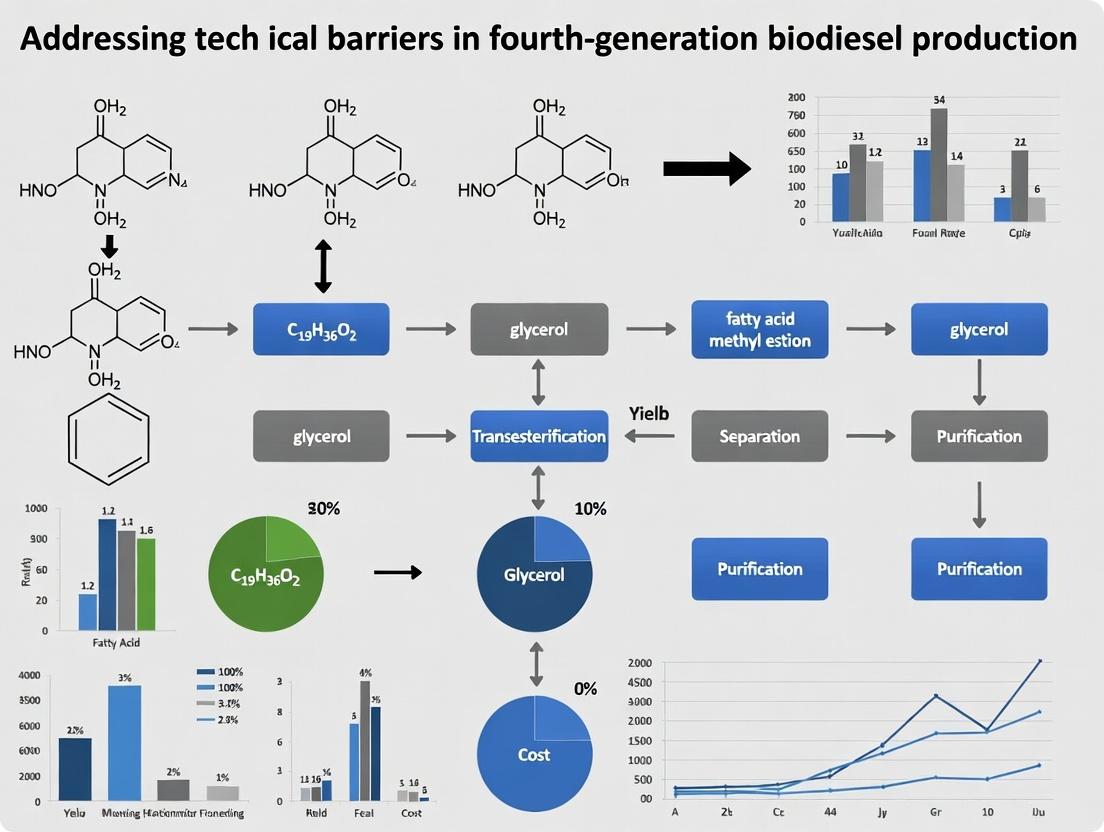
This article provides a comprehensive technical analysis of the primary challenges hindering the scale-up of fourth-generation biodiesel production, which utilizes genetically engineered microalgae and other microbial platforms.
Breaking the Barriers: A Technical Roadmap to Scalable Fourth-Generation Biodiesel Production
Abstract
This article provides a comprehensive technical analysis of the primary challenges hindering the scale-up of fourth-generation biodiesel production, which utilizes genetically engineered microalgae and other microbial platforms. Targeting researchers and industry professionals, we explore the foundational science, current methodologies, and critical optimization strategies needed to overcome hurdles in strain engineering, cultivation, lipid extraction, and fuel conversion. We present comparative analyses of emerging technologies and validation frameworks, aiming to chart a path from lab-scale innovation to commercially viable biofuel production with implications for sustainable energy and biomedical applications.
From Feedstock to Fuel: Defining the Core Challenges in 4th Gen Biodiesel
Technical Support Center
FAQs & Troubleshooting
Q1: Our engineered Yarrowia lipolytica strain shows poor lipid titer despite high sugar consumption. What are the primary causes and solutions?
A: This is commonly due to metabolic flux imbalance. Key troubleshooting steps:
- Check Precursor Drain: Measure acetyl-CoA and malonyl-CoA levels. Drain towards TCA cycle or amino acid synthesis reduces lipid yield.
- Solution: Overexpress ATP-citrate lyase (ACL) and acetyl-CoA carboxylase (ACC) to enhance precursor pool. Consider knocking down competing pathways (e.g., glycogen synthesis).
- Verify Regulation: Ensure lipid droplet proteins (e.g., LDP1) and DGAT enzymes are correctly expressed. Use proteomics to confirm.
Q2: Our non-canonical microbial host (e.g., Pseudomonas putida) exhibits cytotoxicity when engineered for high terpenoid-derived biodiesel precursor production. How can this be mitigated?
A: Cytotoxicity often stems from membrane disruption or redox imbalance.
- Immediate Action: Induce pathway expression only at high cell density and use a weaker promoter.
- Long-term Engineering: Implement a product export system (e.g., efflux pumps). Co-express stress-response genes (e.g., soxR, katG). Consider two-phase fermentation with an organic overlay for continuous extraction.
Q3: Electrofuel production via engineered Clostridium shows inconsistent yield between batch reactors. What critical parameters must be standardized?
A: Electrofuel production is highly sensitive to electrochemistry and electron flux.
- Key Parameters to Control:
- Cathode Potential: Must be precisely maintained (typically -0.4 to -0.6 V vs. SHE for C. ljungdahlii).
- Medium Conductivity: Keep consistent >20 mS/cm.
- Stirring Rate: Optimize for H₂ gas transfer if using indirect electron transfer.
- Protocol: Always pre-reduce medium with cysteine and use identical anode material (e.g., graphite felt) across experiments.
Q4: During continuous fermentation, our strain loses its engineered plasmid or production phenotype. How can strain stability be improved?
A: This indicates high metabolic burden or genetic instability.
- Strategies:
- Genomic Integration: Use CRISPR/Cas9 or transposons to integrate pathway genes into the chromosome with strong, constitutive promoters.
- Post-Segregational Kill Switches: Employ toxin-antitoxin systems on the plasmid for maintenance.
- Essential Gene Complementation: Place an essential gene (e.g., for amino acid synthesis) on the plasmid under selective pressure.
Experimental Protocol: CRISPRi-Mediated Dynamic Pathway Regulation inE. colifor Fatty Acid Optimization
Objective: To dynamically downregulate competing β-oxidation (fadD) during the lipid production phase using aCRISPR interference (CRISPRi).
Materials: See Research Reagent Solutions table.
Methodology:
- Strain Preparation: Transform production strain with plasmid pCRISPRi-fadD (dCas9 + sgRNA targeting fadD promoter).
- Fermentation: Inoculate M9 minimal medium + 2% glucose + appropriate antibiotics.
- Induction: At OD₆₀₀ ≈ 0.6, add 100 µM IPTG to induce dCas9 expression and sgRNA transcription.
- Sampling & Analysis: Harvest cells at 2, 4, 6, 8, and 24h post-induction.
- qPCR: Measure fadD mRNA levels.
- GC-MS: Quantify extracellular fatty acids (C12-C18).
- Flow Cytometry: Monitor single-cell fluorescence if using a GFP-reporter for promoter knockdown efficiency.
- Control: Run parallel fermentation with a non-targeting sgRNA plasmid.
Table 1: Common Microbial Hosts & Performance Metrics (Theoretical vs. Recent Max)
| Host Organism | Primary Feedstock | Target Product | Max Theoretical Yield (g/g) | Recent Titer Reported (g/L) | Key Challenge |
|---|---|---|---|---|---|
| Yarrowia lipolytica | Glucose | Triacylglycerols (TAG) | 0.27 | >100 | Oxygen transfer, scale-up |
| Escherichia coli | Glucose | Fatty Acid Ethyl Esters (FAEE) | 0.28 | 1.5 | Cytotoxicity, low storage |
| Rhodococcus opacus | Lignocellulosic Sugars | TAG | 0.31 | 50 | Slow growth rate |
| Synechocystis sp. PCC 6803 | CO₂, Light | Free Fatty Acids (FFA) | N/A | 0.20 | Low productivity, light penetration |
Table 2: Troubleshooting Matrix: Low Product Yield
| Symptom | Possible Cause | Diagnostic Assay | Suggested Intervention |
|---|---|---|---|
| High substrate, low product | Metabolic bottleneck | Metabolomics (LC-MS) for intermediates | Overexpress rate-limiting enzyme; tune promoter strength. |
| Product degradation | Native host metabolism | RT-qPCR for degradation genes | Knock out β-oxidation or hydrolysis genes (e.g., fadD, tesB). |
| Growth inhibition | Precursor or product toxicity | Growth curve with/without induction | Implement dynamic control; engineer exporter proteins. |
| Genetic drift | Plasmid loss or mutation | Colony PCR; sequencing | Switch to genomic integration; use antibiotic selection. |
Diagrams
Title: Metabolic Flow & Bottlenecks in 4th Gen Biofuel Microbes
Title: Core R&D Workflow for Engineered Microbial Factories
The Scientist's Toolkit: Research Reagent Solutions
| Item | Function | Example/Catalog Consideration |
|---|---|---|
| dCas9 Expression Plasmid | CRISPRi/a base tool for gene repression/activation. | pDawn, pCRISPRi series. Ensure host-compatible origin & resistance. |
| sgRNA Cloning Kit | For rapid construction of target-specific guide RNA vectors. | Addgene Kit #1000000059 or domestic assembly via BsaI sites. |
| GC-MS Standard Mix (C8-C30 FAMEs) | Quantification and identification of biodiesel-profile fatty acid esters. | Supelco 37 Component FAME Mix. Include internal standard (e.g., C17:0). |
| Acetyl-CoA Assay Kit | Fluorometric measurement of key metabolic precursor pool. | Abcam ab87546 or Sigma MAK039. Critical for flux analysis. |
| Cytometry Viability Stain | Distinguish live/dead cells during toxicity screening. | Propidium Iodide (PI) or SYTOX Green. Use with appropriate filter sets. |
| Electroporation Cuvettes (1mm) | Transformation of non-model microbial hosts (e.g., Rhodococcus). | Ensure sterile, pyrogen-free. Use optimized voltage (e.g., 1.8 kV for E. coli). |
| Anaerobic Chamber Gloves | Maintain strict anoxic conditions for electrofuel research. | Butyl rubber gloves (0.4mm thick). Regularly check for integrity/pinholes. |
| Luxury Bioreactor Control Software | For precise regulation of pH, DO, and feed during scale-up. | DASware, BioXpert, or LabVIEW custom scripts. Enable data logging. |
Technical Support Center
Troubleshooting Guides & FAQs
Q1: Our engineered microalgal strain shows a significant drop in lipid productivity after 15-20 sequential batch cultures. What are the likely causes and corrective actions?
A: This indicates a classic strain instability issue, common in engineered strains under continuous cultivation pressure.
- Primary Cause: Genetic reversion, plasmid loss, or metabolic burden leading to the selection of non-productive subpopulations.
- Corrective Actions:
- Implement Selective Pressure: Maintain antibiotic or auxotrophic selection in the media if the modification relies on episomal vectors.
- Genomic Integration: Transition key metabolic pathway genes (e.g., DGAT1, ACC) from plasmids to stable genomic loci via CRISPR-Cas9 or homologous recombination.
- Regular Re-isolation: Periodically re-isolate single cell clones and screen for high lipid producers to re-establish a clonal population.
- Monitor Genetic Drift: Use qPCR to regularly check copy numbers of introduced genes.
Q2: We observe lipid accumulation plateauing prematurely under nitrogen starvation. How can we push the theoretical yield closer to the strain's maximum?
A: This suggests a bottleneck in the lipogenesis pathway or co-factor limitation.
- Diagnostic Protocol: Perform a targeted metabolomics analysis at the mid-point of the accumulation phase. Key metabolites to quantify: Acetyl-CoA, Malonyl-CoA, NADPH, and intermediates in the TAG synthesis pathway.
- Solutions:
- Overexpress Malic Enzyme (ME): To enhance NADPH supply. Use a strong, inducible promoter (e.g., P_{NR}) to express ME concurrently with nitrogen depletion.
- Engineer a "Push-Pull" Pathway: Simultaneously overexpress Acetyl-CoA Carboxylase (ACC, "push") and Diacylglycerol Acyltransferase (DGAT2, "pull") to reduce intermediate feedback inhibition.
- Co-factor Supplementation: In bench-scale experiments, supplement minimal media with 0.5 mM NaHCO₃ to provide additional carbon for carboxylation reactions.
Q3: Our lab-scale photobioreactor (PBR) achieves 90% of theoretical lipid yield, but productivity drops by over 60% when scaling to a 500L pilot system. What are the key scaling parameters we failed to translate?
A: This is a scalability failure, typically due to light, nutrient, or gas transfer limitations.
- Key Scaling Parameters & Solutions:
| Parameter | Lab-Scale (10L) | Pilot-Scale (500L) | Issue & Solution |
|---|---|---|---|
| Light Path / Areal Density | < 10 cm light path, high surface-to-volume | > 30 cm light path, internal shading | Issue: Severe light attenuation. Solution: Implement internal light guides or a cascading PBR design with thinner channels. |
| Mixing / Shear Stress | Gentle magnetic stirring, low shear | Impeller-driven, high shear stress | Issue: Cell damage or stress response. Solution: Shift to airlift- or bubble column PBR design; optimize sparging rate (e.g., 0.2-0.5 vvm). |
| CO₂ Delivery & pH Control | Fine bubble diffuser, manual pH | Sparse pipe, localized acidification | Issue: Inefficient carbon delivery and pH gradients. Solution: Use inline static mixers post-CO₂ injection and implement multiple, distributed pH probes with feedback loops. |
| Nutrient Feeding | Batch or fed-batch | Attempted batch | Issue: Nutrient depletion/toxicity. Solution: Shift to continuous or semi-continuous cultivation with automated feedback from biomass sensors. |
Experimental Protocols
Protocol 1: Assessing Genetic Stability of Engineered Strains Title: Serial Passage and Stability Quantification Assay
- Cultivation: Inoculate the engineered strain in selective medium. Grow to late exponential phase.
- Passaging: Dilute culture to a standardized OD₇₅₀ (e.g., 0.1) into fresh medium with and without selective agent. Repeat for 50+ generations.
- Sampling: Every 5 generations, harvest 1 mL of culture.
- Analysis:
- Plasmid Retention: Perform colony PCR on plated cells using primers for the engineered gene.
- Phenotypic Stability: Measure lipid content via Nile Red fluorescence or GC-FAME for sampled generations.
- Calculation: Determine the percentage of cells retaining the high-lipid phenotype over time.
Protocol 2: High-Throughput Lipid Productivity Screen Title: Microplate-Based Lipid Induction & Quantification
- Pre-culture: Grow strains in 96-deep-well plates in nutrient-replete medium for 48h.
- Induction: Centrifuge plates, resuspend biomass in nitrogen-depleted (-N) medium.
- Staining: At 0, 24, 48, 72h post-induction, add Nile Red dye (final conc. 1 µg/mL from a 1 mg/mL stock in DMSO) to wells.
- Incubation: Shake in dark for 15 min.
- Measurement: Use a plate reader with fluorescence detection (Ex/Em: 530/575 nm for neutral lipids). Normalize to biomass (OD₆₈₀).
- Calibration: Correlate fluorescence units to absolute lipid weight (mg/L) using a standard curve from a strain with known GC-FAME data.
Visualizations
Title: Strategies for Microbial Strain Stabilization
Title: Push-Pull Pathway Engineering for Lipid Yield
The Scientist's Toolkit: Research Reagent Solutions
| Reagent / Material | Function in 4G Biofuel Research | Example Product / Specification |
|---|---|---|
| Nile Red Dye | Fluorescent stain for rapid, quantitative neutral lipid detection in live cells. Must be dissolved in DMSO for stock solution. | Sigma-Aldrich, 72485-1MG. Prepare 1 mg/mL stock in DMSO, store at -20°C. |
| Nitrogen-Depleted (-N) Medium | Standardized medium for inducing lipid accumulation (usually by omitting nitrate, e.g., NaNO₃). Essential for productivity assays. | BG-11₀ medium (BG-11 without sodium nitrate). Can be purchased as a custom mix from algal research suppliers (e.g., UTEX). |
| CRISPR-Cas9 System (Algal-optimized) | For stable genomic integration of pathway genes. Includes Cas9 enzyme and gRNA expression cassettes compatible with the host's codon bias. | Kit from companies like ToolGen or based on published vectors (e.g., pKSI-Cas9 for Chlamydomonas). |
| Inducible Promoter Plasmids | To control gene expression timing, reducing metabolic burden during growth. Common promoters are Nitrate Reductase (P_NR) or Copper Response (P_CA). | Available from algal molecular biology repositories (e.g., Chlamy Collection, Phytozome). |
| GC-FAME Standards | Quantitative calibration standards for Gas Chromatography analysis of Fatty Acid Methyl Esters. Required for absolute lipid quantification. | Supelco 37 Component FAME Mix (CRM47885). |
| Silicone Antifoam Emulsion | Critical for scaled-up bioreactor runs to prevent foam-over from high aeration and cell lysis products. | Sigma-Aldrich, Antifoam 204. Use at 0.01-0.1% (v/v). |
| Dissolved Oxygen & pH Probes | For real-time monitoring of culture health and scalability parameters (kLa, pH gradients). Requires in-line, autoclavable sensors. | Mettler Toledo InPro 6800 series (DO) and InPro 3250i (pH). |
Technical Support Center
Troubleshooting Guide & FAQs
Q1: Our engineered Yarrowia lipolytica strain shows a severe growth defect after introducing the heterologous fatty acid synthase (FAS) pathway, despite successful plasmid integration confirmed by PCR. What are the primary causes and solutions?
- A: This is a classic metabolic burden issue. The overexpression of a resource-intensive pathway like FAS can drain cellular pools of acetyl-CoA, ATP, and NADPH, crippling central metabolism.
- Troubleshooting Steps:
- Analyze Precursor Drain: Measure intracellular acetyl-CoA and NADPH levels in the engineered strain vs. wild-type (see Protocol 1).
- Check Energy Status: Perform an ATP assay.
- Implement a Solution: Introduce a dynamic regulatory circuit. Replace the constitutive promoter driving the FAS genes with a fatty acid-responsive promoter (e.g., derived from FAS1 or PEX10). This decouples pathway expression from growth phase.
- Protocol 1: Measurement of Intracellular Acetyl-CoA and NADPH.
- Materials: Quenching solution (60% methanol, -40°C), Extraction buffer (100% methanol with 0.1 M formic acid), LC-MS system.
- Method:
- Culture cells to mid-log phase (OD600 ~10).
- Rapidly quench 1 mL culture in 4 mL of -40°C quenching solution. Centrifuge at 5000xg, -20°C.
- Extract metabolites from pellet with 1 mL ice-cold extraction buffer. Vortex, sonicate on ice for 10 min.
- Centrifuge at 15,000xg, 4°C for 10 min. Transfer supernatant for LC-MS analysis using a HILIC column.
- Troubleshooting Steps:
Q2: Our oleaginous yeast produces the desired free fatty acids (FFAs) in small-scale fermentation but yield collapses when scaled to a 5L bioreactor using lignocellulosic hydrolysate. What parameters should we investigate?
- A: This points to feedstock-derived inhibitors and inadequate process control. Lignocellulosic hydrolysates contain fermentation inhibitors (furfurals, phenolics, organic acids) whose effects are magnified in high-density bioreactor cultures.
- Troubleshooting Steps:
- Profile the Feedstock: Quantify key inhibitors (5-HMF, furfural, acetic acid) in your hydrolysate batch using HPLC (see Protocol 2).
- Map Inhibition Kinetics: Perform a microtiter plate assay linking inhibitor concentration to growth lag time and FFA titer.
- Implement a Solution: (a) Pre-treat hydrolysate with activated charcoal or anionic exchange resins. (b) Engineer inhibitor tolerance by overexpressing aldose reductases (e.g., GRE3) and phenolic decarboxylases.
- Protocol 2: HPLC Analysis of Common Hydrolysate Inhibitors.
- Materials: Aminex HPX-87H column, 5 mM H2SO4 mobile phase, UV/RI detectors.
- Method:
- Filter hydrolysate through a 0.22 µm membrane.
- Set column temperature to 60°C, flow rate to 0.6 mL/min.
- Detect furfurals and phenolics at 280 nm, organic acids by RI.
- Quantify against standard curves for furfural, 5-HMF, acetic acid, vanillin.
- Troubleshooting Steps:
Q3: We attempted to increase lipid titer by knocking out the beta-oxidation pathway (POX1-6 genes) in our engineered microbe, but observe an accumulation of toxic intermediates and no yield improvement. What went wrong?
- A: Complete blockage of beta-oxidation can lead to the accumulation of acyl-CoAs and reactive oxygen species (ROS), causing cytotoxicity. The strategy requires a more nuanced approach.
- Troubleshooting Steps:
- Confirm Intermediate Accumulation: Analyze acyl-CoA profiles via LC-MS.
- Measure ROS: Use a cell-permeable fluorescent probe like H2DCFDA.
- Implement a Solution: Use a partial, titratable knockdown (e.g., with CRISPRi) rather than a complete knockout. Alternatively, couple the POX knockout with the overexpression of a trans-enoyl-CoA isomerase to shunt substrates back into lipid synthesis.
- Troubleshooting Steps:
Q4: Our high-lipid-producing cyanobacterium strain is unstable, rapidly reverting to a low-yield phenotype after ~40 generations, even under selective pressure. How can we improve genetic stability?
- A: This indicates reliance on unstable plasmid-based expression or selection of compensatory mutations. Chromosomal integration and removal of unnecessary selection markers are key.
- Troubleshooting Steps:
- Determine Cause: Isolate revertants and sequence both the engineered pathway and global regulatory genes (e.g., sigE, ntcA in cyanobacteria).
- Implement a Solution: Use a dual strategy: (a) Integrate the entire pathway into a neutral genomic site (e.g., glgA locus) using CRISPR-Cas9. (b) Remove antibiotic resistance genes after integration via FLP/FRT recombination to reduce metabolic burden.
- Troubleshooting Steps:
Table 1: Performance of Recent Engineered Microbial Platforms for Advanced Biofuels (2022-2024)
| Organism | Engineering Target | Feedstock | Max Titer (g/L) | Max Yield (g/g Substrate) | Key Challenge Addressed | Ref. |
|---|---|---|---|---|---|---|
| Yarrowia lipolytica | Malonyl-CoA overproduction; FAS overexpression | Glucose | 102.5 (Lipids) | 0.22 | Acetyl-CoA carboxylase (ACC) bottleneck | Liu et al., 2023 |
| Rhodococcus opacus | CRISPRi knockdown of triacylglycerol lipase | Lignocellulosic sugars | 78.4 (TAG) | 0.19 | Lipid turnover during stationary phase | Park et al., 2022 |
| Synechocystis sp. PCC 6803 | ΔglgA + alkane biosynthesis pathway (ols) | CO₂ | 1.2 (Alkanes) | Not Applicable | Carbon partitioning to biofuels | Wang et al., 2024 |
| E. coli | Re-routing carbon to malonyl-CoA via "push-pull" | Fatty Alcohols | 2.1 (Fatty Acids) | 0.28* | Redox cofactor imbalance | Zhang et al., 2023 |
*Yield calculated on a molar basis from fed fatty alcohol.
Table 2: Inhibitor Tolerance Levels in Engineered Oleaginous Yeasts
| Inhibitor Compound | Typical Conc. in Hydrolysate (g/L) | Wild-type Y. lipolytica IC50 (g/L) | Engineered Strain (Modification) | Improved IC50 (g/L) |
|---|---|---|---|---|
| Acetic Acid | 1.0 - 8.0 | 3.5 | ADH2 overexpression (acetaldehyde dehydrogenase) | 6.8 |
| Furfural | 0.5 - 3.0 | 1.2 | ALD6 overexpression (aldehyde dehydrogenase) | 2.5 |
| Vanillin | 0.1 - 1.5 | 0.8 | VRE1 overexpression (vanillyl alcohol oxidase) | 1.9 |
Visualizations
Diagram 1: Dynamic Regulation Circuit for FAS
Diagram 2: Troubleshooting Workflow for Scale-Up Failure
The Scientist's Toolkit: Research Reagent Solutions
| Reagent / Material | Function & Application | Key Consideration |
|---|---|---|
| CRISPR-Cas12a (Cpf1) System | Genome editing in GC-rich oleaginous yeasts (e.g., R. toruloides). Prefers T-rich PAM, simplifying multiplexed knockouts. | Higher fidelity than SpCas9 in some hosts, but requires optimization of guide RNA design. |
| HILIC-MS Columns (e.g., Acquity UPLC BEH Amide) | Separation and quantification of central metabolites (acyl-CoAs, NADPH, organic acids). Critical for metabolic flux analysis. | Requires specific mobile phases (high acetonitrile). Sensitive to column temperature. |
| Fatty Acid-Responsive Biosensor Plasmids (e.g., pFAS1-GFP) | Real-time, single-cell monitoring of fatty acid pool dynamics without cell lysis. Used for promoter characterization and high-throughput screening. | Response curve must be calibrated for each new host chassis. |
| Lignocellulosic Inhibitor Standard Kits | Pre-mixed analytical standards for furfural, 5-HMF, syringaldehyde, vanillic acid, etc. Essential for quantifying feedstock toxicity. | Standards are light-sensitive and require -20°C storage in the dark. |
| Metabolic Burden Assay Kit | Fluorometric measurement of translational capacity (e.g., via uncharged tRNA accumulation) and ATP levels to quantify stress from pathway expression. | Provides a more direct measure of burden than growth rate alone. |
Understanding Metabolic Pathways for Enhanced Lipid Biosynthesis
Technical Support Center
Troubleshooting Guide: Common Issues in Metabolic Engineering for Lipid Biosynthesis
Issue 1: Low Lipid Titer in Recombinant Microbial Strain
- Problem: Engineered Yarrowia lipolytica or Saccharomyces cerevisiae shows poor lipid accumulation despite genetic modifications.
- Potential Causes & Solutions:
- Cause A: Precursor imbalance (Acetyl-CoA/NADPH limitation).
- Solution: Overexpress cytosolic acetyl-CoA pathways (e.g., ATP-citrate lyase, acetyl-CoA synthase) and NADPH-generating enzymes (e.g., glucose-6-phosphate dehydrogenase, malic enzyme). Monitor cofactor ratios via metabolomics.
- Cause B: Feedback inhibition or competitive pathways.
- Solution: Knock out β-oxidation genes (e.g., POX1-6 in Y. lipolytica) and use lipid-tagging promoters (e.g., EXP1 promoter) to decouple growth and production phases.
- Cause C: Toxicity from lipid intermediates.
- Solution: Implement dynamic regulation to control flux and use two-phase bioreactor systems with in-situ extraction.
- Cause A: Precursor imbalance (Acetyl-CoA/NADPH limitation).
Issue 2: Inefficient Carbon Flux Toward Fatty Acid Synthesis
- Problem: Glucose is primarily directed toward cell growth/glycolysis, not lipogenesis.
- Potential Causes & Solutions:
- Cause: Strong glycolytic flux outcompeting acetyl-CoA production for TCA cycle.
- Solution:
- Use CRISPRi to downregulate key glycolytic enzymes (e.g., Pfk, Pyk) during production phase.
- Introduce heterologous phosphoketolase (PHK) pathway to bypass glycolysis, directly converting G6P/X5P to Acetyl-P.
- Supplement culture with acetate or oleic acid as auxiliary carbon sources to bypass endogenous regulation.
Issue 3: Poor Genetic Tool Efficacy in Non-Model Oleaginous Hosts
- Problem: Low transformation efficiency, unstable expression, or poor CRISPR editing efficiency in non-model hosts like Rhodotorula toruloides.
- Potential Causes & Solutions:
- Cause A: Restriction-Modification systems degrading foreign DNA.
- Solution: Co-express host-specific methyltransferases or use plasmid DNA isolated from a dam+/dcm+ E. coli strain.
- Cause B: Weak or incompatible promoters/terminators.
- Solution: Use native promoters/terminators (e.g., TEF1, GPD) identified via RNA-seq. Construct a library of synthetic hybrid promoters.
- Cause A: Restriction-Modification systems degrading foreign DNA.
Frequently Asked Questions (FAQs)
Q1: What are the most effective strategies to boost NADPH supply for fatty acid biosynthesis in yeast? A: The primary methods are: 1) Overexpressing the oxidative pentose phosphate pathway (PPP) enzymes (G6PD, 6PGD). 2) Introducing the soluble transhydrogenase (UdhA) from E. coli to recycle NADH to NADPH. 3) Expressing a malic enzyme (ME) variant with high NADPH specificity. Recent data (2024) suggests a combined PPP + UdhA approach yields a ~40% increase in NADPH/NADP+ ratio and a corresponding 25% increase in lipid yield in S. cerevisiae.
Q2: How can I accurately measure the intracellular flux through the glyoxylate shunt versus the TCA cycle? A: Perform 13C-Metabolic Flux Analysis (13C-MFA). Use [1-13C] or [U-13C] glucose as a tracer. Measure labeling patterns in proteinogenic amino acids via GC-MS. The key metabolites to track are succinate and malate labeling, which distinctly differ between the two pathways. A simplified protocol is provided in the Experimental Protocols section below.
Q3: Which inducible promoter system is recommended for controlling toxic gene expression in lipid-overproducing Yarrowia lipolytica? A: The E. coli-derived rhamnose-inducible (RhaR-P_{RHA}) system is highly effective due to its tight repression and low basal expression in lipid-producing conditions. Recent studies show >95% induction efficiency with 0.2% w/v rhamnose and negligible leakiness, making it superior to traditional oleic acid-responsive promoters in defined media.
Q4: What are common bottlenecks after overexpressing the core fatty acid synthase (FAS) complex? A: Post-FAS bottlenecks often include: 1) Acyl-CoA pool limitation – address by overexpressing acyl-CoA synthetases. 2) Acyltransferase capacity – overexpress DGAT1 and PDAT enzymes for triacylglycerol (TAG) assembly. 3) Lipid droplet (LD) surface area – co-express LD scaffolding proteins like perilipins to prevent cytosolic lipotoxicity. Data indicates DGAT overexpression is often the most critical single step.
Table 1: Comparison of Key Genetic Modifications on Lipid Yield in Yeast (2023-2024 Studies)
| Engineered Pathway/Module | Host Organism | Baseline Lipid Titer (g/L) | Final Lipid Titer (g/L) | % Increase | Key Enzymes Overexpressed |
|---|---|---|---|---|---|
| Acetyl-CoA & NADPH Supply | Y. lipolytica | 8.5 | 15.2 | 78.8% | ACL, ME, G6PD |
| TAG Assembly & Storage | S. cerevisiae | 1.8 | 4.1 | 127.8% | DGA1, LRO1, SEI1 |
| Phosphoketolase (PHK) Bypass | R. toruloides | 10.1 | 18.7 | 85.1% | Xpk, Pta |
| Dynamic Downregulation of β-oxidation | Y. lipolytica | 9.2 | 16.5 | 79.3% | CRISPRi targeting POX3, POX6 |
Table 2: Performance of Inducible Promoters for Metabolic Engineering
| Promoter System | Host | Inducer | Induction Ratio | Basal Leakiness | Best Use Case |
|---|---|---|---|---|---|
| pTEF1 (constitutive) | Y. lipolytica | N/A | N/A | High | Non-toxic, high-level expression |
| pEXP1 (oleic acid) | Y. lipolytica | Oleic Acid (0.1%) | ~120x | Low | Lipid production phase |
| pRHA (rhamnose) | Y. lipolytica | L-Rhamnose (0.2%) | ~200x | Very Low | Toxic gene expression |
| pCuRE (copper) | S. cerevisiae | CuSO4 (50 µM) | ~80x | Medium | Low-cost, scalable induction |
Experimental Protocols
Protocol 1: 13C-MFA for Flux Determination in Oleaginous Yeast
- Culture & Labeling: Grow pre-culture in unlabeled YPD. Inoculate main culture in defined minimal medium with [U-13C] glucose (99% atom purity) as sole carbon source. Harvest cells at mid-lipogenic phase (OD600 ~25-30).
- Hydrolysis & Derivatization: Quench metabolism rapidly in -40°C methanol. Pellet cells, hydrolyze proteins in 6M HCl at 105°C for 24h. Derivatize released amino acids to N(tert-butyldimethylsilyl) derivatives using MTBSTFA.
- GC-MS Analysis: Analyze derivatives on GC-MS system. Use a DB-5MS column. Monitor mass isotopomer distributions (MIDs) of key fragments (e.g., alanine [m/z 260], valine [m/z 288]).
- Flux Calculation: Input MIDs into flux analysis software (e.g., INCA, OpenFlux). Constrain model with measured uptake/secretion rates. Use least-squares regression to estimate net fluxes through glyoxylate shunt, TCA, and PPP.
Protocol 2: CRISPR-Cas9 Mediated Multiplex Gene Knockout in R. toruloides
- gRNA Design & Expression Cassette Assembly: Design three 20-nt gRNAs targeting FAA1, FAA4, and POX1 using host-specific genomic data. Clone each into the pCRISPR-RT plasmid under individual tRNA-gRNA promoters.
- Donor DNA Preparation: Synthesize ~1kb homology arms flanking each target gene. Use these as templates for PCR to generate linear double-stranded donor DNA with stop codons and frame shifts.
- Transformation: Use electroporation (2.0 kV, 5 ms) to co-transform 5 µg of pCRISPR-RT and 1 µg of each donor DNA into competent R. toruloides cells.
- Screening: Plate on hygromycin-containing media. Screen colonies via diagnostic PCR and Sanger sequencing of the target loci.
Visualizations
The Scientist's Toolkit: Research Reagent Solutions
Table 3: Essential Reagents for Metabolic Pathway Engineering
| Reagent/Material | Supplier Examples | Function | Critical Application |
|---|---|---|---|
| [1-13C] Glucose | Cambridge Isotope Labs, Sigma-Aldrich | Tracer for metabolic flux analysis (13C-MFA). | Quantifying flux through PPP vs. glycolysis in vivo. |
| Nile Red / BODIPY 493/503 | Thermo Fisher, Invitrogen | Fluorescent lipophilic dyes for lipid droplet staining. | Rapid, quantitative screening of lipid-accumulating clones via flow cytometry. |
| YPD / Yeast Nitrogen Base (YNB) | Difco, Formedium | Standard rich and defined media for yeast cultivation. | Maintaining and selecting transformed yeast strains. |
| MTBSTFA (Derivatization Reagent) | Regis Technologies, Sigma-Aldrich | Silylating agent for GC-MS sample preparation. | Derivatizing amino acids and organic acids for isotopomer analysis. |
| Hygromycin B / Nourseothricin | Corning, Jena Bioscience | Antibiotics for selection of resistant transformants. | Maintaining plasmid and selectable marker stability in engineered yeasts. |
| Phusion High-Fidelity DNA Polymerase | Thermo Fisher, NEB | High-fidelity PCR enzyme for genetic construct assembly. | Cloning large gene fragments and fusion constructs with minimal errors. |
| Cas9 Protein (Alt-R S.p.) | Integrated DNA Technologies (IDT) | Purified Cas9 nuclease for in vitro RNP complex formation. | CRISPR-Cas9 editing in protoplasts of non-model yeast. |
The Economic and Energetic Bottlenecks of Current Photobioreactor Designs
To support research framed within the thesis of Addressing technical barriers in fourth-generation biodiesel production research, this technical center provides targeted troubleshooting for common PBR operational challenges.
FAQs & Troubleshooting Guides
Q1: Our tubular PBR experiences rapid pH increase and dissolved oxygen (DO) accumulation beyond 400% saturation, followed by culture crash. What is the cause and solution? A: This indicates insufficient gas exchange (CO₂ delivery and O₂ stripping) due to low linear flow velocity (<0.3 m/s). High O₂ causes photoinhibition, while CO₂ depletion raises pH.
- Protocol for Diagnosis & Mitigation:
- Measure: Install in-line DO and pH probes at the reactor outlet.
- Calculate: Determine actual fluid velocity (V = flow rate / cross-sectional area).
- Act: Increase pumping rate to achieve V > 0.4 m/s. If using a degassing column, ensure its headspace is actively vented. Consider injecting pure CO₂ (at 1-5% v/v in air) on-demand via a feedback loop with pH setpoint (e.g., pH 8.0).
- Validate: Monitor culture stability over 24 hours post-adjustment.
Q2: We observe severe biofilm formation on internal glass/plexiglass surfaces, blocking light and contaminating cultures. How can we prevent this? A: Biofilms are a major source of contamination and reduced light penetration.
- Protocol for Cleaning & Prevention:
- Immediate Cleaning: Drain system and circulate 2% (v/v) phosphoric acid for 1 hour to dissolve mineral scales, followed by a 0.5% (w/v) sodium hypochlorite solution for 2 hours for biofilm sterilization. Rinse thoroughly with sterile water.
- Preventive Measure: Implement a "clean-in-place" (CIP) cycle every 10-14 days using 0.1% (v/v) hydrogen peroxide or 0.01% (w/v) peracetic acid. For ongoing prevention, ensure system has no dead zones by verifying flow uniformity (e.g., via tracer studies).
Q3: The energy input for mixing and cooling in our flat-panel PBR is unsustainable, contributing to a negative energy balance. How can we optimize? A: This is a core economic bottleneck. Focus on reducing mixing power and passive cooling.
- Protocol for Energy Audit and Reduction:
- Quantify: Measure power (kW) to air pumps/impellers and chiller. Calculate total kWh per cultivation day.
- Optimize Mixing: For airlift systems, reduce aeration rate to the minimum required for cell suspension (typically 0.1-0.3 vvm). Test by gradually lowering rate until settling is observed, then increase by 20%.
- Implement Passive Cooling: For outdoor panels, use a radiative cooling white paint on the rear surface and install a water-jacket with evaporative cooling (a thin water film dripping down the exterior). Monitor temperature stability during peak solar irradiance.
Q4: How do we accurately scale biomass productivity from lab-scale to pilot-scale PBRs? Our yields drop significantly. A: Scale-up failure often stems from light regime changes and nutrient gradient formation.
- Protocol for Predictive Scale-Up:
- Characterize Light Path: At lab scale, measure biomass density (g/L) vs. incident light (μmol/m²/s) to establish the light saturation parameter (Ik).
- Design Constraint: Ensure the optical path length (panel depth or tube diameter) at pilot scale does not exceed the depth where light attenuates to < Ik at your target biomass concentration. Use the Beer-Lambert law for estimation.
- Maintain Mixing: Scale mixing based on power input per unit volume (W/m³). Keep this constant between scales to minimize nutrient gradients.
Data Presentation
Table 1: Comparative Analysis of Common PBR Design Bottlenecks & Mitigations
| PBR Type | Primary Economic Bottleneck | Primary Energetic Bottleneck | Typical Biomass Productivity (g/L/day) | Recommended Mitigation Strategy |
|---|---|---|---|---|
| Tubular (Horizontal) | High land area, cleaning/maintenance labor | Pumping power for mixing & cooling | 0.8 - 1.5 | Use larger diameter manifolds to reduce pressure drop; deploy on non-arable land. |
| Flat-Panel (Vertical) | Material cost (transparent facing), biofilm control | Temperature control (cooling fans/chillers) | 1.2 - 2.0 | Adopt durable, low-cost polymer films; implement passive evaporative cooling. |
| Airlift/Bubble Column | Gas compression and sterilization cost | Aeration/compression energy | 0.5 - 1.2 | Optimize sparger design for smaller bubbles; utilize waste CO₂ streams from industry. |
| Thin-Layer Cascade | Water loss due to evaporation, precise engineering | Pumping for recirculation | 1.5 - 3.0 | Install condensing covers; use gravity-fed designs where terrain allows. |
Experimental Protocols
Protocol: Determining the Critical Light Path for Scale-Up Objective: To determine the maximum allowable culture depth/diameter to prevent light limitation at scale. Materials: Lab-scale PBR (1-5L), spectrophotometer, bench-top centrifuge, PAR (Photosynthetically Active Radiation) sensor. Method:
- Grow target strain (e.g., Nannochloropsis sp.) to mid-exponential phase.
- Take a culture sample. Measure optical density at 750 nm (OD₇₅₀) and dry cell weight (DCW) via filtration and drying (105°C, 24h) to establish an OD-DCW standard curve.
- Dilute culture to a series of biomass concentrations (e.g., 0.2, 0.5, 1.0 g/L).
- Fill thin, rectangular cuvettes with these dilutions. Measure PAR intensity incident on the front surface (I₀) and transmitted through the sample (I).
- Calculate the light extinction coefficient (ε) using Beer-Lambert's Law: I = I₀ * e^(-ε * X * L), where X is biomass conc. (g/L) and L is path length (m).
- Calculation: For your target operational biomass (Xop), calculate the path length where light attenuates to the saturation intensity (Iₖ, species-specific, ~100-200 μmol/m²/s): Lcritical = -ln(Iₖ / I₀) / (ε * X_op).
Protocol: Systematic Cleaning-in-Place (CIP) for Biofilm Prevention Objective: To sterilize PBR and associated tubing without disassembly. Materials: Peristaltic pump, CIP reservoir, 0.5% (w/v) NaClO solution, 2% (v/v) food-grade phosphoric acid, neutralization tank. Method:
- Drain culture harvest completely.
- Rinse system with tap water for 5 minutes to remove debris.
- Circulate 2% phosphoric acid solution for 60 minutes at room temperature.
- Drain acid and rinse with water until effluent pH is neutral.
- Circulate 0.5% NaClO solution for 120 minutes.
- Drain bleach and rinse thoroughly with sterile water or culture medium until no chlorine odor is detected (test with potassium iodide strips).
- The system is now ready for inoculation.
Visualizations
PBR Troubleshooting Decision Pathway
Light Attenuation Defines PBR Scale-Up Limit
The Scientist's Toolkit: Research Reagent Solutions
| Item | Function / Rationale |
|---|---|
| Inline DO/pH Sensor (e.g., Hamilton, Mettler Toledo) | Provides real-time, sterile monitoring of two most critical parameters for culture health and gas exchange efficiency. |
| PAR Sensor & Datalogger (e.g., LI-COR Quantum Sensor) | Essential for quantifying the light environment (I₀) and establishing light response curves for strain selection and PBR design. |
| Peracetic Acid (PAA) 1-5% Solution | A highly effective, fast-acting sterilant for CIP that decomposes into harmless acetic acid and oxygen, reducing rinse water needs. |
| Silicone-based Antifoam (Food Grade) | Critical for controlling foam in high-aeration systems to prevent biomass loss and contamination via exhaust lines. |
| Trace Metal Chelator (e.g., EDTA, Citric Acid) | Prevents precipitation of essential micronutrients (Fe, Cu) in alkaline medium typical of high-CO₂ absorption cultures. |
| Polymer Film (e.g., ETFE, FEP) | Durable, low-cost, high-light-transmittance alternative to glass or plexiglass for panel/tube construction, reducing capital expense. |
| Programmable Logic Controller (PLC) | Automates control of pumps, valves, and lights based on sensor data (pH, T, DO), ensuring reproducibility and reducing labor. |
Engineering Solutions: Advanced Methodologies for Enhanced Production
CRISPR-Cas and Synthetic Biology Tools for Precise Metabolic Engineering
Technical Support Center: Troubleshooting and FAQs
FAQ Section: Common Conceptual and Application Issues
Q1: When using CRISPR-Cas9 to knockout an acetyl-CoA competing pathway gene in Yarrowia lipolytica for lipid overproduction, I observe very low editing efficiency. What could be the cause? A: Low editing efficiency in oleaginous yeasts is frequently due to suboptimal gRNA design or poor Cas9 expression. First, verify your gRNA sequence for specificity and minimal off-target potential using current tools like CHOPCHOP or Benchling. Second, ensure your Cas9 is codon-optimized for your host organism. Third, consider the delivery method; for Y. lipolytica, lithium acetate transformation followed by homologous recombination is standard, but efficiency varies with strain and growth phase. Use a high-fidelity polymerase for repair template amplification to prevent unwanted mutations. Finally, include a positive control (e.g., a gRNA targeting a known essential gene with a non-lethal phenotype) to validate your system.
Q2: My CRISPRi system for downregulating a key enzyme in the β-oxidation pathway is showing inconsistent repression across my microbial culture. How can I improve uniformity? A: Inconsistent repression often stems from plasmid loss or variable dCas9 expression. Ensure your system is under tight, inducible control (e.g., using a tetracycline-inducible promoter) and include a selective antibiotic throughout the culturing period. For more stable repression, consider integrating the dCas9 and gRNA expression cassettes into the host genome. Also, verify the gRNA target site is within the early region of the gene's coding sequence for optimal steric hindrance. Monitor culture fluorescence if using a reporter, and sort for uniform population via FACS if necessary.
Q3: I am designing a synthetic pathway for fatty acid-derived biofuel (e.g., fatty ethyl esters) in E. coli. Metabolic flux analysis indicates a bottleneck at the fatty acyl-ACP step. Which synthetic biology tool is best to address this? A: To address a precise metabolic bottleneck, consider employing CRISPR-mediated transcriptional activation (CRISPRa) to upregulate the downstream enzyme (e.g., acyl-ACP thioesterase) or a tunable intergenic region (TIGR) library to optimize ribosomal binding sites and expression levels of multiple operon genes simultaneously. Alternatively, MAGE (Multiplex Automated Genome Engineering) can be used to create a library of promoter variants for the rate-limiting gene to screen for optimal flux. The choice depends on whether you need targeted upregulation (CRISPRa) or high-throughput screening of regulatory parts (TIGR or MAGE).
Q4: During the purification of microbially synthesized biodiesel precursors, I encounter high cellular toxicity of the intermediates. What genetic safeguards can be implemented? A: Implement a biosensor-responsive containment strategy. Design a circuit where a toxic intermediate activates a biosensor (e.g., a transcription factor) that subsequently induces the expression of (a) an efflux pump to export the compound, or (b) a dedicated detoxification enzyme. Alternatively, use dynamic pathway regulation: employ a CRISPRi system where the gRNA expression is controlled by a metabolite-responsive promoter, automatically downregulating the pathway once a toxic threshold is reached, balancing production and cell viability.
Troubleshooting Guide: Step-by-Step Experimental Issues
| Problem | Potential Cause | Solution | Verification Step |
|---|---|---|---|
| No colony growth after transformation with CRISPR plasmid. | 1. Cas9 toxicity.2. Ineffective double-strand break repair (no template).3. Antibiotic concentration too high. | 1. Use an inducible promoter for Cas9.2. Co-transform with a linear repair template with >50 bp homology arms.3. Titrate antibiotic to find minimum inhibitory concentration. | Plate on inducing vs. non-inducing media. Check for template presence via PCR on transformation mix. |
| High rate of undesired mutations (off-target effects). | gRNA with low specificity. | Re-design gRNA using updated algorithms. Use a high-fidelity Cas9 variant (e.g., SpCas9-HF1). Deliver as a ribonucleoprotein (RNP) complex for shorter activity window. | Perform whole-genome sequencing on 2-3 edited clones. |
| Poor performance of synthetic pathway after genome integration. | 1. Chromosomal position effect.2. Insufficient metabolic precursors. | 1. Target integration to a genomic "hotspot" known for stable expression (e.g., phiC31 or Bxb1 attB sites).2. Use CRISPRa to upregulate precursor-supplying pathways (e.g., Malonyl-CoA pathway). | qPCR to measure integrated gene copy number and expression. LC-MS to measure precursor pool sizes. |
| Biosensor for fatty acyl-CoAs shows low dynamic range. | Poor promoter sensitivity or high background. | Screen a mutant promoter library for the biosensor's transcription factor. Optimize the binding site copy number upstream of the reporter gene. | Calibrate with pure acyl-CoA standards. Flow cytometry to measure population distribution. |
Table 1: Comparison of Common CRISPR-Cas Systems for Metabolic Engineering
| System | Editing Type | Typical Efficiency in Yeast/Bacteria | Key Advantage | Primary Use in 4G Biodiesel |
|---|---|---|---|---|
| CRISPR-Cas9 (Streptococcus pyogenes) | Knockout, Knock-in | 70-95% / 80-99% | High efficiency, well-characterized | Disrupting competing pathways (e.g., polyhydroxyalkanoate synthesis). |
| CRISPR-dCas9 (i/a) | Transcriptional Inhibition/Activation | 50-80% repression / 10-50x activation | Tunable, reversible | Fine-tuning expression of fatty acid synthase complex. |
| CRISPR-Cas12a (Cpfl) | Multiplex editing | 40-70% / 60-90% | Simpler gRNA, creates sticky ends | Simultaneous knockout of multiple β-oxidation genes. |
| Base Editors (BE) | Point Mutation (C>T, A>G) | 10-50% / up to 100% | No double-strand break, no donor template | Precustation of enzyme active sites (e.g., thioesterase substrate specificity). |
Table 2: Performance Metrics of Engineered Strains for Biodiesel Precursors
| Host Organism | Engineering Strategy | Key Product | Titer (g/L) | Yield (g/g substrate) | Reference Year |
|---|---|---|---|---|---|
| Yarrowia lipolytica | CRISPR-Cas9 KO of POX1-6, Multisite integration of DGA1 | Triacylglycerols (TAG) | ~120 | 0.22 | 2023 |
| Escherichia coli | CRISPR-MAGE to optimize T7 promoters, FadR deletion | Free Fatty Acids (FFA) | 15.5 | 0.21 | 2024 |
| Synechocystis sp. | CRISPRi repression of glycogen synthase, tesA overexpression | Fatty Acids | 1.2 (per g DW) | N/A (photoautotrophic) | 2023 |
| Aspergillus niger | CRISPR-Cas9 mediated mlcR overexpression | Malonyl-CoA | N/A | Pool increased by 8-fold | 2024 |
Detailed Experimental Protocols
Protocol 1: CRISPR-Cas9 Mediated Gene Knockout in Yarrowia lipolytica for Lipid Accumulation Objective: Disrupt the GUT2 gene (glycerol-3-phosphate dehydrogenase) to redirect carbon flux towards lipid synthesis.
Materials:
- Y. lipolytica PO1f strain.
- pCRISPRyl plasmid (or similar Cas9/gRNA expression vector for Y. lipolytica).
- gRNA design: Oligonucleotides targeting GUT2.
- Repair Template: Double-stranded DNA fragment with 5' and 3' homology arms (80-100 bp) surrounding the GUT2 ORF.
- YPD media, Lithium Acetate transformation reagents, SD-URA plates.
Method:
- gRNA Cloning: Anneal and phosphorylate oligonucleotides. Ligate into the BsmBI-digested pCRISPRyl vector. Transform into E. coli, isolate, and sequence-verify plasmid.
- Strain Transformation: Grow Y. lipolytica to mid-log phase. Prepare competent cells using lithium acetate/PEG method. Co-transform 100 ng of the pCRISPRyl-GUT2_gRNA plasmid with 500 ng of the GUT2 repair template (which contains a stop codon insertion). Include a no-template control.
- Selection and Screening: Plate on SD-URA to select for plasmid retention. Incubate at 28°C for 3 days.
- Colony PCR: Screen 10-20 colonies via PCR using primers flanking the GUT2 target site. Compare amplicon size to wild-type.
- Curing the Plasmid: Grow positive clones in YPD without selection for 2-3 generations. Plate for single colonies on YPD, then replica-plate to SD-URA and YPD to identify uracil-prototrophs (plasmid-cured).
- Phenotypic Validation: Grow edited and WT strains in lipid-accumulation media (e.g., nitrogen-limited). Stain with Nile Red and quantify fluorescence or perform GC-MS analysis of lipids.
Protocol 2: Implementing a CRISPRi Fatty Acid Biosensor in E. coli Objective: Construct a feedback circuit where acyl-ACP levels repress fabI expression to reduce saturation.
Materials:
- E. coli MG1655.
- Plasmid with dCas9 (e.g., pdx-dCas9).
- gRNA expression plasmid with a metabolite-responsive promoter (e.g., PfabH).
- Fluorescent reporter plasmid with fabI promoter driving GFP.
Method:
- Circuit Assembly: Clone a gRNA sequence targeting the fabI RBS into a vector downstream of the PfabH promoter (activated by acyl-ACP). Transform the dCas9 plasmid, the biosensor-gRNA plasmid, and the PfabI-GFP reporter plasmid sequentially into E. coli.
- Calibration: Grow the strain in M9 minimal media supplemented with varying concentrations of exogenous fatty acids (e.g., oleic acid). Measure GFP fluorescence (reporter) and mCherry (if from dCas9 plasmid) via plate reader over 24h.
- Dynamic Response Test: Shift cultures from low to high fatty acid conditions. Take time-point samples for flow cytometry to assess single-cell fluorescence distribution and response time.
- Functional Validation: Measure fatty acid composition of strains with active vs. inactive (control gRNA) circuit using GC-FAME after growth in defined conditions.
Visualizations
(Diagram Title: CRISPR Metabolic Engineering Workflow)
(Diagram Title: Metabolic Pathway with Intervention Points)
The Scientist's Toolkit: Research Reagent Solutions
| Reagent/Material | Supplier Examples | Function in CRISPR/SynBio for Biodiesel |
|---|---|---|
| High-Fidelity Cas9 Nuclease (e.g., SpyFi) | Integrated DNA Technologies (IDT), NEB | Reduces off-target effects during knockouts, critical for maintaining genome integrity in production strains. |
| dCas9-VPR Transcriptional Activator Plasmid | Addgene (various), ATCC | Enables CRISPRa for upregulating rate-limiting genes (e.g., acetyl-CoA carboxylase) without gene insertion. |
| Cytidine Base Editor (BE4max) System | Addgene (#112093), BEAT Bio | Allows precise C-to-T conversion to create stop codons in competitor genes or tune enzyme kinetics. |
| Nile Red Fluorescent Dye | Sigma-Aldrich, Thermo Fisher | Rapid, quantitative staining of intracellular lipid droplets for high-throughput screening of engineered strains. |
| Gibson Assembly Master Mix | NEB, Thermo Fisher | Enables seamless, one-pot assembly of multiple DNA fragments (e.g., pathway operons) into a vector. |
| Lipidomic Standard Mix (e.g., FAME Mix C4-C24) | Sigma-Aldrich, Larodan | Essential internal standards for GC-MS quantification of fatty acid and biodiesel precursor profiles. |
| RNP Complex (Custom gRNA + Cas9) | Synthego, IDT | For transient, high-efficiency editing in hard-to-transform hosts, minimizing plasmid toxicity. |
| Bxb1 Integrase Kit | Lucigen, Takara | Enables stable, single-copy integration of large biosynthetic pathways into specific genomic "landing pads". |
Technical Support Center
Troubleshooting Guides
Issue Category 1: Photobioreactor (PBR) Performance Decline
Q1: I am observing a sudden drop in biomass productivity in my tubular PBR. The culture appears less dense. What could be the cause and how can I resolve it?
A: A sudden drop in productivity often stems from light limitation, CO₂ starvation, or biofilm formation.
- Check Light Penetration: Measure PAR (Photosynthetically Active Radiation) at various depths. If light attenuation is >70% at the core, consider diluting the culture to an OD750 of 0.8-1.2.
- Inspect CO₂ Delivery: Verify the sparger integrity and CO₂ concentration in the inlet gas (should be 1-5% v/v). Calibrate your in-line pH sensor; a rising pH (>8.5) indicates CO₂ deficiency.
- Examine for Biofilms: Inspect tube interiors and baffles for slime formation. Implement a scheduled cleaning protocol with 1M NaOH, followed by thorough rinsing with sterile water.
Q2: My flat-panel PBR is experiencing overheating (>35°C) despite active cooling, leading to culture bleaching. What steps should I take?
A: Overheating is critical. Execute the following immediately:
- Emergency Protocol: Increase cooling water flow rate and reduce incident light intensity by 50% using neutral density filters or dimmers.
- Long-term Solution: Integrate a temperature-interlocked light control system. Consider using heat exchangers with higher BTU capacity. Data from recent studies (2023) shows that a temperature differential (Tculture - Tcoolant) of >10°C requires system recalibration.
Table 1: PBR Critical Parameter Thresholds
| Parameter | Optimal Range | Critical Threshold (Action Required) | Typical Sensor |
|---|---|---|---|
| Temperature | 20-28°C | >35°C or <15°C | PT-100 Probe |
| pH | 7.0-8.2 | >8.5 or <6.8 | Electrochemical pH Sensor |
| Dissolved O₂ | 80-120% air saturation | >150% (Risk of photoxidation) | Optical DO Probe |
| PAR at Culture Surface | 200-500 µmol m⁻² s⁻¹ | <100 µmol m⁻² s⁻¹ | Quantum Sensor |
Issue Category 2: Heterotrophic Fermentation Contamination & Yield
Q3: My heterotrophic fermentation for lipid accumulation is consistently contaminated with yeast after 48 hours, despite an initial sterile inoculum. Where is the likely breach?
A: Late-stage contamination typically points to gas exchange or sampling ports.
- Protocol for Sterility Check: Replace all inlet air filters (0.2 µm hydrophobic PTFE). Pressure-test the vessel at 0.5 bar for 20 minutes. Seal all sampling ports with silicone sleeves and sterilize with 70% ethanol before each needle puncture.
- Medium Revision: Lower the initial pH of your medium to 5.5 for the first 24 hours to inhibit yeast, then adjust to optimal range (7.0) for bacterial/algal growth.
Q4: I am not achieving the reported high lipid titers (>10 g/L) during nitrogen-starvation phase in fermenters. What are the key controlling factors?
A: Lipid overproduction is tightly linked to nutrient stress and C/N ratio.
- Detailed Protocol - Nitrogen Starvation Induction:
- Grow culture to late-exponential phase in complete medium (e.g., BG-11 with glucose).
- Harvest cells via aseptic centrifugation (4000 x g, 10 min).
- Resuspend in medium with 10x the carbon source (e.g., 50 g/L glucose) but zero nitrogen (omit NaNO₃ or NH₄Cl).
- Maintain dissolved oxygen above 30% saturation via aggressive stirring (300-500 rpm) and aeration.
- Monitor lipid accumulation over 72-96h using Nile Red fluorescence or GC-MS.
Table 2: Heterotrophic Fermentation Optimization Parameters
| Factor | Target for High Lipid Yield | Common Pitfall |
|---|---|---|
| C/N Ratio | 40-60:1 (mol/mol) | Inconsistent carbon source feed |
| Dissolved O₂ | 30-50% air saturation | Oxygen limitation during stress phase |
| Induction Point | Late-exponential phase (OD ~12-15) | Induction during lag or early phase |
| Micronutrients | Adequate Fe³⁺, Mg²⁺, PO₄³⁻ | Precipitation of Fe in phosphate-rich media |
Frequently Asked Questions (FAQs)
Q5: What is the most effective sterilizing agent for PBR silicone tubing without causing degradation? A: Peracetic acid (0.1-0.2%) is highly effective for in-place sterilization of sensitive tubing. Follow with sterile water flush. Avoid prolonged exposure to chlorine-based agents which accelerate silicone cracking.
Q6: How do I scale lipid productivity from a 5L lab-scale fermenter to a 500L pilot system? A: Focus on maintaining constant kLa (volumetric oxygen transfer coefficient) and P/V (power per volume). Perform scale-up calculations based on these parameters, not just geometric similarity. Expect a 10-20% drop in titer during initial pilot runs.
Q7: Can I use waste carbon sources (e.g., glycerol, acetate) directly in heterotrophic fermentation? A: Yes, but pre-treatment is mandatory. Protocol: Filter through 0.2 µm, adjust to non-inhibitory concentrations (<50 g/L for crude glycerol), and supplement with a defined nitrogen source. Performance varies by strain; conduct a Design of Experiment (DoE) to optimize.
Q8: My PBR data shows diurnal pH swings. Is this normal? A: Yes, it indicates active photosynthesis (CO₂ consumption raises pH) and respiration (CO₂ production lowers pH). Automated control via pulsed CO₂ injection is recommended to keep pH within ±0.3 of setpoint.
Experimental Protocol: Comparative Lipid Yield in PBR vs. Fermentation
Objective: To quantify and compare lipid content and productivity of Chlorella vulgaris between autotrophic (PBR) and heterotrophic (Fermenter) cultivation under nitrogen-starvation.
Materials: See "The Scientist's Toolkit" below. Method:
- Inoculum Prep: Grow axenic C. vulgaris in 500 mL TAP medium for 72h.
- Photobioreactor Arm:
- Inoculate 10L tubular PBR (OD750 0.1) with N-replete medium.
- Maintain: 25°C, 150 µmol m⁻² s⁻¹ continuous light, 1% CO₂, pH 7.5.
- At OD750 2.0, switch to N-deplete medium. Continue for 96h.
- Sample daily for biomass (dry cell weight) and lipid analysis (Nile Red/GC-MS).
- Fermentation Arm:
- Inoculate 5L bioreactor with 3L TAP + 20 g/L glucose.
- Maintain: 25°C, 400 rpm, 1 vvm air, pH 6.8 (controlled with NH₄OH).
- At OD750 12-15, cease NH₄OH and add 50 g/L glucose bolus for N-starvation.
- Maintain DO >30% for 96h. Sample as in Step 2.
- Analysis: Calculate lipid productivity as (Lipid concentration (g/L) / time (days)).
The Scientist's Toolkit: Research Reagent Solutions
| Item | Function | Example Product/Catalog # |
|---|---|---|
| Nile Red Stain | Fluorescent dye for neutral lipid quantification in vivo. | Sigma-Aldrich, N3013 |
| BG-11 & TAP Media Kits | Defined culture media for cyanobacteria/microalgae. | UTEX Culture Media Kits |
| Hydrophobic PTFE Filter (0.2 µm) | Sterile venting and gas delivery for fermenters. | Millipore, SLFG05010 |
| Dissolved Oxygen Probe | Real-time monitoring of % air saturation in broth. | Mettler Toledo, InPro6800 |
| PAR (Quantum) Sensor | Measures photosynthetically active radiation in PBRs. | LI-COR, LI-190R |
| Peracetic Acid Solution | Effective, low-residue sterilant for sensitive components. | Sigma-Aldrich, 269336 |
| Fatty Acid Methyl Ester (FAME) Mix | GC standard for lipid profile identification and quantification. | Supelco, 47885-U |
Visualizations
Technical Support Center: Troubleshooting & FAQs
Thesis Context: This support content is designed to address common technical barriers in fourth-generation biodiesel production research, specifically related to enhancing lipid yields in oleaginous microorganisms via advanced induction strategies.
Frequently Asked Questions (FAQs)
Q1: In nitrogen-stress induction, my culture shows negligible lipid accumulation despite stationary phase. What is the primary cause? A: The most common cause is an insufficient Carbon-to-Nitrogen (C/N) ratio. A true nitrogen limitation is required. Verify your initial nitrogen concentration. For Yarrowia lipolytica, a C/N ratio >100 is often necessary. Check your nitrogen source; some strains may utilize trace nitrogen from impurities or yeast extract. Switch to a defined synthetic medium and use ammonium sulfate for precise control. Monitor depletion with a colorimetric assay.
Q2: During two-stage cultivation, I observe cell lysis or viability loss after switching to the lipid-accumulation stage. How can I mitigate this? A: This indicates a severe metabolic shock. Implement a more gradual transition. Do not simply centrifuge and resuspend; instead, perform a fed-batch or partial media exchange. Ensure the induction stage medium maintains essential micronutrients (Mg²⁺, Ca²⁺, trace elements) and a pH buffer. Sudden osmotic pressure change from high sugar concentration can also cause stress; consider using a less metabolically reactive carbon source like glycerol for the initial induction phase.
Q3: The addition of chemical triggers (e.g., NaCl, FCCP) drastically inhibits growth and overall lipid productivity. What is the optimal approach? A: Chemical triggers are highly concentration-specific and strain-dependent. You are likely using a cytotoxic concentration. Perform a detailed dose-response curve for biomass and lipid content. Add the trigger in the early to mid-exponential phase, not at inoculation. For uncouplers like FCCP, start at sub-micromolar ranges (0.5-5 µM). Always run a viability assay (e.g., methylene blue staining) in parallel.
Q4: My lipid extraction yield from stressed cells is lower than expected despite high in vivo fluorescence (Nile Red) signals. Why? A: This is a known discrepancy. Nutrient stress can alter cell wall rigidity (e.g., chitin accumulation), impairing solvent access. Implement a mechanical disruption step (bead beating, sonication) prior to the Bligh & Dyer or Folch extraction. Alternatively, use a two-step enzymatic (lyticase) and chemical digestion protocol. Verify your extraction solvent ratio is adjusted for the high carbohydrate content common in stressed cells.
Q5: How do I choose between nitrogen, phosphorus, or sulfur starvation for my novel marine microalgae strain? A: This requires a preliminary screening. Phosphorus starvation often leads to the fastest lipid induction but can severely impact biomass. Sulfur limitation can be very effective for certain hydrocarbons. Design a microplate experiment with controlled omission of each nutrient, monitoring lipid content (via fluorescence) and biomass over 96 hours. Refer to Table 1 for comparative outcomes.
Table 1: Comparative Analysis of Lipid Induction Strategies in Model Oleaginous Microorganisms
| Strategy | Organism | Key Condition/Trigger | Lipid Content (% Dry Cell Weight) | Lipid Productivity (mg/L/day) | Key Challenge |
|---|---|---|---|---|---|
| Nitrogen Stress | Yarrowia lipolytica | C/N = 120, Glucose | 45-55% | 350-450 | Precise N-depletion timing |
| Two-Stage Cultivation | Chlorella vulgaris | Stage 1: N-replete; Stage 2: N-deplete, High Light | 40-50% | 180-220 | Scale-up of stage transition |
| Chemical Trigger (Uncoupler) | Rhodotorula toruloides | 2 µM FCCP at OD₆₀₀=10 | 48% | 310 | Cytotoxicity, cost |
| Phosphorus Stress | Nannochloropsis oceanica | P < 10% of replete level | 35-45% | 150-190 | Irreversible growth arrest |
| Chemical Trigger (Osmotic) | Schizochytrium sp. | 3% (w/v) NaCl | 55-60% | 400-500 | High energy for downstream |
Detailed Experimental Protocols
Protocol 1: Standardized Two-Stage Cultivation for Microalgae Objective: To decouple growth and lipid accumulation phases.
- Stage 1 (Growth): Inoculate culture in complete BG-11 medium (1.5 g/L NaNO₃). Incubate under continuous light (100 µmol photons/m²/s) with 2% CO₂ at 25°C with agitation until late exponential phase (OD₇₅₀ ~ 2.0).
- Harvest: Centrifuge culture at 3000 x g for 10 min at 25°C.
- Stage 2 (Induction): Resuspend biomass in nitrogen-deficient BG-11 medium (NaNO₃ omitted). Adjust initial OD₇₅₀ to 1.0.
- Induction Conditions: Increase light intensity to 300 µmol photons/m²/s, maintain 5% CO₂, 25°C. Supplement with 2% (w/v) sodium acetate.
- Monitor: Sample at 0, 24, 48, 72h for biomass (dry weight) and lipid analysis (in situ fluorescence or GC-FID).
Protocol 2: Dose Optimization for Chemical Uncoupler (FCCP) Objective: To determine the sub-cytotoxic concentration of FCCP that maximizes lipid accumulation.
- Culture Preparation: Grow yeast (R. toruloides) in YPD to mid-exponential phase (OD₆₀₀ = 8.0).
- Trigger Addition: Prepare FCCP stock solution in ethanol. Add to cultures to achieve final concentrations of 0, 0.5, 1, 2, 5, 10 µM. Include an ethanol-only vehicle control (≤0.1% v/v).
- Incubation: Continue incubation for 48h under standard conditions.
- Analysis: At 48h, measure final OD₆₀₀ (biomass). Harvest cells, wash, and perform lipid extraction via Bligh & Dyer method. Calculate lipid content gravimetrically.
- Calculation: Determine lipid productivity (mg/L) = Biomass (mg/L) * Lipid Content (%). The optimal dose maximizes this product.
Diagrams
Diagram 1: Nutrient Stress Signaling Pathways to Lipid Accumulation
Diagram 2: Two-Stage Cultivation Workflow
The Scientist's Toolkit: Research Reagent Solutions
Table 2: Essential Materials for Lipid Induction Experiments
| Item | Function & Rationale | Example/Catalog Consideration |
|---|---|---|
| Defined Synthetic Medium | Eliminates unknown nitrogen sources, enabling precise C/N ratio control. Essential for reproducible stress studies. | D.YM + 60g/L Glucose (for yeast); Modified BG-11 (for algae). |
| Nile Red or BODIPY 493/503 | Vital fluorescent dyes for rapid, in situ quantification of neutral lipid content via plate reader or microscopy. | N3013 (Sigma); D3922 (Thermo Fisher). Must be prepared in DMSO. |
| Carbon Source (High-Purity) | The carbon backbone for lipid synthesis. Purity is critical to avoid trace nutrient contamination. | >99.5% Glucose, Glycerol, or Sodium Acetate. |
| Chemical Triggers (Uncouplers) | Induces metabolic redirection by dissipating proton motive force, forcing excess carbon flux to lipids. | Carbonyl cyanide 4-(trifluoromethoxy)phenylhydrazone (FCCP). Handle with care, light-sensitive. |
| Bead Beater/Homogenizer | Mechanical cell disruption is necessary for efficient lipid extraction from stress-hardened cell walls. | FastPrep-24 (MP Biomedicals) with 0.5mm zirconia beads. |
| FAME Standards | For calibration and quantification of lipid composition via Gas Chromatography (GC). Key for biodiesel quality prediction. | Supelco 37 Component FAME Mix. |
| Inhibitors of Competing Pathways | To channel metabolites towards lipid synthesis (e.g., inhibit β-oxidation or phospholipid synthesis). | Cerulenin (fatty acid synthase inhibitor), 3-Bromopyruvate. |
Technical Support Center: Troubleshooting & FAQs
FAQ 1: Why is my chitosan-based flocculation of Nannochloropsis sp. yielding inconsistent recovery rates (<80%)?
- Answer: Inconsistent recovery with cationic biopolymers like chitosan is often due to variable zeta potential and organic release. Chitosan's efficacy is highly pH-dependent.
- Troubleshooting Protocol:
- Measure Zeta Potential: Confirm culture is in late exponential/early stationary phase. Dilute a sample and measure zeta potential. The optimal range for chitosan is between pH 6-7, where the cells are negatively charged and chitosan is positively charged.
- Chitosan Stock Preparation: Ensure chitosan is dissolved in a 1% (v/v) acetic acid solution and sterile-filtered (0.22 µm). Old stock solutions can hydrolyze; prepare fresh weekly.
- Jar Test: Perform a standard jar test. Add chitosan (final conc. 10-150 mg/L) to 200 mL aliquots. Stir rapidly (150 rpm) for 2 min, then slowly (50 rpm) for 15 min. Let settle for 30 min. Sample the top layer for optical density (OD680) measurement.
- Check for Contaminants: Bacterial contamination can consume released organics and alter flocculation dynamics. Check via microscopy.
FAQ 2: My dissolved air flotation (DAF) unit is producing large, unstable bubbles, leading to low lipid-rich biomass recovery.
- Answer: Large bubbles are inefficient for attaching to and lifting microalgal cells. This is typically a saturator pressure or nozzle issue.
- Troubleshooting Protocol:
- Verify Saturator Conditions: Ensure the saturator pressure is maintained at 400-600 kPa. Use a calibrated pressure gauge. The water temperature should be <25°C for optimal gas dissolution.
- Inspect Nozzle/Release Valve: Clean or replace the pressure release valve/nozzle to ensure it creates a fine, milky white cloud of microbubbles (target diameter 10-100 µm).
- Coagulant/Flocculant Pre-treatment: DAF often requires a pre-flocculation step. Add a low dose of cationic starch (5-20 mg/L) or aluminum sulfate (10-50 mg/L) during slow mixing before the DAF inlet to form small, bubble-attachable flocs.
- Measure Bubble Size: Capture a video of the bubble cloud and analyze using image analysis software (e.g., ImageJ) to confirm bubble size distribution.
FAQ 3: During electrochemical harvesting, I observe excessive water electrolysis and high energy consumption without improved biomass recovery.
- Answer: This indicates an inappropriate electrode potential or current density, driving water splitting instead of algal cell destabilization.
- Troubleshooting Protocol:
- Characterize Electrolyte: Measure the conductivity of your culture medium. Low conductivity (<1.5 mS/cm) increases voltage requirements. You may adjust minimally with inert salts (e.g., NaCl, ≤0.1 M).
- Optimize Current Density: Run a controlled experiment varying current density. Use an Al or Fe anode and a stainless-steel cathode at a fixed distance (e.g., 1 cm). Apply densities from 10 to 150 A/m² in 20 A/m² increments for 10 minutes. Measure recovery and calculate energy consumption (kWh/kg biomass).
- Monitor pH Shifts: Electrolysis can cause extreme local pH shifts. Use a pH probe near the anode. If pH drops below 4 or rises above 10, consider pulse or alternating current (AC) to mitigate.
- Electrode Passivation: If using aluminum anodes, the formation of an oxide layer reduces efficiency. Periodically reverse polarity or clean the electrode with a dilute HCl wash.
Data Presentation: Comparative Performance Metrics
Table 1: Quantitative Comparison of Featured Harvesting Techniques for Chlorella vulgaris
| Technique | Key Parameter | Optimal Value | Harvesting Efficiency (%) | Energy Demand (kWh/kg biomass) | Processing Time (min) | Key Challenge |
|---|---|---|---|---|---|---|
| Flocculation (Chitosan) | pH, Dosage | pH 6.5, 40 mg/L | 85 - 92 | 0.05 - 0.1 | 45 - 60 | Sensitive to water chemistry |
| Flotation (DAF) | Saturation Pressure, Recycle Ratio | 500 kPa, 30% | 88 - 95 | 0.5 - 1.2 | 10 - 20 | High capital/maintenance cost |
| Electrochemical (Al anode) | Current Density, Conductivity | 75 A/m², 1.8 mS/cm | 90 - 98 | 0.8 - 2.0 | 10 - 30 | Electrode dissolution, pH control |
Experimental Protocols
Protocol 1: Standard Jar Test for Flocculant Screening Objective: Determine optimal dose and pH for a given flocculant.
- Prepare 6 x 500 mL beakers with 200 mL of homogeneous algal culture.
- Adjust pH of each beaker to a target value (e.g., 5, 6, 7, 8, 9, 10) using 0.1M HCl or NaOH.
- Under rapid mixing (150 rpm), add different doses of flocculant stock solution (e.g., 0, 10, 25, 50, 75, 100 mg/L).
- Rapid mix for 2 min, then slow mix (50 rpm) for 15 min.
- Stop mixing, allow to settle for 30 min.
- Carefully extract a 5 mL sample from 2 cm below the surface. Measure OD680.
- Calculate harvesting efficiency: HE (%) = [(ODinitial - ODfinal) / OD_initial] * 100.
Protocol 2: Bench-Scale Dissolved Air Flotation (DAF) Unit Operation Objective: Harvest biomass using DAF.
- Saturation: Pump clean water or a portion of clarified effluent into the pressure saturator tank. Maintain at 500 kPa with compressed air for ≥15 min.
- Conditioning: In a separate mixing tank, add the algal culture and coagulant dose (e.g., 20 mg/L cationic polyacrylamide). Mix gently (50 rpm) for 5 min to form microflocs.
- Flotation: Pump the conditioned culture into the DAF tank inlet. Simultaneously, release the pressurized water through a needle valve into the tank, creating microbubbles.
- Collection: Allow the bubble-floc aggregates to rise and form a sludge blanket at the top for 10-15 min.
- Skimming: Manually or mechanically skim the sludge from the surface. The clarified water exits from the bottom outlet.
Mandatory Visualizations
Diagram 1: Decision Workflow for Harvesting Method Selection
Diagram 2: Electrochemical Harvesting Mechanism
The Scientist's Toolkit: Research Reagent Solutions
Table 2: Essential Reagents & Materials for Harvesting Experiments
| Item | Function & Specification | Example Use Case |
|---|---|---|
| Chitosan (Medium MW) | Cationic biopolymer flocculant; Degree of deacetylation >75%. | Flocculation of marine microalgae at near-neutral pH. |
| Polyaluminum Chloride (PAC) | Inorganic pre-polymerized coagulant; Basicity 70%. | Pre-treatment for DAF to form strong, shear-resistant flocs. |
| Cationic Starch (Starch-g-PAM) | Grafted polymeric flocculant; Low environmental impact. | Flocculation of freshwater species where biopolymer residue is a concern. |
| Aluminum Electrode (Sheet) | Sacrificial anode for electro-coagulation; Purity 99.5%. | Electrochemical harvesting in batch reactors. |
| Zeta Potential Analyzer | Measures surface charge of algal cells in mV. | Determining optimal dosage and pH for any chemical flocculant. |
| Laboratory DAF Unit (Bench) | Small-scale flotation system with saturator tank. | Screening floatability of different algal strains/coagulants. |
Technical Support Center
Troubleshooting Guides & FAQs
FAQ 1: Why is my in-situ transesterification yield from wet microalgae biomass consistently below 50%?
- Answer: Low yields with wet biomass are commonly due to excessive water content interfering with the catalyst and reaction equilibrium. Water hydrolyzes triglycerides to free fatty acids (FFAs) and can deactivate acid/base catalysts. Please refer to the protocol below (Protocol A) for a standardized method using moisture-tolerant catalysts and co-solvents. Ensure biomass moisture is characterized first—aim for a controlled water content below 20% w/w for optimal results. Recent studies (2023) indicate that using sulfonated zirconia catalysts at 65°C with a 1:12 biomass-to-methanol ratio (v/w) and 5% dimethyl ether as a co-solvent can improve yields to ~78% with 15% water content.
FAQ 2: My solid acid catalyst shows rapid deactivation during repeated cycles. What are the primary causes and regeneration strategies?
- Answer: Catalyst deactivation in this context is typically from (a) pore blockage/adsorption by biomass residues (fouling), (b) leaching of active acidic sites (e.g., SO3H- groups), or (c) poisoning by inorganic salts (e.g., Na+, K+, Mg2+) present in the biomass. A stepwise troubleshooting protocol is recommended:
- Post-reaction Wash: Rinse the recovered catalyst sequentially with hexane, ethanol, and deionized water to remove non-polar, polar, and ionic adsorbates, respectively.
- Thermal Regeneration: Dry the washed catalyst at 110°C for 2 hours, followed by calcination at 400°C for 4 hours under an inert atmosphere to burn off carbonaceous deposits.
- Re-sulfonation: If leaching is suspected (confirmed by ICP-MS of the reaction mixture), re-functionalize the catalyst support via reflux in concentrated sulfuric acid or re-impregnation. Table 1 summarizes common deactivation modes and solutions.
FAQ 3: How do I effectively separate the FAMEs (biodiesel) from the reaction mixture containing residual biomass solids and catalyst?
- Answer: This is a key downstream processing challenge. Implement a multi-stage separation workflow (see Diagram 1):
- Primary Solids Removal: Centrifuge the crude mixture at 8000 x g for 15 minutes to pellet biomass solids and catalyst powders.
- Liquid-Liquid Separation: Transfer the supernatant to a separation funnel. Add a volume of warm (40°C) deionized water equal to the supernatant volume and shake gently. Allow phases to separate for 1-2 hours. The upper organic layer will contain FAMEs and unreacted methanol/co-solvent.
- FAME Purification: Wash the collected organic layer with 5% w/v sodium bicarbonate solution to neutralize any residual acids, then with brine to remove water. Dry over anhydrous sodium sulfate before rotary evaporation to recover pure FAMEs.
FAQ 4: What analytical methods are recommended for monitoring reaction progress and final product quality according to current standards?
- Answer: Standard monitoring requires a combination of chromatographic and spectroscopic techniques. For reaction kinetics, use Gas Chromatography (GC-FID) with an internal standard (e.g., methyl heptadecanoate) to quantify FAME yield at regular intervals. For catalyst characterization, use FT-IR to confirm functional groups and XRD for structural integrity. Final biodiesel must meet ASTM D6751 or EN 14214 standards. Key quality parameters and their test methods are in Table 2.
Experimental Protocols
Protocol A: Standardized In-Situ Transesterification of Wet Oleaginous Yeast (Lipomyces starkeyi)
- Objective: To directly convert lipids within wet yeast biomass to Fatty Acid Methyl Esters (FAMEs).
- Materials: See "Research Reagent Solutions" table.
- Method:
- Biomass Preparation: Harvest L. starkeyi culture by centrifugation (5000 x g, 10 min). Do not lyophilize. Determine wet weight and moisture content via loss on drying.
- Reaction Setup: In a 250 mL round-bottom flask, combine 10g of wet biomass (70% moisture), 120 mL of anhydrous methanol, and 0.5g of heterogeneous catalyst (e.g., TiO2-SO3H). Add a magnetic stir bar.
- Reaction: Fit the flask with a reflux condenser. Heat the mixture to 65°C with vigorous stirring (600 rpm) for 8 hours under an inert N2 atmosphere.
- Termination & Separation: Cool the mixture to room temperature. Filter through a Buchner funnel with Whatman No. 1 filter paper to remove solids. Transfer the filtrate to a separation funnel.
- Purification: Follow the separation steps outlined in FAQ 3 (above).
- Analysis: Weigh the final FAME product and analyze by GC-FID per ASTM D6584.
Protocol B: Leaching Test for Solid Acid Catalysts
- Objective: To quantify active site leaching during reaction, a major barrier to catalyst reusability.
- Method:
- After completing Protocol A, separate the reaction mixture via centrifugation (Step 4).
- Completely evaporate the methanol from a 10 mL aliquot of the clear liquid filtrate using a rotary evaporator.
- Digest the residue in 5 mL of concentrated nitric acid (HNO3, 70%) at 120°C for 3 hours.
- Dilute the digestate to 50 mL with deionized water.
- Analyze the solution using Inductively Coupled Plasma Mass Spectrometry (ICP-MS) to detect metal ions (e.g., Ti, Zr, Al) leached from the catalyst support. Compare against a calibration curve.
Data Tables
Table 1: Common Catalyst Deactivation Modes & Mitigation
| Deactivation Mode | Primary Cause | Diagnostic Test | Mitigation Strategy |
|---|---|---|---|
| Fouling/Coking | Pore blockage by large organics | BET Surface Area Analysis (↓ >30%) | Solvent washing; Calcination at 450°C |
| Active Site Leaching | Esterification environment | ICP-MS of reaction broth | Use cross-linked supports; Lower reaction temperature |
| Poisoning | Adsorption of inorganic cations (Na+, K+) | XPS or EDX of spent catalyst | Pre-wash biomass with mild acid; Use chelating agents |
| Structural Degradation | Hydrothermal instability | XRD (loss of crystallinity) | Employ hydrothermally stable supports (e.g., SBA-16) |
Table 2: Key Biodiesel (FAME) Quality Parameters (ASTM D6751)
| Parameter | Specification (ASTM D6751) | Standard Test Method | Typical Issue if Out of Spec |
|---|---|---|---|
| Ester Content | ≥ 96.5% | EN 14103 (GC) | Incomplete reaction; Poor purification |
| Free Glycerin | ≤ 0.020% mass | ASTM D6584 (GC) | Insufficient washing; Catalyst issues |
| Total Glycerin | ≤ 0.240% mass | ASTM D6584 (GC) | Incomplete reaction; Contamination |
| Acid Value | ≤ 0.50 mg KOH/g | ASTM D664 | High FFA feedstock; Catalyst leaching |
| Water & Sediment | ≤ 0.050% vol | ASTM D2709 | Inefficient separation/drying |
Diagrams
The Scientist's Toolkit: Research Reagent Solutions
| Item | Function & Rationale |
|---|---|
| Sulfonated Zirconia (ZrO2-SO3H) | Heterogeneous solid acid catalyst. Tolerates moderate water content (<20%), minimizes leaching, and is separable/reusable. |
| Anhydrous Methanol with <0.01% H2O | Reagent and solvent for transesterification. Anhydrous grade is critical to prevent hydrolysis of triglycerides to FFAs. |
| Dimethyl Ether (Co-solvent) | Enhances lipid extraction from biomass by increasing permeability of cell walls and improving reagent contact. |
| Methyl Heptadecanoate (C17:0 ME) | Chromatographic internal standard for accurate quantification of FAME yield via GC-FID. |
| Titanium(IV) Isopropoxide | Precursor for the synthesis of TiO2-based solid acid catalyst supports via sol-gel methods. |
| Nafion NR50 | Reference heterogeneous acid catalyst for comparative performance studies in transesterification. |
| Anhydrous Sodium Sulfate | Drying agent for removing trace water from the purified FAME product post-washing. |
| Whatman GF/F Glass Microfiber Filters | For hot filtration of reaction mixtures to retain fine catalyst and biomass particles. |
Overcoming Production Pitfalls: Troubleshooting and Process Optimization
Diagnosing and Mitigating Contamination in Large-Scale Microbial Cultures
Technical Support Center: Troubleshooting Guides & FAQs
Frequently Asked Questions (FAQ)
Q1: What are the most common visual indicators of bacterial contamination in a fungal-based (e.g., Aspergillus, Yarrowia) biodiesel culture? A: The most common indicators include: (1) A sudden, unexplained drop in dissolved oxygen (DO) not correlated with increased biomass, (2) Unusual turbidity or sedimentation patterns distinct from the host microorganism, (3) A rapid, premature drop in pH, (4) Unexpected foaming or changes in broth viscosity, and (5) Off-odors (e.g., sour, putrid). Under the microscope, the presence of motile rods or cocci chains amidst fungal hyphae or yeast cells is definitive.
Q2: Our lipid-producing algae (Chlorella vulgaris) culture shows reduced growth and lipid yield. How can we distinguish between phage contamination and chemical inhibitor carryover? A: Perform a diagnostic plating and filtrate assay. Plate culture samples on solid media; if colonies fail to grow, it suggests a diffusible chemical inhibitor. Filter-sterilize (0.22 µm) broth from the suspect culture and use it to resuspend a fresh, healthy pellet. If the fresh culture still fails, it indicates chemical inhibition. If it grows normally, but the original liquid culture shows clearing and a loss of cell density under microscopy, phage contamination is likely.
Q3: What is the most effective immediate action if contamination is detected in a 10,000 L bioreactor run for biodiesel feedstock production? A: Immediate containment is critical. (1) Do NOT harvest or open the system. (2) Immediately terminate the batch by initiating a sterilize-in-place (SIP) cycle for the entire vessel and all associated harvest/feed lines. (3) All sample ports used should be chemically sterilized. (4) Document all parameters and samples for forensic analysis. It is often more cost-effective to sacrifice one batch than risk contaminating the entire facility.
Q4: Can antibiotic cocktails be used routinely to prevent contamination in non-sterile biodiesel fermentation setups? A: Routine prophylactic use is strongly discouraged for large-scale production. It drives antibiotic resistance, increases cost, can inhibit the production host, and complicates downstream processing. Their use should be restricted to safeguarding high-value seed train cultures. Primary prevention must rely on robust engineering controls (SIP, CIP), aseptic technique, and rigorous sterility testing.
Troubleshooting Guide: Step-by-Step Protocols
Protocol 1: Differential Staining for Rapid Contamination Identification
Purpose: To quickly distinguish between desired eukaryotic microbes (yeast/algae) and common bacterial contaminants. Materials: Microscope slides, Bunsen burner, Crystal Violet stain, Safranin counterstain, Immersion oil. Methodology:
- Prepare a thin smear of the suspect culture on a slide, air dry, and heat-fix.
- Flood slide with Crystal Violet for 60 seconds. Rinse gently with distilled water.
- Flood with Gram's Iodine for 60 seconds. Rinse.
- Decolorize with 95% ethanol for 10-15 seconds. Rinse immediately.
- Counterstain with Safranin for 45 seconds. Rinse and air dry.
- Observe under oil immersion (100x). Desired fungi/yeast (Gram-positive) will stain purple, while many common bacterial contaminants (e.g., E. coli, Acinetobacter) will stain pink/red.
Protocol 2: Culture-Based Forensic Analysis for Source Identification
Purpose: To identify the contamination source (air, feed, seed, or human). Materials: Various culture media (TSA, SDA, LB), settle plates, membrane filtration units. Methodology:
- Sample Potential Sources: Use settle plates to monitor air near vents and sample ports. Aseptically collect samples from nutrient feed, antifoam, base, and inoculum tanks.
- Processing: Serially dilute liquid samples and plate on non-selective (TSA, 30°C & 55°C) and fungal-selective (SDA + antibiotic) media. For feed stocks, use membrane filtration.
- Incubation: Incubate plates for 24-72 hours.
- Analysis: Compare colony morphologies from source samples to those isolated from the contaminated bioreactor. Genetic fingerprinting (16S/ITS rRNA sequencing) provides definitive confirmation.
Table 1: Common Contaminants in Biodiesel Microbial Cultures & Impact
| Contaminant Type | Typical Genera | Primary Impact on 4th Gen Biodiesel Process | Optimal Growth Conditions for Detection |
|---|---|---|---|
| Competing Bacteria | Bacillus, Lactobacillus, Pseudomonas | Consumes carbon source, secretes acids/toxins, reduces lipid yield. | TSA, 30-37°C, 24-48h. |
| Phages | Various, host-specific | Lyses production host, causes culture collapse ("crash"). | Host-specific plaque assay. |
| Wild Yeast/Molds | Candida, Penicillium, Aspergillus | Competes for resources, may produce inhibitory metabolites. | SDA, 25-30°C, 48-72h. |
| Mycoplasma | Acholeplasma, Mycoplasma | Alters host metabolism, persistent, difficult to detect. | Specialized PCR or staining. |
The Scientist's Toolkit: Research Reagent Solutions
Table 2: Essential Materials for Contamination Management
| Item | Function & Application |
|---|---|
| Broad-Range 16S rRNA PCR Primers (e.g., 27F/1492R) | For universal bacterial identification and sequencing from contaminated samples. |
| Selective Media (e.g., YM + Streptomycin/Penicillin) | For isolating eukaryotic production hosts (yeast/fungi) from mixed bacterial communities. |
| Rapid Viability PCR Kits | Distinguishes between live and dead contaminants, crucial for post-sterilization validation. |
| Fluorescent Viability Stains (e.g., SYTO 9/Propidium Iodide) | Live/Dead staining for quick microscopic assessment of culture health and contaminant presence. |
| ATP Bioluminescence Assay Kit | Provides ultra-rapid (seconds-minutes) detection of microbial contamination on surfaces or in clean utilities. |
| 0.22 µm Hydrophilic PTFE Membrane Filters | For sterile filtration of sensitive additives (vitamins, trace metals) and air vent gases. |
| In-line DO & pH Probes with Anomaly Detection Software | Enables real-time monitoring for parameter deviations that signal contamination onset. |
Visualizations
Title: Contamination Diagnosis and Response Workflow
Title: Contamination Impact Pathway on Lipid Yield
Optimizing Light Delivery and CO2 Mass Transfer in Photobioreactors
Technical Support Center
Troubleshooting Guides & FAQs
Q1: We observe a steep decline in biomass productivity after a few days of cultivation in our tubular photobioreactor, despite consistent nutrient supply. What could be the issue?
A: This is a classic symptom of poor CO2 mass transfer leading to carbon limitation and pH drift. As biomass increases, the demand for dissolved inorganic carbon (DIC) outstrips the supply rate. Check the following:
- pH Trend: Monitor pH continuously. A rapid rise (e.g., >pH 8.5) indicates CO2 starvation.
- CO2 Injection Point & Bubble Size: Ensure injection is at the base of the riser section. Microbubbles (0.5-2 mm diameter) provide higher surface area for transfer. Use a ceramic or stainless steel sparger.
- Gas-Liquid Mass Transfer Coefficient (kLa): Measure it for your system. For dense algal cultures, target kLa(CO2) > 0.01 s⁻¹. See Protocol 1 for measurement.
Q2: Our flat-panel photobioreactor shows high biomass density at the surface but very low cell density in the middle and bottom layers. How can we improve light penetration?
A: This indicates severe light gradient and "self-shading." Solutions focus on optimizing light delivery:
- Reduce Optical Path Length: Consider redesigning panels to a width of 10-40 mm.
- Implement Internal Light Structures: Install transparent static mixers or optical fibers to distribute light internally.
- Enhance Mixing: Increase turbulence (via aeration or mechanical pumping) to create a "light-dark cycle" for cells, moving them between illuminated and dark zones. Target a mixing time that ensures cells receive light flashes at frequencies >1 Hz. See Protocol 2 for light gradient assessment.
Q3: We are experiencing biofouling on the internal light sources and sensors, which drastically reduces performance over time. What are the mitigation strategies?
A: Biofouling is a major barrier. Implement a multi-pronged approach:
- Material Selection: Use hydrophilic, anti-adhesive coatings (e.g., SiO2-based, zwitterionic polymers) on all internal surfaces.
- Operational Strategy: Implement periodic "cleaning-in-place" (CIP) cycles with low concentrations of H2O2 (e.g., 0.1% w/v) or ozone.
- Physical Methods: For external lights, ensure a smooth, cleanable barrier. Consider integrating ultrasonic vibration systems on internal probes.
Q4: How do we accurately balance light intensity (PAR) with CO2 delivery to prevent photoinhibition or carbon waste?
A: This requires real-time monitoring and feedback control.
- Monitor Key Parameters: Use inline sensors for Photosynthetically Active Radiation (PAR, μmol photons m⁻² s⁻¹), dissolved CO2/pH, and off-gas O2/CO2 composition.
- Implement a Feedback Loop: Program your bioreactor control software to modulate both LED light intensity and CO2 injection rate based on dissolved O2 or pH setpoints. A useful ratio is to supply 1.8-2.2 g CO2 per mol of photons (PAR). See Table 1 for optimal ranges.
Q5: What is the most effective method for measuring the true CO2 mass transfer coefficient (kLa) in a dense, optically thick microalgae culture?
A: The dynamic gassing-out method with a pH-based proxy is most practical. Because direct CO2 measurement is complex, a step-change in inlet CO2 concentration is made and the dissolution rate is tracked via pH change, calibrated against a known carbonate buffer system. Full details are in Protocol 1 below.
Experimental Protocols
Protocol 1: Determination of Volumetric Mass Transfer Coefficient (kLa) for CO2 in a Dense Photobioreactor Culture
Principle: The dynamic method tracks the increase in dissolved CO2 concentration after a step increase in the inlet gas CO2 fraction, using pH as a proxy.
Materials:
- Photobioreactor with pH probe, temperature control, and gas mixing system.
- Calibrated, high-response pH sensor (sampling rate >1 Hz).
- Data logging system.
- 1M Carbonate buffer (for calibration).
Procedure:
- Operate the PBR at steady-state with a known inlet CO2 level (e.g., 2% v/v in air). Record stable pH (pH0).
- Instantly switch the inlet gas to a higher CO2 concentration (e.g., 10% v/v). Ensure gas flow rate remains constant.
- Log pH data at high frequency (1-10 Hz) as it drops to a new steady-state (pH∞).
- Switch the gas back to the original mixture and observe the pH recovery (optional, for validation).
- Relate pH to dissolved CO2 concentration ([CO2(aq)]) using a predetermined calibration curve for your specific medium, derived from the carbonate equilibrium.
- Plot ln([CO2]∞ - [CO2(t)]) versus time (t). The slope of the linear region equals -kLa.
- Calculation: kLa = -slope. Report at standard temperature (e.g., 25°C).
Protocol 2: Assessing Internal Light Gradients and Mixing-Driven Light-Dark Cycles
Principle: Use a chain of micro-quantum PAR sensors spaced along the optical path to measure light attenuation. Correlate with tracer studies to determine mixing frequency.
Materials:
- Flat-panel or tubular PBR.
- Multiple submersion micro-spherical PAR sensors connected to a multiplexer.
- Data recorder.
- Tracer (e.g., neutral red dye or conductivity pulse).
- LED light source on one side.
Procedure:
- Place PAR sensors at regular intervals from the illuminated surface to the darkest point.
- Operate the PBR with culture at the intended density (e.g., OD750 = 10).
- Record simultaneous PAR readings from all sensors under constant external illumination.
- Attenuation Calculation: Fit the data to the Beer-Lambert law to determine the culture's effective extinction coefficient.
- Mixing Analysis: Inject a tracer pulse at a fixed point. Use a sensor (e.g., conductivity) at another point to record the fluctuation frequency. The peak frequency of the fluctuation spectrum corresponds to the dominant light-dark cycling frequency experienced by cells.
Data Presentation
Table 1: Target Operational Parameters for Optimal Light & CO2 Delivery in PBRs
| Parameter | Symbol | Target Range | Typical Optimal Value | Measurement Technique |
|---|---|---|---|---|
| Surface Light Intensity | PARsurface | 200 - 1500 μmol m⁻² s⁻¹ | 500 - 800 μmol m⁻² s⁻¹ | Quantum sensor (external) |
| Optical Path Length | L | 10 - 40 mm | 20 - 30 mm | Design parameter |
| Culture Mixing Time | t_m | 1 - 10 s | 2 - 5 s | Tracer response analysis |
| Volumetric Mass Transfer Coefficient | kLa(CO2) | 0.005 - 0.05 s⁻¹ | >0.01 s⁻¹ | Dynamic gassing-out method |
| CO2 Supply Ratio | CO2/Photon | 1.8 - 2.2 g/mol | ~2.0 g/mol | Mass flow control & PAR integration |
| Dissolved Oxygen | DO | <150% air saturation | 100-120% | Electrochemical or optical probe |
| Operating pH | pH | 7.0 - 8.5 | 7.5 - 8.0 (species dependent) | pH probe/controller |
The Scientist's Toolkit
Research Reagent & Essential Materials Table
| Item | Function & Rationale |
|---|---|
| Micro-spherical PAR Sensor | Measures Photosynthetically Active Radiation (400-700 nm) within the culture, crucial for quantifying internal light gradients. |
| pH/DO Combo Probe with CIP Capability | For simultaneous, real-time monitoring of pH (proxy for CO2) and Dissolved Oxygen (indicator of photosynthesis/respiration balance). Stainless steel housing allows cleaning. |
| Gas Mass Flow Controller (MFC) | Precisely controls the blend and flow rate of air and CO2, enabling accurate kLa studies and optimized carbon delivery. |
| Ceramic Micro-sparger | Generates small bubbles (50-200 μm), maximizing the gas-liquid interfacial area for superior CO2 mass transfer. |
| Anti-fouling Coating Solution (e.g., Zwitterionic Polymer) | Applied to internal sensors and light guides to reduce biofilm adhesion, maintaining measurement accuracy and light clarity. |
| Static Mixer (Transparent) | Installed inside flat-panel PBRs to enhance radial mixing, reduce light gradients, and improve overall light utilization efficiency. |
| Inline Particle Counter / Densitometer | Monitors biomass concentration (via optical density or cell count) in real-time, essential for growth rate calculations and triggering harvest phases. |
Mandatory Visualizations
Title: Light & CO2 Optimization Logic Flow in PBRs
Title: PBR Performance Diagnostic & Action Workflow
Addressing Genetic Instability and Productivity Loss in Engineered Strains.
Technical Support Center
Troubleshooting Guide
Issue 1: Rapid Loss of Heterologous Gene Expression in Oleaginous Yeast
- Problem: The engineered Yarrowia lipolytica or Rhodosporidium toruloides strain shows high lipid titers initially but loses productivity after 5-7 serial subcultures in non-selective media.
- Diagnosis: Likely due to genetic instability from improper genomic integration, use of autonomous replicating sequences (ARS), or metabolic burden.
- Solution:
- Verify integration using a standardized PCR protocol (see below).
- Switch to genomic integration via homologous recombination into stable loci (e.g., rDNA sites, "safe harbors").
- Implement synthetic essential gene complementation as a selection strategy to maintain pressure without antibiotics.
Issue 2: Increased Mutation Rate and Morphological Variants
- Problem: After long-term chemostat cultivation for adaptive laboratory evolution (ALE), the population shows high phenotypic heterogeneity, including petite mutants and non-sporulating cells.
- Diagnosis: Elevated genetic instability potentially from DNA repair pathway dysregulation (RAD52 overexpression) or oxidative stress from high metabolic flux.
- Solution:
- Assay mutation frequency using a canavanine resistance or 5-FOA counter-selection assay.
- Consider supplementing media with antioxidants (e.g., 1 mM Glutathione).
- Employ a dedicated genome stabilization protocol post-engineering (see below).
Issue 3: Plasmid or Pathway Instability in High-Density Fermentations
- Problem: Scale-up from shake flask to 5L bioreactor results in a 60-70% drop in FAME (Fatty Acid Methyl Ester) yield, not explained by mass transfer alone.
- Diagnosis: Genetic instability exacerbated by environmental stresses (pH, shear, nutrient gradients).
- Solution:
- Sample cells from different time points and plate on selective vs. non-selective media to determine plasmid loss rate.
- Optimize bioreactor conditions to minimize stress: maintain DO >30%, use a controlled feed strategy to avoid catabolite repression.
- Use a genomically integrated, titratable promoter system (e.g., Tet-On) instead of constitutive promoters.
Frequently Asked Questions (FAQs)
Q1: What are the most common genetic instability mechanisms in fourth-generation biodiesel strains? A: The primary mechanisms are: (1) Structural Instability: Unequal homologous recombination, transposon activation, or CRISPR/Cas9-mediated off-target effects leading to deletions/ rearrangements in metabolic pathways. (2) Segregational Instability: Loss of extrachromosomal vectors or even artificial chromosomes during mitosis due to improper partitioning. (3) Conditional Instability: Stress-induced mutagenesis where high flux through heterologous pathways (e.g., fatty acid synthesis) generates reactive oxygen species (ROS), damaging DNA and increasing mutation rates.
Q2: Which genetic elements or parts can I use to enhance stability in my construct? A: Utilize stabilized genetic parts as listed in the "Research Reagent Solutions" table below. Key strategies include using genomic neutral sites (e.g., SPAC23H3.02c in S. pombe), CEN/ARS sequences for stable episomal maintenance in yeast, and insulator elements to prevent transcriptional interference.
Q3: How do I quantitatively measure genetic instability in my population? A: Instability is typically measured as the Plasmid or Pathway Loss Rate per generation. Perform a serial passage experiment in non-selective media and plate for single colonies. The loss rate is calculated from the fraction of colonies that retain the marker/function. See the Quantitative Data table for an example.
Q4: Can I predict genetic instability from sequence features? A: Emerging bioinformatics tools can help. High GC/AT skews, long direct repeats (>300 bp), and sequences with high homology to endogenous transposons are red flags. Tools like PlasmidHawk and DeepSignal can predict integration sites and stability from NGS data.
Quantitative Data: Common Instability Metrics in Model Oleaginous Microbes
| Strain & Modification | Instability Metric | Value at 50 Generations | Key Experimental Condition | Reference (Example) |
|---|---|---|---|---|
| Y. lipolytica (Episomal Plasmid) | Plasmid Retention Rate | 12% ± 3% | Non-selective YPD media, 30°C | Lee et al., 2023 |
| Y. lipolytica (rDNA Locus Integration) | Productivity Loss (Lipid g/L) | < 5% loss | 10L Fed-Batch Fermentation | Zhang et al., 2024 |
| R. toruloides (CRISPR-edited FAA1) | Phenotypic Reversion Rate | 0.8 x 10⁻⁴ per gen | Chemical defined media, N-limitation | Patel & Chen, 2024 |
| E. coli (Biodiesel Pathway Operon) | Population Heterogeneity (CV of Titer) | 45% | Minimal M9 media with glycerol | Smith et al., 2023 |
Experimental Protocols
Protocol 1: Verification of Stable Genomic Integration via Diagnostic PCR Purpose: Confirm correct, single-copy integration of a gene cassette. Steps:
- Primer Design: Design three primers: P1 (within the upstream homologous arm), P2 (within the inserted gene), P3 (within the downstream homologous arm).
- Template Prep: Isolate genomic DNA from 5+ transformant colonies and a wild-type control.
- PCR Reactions: Set up two reactions per strain:
- Reaction A (5' junction): Use primers P1 + P2. Expect a band only if the 5' junction is correct.
- Reaction B (3' junction): Use primers P2 + P3. Expect a band only if the 3' junction is correct.
- Control: Use P1 + P3 on wild-type DNA to amplify the native locus.
- Analysis: Run products on a 1% agarose gel. Correct integrants will show bands of expected size in A and B, but not in the wild-type P1+P3 control.
Protocol 2: Genome Stabilization via RAD51 Overexpression and ALE Purpose: Reduce mutation accumulation in a high-performing, but unstable, engineered strain. Steps:
- Strain Engineering: Transform your base strain with a construct for constitutive, moderate overexpression of the homologous recombination repair gene RAD51 (or its ortholog), integrated into a stable locus.
- Adaptive Laboratory Evolution (ALE): Inoculate the transformed strain in biological triplicate into relevant production media (e.g., high C/N ratio).
- Serial Passage: Grow for ~500 generations, maintaining cells in mid-exponential phase via regular dilution.
- Sampling & Screening: Every 50 generations, sample the population, cryopreserve, and assay for desired product titer and genetic stability (e.g., via PCR or flow cytometry on a fluorescent reporter).
- Isolation: At endpoint, plate for single colonies and screen for clones that maintain high productivity.
Visualizations
Diagram 1: Genetic Instability Causes & Mitigation Workflow
Diagram 2: Diagnostic PCR for Integration Site Analysis
The Scientist's Toolkit: Research Reagent Solutions
| Reagent / Material | Function & Rationale |
|---|---|
| Neutral Site Integration Vectors (e.g., pCRISPRyl-Neut) | Pre-designed plasmids for targeting transcriptionally silent, stable genomic loci, minimizing metabolic burden and positional effects. |
| CEN/ARS Plasmids for Yeast | Contains a centromere sequence (CEN) and autonomous replicating sequence (ARS) for low-copy, stable episomal maintenance, reducing segregation loss. |
| Toxin-Antitoxin Stabilization System | The plasmid carries a conditionally expressed toxin and constitutively expressed antitoxin. Plasmid loss leads to toxin persistence, killing the daughter cell. |
| Hydroxyurea or MMS (Methyl Methanesulfonate) | Chemicals used to induce replication stress or DNA damage, allowing for selective enrichment of mutants with enhanced genome stability during ALE. |
| ROS Detection Dye (e.g., H2DCFDA) | Cell-permeant dye that becomes fluorescent upon oxidation by intracellular ROS, used to correlate metabolic burden with genetic instability. |
| Long-read Sequencing Kit (Oxford Nanopore) | For resolving complex genomic rearrangements, tandem repeats, and precise integration site analysis in engineered strains. |
Reducing Energy and Solvent Costs in Cell Disruption and Lipid Extraction
Technical Support Center
Troubleshooting Guides
Guide 1: Low Lipid Yield Post-Extraction
- Problem: Lipid yield is below expected values after cell disruption and solvent extraction.
- Potential Causes & Solutions:
- Inefficient Cell Disruption: The chosen method may not be adequate for your specific microalgal or fungal strain. Consider combining methods (e.g., a mild bead-beating pre-treatment followed by pulsed electric field).
- Solvent Polarity Mismatch: The solvent may not be optimal for your target lipids. Test a solvent mixture (e.g., chloroform:methanol in a 2:1 ratio) and compare yields.
- Insufficient Extraction Time/Contacts: Increase the number of extraction cycles or the contact time between the biomass and solvent.
- Solvent Degradation: Ensure solvents are fresh and stored properly. Old ethyl acetate or chloroform can form acids, degrading lipids.
Guide 2: Excessive Energy Consumption During Disruption
- Problem: High-pressure homogenization or ultrasonication is consuming more energy than projected.
- Potential Causes & Solutions:
- Unoptimized Biomass Concentration: Too dense a slurry increases viscosity and energy demand. Dilute the slurry to an optimal 10-20% dry weight concentration.
- Excessive Passes/Cycles: Determine the minimum number of homogenizer passes or sonication cycles needed for adequate disruption via microscopy.
- Equipment Scaling Issue: Lab-scale parameters may not translate linearly. Re-calibrate pressure (for HPH) or amplitude/duty cycle (for sonication) when scaling.
Guide 3: High Solvent Loss and Recovery Costs
- Problem: Significant solvent loss during evaporation and recovery, increasing cost and environmental burden.
- Potential Causes & Solutions:
- Inefficient Evaporation: Ensure the rotary evaporator bath temperature is optimized for the solvent's boiling point and the vacuum is sufficient.
- Lack of Condenser Efficiency: Check that condenser coolant is at the correct temperature (e.g., -20°C for acetone).
- No Solvent Recycling System: Implement a closed-loop condenser system to trap and recover spent solvents for distillation and reuse.
Frequently Asked Questions (FAQs)
Q1: What is the most energy-efficient mechanical disruption method for wet biomass? A: Pulsed Electric Field (PEF) and moderate-pressure bead milling often show the best compromise between disruption efficiency and specific energy input (kJ/kg). PEF is particularly selective for lipid release with minimal heating. However, the optimal method is strain-dependent.
Q2: Can we completely eliminate chlorinated solvents like chloroform for lipid extraction? A: While challenging, solvent mixtures like ethyl acetate/ethanol or isopropanol/hexane can approach the efficiency of the Bligh & Dyer (chloroform/methanol) method, especially when combined with effective pre-disruption. See Table 1 for comparative data.
Q3: How can I monitor cell disruption efficiency in real-time without halting the process? A: Online turbidity measurement or dielectric spectroscopy are promising techniques. For most labs, periodic sampling and quick staining with methylene blue (for algae) or Nile red (for neutral lipids) under a microscope is a reliable offline method.
Q4: Are there "switchable" or "green" solvents practical for pilot-scale lipid extraction? A: Switchable hydrophilicity solvents (SHS) like DBU (1,8-diazabicyclo[5.4.0]undec-7-ene) and alcohols are promising but current costs and recovery complexities remain barriers for scaling. They are an active area of research for 4th generation processes.
Data Presentation
Table 1: Comparison of Cell Disruption Methods for Oleaginous Yeast (Yarrowia lipolytica)
| Method | Specific Energy Input (kJ/g biomass) | Lipid Recovery Efficiency (%) | Solvent Requirement (mL/g biomass) | Key Advantage | Key Limitation |
|---|---|---|---|---|---|
| High-Pressure Homogenization | 2.5 - 4.0 | 90 - 95 | 20 - 30 | Scalable, fast | High energy, heat generation |
| Bead Milling | 1.8 - 3.0 | 85 - 92 | 20 - 30 | Effective for tough cells | Bead wear, debris separation |
| Ultrasonication | 3.5 - 6.0 | 80 - 88 | 20 - 30 | Simple apparatus | Very high energy, poor scalability |
| Pulsed Electric Field | 0.8 - 1.5 | 82 - 90 | 15 - 25 | Lowest energy, selective | Capital cost, conductivity sensitive |
| Microwave-Assisted | 2.0 - 3.5 | 88 - 94 | 15 - 25 | Rapid, heats directly | Non-uniform heating, safety |
Table 2: Lipid Yield from Nannochloropsis sp. with Different Green Solvent Systems
| Solvent System | Ratio (v/v) | Extraction Temp (°C) | Time (min) | Lipid Yield (% dry wt) | Relative to Chloroform/Methanol |
|---|---|---|---|---|---|
| Chloroform/Methanol | 2:1 | 25 | 30 | 32.5 ± 1.2 | 100% (Baseline) |
| Ethyl Acetate/Ethanol | 3:1 | 50 | 45 | 30.1 ± 0.9 | 93% |
| Isopropanol/Hexane | 3:1 | 60 | 60 | 28.7 ± 1.1 | 88% |
| Cyclopentyl Methyl Ether | - | 40 | 40 | 26.5 ± 1.4 | 82% |
| Dimethyl Carbonate | - | 90 | 90 | 24.8 ± 0.8 | 76% |
Experimental Protocols
Protocol 1: Integrated Low-Energy Disruption and Extraction using PEF and Ethyl Acetate
- Objective: Extract lipids from wet microalgal paste with minimal energy and solvent.
- Materials: Nannochloropsis paste (20% dry weight), PEF system, ethyl acetate, ethanol, centrifuge, rotary evaporator.
- Procedure:
- Dilute biomass paste to 15% dry weight with deionized water.
- PEF Treatment: Subject slurry to PEF at 20 kV/cm, 100 pulses of 10 µs duration. Keep temperature < 40°C using a cooling jacket.
- Immediately mix the disrupted slurry with a pre-cooled ethyl acetate:ethanol mixture (3:1 v/v) at a 1:5 biomass-to-solvent ratio.
- Agitate vigorously for 45 minutes at 50°C.
- Centrifuge at 5000 x g for 10 minutes to separate the organic (top), aqueous, and biomass debris layers.
- Collect the organic layer and evaporate the solvent using a rotary evaporator (40°C, reduced pressure).
- Weigh the crude lipid and calculate yield.
Protocol 2: Solvent Recycling Efficiency Test
- Objective: Quantify recovery and purity of recycled solvent for cost analysis.
- Materials: Spent solvent (e.g., hexane-isopropanol mixture), distillation setup, gas chromatography (GC) system.
- Procedure:
- Distill the spent solvent mixture using a fractional distillation column.
- Collect the fraction corresponding to the boiling point of the primary solvent (e.g., ~69°C for hexane).
- Analyze both fresh and recycled solvent via GC to detect contamination (e.g., fatty acid methyl esters, water).
- Use the recycled solvent in a standard extraction (see Protocol 1).
- Compare lipid yield and purity with extraction using fresh solvent.
Mandatory Visualization
Title: Integrated Low-Energy Lipid Extraction and Solvent Recycling Workflow
Title: Technical Barriers and Research Solutions in 4G Biodiesel
The Scientist's Toolkit: Research Reagent Solutions
| Item | Function | Example/Note |
|---|---|---|
| Pulsed Electric Field (PEF) System | Applies short, high-voltage pulses to permeabilize cell membranes selectively, enabling low-energy lipid release. | Lab-scale batch or continuous flow systems. Key parameters: Field strength (kV/cm), pulse width, energy input. |
| Cyclopentyl Methyl Ether (CPME) | A green, hydrophobic solvent with high stability, low toxicity, and good lipid solubility. Potential chloroform substitute. | Forms azeotropes with water, aiding in separation. Higher cost than traditional solvents. |
| Switchable Hydrophilicity Solvent (SHS) | A solvent that can change polarity (e.g., from hydrophobic to hydrophilic) with a CO₂ trigger, simplifying recovery. | Example: DBU/Alcohol mixtures. Recovery requires CO₂ bubbling and mild heating. |
| Nile Red Stain | A fluorescent dye used to rapidly quantify intracellular neutral lipid content before and after extraction via microscopy or fluorometry. | Enables quick optimization of disruption parameters without full extraction. |
| Ceramic Beads (0.5mm) | Used in bead milling for high-efficiency mechanical cell disruption. Zirconia-silicate offers durability for tough fungal cells. | Bead-to-biomass ratio and milling time are critical optimization parameters. |
| Dimethyl Carbonate (DMC) | A biodegradable, green ester with low toxicity. Can act as both an extraction solvent and a transesterification reagent. | Offers a "combined extraction-transesterification" pathway, simplifying the process. |
Technical Support Center & Troubleshooting Hub
Troubleshooting Guides
Guide 1: Sudden Drop in Fatty Acid Methyl Ester (FAME) Yield
- Problem: A rapid, unexpected decline in biodiesel conversion efficiency is observed during a continuous or batch reaction process.
- Likely Cause: Catalyst poisoning or fouling. Common poisons include free fatty acids (FFAs > 0.5 wt%), water content (> 500 ppm), phospholipids, and inorganic ions (e.g., Na⁺, K⁺, Ca²⁺, Mg²⁺, P, S) present in the algal oil or methanol feedstock.
- Diagnostic Steps:
- Analyze Feedstock: Immediately test the purity of your incoming oil using acid value titration (for FFAs) and Karl Fischer titration (for water). Check for solid particulates via filtration and gravimetric analysis.
- Characterize Spent Catalyst: Perform Thermogravimetric Analysis (TGA) to check for carbonaceous coke deposits. Use Inductively Coupled Plasma Optical Emission Spectroscopy (ICP-OES) to detect metal ion adsorption on the catalyst surface.
- Check Process Parameters: Verify reaction temperature and methanol-to-oil ratio have not deviated from optimal set points.
- Immediate Actions:
- Stop the reaction and filter the catalyst.
- Re-purify the feedstock using acid pre-treatment (for high FFA) and rigorous drying/adsorption columns.
- Implement a guard bed with an adsorbent (e.g., silica gel, alumina) upstream of the reactor to protect the main catalyst.
- If the catalyst is fouled by coke, initiate a regeneration protocol (see Experimental Protocol 1).
Guide 2: Off-Spec Purity: Excessive Glycerol, Soap, or Catalyst Residue in Product
- Problem: The final biodiesel product fails to meet EN 14214 or ASTM D6751 standards for glycerol content, ash (catalyst residue), or soap concentration.
- Likely Cause: Incomplete separation, insufficient washing, or catalyst leaching/solubilization. Heterogeneous catalysts can erode; homogeneous catalysts (e.g., KOH) form soaps via saponification.
- Diagnostic Steps:
- Phase Separation Analysis: Monitor the time for phase separation post-reaction. Slow separation indicates high soap content.
- Quantitative Analysis: Use gas chromatography (GC) for glycerol and mono-, di-, tri-glyceride levels. Use ICP-OES or atomic absorption spectroscopy (AAS) to quantify metal ions (Na, K, Ca) in the biodiesel phase.
- Immediate Actions:
- For Soap/High Glycerol: Adjust the catalyst concentration or type. Consider switching to a solid acid catalyst if FFAs are high. Optimize the washing protocol: use warm deionized water acidified with a weak acid (e.g., phosphoric acid to pH 5-6) to break soaps.
- For Catalyst Residue: Enhance filtration. For nano-catalysts, implement a cross-flow ultrafiltration (UF) or ceramic membrane system (see Experimental Protocol 2).
Frequently Asked Questions (FAQs)
Q1: What are the primary causes of solid acid/base catalyst deactivation in 4G biodiesel processes? A: The main mechanisms are (1) Poisoning: Chemisorption of impurities (S, P, metals) onto active sites. (2) Fouling/Coking: Physical deposition of carbonaceous polymers from side reactions at high temperatures. (3) Leaching: Dissolution of active species (e.g., CaO leaching Ca into methanol). (4) Attrition/Erosion: Mechanical wearing down of catalyst particles, causing loss and downstream contamination.
Q2: How can I determine if my catalyst is deactivated by coke or poisoning? A: A combination of techniques is required. Temperature-Programmed Oxidation (TPO) will show a CO₂ peak corresponding to coke combustion. X-ray Photoelectron Spectroscopy (XPS) or ICP-OES of the spent catalyst surface will reveal the presence of poisoning elements adsorbed from the feedstock.
Q3: What are the most effective purification strategies for biodiesel derived from wet algal oil? A: A multi-stage approach is critical:
- Pre-treatment: Demetallization and phospholipid removal using chelating resins or acid degumming.
- Dehydration: Use of molecular sieves (3Å) or vacuum drying.
- Post-reaction Purification: Employ membrane technology (nanofiltration) or magnetic separation (for magnetic nano-catalysts) followed by water washing with acidulation.
Table 1: Common Catalyst Poisons in 4G Feedstocks and Their Effects
| Poisoning Agent | Typical Source in 4G Oil (Algal) | Critical Concentration for Significant Deactivation | Primary Deactivation Mechanism | Analysis Method |
|---|---|---|---|---|
| Free Fatty Acids (FFAs) | Cellular lipids, hydrolysis | > 1.0 wt% (for base catalysts) | Soap formation, pore blockage | Titration (ASTM D664) |
| Water | Wet extraction processes | > 500 ppm | Hydrolysis, active site leaching | Karl Fischer Titration |
| Phosphorus | Phospholipids | > 10 ppm | Strong chemisorption on acid sites | ICP-OES / ICP-MS |
| Sulfur | Metabolic compounds | > 15 ppm | Irreversible adsorption on metal sites | ICP-OES |
| Alkali Metals (Na, K) | Culture media, process contamination | > 50 ppm | Pore mouth blockage, side reactions | Flame AAS / ICP-OES |
Table 2: Comparison of Catalyst Regeneration Methods
| Regeneration Method | Applicable Deactivation Type | Typical Conditions | Efficacy (% Activity Recovery) | Key Limitation |
|---|---|---|---|---|
| Thermal Oxidation (Calcination) | Coke Fouling | 450-550°C, Air flow, 2-4 hrs | 85-95% | Sintering of catalyst particles |
| Solvent Washing | Physical fouling, Soluble deposits | Soxhlet, Toluene/Ethanol, 6-12 hrs | 70-80% | Cannot reverse chemical poisoning |
| Acid Washing | Metal Ion Poisoning | Dilute HNO₃/HCl, 60°C, 1-2 hrs | 60-90% (varies) | Can leach active phases, structural damage |
| Plasma Treatment | Coke, Light poisoning | Non-thermal H₂ plasma, 30-60 min | 75-85% | High energy cost, specialized equipment |
Experimental Protocols
Protocol 1: Regeneration of Coked Solid Acid Catalyst via Controlled Calcination
Objective: To restore the activity of a sulfated zirconia (or similar) catalyst deactivated by carbonaceous deposits. Materials: Spent catalyst, tubular furnace, quartz boat, temperature controller, synthetic air (20% O₂ in N₂), flow meters. Procedure:
- Place 5.0 g of spent catalyst in a quartz boat.
- Insert the boat into a tubular furnace connected to a gas flow system.
- Purge the tube with inert N₂ (50 mL/min) at room temperature for 15 minutes.
- Switch gas to synthetic air at a flow rate of 100 mL/min.
- Heat from room temperature to 500°C at a controlled ramp rate of 5°C/min.
- Hold the temperature at 500°C for 4 hours under constant air flow.
- Cool the furnace to 100°C under air flow, then switch to N₂ until it reaches room temperature.
- Store the regenerated catalyst in a desiccator. Note: The optimal temperature and time must be determined via TGA analysis to avoid catalyst phase change or sulfate loss.
Protocol 2: Purification of Biodiesel Using Ceramic Membrane Nanofiltration to Remove Nano-Catalyst Residues
Objective: To separate and recover nano-sized solid catalysts (e.g., CaO nanoparticles) from crude biodiesel to meet ash content standards. Materials: Crude biodiesel slurry, cross-flow nanofiltration unit with TiO₂/ZrO₂ ceramic membrane (5 nm pore size, 0.01 m² area), gear pump, pressure gauges, heating jacket, nitrogen cylinder. Procedure:
- Pre-condition the ceramic membrane with pure methanol, then with fresh oil, each for 30 minutes at 50°C.
- Load 2.0 L of crude biodiesel slurry into the feed tank. Maintain the mixture under gentle N₂ stirring to prevent settling.
- Circulate the slurry through the membrane module using the gear pump. Set the transmembrane pressure (TMP) to 8 bar and temperature to 60°C. Maintain cross-flow velocity at 4 m/s.
- Collect the permeate (purified biodiesel) and monitor its flow rate.
- Periodically sample the permeate for ICP-OES analysis to determine catalyst metal content.
- Continue the process in a concentration mode until the desired volume reduction ratio is achieved. The catalyst nanoparticles are retained in the retentate for recycling.
Visualizations
Diagram Title: Catalyst Deactivation Pathways
Diagram Title: Remediation and Purification Workflow
The Scientist's Toolkit: Research Reagent Solutions
| Item / Reagent | Function in Context of Catalyst & Purity Research |
|---|---|
| Solid Acid Catalysts (e.g., Sulfated Zirconia, Amberlyst-15) | Heterogeneous catalysts resistant to FFA, minimizing soap formation and simplifying separation. |
| Magnetic Nano-Catalysts (e.g., Fe₃O₄@SiO₂-SO₃H) | Core-shell particles separable via external magnetic fields, addressing residue contamination. |
| Molecular Sieves (3Å & 4Å) | Adsorbents for drying feedstocks (removing water) and final biodiesel polish. |
| Chelating Resins (e.g., iminodiacetic acid type) | Pre-treatment agents to remove trace metal ions (Ca²⁺, Mg²⁺) from crude algal oil. |
| Titration Standards (KOH in Ethanol, Phenolphthalein) | For determining Acid Value (ASTM D664) to quantify FFA content in feedstocks and products. |
| Ceramic Nanofiltration Membranes (5-50 nm pore size) | For continuous, efficient separation of nano-catalysts and suspended solids from liquid products. |
| Thermogravimetric Analyzer (TGA) | Critical instrument for quantifying coke deposits on spent catalysts and designing regeneration protocols. |
| Inductively Coupled Plasma (ICP) Standards | Calibration standards for elemental analysis of poisons (P, S, metals) in oil, catalyst, and biodiesel. |
Benchmarking Progress: Validating and Comparing Emerging Technologies
Troubleshooting Guides & FAQs
Q1: During oxidation stability analysis (Rancimat, EN 14112), we observe inconsistent induction period (IP) values for the same B100 sample. What are potential causes? A: Inconsistent IP values are commonly due to: 1) Airflow rate fluctuations – Ensure the airflow is precisely calibrated to 10 L/h and is stable. 2) Water conductivity cell contamination – Rinse thoroughly with distilled water and ethanol between runs. 3) Sample temperature gradients – Verify the heating block temperature uniformity is within ±0.1°C at 110°C. 4) Presence of volatile antioxidants – Use a sealed vessel loading technique to prevent loss during heating.
Q2: Our results for monoglyceride content (EN 14105) show poor chromatographic resolution between 1- and 2-monoglyceride peaks. How can this be resolved? A: Poor resolution typically stems from column degradation or suboptimal derivatization. Protocol: Ensure fresh derivatization reagents (N-methyl-N-trimethylsilyltrifluoroacetamide, MSTFA) and a 1:1:1 mix of pyridine as solvent. Use a dedicated mid-polarity GC column (e.g., 5% phenyl polysilphenylene-siloxane). Method: Condition the column at 370°C for 2 hours before the sequence. Adjust the oven temperature ramp: hold at 50°C for 1 min, ramp at 15°C/min to 180°C, then at 7°C/min to 230°C, finally at 10°C/min to 370°C, hold for 10 min.
Q3: Cold Filter Plugging Point (CFPP, EN 116) results vary significantly between replicates. What is the critical step? A: Variation is often due to improper sample pre-conditioning. Protocol: The sample must be completely homogeneous and clear before testing. Heat the sample to 45±2°C in a water bath until clear, then cool to 15-25°C before placing it in the CFPP apparatus. Ensure the vacuum pressure is precisely adjusted to 200±15 mm H₂O and that the filter mesh is pristine and fully dry for each test.
Q4: How do we address calcium and magnesium (EN 14538) quantification interference from potassium in the sample? A: Use a nitrous oxide-acetylene flame in Atomic Absorption Spectroscopy (AAS) instead of air-acetylene. Protocol: Prepare standards in a biodiesel matrix matched to the sample. Add 1% lanthanum chloride (LaCl₃) to both samples and standards as a releasing agent to suppress phosphate and aluminum interference. Use a wavelength of 422.7 nm for Ca and 285.2 nm for Mg. Background correction (deuterium lamp) is mandatory.
Q5: When testing acid value (AV, ASTM D664), the endpoint is unclear, leading to over-titration. What is the best practice? A: Use potentiometric titration with a combined pH electrode calibrated in non-aqueous buffers. Protocol: Dissolve 2.0 g of sample in 50 mL of a 1:1 toluene-isopropanol solvent mixture. Titrate with 0.1 M KOH in isopropanol. The endpoint is defined as the inflection point (greatest slope) on the mV vs. titrant volume curve. For routine checks, use an endpoint pH of 11.0 as per ASTM D664. Ensure the electrode is thoroughly rinsed with titration solvent between tests.
Table 1: Key Property Limits - ASTM D6751 vs. EN 14214
| Property | Test Method (ASTM) | ASTM D6751 Limit | Test Method (EN) | EN 14214 Limit |
|---|---|---|---|---|
| Ester Content | - | - | EN 14103 | ≥96.5 % (m/m) |
| Density at 15°C | - | - | EN 3675 / EN 12185 | 860-900 kg/m³ |
| Viscosity at 40°C | D445 | 1.9-6.0 mm²/s | EN 3104 | 3.5-5.0 mm²/s |
| Flash Point | D93 | ≥93°C | ISO 3679 | >101°C |
| Water Content | D2709 | ≤0.05 % (v/v) | EN 12937 | ≤500 mg/kg |
| Total Contamination | D6217 | ≤24 mg/kg | EN 12662 | ≤24 mg/kg |
| Oxidation Stability | - | - | EN 14112 | ≥8 hours |
| Acid Value | D664 | ≤0.50 mg KOH/g | EN 14104 | ≤0.50 mg KOH/g |
Table 2: Typical Metal Limits for B100
| Element | EN 14538 Limit (mg/kg) | Common Source & Impact |
|---|---|---|
| Na + K | ≤5.0 (combined) | Catalyst residue, causes ash deposits, filter plugging. |
| Ca + Mg | ≤5.0 (combined) | Soap formation, engine deposits, water wash residue. |
| P | ≤4.0 (EN 14107) | Catalyst (e.g., H₃PO₄) residue, damages exhaust catalysts. |
Experimental Protocols
Protocol 1: Determination of Ester and Linolenic Acid Methyl Ester Content (EN 14103)
- Internal Standard Solution: Weigh 250 mg of methyl heptadecanoate (C17:0 ME) into a 50 mL volumetric flask. Dilute to mark with heptane (≈5 mg/mL).
- Sample Prep: Weigh approx. 100 mg of biodiesel sample into a 10 mL vial. Add 100 µL of the internal standard solution using a calibrated pipette.
- Dilution: Dilute the mixture to approximately 10 mL with heptane and mix thoroughly.
- GC Conditions: Inject 1 µL split (split ratio 1:100). Column: FAME-specific capillary column (e.g., 30 m x 0.32 mm ID, 0.25 µm film). Oven: 220°C isothermal. Detector: FID at 250°C.
- Calculation: Ester content is calculated from the total area of all FAME peaks relative to the internal standard peak, using response factors.
Protocol 2: Determination of Oxidation Stability (Induction Period) by Rancimat (EN 14112)
- Apparatus Setup: Clean all glassware. Fill the measuring vessels with 50 mL of distilled water. Ensure water bath is at 110.0±0.1°C and airflow is 10.0±0.5 L/h.
- Sample Loading: Weigh 3.00±0.01 g of biodiesel sample into the reaction tube.
- Assembly: Connect the reaction tube to the air supply and the conductivity measuring vessel. Start air flow and data logging.
- Analysis: Heat the sample block to 110°C. Monitor water conductivity continuously. The induction period (IP) is the time to the inflection point (second derivative maximum) on the conductivity curve.
- Calibration: Run a reference oil (e.g., tocopherol-stripped soybean oil) with known IP to validate system performance.
Diagrams
Title: Standards Comparison: ASTM vs. EN Test Focus
Title: B100 Fuel Property Validation Workflow
The Scientist's Toolkit: Research Reagent Solutions
Table 3: Essential Materials for Biodiesel Standard Analysis
| Item | Function/Application | Key Consideration |
|---|---|---|
| Methyl Heptadecanoate (C17:0 ME) | Internal Standard for EN 14103 (FAME content). | Must be >99.5% purity. Store under inert gas to prevent oxidation. |
| N-Methyl-N-(trimethylsilyl)trifluoroacetamide (MSTFA) | Derivatizing agent for monoglycerides in EN 14105. | Highly moisture-sensitive. Use sealed vials and dry solvents. |
| Lanthanum Chloride (LaCl₃) Solution | Releasing agent for Ca/Mg analysis by AAS (EN 14538). | Use 1% (w/v) in 0.1 M HCl to suppress chemical interference. |
| Potassium Hydroxide in Isopropanol (0.1 M) | Titrant for Acid Value (ASTM D664, EN 14104). | Standardize frequently against potassium hydrogen phthalate. |
| Tocopherol-Stripped Soybean Oil | Reference material for Rancimat (EN 14112) calibration. | Provides a consistent, low-stability matrix for IP verification. |
| Certified FAME Mix (C8-C24) | GC calibration standard for fatty acid profile (EN 14103). | Must include all relevant esters present in feedstock (e.g., C18:3). |
| Multi-Element ICP Standard in Oil Matrix | Calibration for metals (Na, K, Ca, Mg, P) per EN 14538/14107. | Matrix-matched standards are critical for accurate quantification. |
Technical Support Center: Troubleshooting Guides & FAQs
This support center is framed within the thesis: Addressing technical barriers in fourth-generation biodiesel production research. It addresses common experimental challenges in working with these engineered organisms for lipid and biofuel precursor production.
FAQ Section: Common Experimental Issues
Q1: My engineered microalgae strain shows poor growth and lipid accumulation in the photobioreactor. What are the primary factors to check?
A: First, verify light parameters (intensity, wavelength, and photoperiod). Excessive light causes photoinhibition, while insufficient light limits photosynthesis. Second, check carbon delivery if using CO2 enrichment; ensure proper sparging and concentration (typically 1-5% v/v). Third, test for bacterial or fungal contamination via microscopy and plating on selective media. Nutrient depletion, especially nitrogen (N) and phosphorus (P), triggers lipid accumulation but must be timed correctly—monitor N:P ratios.
Q2: During scale-up with oleaginous yeast, lipid titers drop significantly compared to shake-flask cultures. How can I address this?
A: This is typically due to oxygen transfer limitation. Yeasts like Yarrowia lipolytica or Rhodosporidium toruloides are strictly aerobic. In bioreactors, ensure dissolved oxygen (DO) is maintained above 20-30% saturation. Increase agitation and aeration rates stepwise while monitoring for shear stress. Also, confirm carbon source (e.g., glucose) feeding is controlled to avoid Crabtree effects or substrate inhibition. Implement a fed-batch protocol with a defined C:N ratio >50 to induce lipogenesis.
Q3: My genetically modified cyanobacteria (e.g., Synechocystis sp.) are not expressing the heterologous acyl-ACP reductase gene for alkane production. What troubleshooting steps should I take?
A: Follow this sequence: 1) Confirm transformation: Check antibiotic resistance marker stability and perform colony PCR on the integration site. 2) Check promoter strength: Native cyanobacterial promoters (e.g., PpsbA2) are strong but light-regulated; ensure correct light conditions. Consider an inducible promoter (e.g., nickel-inducible PnrsB). 3) Check codon optimization: The heterologous gene must be optimized for cyanobacterial codon usage bias. 4) Rule out toxicity: Product toxicity can inhibit growth; consider using a weaker promoter or an inducible system to express the gene only after sufficient biomass is achieved.
Q4: I am encountering persistent microbial contamination in my cyanobacterial cultures. What are effective sterilization and prophylactic measures?
A: Cyanobacteria grow slowly and are vulnerable to faster contaminants. 1) Medium: For BG-11, autoclave at 121°C for 20-30 minutes. Heat-sensitive components (e.g., some vitamins) should be filter-sterilized (0.22 µm) and added post-autoclaving. 2) Antibiotics: Use specific cocktails for cyanobacteria that do not carry resistance. Common prophylaxis includes ampicillin (50-100 µg/mL) and spectinomycin (25-50 µg/mL) for Synechococcus or Synechocystis. 3) Culture Practice: Perform all transfers in a laminar flow hood. Periodically streak cultures on solid agar to check for contaminant colonies.
Q5: How do I efficiently extract lipids from oleaginous yeasts with robust cell walls?
A: Mechanical disruption is often necessary. 1) Bead Beating: Use 0.5 mm diameter glass beads with a ratio of 1:1:1 (cells:beads:buffer) and process in short, cooled bursts (30 sec ON, 90 sec OFF on ice) to prevent heat degradation. 2) Alternative: Combine enzymatic lysis (e.g., lyticase or zymolyase for yeast cell wall) followed by sonication (on ice, 50% duty cycle for 5-10 min). 3) Solvent: Use a chloroform:methanol (2:1 v/v) Bligh & Dyer method for total lipid extraction post-disruption. Confirm efficiency by comparing to a commercial kit standard.
Quantitative Data Comparison
Table 1: Comparative Performance Metrics of Engineered Strains for Biodiesel Precursors
| Organism & Exemplar Strain | Max Lipid Content (% Dry Cell Weight) | Typical Productivity (mg/L/day) | Preferred Carbon Source | Key Engineering Target for Enhancement |
|---|---|---|---|---|
| Engineered Microalgae(Chlamydomonas reinhardtii engineered) | 40-45% | 50-80 | CO₂ (Photoautotrophic) | Overexpression of DGAT2, knockout of PDAT |
| Oleaginous Yeast(Yarrowia lipolytica Po1g) | 50-60% | 100-200 | Glucose, Glycerol, Waste Sugars | Multi-copy DGAT1, ACL, ACC genes; blocking β-oxidation |
| Cyanobacteria(Synechocystis sp. PCC 6803 engineered) | 15-25% (as alkanes/FAEEs) | 20-40 | CO₂ (Photoautotrophic) | Heterologous expression of aar/adla (alkane synthase), ws/dgat |
Table 2: Common Technical Challenges and Mitigation Strategies
| Challenge | Microalgae | Oleaginous Yeasts | Cyanobacteria |
|---|---|---|---|
| Contamination Control | Difficult in open ponds; use closed PBRs and antibiotics. | Easier; use low pH media and antibiotics. | Very difficult; strict aseptic technique, specific antibiotics required. |
| Nutrient Stress Induction | Nitrogen depletion is standard but reduces growth. | High C:N ratio (>50:1) in fed-batch mode. | Phosphate or nitrate depletion; must be carefully timed. |
| Scale-up Complexity | High (light penetration, gas exchange). | Moderate (high O₂ demand, heat removal). | High (light, shear stress, slow growth). |
| Genetic Toolbox | Moderately developed (nuclear/chloroplast transformation). | Highly developed (CRISPR, strong promoters). | Developed but slower (homologous recombination, neutral sites). |
Experimental Protocols
Protocol 1: Two-Stage Nitrogen Depletion for Lipid Induction in Microalgae
- Objective: Maximize lipid accumulation in Nannochloropsis oceanica.
- Method:
- Stage 1 - Growth: Inoculate culture in f/2 medium with full nitrate (NO₃⁻ at 0.88 mM). Maintain at 22°C, 100 µmol photons/m²/s, 12:12 light:dark cycle with continuous aeration (1% CO₂ in air) for 5-7 days to late-log phase.
- Stage 2 - Induction: Harvest cells via centrifugation (3000 x g, 5 min). Resuspend pellet in nitrogen-free f/2 medium (NaNO₃ is omitted). Return to culture conditions for 5 days.
- Analysis: Monitor biomass (OD750) and lipid content daily via Nile Red fluorescence assay or gravimetric analysis after extraction.
Protocol 2: Fed-Batch Fermentation for High-Density Oleaginous Yeast Cultivation
- Objective: Achieve high cell density and lipid titer in Yarrowia lipolytica.
- Method:
- Seed Culture: Grow yeast in YPD to mid-log phase (OD600 ~6-8).
- Bioreactor Inoculation: Transfer to bioreactor with defined minimal medium (e.g., YNB without amino acids) containing 30 g/L initial glucose. Set pH to 5.5, temperature to 28°C, DO to 30% via cascade agitation/aeration.
- Fed-Batch Phase: Upon glucose depletion (marked by DO spike), initiate feed solution (600 g/L glucose, C:N ratio 60:1 using ammonium sulfate as N source). Maintain glucose concentration at <10 g/L using a controlled pump.
- Harvest: At 72-96 hours post-feed start, harvest when lipid accumulation plateaus (monitored by in-situ staining).
Protocol 3: Genetic Transformation of Synechocystis sp. PCC 6803 via Natural Competence
- Objective: Integrate a gene cassette into the cyanobacterial genome.
- Method:
- DNA Preparation: Linearize your plasmid containing the gene of interest flanked by ~1 kb homology arms to a neutral site (e.g., slr0168 locus). Purify DNA.
- Culture Growth: Grow wild-type Synechocystis in BG-11 medium to mid-exponential phase (OD730 ~0.8-1.0).
- Transformation: Concentrate 1 mL of cells by centrifugation (5000 x g, 5 min). Resuspend in 100 µL fresh BG-11. Add 100-500 ng of linear DNA. Incubate under normal growth light for 6 hours.
- Selection: Spread cells on BG-11 agar plates with appropriate antibiotic (e.g., kanamycin 25 µg/mL). Incubate at 30°C under continuous light (30 µmol photons/m²/s) for 7-14 days until transformant colonies appear.
- Segregation: Re-streak colonies repeatedly on selective plates to achieve full segregation of the mutated genome, confirmed by PCR.
Visualization: Pathways and Workflows
Diagram 1: Lipid Biosynthesis Pathway Comparison
Diagram 2: Experimental Workflow for Strain Screening
The Scientist's Toolkit: Research Reagent Solutions
Table 3: Essential Reagents and Materials for 4th Gen Biodiesel Research
| Item | Function & Application | Example Product/Catalog Number |
|---|---|---|
| Nile Red Stain | Fluorescent dye for in-situ neutral lipid staining and quantification in living cells. | Sigma-Aldrich, N3013. Prepare as 1 mg/mL stock in DMSO. |
| Zymolyase | Enzyme complex for yeast cell wall digestion, critical for efficient transformation or lipid extraction from yeasts. | Sunjin Chemical, 120491-1. Use at 10-100 µg/mL. |
| BG-11 Medium | Defined freshwater medium essential for culturing cyanobacteria like Synechocystis. | Available as premixed powder (e.g., Sigma 94781) or prepare from individual salts. |
| Chloroform:MeOH (2:1) | Solvent mixture for total lipid extraction via the Bligh & Dyer method. | Prepare fresh in a fume hood. CAUTION: Toxic. |
| Spectinomycin Dihydrochloride | Antibiotic for selection and maintenance of genetically engineered cyanobacterial and microalgal strains. | Sigma-Aldrich, S4014. Typical working conc.: 25-50 µg/mL. |
| Lysozyme (from chicken egg white) | For cell wall lysis in Gram-positive bacteria and some microalgae; used in combination with other methods. | Sigma-Aldrich, L6876. |
| 0.5mm Glass Beads | For mechanical cell disruption in a bead beater for robust organisms like yeasts. | BioSpec Products, 11079105. |
| Fluorometer-compatible Microplates | For high-throughput screening of fluorescence (lipid, chlorophyll) and growth (OD). | Corning, 3686 (black, clear-bottom). |
Life Cycle Assessment (LCA) and Techno-Economic Analysis (TEA) as Validation Tools
Technical Support Center
This support center provides targeted guidance for researchers integrating LCA and TEA into fourth-generation biodiesel (biofuel from algal or microbial feedstock) research, addressing common technical barriers.
Troubleshooting Guides & FAQs
Q1: During the LCA of my algal biodiesel process, I'm getting an overwhelmingly high result for the Global Warming Potential (GWP) impact, dominated by the electricity used for paddlewheel mixing. Is my process fundamentally non-viable?
- A: Not necessarily. A high GWP from utilities often indicates a system boundary or data issue.
- Check 1: Data Granularity. Are you using generic grid electricity data? Replace it with location-specific, time-adjusted data for your pilot plant's region, incorporating renewable energy mixes if applicable.
- Check 2: Functional Unit. Re-verify your Functional Unit (e.g., 1 MJ of biodiesel, 1 kg of biofuel). An error here distorts all inputs.
- Check 3: System Boundary Exclusion. Have you credited the system for co-products? Apply an allocation method (mass, energy, economic) or system expansion to account for the value of spent algal biomass.
- Protocol for Sensitivity Analysis: Rerun your LCA model (using SimaPro, openLCA, or GaBi) with these adjusted parameters. Perform a Monte Carlo analysis (≥1000 iterations) to quantify the uncertainty and identify if the high electricity impact is a definitive conclusion or a data artifact.
Q2: My TEA shows a positive Net Present Value (NPV), but the Minimum Fuel Selling Price (MFSP) is 3 times higher than current diesel. Which result should I trust, and how can I improve realism?
- A: Trust the MFSP for biofuels market assessment. A positive NPV can be misleading if it's based on an unrealistically high selling price assumption.
- Action 1: Capital Cost Reconciliation. Cross-check your Equipment Purchase Costs. For novel bioreactor designs, do not rely on vendor quotes alone. Use the Guthrie/Northwest Method for factorial estimation:
Total Capital Investment = Total Purchased Equipment Cost * Lang Factor (typically 3.1-5.0 for solids/fluids processing). - Action 2: Process Parameter Sweep. Conduct a sensitivity analysis on the top 3 cost drivers (e.g., algal lipid yield, productivity, extraction solvent recovery rate). Use your experimental data to define realistic ranges.
- Experimental Protocol for Lipid Yield Validation: To obtain reliable lipid yield data for TEA: Culture your algal strain in triplicate 5L photobioreactors under defined N-starvation. Harvest, dry, and perform lipid extraction via a modified Bligh & Dyer method using a chloroform:methanol (2:1 v/v) mixture. Quantify total lipids gravimetrically. Use this empirical range (mean ± std dev) in your TEA model, not a single literature value.
- Action 1: Capital Cost Reconciliation. Cross-check your Equipment Purchase Costs. For novel bioreactor designs, do not rely on vendor quotes alone. Use the Guthrie/Northwest Method for factorial estimation:
Q3: How do I harmonize data between my lab-scale LCA and pilot-scale TEA when they are at different Technology Readiness Levels (TRL)?
- A: This is a key integration challenge. You must scale your lab data with justified scaling factors.
- Step 1: Establish Common Metrics. Define a set of Key Performance Indicators (KPIs) both assessments must report: e.g., Energy Return on Investment (EROI), GHG emissions per MJ, Cost per kg of lipid.
- Step 2: Scale-Up Modeling. For LCA, use scale-up factors for utilities. For example, if mixing energy scales with volume^0.7 (based on impeller law), apply this to your lab data to estimate pilot-scale consumption.
- Step 3: Iterative Validation. Design a gate-to-gate LCA for your specific pilot plant operation. Run the TEA concurrently using the same mass and energy balances. Discrepancies >20% require re-examination of the underlying process model.
Data Presentation Tables
Table 1: Comparative LCA Impact Results for Different 4th Gen Biodiesel Feedstocks (per 1 MJ fuel)
| Impact Category | Unit | Cyanobacteria (Direct Secretion) | Oleaginous Yeast (Lignocellulosic Sugar) | Macroalgae | Conventional Diesel (Baseline) |
|---|---|---|---|---|---|
| Global Warming Potential | kg CO₂ eq | 0.025 - 0.045 | 0.030 - 0.060 | 0.015 - 0.035 | 0.085 - 0.100 |
| Water Consumption | m³ | 0.10 - 0.25 | 0.05 - 0.15 | 0.30 - 0.60 | 0.001 - 0.005 |
| Fossil Resource Scarcity | kg oil eq | 0.010 - 0.020 | 0.018 - 0.028 | 0.008 - 0.015 | 0.075 - 0.085 |
Note: Ranges reflect variations in cultivation, nutrient source, and energy mix assumptions (2023-2024 data).
Table 2: TEA Cost Breakdown for a Model Algal Biodiesel Pilot Facility (Annual Capacity: 100,000 L)
| Cost Category | Percentage of Total Production Cost | Key Cost Driver Variables |
|---|---|---|
| Capital Costs (Depreciated) | 25% - 40% | Photobioreactor type, Material of construction, Scale |
| Operational Costs - Cultivation | 30% - 50% | CO₂ supply, Nutrient (P, N) cost, Water recycling efficiency |
| Operational Costs - Downstream | 20% - 35% | Dewatering energy, Lipid extraction method, Solvent recovery rate |
| Co-Product Credit | (-15%) - (-30%) | Value of defatted biomass for animal feed or biogas |
Experimental Protocols
Protocol 1: Gate-to-Gate LCA for Algal Cultivation
- Goal & Scope: Define FU as
1 kg of dry algal biomass at harvest gate. Set system boundary from nutrient inputs to wet algal slurry. - Life Cycle Inventory (LCI): For 1 batch, measure all inputs: water (L), CO₂ (kg), fertilizers (N, P, K in kg), electricity (kWh for mixing, pumping, lighting). Use lab meters (pH, conductivity, flow) and a power logger.
- Impact Assessment: Input LCI data into LCA software. Select the
ReCiPe 2016 Midpoint (H)method. Calculate impacts for GWP, freshwater eutrophication, and water consumption. - Interpretation: Perform contribution analysis to identify hotspots (>60% of impact). Conduct sensitivity analysis on electricity source and nutrient uptake efficiency.
Protocol 2: Process Modeling for TEA
- Base Case Model: Develop a process flow diagram (PFD) in software (Aspen Plus, SuperPro Designer) or a structured spreadsheet.
- Mass & Energy Balance: Solve balances for each unit operation (cultivation, harvesting, extraction, transesterification) using experimental yield data.
- Cost Estimation: Use factorial method. Obtain vendor quotes for key equipment (centrifuge, extractor). Apply Lang factor of 4.0 for total capital investment. Estimate operating costs (utilities, labor, consumables).
- Financial Analysis: Calculate MFSP using:
MFSP = (Total Annualized Cost) / (Annual Biodiesel Production Volume), where total cost includes capital recovery, operating cost, and taxes.
Diagrams
Title: LCA & TEA Integration Workflow for Biofuel Research
Title: Using LCA/TEA to Target Technical Barriers
The Scientist's Toolkit: Research Reagent Solutions
Table 3: Essential Materials for 4th Gen Biodiesel LCA/TEA Validation Experiments
| Item | Function | Example/Notes |
|---|---|---|
| Lab-Scale Photobioreactor (PBR) | Provides controlled environment (light, temp, pH, CO₂) for cultivation trials to generate reliable LCI data. | Glass/acrylic column or flat-panel PBRs with integrated sensors. |
| Solvent for Lipid Extraction | Used in Bligh & Dyer method to quantitatively extract lipids from biomass for yield determination. | Chloroform-Methanol (2:1 v/v). Handle with appropriate toxic solvent controls. |
| Gas Chromatograph (GC-FID) | Analyzes fatty acid methyl ester (FAME) profile and purity post-transesterification, critical for fuel quality and TEA value. | Equipped with a capillary column (e.g., DB-WAX). |
| Power & Flow Data Loggers | Precisely measures electricity (kWh) and gas/liquid flows for accurate LCA inventory and TEA utility costing. | Clamp-on power meters, mass flow controllers for CO₂. |
| Process Modeling Software | Creates mass/energy balance models from experimental data for scalable TEA and LCA scaling. | Aspen Plus, SuperPro Designer, or open-source Python packages. |
| LCA Database & Software | Contains background lifecycle data (e.g., electricity, chemical production) to model upstream impacts. | Commercial: SimaPro, GaBi. Open Source: openLCA with ecoinvent/Agribalyse data. |
Technical Support Center: Troubleshooting & FAQs
Context: This support content is designed to assist researchers in overcoming technical barriers in fourth-generation (photoautotrophic algal and direct solar-fuel) biodiesel production, as identified in broader thesis research.
Frequently Asked Questions (FAQs)
Q1: Our pilot-scale photobioreactor (PBR) shows a rapid decline in algal lipid productivity after 10 days. What could be the cause? A: This is a common failure mode often linked to nutrient starvation or quorum sensing-triggered dormancy. While nitrogen depletion is designed to trigger lipid accumulation, premature phosphate or silicate (for diatoms) starvation causes a collapse. Protocol:
- Daily, measure phosphate and ammonium levels in the medium via colorimetric assay (e.g., Macherey-Nagel test kits).
- If phosphate <0.05 mM, initiate a continuous, low-level phosphate dosing regimen (e.g., 0.1 mM/day).
- Monitor culture density (OD750) and lipid content via Nile Red fluorescence daily.
Q2: We encounter consistent biofilm formation on internal PBR sensors, leading to faulty data. How can we mitigate this? A: Biofilms foul sensors and reduce light penetration. A multi-pronged approach is needed. Protocol for Ultrasonic Prevention:
- Install low-frequency (40 kHz) ultrasonic transducers on the exterior of the PBR vessel.
- Operate in pulsed mode (5 sec ON, 30 sec OFF) to prevent cell damage.
- Combine with periodic (bi-weekly) introduction of a non-reactive, gas-phase sterilant like chlorine dioxide (ClO₂) at 0.1 ppmv for 2 hours, followed by thorough purging with sterile air.
Q3: Downstream processing fails due to inefficient cell wall disruption of our engineered cyanobacterial strain. What methods are most effective? A: Mechanical disruption is preferred to avoid solvent contamination. A high-pressure homogenizer (HPH) is standard, but parameters need optimization. Protocol for HPH Optimization:
- Harvest biomass via centrifugation at 5000 x g for 10 min.
- Resuspend in mild buffer (e.g., 50 mM Tris-HCl, pH 8.0) to 50 g/L DCW.
- Process through HPH at incrementally increasing pressures (800, 1000, 1200, 1500 bar) for 1-3 passes.
- Assess disruption efficiency microscopically with trypan blue staining and measure total lipid release gravimetrically.
Q4: Our catalytic hydrothermal liquefaction (HTL) unit shows rapid catalyst deactivation (carbon coking) when processing wet biomass. How can we address this? A: Coking is a major technical barrier in thermochemical pathways. Use of a sacrificial hydrogen donor solvent can extend catalyst life. Protocol:
- Prepare a slurry of wet algae (15-20% solids) with a 1:1 mass ratio of isopropanol (acts as H-donor) to water.
- Load the slurry into the HTL reactor with a heterogeneous catalyst (e.g., 5% Pt/Al₂O₃).
- Run reaction at 300°C, 15 MPa for 30 min.
- Compare bio-crude yield and catalyst TGA analysis post-run to a control without isopropanol.
Table 1: Comparison of Reported Pilot-Scale (100-10,000 L) 4th Gen Biodiesel Performance
| Organism/Pathway | Reactor Type | Max Lipid Productivity (mg/L/day) | Key Reported Success | Primary Documented Failure | Scale (L) | Reference Year* |
|---|---|---|---|---|---|---|
| Engineered Nannochloropsis | Tubular PBR | 120 | Sustained high yield for 8 weeks | Contamination by rotifers, total culture loss | 5,000 | 2023 |
| Mixed Diatom Consortium | Open Raceway Pond | 45 | Robust outdoor performance | Inconsistent seasonal yield; low in winter | 10,000 | 2022 |
| Syngas Fermentation (C. autoethanogenum) | Bubble Column Bioreactor | N/A (Yield: 0.15 g/g syngas) | High conversion efficiency of industrial waste gas | Mass transfer limitation of CO/H₂ at >1000 L scale | 1,200 | 2024 |
| Catalytic HTL of Waste Algae | Continuous Flow Reactor | N/A (Bio-crude Yield: 35 wt%) | Efficient wet processing | Severe heat exchanger fouling after 50 hrs operation | Pilot | 2023 |
Note: Data synthesized from recent literature and conference proceedings (2022-2024).
Experimental Protocols
Protocol 1: High-Throughput Screening for Lipid Over-Producers Under Stress. Method: Utilize fluorescence-activated cell sorting (FACS) with dual staining.
- Culture: Grow algal strains in 96-deep well plates in standard medium for 4 days.
- Stress Induction: Transfer 100 µL to a new plate with nitrogen-depleted medium. Incubate 48h.
- Staining: Add Nile Red (final 0.1 µg/mL) for neutral lipids and Chlorophyll a autofluorescence.
- FACS Sorting: Use a BD FACSAria. Gate population high in Nile Red fluorescence (ex/em: 488/575 nm) and moderate in Chlorophyll (ex/em: 488/680 nm). Sort into 384-well plates with recovery medium.
- Validation: Grow sorted clones and validate lipid content via GC-MS.
Protocol 2: Assessing Catalytic Hydrothermal Liquefaction (HTL) Efficiency. Method: Bench-scale batch reactor simulation.
- Feedstock Prep: Homogenize wet biomass slurry to 15% solids content. Determine elemental (CHNS) analysis.
- Reaction: Load 50 g slurry and catalyst (1:10 catalyst:biomass mass ratio) into a 100 mL Parr batch reactor. Purge with N₂. Heat to target (300-350°C) at ~10°C/min, hold for 30 min.
- Product Separation: Cool, recover gases in a Tedlar bag. Wash contents with dichloromethane (DCM). Separate aqueous phase. Filter solids (char + catalyst) from organic (DCM + bio-crude) phase.
- Analysis: Rotovap DCM to yield bio-crude. Calculate yield: (Mass of bio-crude / Mass of ash-free dry biomass) x 100. Analyze bio-crude via FTIR and GC-MS.
Visualizations
Title: 4th Gen Biodiesel Production Workflow from Algae
Title: Key Lipid Accumulation Signaling Pathway in Microalgae
The Scientist's Toolkit: Research Reagent Solutions
Table 2: Essential Materials for 4th Gen Biodiesel Research
| Item / Reagent | Function & Application | Key Consideration |
|---|---|---|
| Nile Red Stain | Fluorescent dye for in vivo neutral lipid quantification and FACS screening. | Solubilize in DMSO; working conc. ~0.1-1.0 µg/mL. Light sensitive. |
| BODIPY 505/515 | Alternative lipid stain with superior photostability for confocal imaging. | More specific for lipid droplets; use ex/em ~488/510 nm. |
| Polyallylamine (PAA) | Cationic flocculant for low-energy harvesting of microalgal biomass. | Optimal dosage is strain-specific; test range 10-50 mg/L. |
| Zeocin/Geneticin (G418) | Antibiotics for selection of genetically engineered algae/cyanobacteria. | Determine minimum inhibitory concentration (MIC) for each strain. |
| Methyl heptadecanoate (C17:0 Me ester) | Internal standard for accurate GC-MS/FID quantification of FAME yields. | Add at known concentration prior to transesterification. |
| Pt/Al₂O₃ or NiMo/Al₂O₃ catalysts | Heterogeneous catalysts for hydrotreating bio-crude during/after HTL. | Pre-reduce (activate) under H₂ flow at high temp before use. |
| Supercritical CO₂ Extraction System | Solvent-free lipid extraction for high-purity, food/pharma-grade products. | Optimize pressure (200-400 bar) and temperature (40-60°C). |
Technical Support Center
Troubleshooting Guides & FAQs
Q1: During enzymatic transesterification scale-up, my conversion yield drops from 98% (lab) to 72% (pilot). What could be causing this? A: This common issue is often due to inefficient mass transfer and shear stress on the enzyme at larger scales.
- Check & Action: Verify agitator type and tip speed. Lab-scale magnetic stirrers provide high shear, while large-scale Rushton turbines may create dead zones. Switch to a combination of axial (e.g., Hydrofoil) and radial impellers. Monitor enzyme immobilization carrier integrity—crushing can cause loss. Consider fed-batch substrate addition to reduce inhibitor (e.g., glycerol) buildup on the enzyme surface.
Q2: My lipid extraction efficiency from Nannochloropsis spp. drops significantly when moving from a 2L to a 200L PBR. Productivity plummets. A: This indicates light penetration and mixing limitations, critical for phototrophic growth.
- Check & Action:
- Measure Light Path: In a 200L tubular PBR, the dark zone increases exponentially. Ensure tube diameter is <0.1m or install internal light guides.
- Measure Dissolved O₂: High O₂ from photosynthesis inhibits growth. Increase gas exchange rate (vvm) and consider integrating a hollow-fiber membrane degasser.
- Check Circulation Time: Cells may be cycling between light and dark zones too slowly. Increase circulation pump rate to ensure flash frequencies >1 Hz.
Q3: In my solvent-free esterification process, acid catalyst (e.g., sulfonic resin) deactivates rapidly at pilot scale versus lab scale. A: Lab-scale batch reactors often use pristine, fresh catalyst. Pilot-scale continuous packed beds face fouling and diffusion limitations.
- Check & Action:
- Pre-filtration: Install a 5-micron pre-filter for feedstock to remove particulates.
- Backflush Protocol: Implement automated hot solvent backflush every 24-48 operational hours.
- Thermal Profiling: Use inline thermocouples along the bed length. A moving hot spot (>90°C) indicates deactivation. Consider a staged reactor system with catalyst beds replaced in sequence.
Q4: My supercritical methanol (scMeOH) process at pilot scale consumes 3x more energy per liter of biodiesel than lab calculations predicted. A: Lab-scale energy calculations often omit pre-heating, heat loss, and pump inefficiencies.
- Check & Action:
- Heat Integration: Install a shell-and-tube heat exchanger to pre-heat incoming methanol with outgoing product stream. Target >60% heat recovery.
- Insulation: Audit skin temperatures on reactors and pipes. Surface temps should not exceed 40°C above ambient. Upgrade to vacuum-insulated panels.
- Co-solvent: Introduce 5-10 mol% CO₂ to lower the critical point of the mixture, reducing operational pressure and temperature requirements.
Q5: How do I manage water content in feedstock when scaling up a heterogeneous catalytic process? A: While lab-scale uses oven-dried reagents, bulk feedstock (e.g., waste cooking oil) has variable water.
- Action: Implement a three-stage pre-treatment protocol:
- Coalescing filter for bulk water removal.
- Molecular sieve guard bed (3Å) in a swing-column setup for continuous drying.
- Real-time NIR spectroscopy inline before the reactor to trigger diversion if H₂O > 500 ppm.
Experimental Protocols for Critical Scale-Up Studies
Protocol 1: Determining Mass Transfer Coefficients (kLa) for Oleaginous Yeast Fermentation Objective: Quantify oxygen transfer to predict biomass growth at scale.
- Setup: Use your pilot-scale bioreactor (e.g., 50L) with standard Rushton turbines.
- Method: Dynamic gassing-out method. Sparge N₂ to deplete dissolved O₂ to zero. Switch to air sparging at your operational conditions (e.g., 1 vvm, 400 rpm).
- Data Collection: Record dissolved oxygen (DO) probe readings every second until saturation (100%).
- Calculation: Plot ln(1 – DO) vs. time. The slope is the kLa (s⁻¹). Compare to lab-scale (typically 10-50x higher in small vessels).
- Scale-Up Rule: To maintain kLa constant, adjust P/V (power per volume) and superficial gas velocity. Expect to increase agitation power significantly.
Protocol 2: Assessing Shear Sensitivity of Immobilized Lipase Objective: Prevent catalyst attrition in continuous stirred-tank reactors (CSTR).
- Setup: Prepare standardized beads (e.g., Novozym 435). Use a lab reactor fitted with different impellers (Rushton vs. Marine).
- Stress Test: Subject beads to controlled shear at tip speeds from 1 to 5 m/s for 24 hours. Use a particle size analyzer to measure fragmentation.
- Activity Assay: Post-shear, test residual activity in a standard transesterification (e.g., olive oil to FAME). Measure conversion via GC-FID.
- Analysis: Establish a tip speed threshold (<2.5 m/s) for your catalyst. Specify this for large-scale reactor design.
Data Presentation
Table 1: Comparative Performance Metrics: Lab vs. Pilot Scale for 4G Biodiesel Processes
| Process Parameter | Lab Scale (0.5L) | Pilot Scale (500L) | Typical Cause of Gap | Mitigation Strategy |
|---|---|---|---|---|
| Enzymatic Transesterification Yield | 95-98% | 70-80% | Mass transfer, Glycerol inhibition | Fed-batch, Axial flow impeller |
| Photobioreactor Biomass Productivity (g/L/day) | 2.0-2.5 | 0.5-0.8 | Light gradient, O₂ buildup | Internal lighting, Advanced sparging |
| Supercritical Methanol Energy Intensity (MJ/L FAME) | 12-15 | 35-45 | Heat loss, Pump inefficiency | Heat integration, Co-solvent (CO₂) |
| Heterogeneous Catalyst Lifespan (hours) | 200-250 | 80-120 | Pore fouling, Channeling | Guard bed, Structured reactor |
| Lipid Extraction Efficiency (from wet algae) | 90-95% | 60-70% | Cell rupture inefficiency | Pulsed electric field pre-treatment |
Visualizations
Title: Bridging the Lab-to-Industrial Scale Performance Gap
Title: Integrated Process for 4G Biodiesel from Microalgae
The Scientist's Toolkit: Research Reagent Solutions
| Item | Function in 4G Biodiesel Research | Example/Catalog Consideration |
|---|---|---|
| Immobilized Lipase (e.g., Candida antarctica Lipase B) | Catalyst for low-temperature, solvent-free transesterification. Reusable, selective. | Novozym 435 (Sigma-Aldrich), Immobilized on acrylic resin. |
| Supercritical Fluid Chromatography (SFC) System | Analytical tool for rapid separation and quantification of fatty acid methyl esters (FAMEs), triglycerides, and glycerol without degradation. | Berger SFC, UPC² systems. |
| Hydrophobic Ionic Liquids | Green solvent for selective lipid extraction from wet algal biomass, minimizing cell disruption energy. | [C₈mim][PF₆], [C₈mim][NTf₂]. |
| Mesoporous Solid Acid Catalyst (Sulfonated) | Heterogeneous catalyst for esterification of high-FFA feedstocks (e.g., waste oil). Regenerable, reduces washing steps. | Amberlyst BD20, ZrO₂/SO₄²⁻. |
| In-situ FT-NIR Probe | Real-time monitoring of reaction conversion (e.g., C=O bond change) directly in the reactor, critical for process control. | Mettler Toledo ReactIR. |
| Algal Growth Medium Optimizer | Pre-mixed nutrient boost for high-density phototrophic or heterotrophic cultivation of oleaginous strains. | f/2 medium for marine algae, B3 medium for freshwater. |
Conclusion
The path to commercially viable fourth-generation biodiesel is paved with complex but surmountable technical barriers. This analysis underscores that progress requires an integrated approach, merging breakthroughs in synthetic biology with innovations in bioprocess engineering. Success hinges on developing genetically stable, high-productivity microbial strains alongside energy- and cost-efficient cultivation and downstream systems. Rigorous validation through standardized testing and comprehensive life-cycle analysis remains critical for benchmarking and attracting investment. Future research must prioritize synergistic solutions that address biological, engineering, and economic constraints simultaneously. For the biomedical field, the advanced metabolic engineering and fermentation control techniques developed for biofuel feedstocks offer parallel pathways for optimizing the production of high-value lipids, therapeutic proteins, and other biochemicals, demonstrating a valuable cross-disciplinary exchange.