A Complete Guide to ISO 14044 LCA for Wood-Based Bioelectricity: Methodology, Challenges, and Comparative Impact
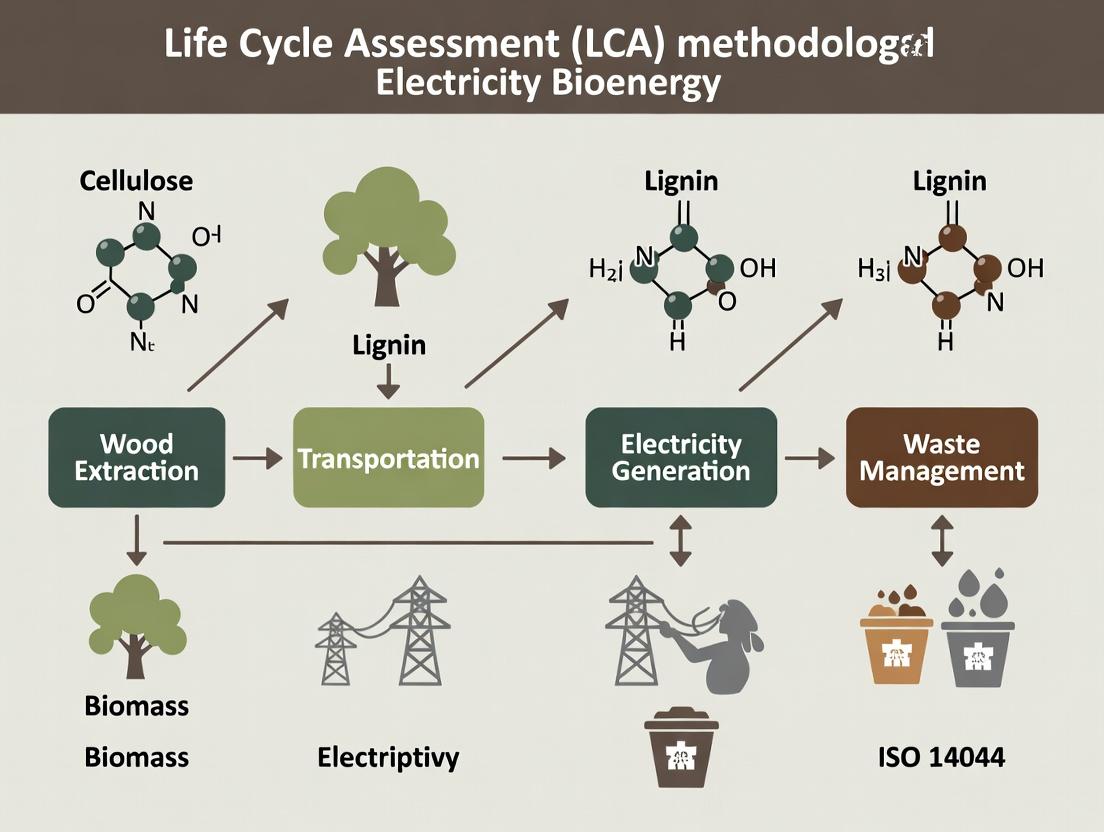
This article provides a comprehensive guide for researchers, scientists, and drug development professionals on applying ISO 14044 Life Cycle Assessment (LCA) methodology to wood-based electricity generation.
A Complete Guide to ISO 14044 LCA for Wood-Based Bioelectricity: Methodology, Challenges, and Comparative Impact
Abstract
This article provides a comprehensive guide for researchers, scientists, and drug development professionals on applying ISO 14044 Life Cycle Assessment (LCA) methodology to wood-based electricity generation. It explores the foundational principles of LCA in the context of biomass energy, details the step-by-step methodological application specific to wood feedstocks, addresses common data and modeling challenges, and presents frameworks for validation and comparative analysis against fossil and other renewable energy sources. The guide synthesizes current best practices to ensure robust, credible environmental impact assessments for sustainable energy research and development.
Understanding ISO 14044 LCA: Core Principles for Biomass Energy Analysis
Core Principles and Framework
ISO 14044:2006/A2:2020 specifies the requirements and provides guidelines for Life Cycle Assessment (LCA). It is the pivotal standard for conducting a rigorous, peer-reviewable LCA study. For research on wood-based electricity systems, it provides the critical methodological structure to ensure comparability, consistency, and credibility.
Table 1: ISO 14044 Mandatory Phases and Application to Wood-Based Electricity LCA
| Phase | Key Requirements (ISO 14044) | Specific Application for Wood-Based Electricity Research |
|---|---|---|
| Goal & Scope Definition | Intended application, reasons, audience, comparative assertions, system boundary, functional unit. | Functional Unit: 1 kWh of delivered electricity. System Boundary: Cradle-to-gate or cradle-to-grave (includes biomass growth, harvesting, transport, conversion, emissions, waste). |
| Life Cycle Inventory (LCI) | Data collection procedures, calculation methods, allocation procedures for co-products. | Data: Biomass yield (ton/ha/yr), transport distances, boiler efficiency (%), emission factors (kg CO2-eq/MJ). Allocation: Mass/economic allocation for sawmill residues (chips, bark). |
| Life Cycle Impact Assessment (LCIA) | Selection of impact categories, category indicators, models (mandatory & optional elements). | Categories: Global Warming Potential (GWP), Acidification, Eutrophication, Land Use. Models: IPCC GWP100, ReCiPe midpoint. |
| Interpretation | Identification of significant issues, evaluation (completeness, sensitivity, consistency), conclusions, limitations. | Sensitivity analysis on key parameters: biomass transport distance, biogenic carbon modeling, system lifetime. |
Application Notes for Wood-Based Electricity Systems
Note 1: Modeling Biogenic Carbon Cycles The treatment of biogenic carbon is central. ISO 14044 requires transparent modeling. The default assumption is carbon neutrality where CO2 uptake during growth equals emissions at combustion. However, timing (e.g., forest carbon stock change) and spatial considerations must be assessed and reported.
Note 2: Allocation in Multi-Product Forestry Systems For wood from dedicated harvests, allocation between timber (long-lived product) and energy wood (residues) is required. ISO 14044 hierarchy: 1) avoid allocation by subdivision/process expansion, 2) use physical relationships (e.g., mass, energy), 3) use economic or other relationships.
Table 2: Quantitative Data Range for Key Wood-Based Electricity LCI Parameters
| Parameter | Typical Range (Literature 2020-2024) | Data Source Type | Criticality |
|---|---|---|---|
| Forest Growth Yield (Softwood) | 8 - 20 m³/ha/yr | Primary literature, national inventories | High |
| Biomass Transport Distance | 50 - 150 km (road) | Case-specific logistics model | Medium-High |
| Combustion/Conversion Efficiency | 25% (Steam Turbine) - 45% (CHP, Gasification) | Manufacturer data, pilot studies | High |
| Direct PM Emissions (Uncontrolled) | 50 - 500 mg/MJ fuel | Stack emission measurements | High |
| Biogenic Carbon Content (Dry Wood) | ~0.5 kg C/kg wood | Chemical analysis, database value | Fundamental |
Experimental Protocols
Protocol 1: Comparative LCA of Wood Chip vs. Natural Gas Electricity
- Objective: To quantify and compare the environmental impacts of 1 kWh electricity from wood chips versus natural gas, compliant with ISO 14044 for comparative assertion.
- Methodology:
- Goal & Scope: Define FU as 1 kWh low-voltage electricity at grid. Audience: policy makers. Declare study as comparative assertion requiring critical review.
- System Boundaries: Cradle-to-gate. Include: feedstock production/extraction, transport, processing, combustion, direct emissions. Exclude: grid infrastructure.
- LCI Data Collection: For wood: collect primary data from a 10 MW CHP plant (fuel consumption, emissions monitoring over 1 year). For gas: use secondary data from ecoinvent v3.9 or USLCI database.
- Allocation: In wood system, allocate burdens between heat and electricity by exergy content.
- LCIA: Calculate impacts using EF 3.1 method (GWP, Acidification, Particulate Matter).
- Interpretation: Conduct sensitivity analysis on wood supply radius (+/- 50 km) and biogenic carbon modeling approach. Perform materiality check (>60% of total impact per category).
Protocol 2: Temporal Analysis of Biogenic Carbon Stock Impacts
- Objective: To experimentally assess the net GWP impact of a wood-based electricity system incorporating temporal forest carbon stock dynamics.
- Methodology:
- Experimental Setup: Define two biomass sourcing scenarios: (A) residues from sustained-yield forestry (constant stock), (B) whole trees from forest conversion.
- Carbon Modeling: Use the
t-year method or a dynamic LCA model. Measure/obtain data on: above-ground biomass carbon, soil organic carbon (SOC) pre- and post-harvest. - Field Data Collection: For Scenario B, establish sample plots (n=5, 0.1 ha each) pre-harvest. Measure tree DBH, species, use allometric equations to calculate carbon stock. Repeat in adjacent unharvested control plots. Re-measure at years 1, 5, 10 post-harvest.
- Calculation: Integrate carbon stock difference time-series into LCI, applying a dynamic characterization factor for CO2 emissions/removals. Compare static (0/100-year) and dynamic results.
Visualization of Methodological Workflows
ISO 14044 LCA Iterative Four-Phase Framework
Wood-Based Electricity Cradle-to-Gate System Boundary
The Scientist's Toolkit: Research Reagent Solutions
Table 3: Essential Resources for ISO-Compliant Wood-Based Electricity LCA Research
| Tool/Resource | Function/Description | Example/Provider |
|---|---|---|
| LCA Software | Enables modeling of product systems, inventory calculation, and impact assessment. | OpenLCA, SimaPro, GaBi. |
| Life Cycle Inventory (LCI) Database | Provides secondary, background data (e.g., for diesel production, equipment manufacture). | ecoinvent, USLCI, Agribalyse. |
| LCIA Method Package | Contains the set of characterization factors to translate LCI data into environmental impacts. | EF 3.1 (European Commission), ReCiPe 2016, IPCC 2021 GWP. |
| Biogenic Carbon Model | Tool to account for temporal dynamics of carbon stocks and flows in forestry systems. | Dynamic LCA algorithms (e.g., t-year approach), Gothenburg model. |
| Statistical Analysis Software | For conducting sensitivity, uncertainty, and Monte Carlo analysis as required by ISO 14044. | R (with pkg:lcamodeling), Python (NumPy, Pandas), @RISK. |
| Primary Data Collection Kit | For field/plant-specific LCI data: biomass scales, emissions analyzers, GPS for transport. | Portable stack monitor (for NOx, SO2, PM), forestry calipers, data loggers. |
Why LCA is Critical for Evaluating Wood-Based Bioelectricity Sustainability
Application Notes
Life Cycle Assessment (LCA), following ISO 14044, is an indispensable, systematic tool for quantifying the environmental burdens of wood-based bioelectricity systems. Within the broader thesis on LCA methodology for ISO 14044-compliant research, these notes detail its critical application in addressing key sustainability questions for researchers and scientists, including those in related fields like pharmaceutical development where rigorous analytical frameworks are paramount.
1. Addressing Carbon Neutrality Assumptions: A core controversy in bioenergy is the assumed carbon neutrality of biomass combustion. LCA critically tests this by applying a full life-cycle carbon accounting framework. It tracks biogenic carbon flows from forest growth, through harvest, transport, conversion, and emissions, alongside fossil carbon from ancillary activities. This reveals temporal imbalances between sequestration and emission, critical for assessing climate impact within specific policy timeframes (e.g., 2050 targets).
2. System Boundary Definition for Robust Comparison: The sustainability evaluation is highly sensitive to system boundaries. LCA protocols mandate explicit inclusion of:
- Upstream processes: Forest management (including soil carbon changes), feedstock extraction, chipping, and transportation.
- Core processes: Feedstock conversion (e.g., combustion, gasification, pyrolysis), electricity generation, and ash management.
- Downstream processes: Distribution and use of electricity.
- Reference System: A counterfactual scenario (e.g., fossil-based electricity grid) for comparative assertion.
3. Multidimensional Impact Assessment: Beyond greenhouse gases, LCA evaluates trade-offs across impact categories, preventing burden shifting. For wood-based systems, critical categories include:
- Resource use: Water consumption for feedstock growth and plant cooling.
- Eutrophication: From fertilizer runoff in intensive forestry.
- Acidification: From emissions of SOx and NOx during combustion.
- Land use: Impacts on biodiversity and ecosystem services.
Protocols
Protocol 1: Goal and Scope Definition for Comparative LCA
Objective: To define the purpose, system boundaries, functional unit, and scenarios for comparing wood-based bioelectricity with a fossil reference system.
Materials: LCA software (e.g., OpenLCA, SimaPro), relevant background databases (ecoinvent, USLCI), peer-reviewed literature on forest growth and power plant efficiencies.
Procedure:
- Goal Statement: Declare the study's intended application, decision context (e.g., policy support), and target audience.
- Functional Unit: Define as 1 megawatt-hour (MWh) of electricity delivered to the grid.
- System Boundaries: Establish a cradle-to-grave model. Include:
- Foreground System: Specific wood feedstock supply chain (e.g., forest residue collection), specific conversion technology (e.g., 50 MW direct-fired boiler with steam turbine).
- Background System: Production of fuels, chemicals, machinery used in the foreground system.
- Exclusions: Capital goods infrastructure (buildings, heavy equipment) may be excluded if justified, following ISO 14044 cut-off criteria.
- Scenarios: Define at least two scenarios:
- Bioenergy Scenario: Supply chain for wood chips from sustainable forest management.
- Reference Scenario: Marginal grid electricity mix (e.g., natural gas combined cycle) displaced.
- Allocation Procedures: For multi-product systems (e.g., combined heat and power), apply allocation based on physical (exergy) or economic relationships, documenting justification.
Protocol 2: Life Cycle Inventory (LCI) Data Collection for Feedstock Supply
Objective: To compile quantitative input/output data for the wood feedstock supply chain.
Materials: Forestry operation manuals, GIS data, transportation logistics models, emission factor databases (EPA AP-42, IPCC), field measurement equipment for soil carbon.
Procedure:
- Biomass Procurement:
- Determine biomass source (e.g., thinning residues, harvest residues, dedicated short-rotation crops).
- Collect data on yield (dry tonnes/ha/year), harvesting equipment (diesel consumption per m³), and on-site chipping operations.
- Soil Carbon Stock Change Assessment (Critical Flow):
- Establish long-term soil monitoring plots in representative stands.
- Use dynamic LCA modeling (e.g., IPCC Tier 2/3 methods) to estimate changes in soil organic carbon over a 100-year timeframe post-harvest.
- Model both the bioenergy scenario and a baseline "no harvest" or "natural succession" scenario.
- Transportation:
- Model transport distance (km) from forest to plant using average payload for chip trucks.
- Apply fuel consumption and emission factors for heavy-duty diesel trucks.
- Data Aggregation: Compile all inputs (diesel, lubricants, electricity) and outputs (CO₂, CH₄, N₂O, particulate emissions) per functional unit of biomass delivered (e.g., 1 dry tonne).
Protocol 3: Impact Assessment and Interpretation
Objective: To translate LCI data into environmental impacts and interpret results robustly.
Materials: LCA software with impact assessment methods (ReCiPe 2016, TRACI 2.1), statistical analysis software (R, Python).
Procedure:
- Characterization: Apply selected impact assessment method to convert emissions into impact category indicators (e.g., kg CO₂-eq for Global Warming Potential over 100 years, GWP100).
- Contribution Analysis: Isolate the contribution of each life cycle stage (forestry, transport, conversion) to each impact category.
- Uncertainty & Sensitivity Analysis:
- Perform Monte Carlo simulation (≥1000 iterations) using uncertainty distributions (e.g., log-normal) for key parameters: biomass yield, soil carbon change factors, conversion efficiency.
- Conduct scenario sensitivity analysis on critical parameters: varying transport distance (±50%), biomass moisture content, and timeline for carbon debt repayment.
- Interpretation: Report results with confidence intervals. Conclude on the conditions (e.g., feedstock type, transport radius, conversion technology) under which wood-based bioelectricity offers net environmental benefits compared to the reference system.
Data Presentation
Table 1: Comparative Life Cycle Impact Assessment Results for 1 MWh of Electricity
| Impact Category | Unit | Wood Chip Combined Heat & Power (CHP) | Natural Gas Combined Cycle (Reference) | Notes / Key Drivers |
|---|---|---|---|---|
| Global Warming Potential (GWP100) | kg CO₂-eq | 15 - 80 | 350 - 450 | Range for wood depends heavily on soil carbon assumptions and forest management. Fossil emissions are dominant for NGCC. |
| Fossil Resource Scarcity | kg oil-eq | 5 - 15 | 60 - 75 | Lower for wood due to renewable feedstock. Dominated by upstream diesel and equipment. |
| Freshwater Eutrophication | kg P-eq | 0.02 - 0.08 | 0.01 - 0.03 | Can be higher for wood if intensive fertilization is used in feedstock cultivation. |
| Water Consumption | m³ | 1.0 - 2.5 | 0.4 - 0.7 | Higher for wood if irrigation is used for feedstock or for plant cooling with open-loop systems. |
| Acidification | kg SO₂-eq | 0.3 - 0.8 | 0.2 - 0.5 | Combustion emissions (NOx, SOx) from both systems are primary contributors. |
Table 2: Key Inventory Data Ranges for Wood Feedstock Supply (per dry tonne)
| Parameter | Unit | Typical Range | Source / Comment |
|---|---|---|---|
| Diesel for Harvesting/Collection | L/tonne | 2 - 6 | Depends on terrain and equipment. |
| Transport Distance (One-way) | km | 50 - 150 | Critical sensitivity parameter. |
| Diesel for Transport | L/tonne-km | 0.05 - 0.08 | For heavy-duty truck, loaded. |
| Net Soil Carbon Change (Year 1-20) | kg C/tonne-biomass | -50 to +10 | Negative indicates loss; highly variable. Key uncertainty. |
| Biomass Moisture Content (at plant) | % (wet basis) | 30 - 50 | Significantly affects conversion efficiency and emissions. |
Visualizations
Title: ISO 14044 LCA Framework for Bioelectricity
Title: Biogenic and Fossil Carbon Flows in Bioenergy LCA
The Scientist's Toolkit: Key Research Reagent Solutions & Materials
| Item / Solution | Function in LCA of Wood-Based Bioelectricity |
|---|---|
| LCA Software (e.g., OpenLCA, SimaPro, Gabi) | Core platform for modeling product systems, managing life cycle inventory data, performing calculations, and conducting impact assessment. |
| Background Life Cycle Inventory Databases (e.g., ecoinvent, USLCI) | Provide validated, generic data for background processes (e.g., diesel production, electricity mixes, chemicals) essential for building comprehensive models. |
| Dynamic Soil Carbon Models (e.g., IPCC Tier 2/3, CENTURY, DayCent) | Critical for modeling temporal changes in forest soil carbon stocks following biomass removal, addressing a major source of uncertainty and debate. |
| Monte Carlo Simulation Module (integrated in LCA software or via R/Python) | Enables probabilistic uncertainty and sensitivity analysis by propagating parameter uncertainties through the model to produce result distributions. |
| GIS Software & Data (e.g., ArcGIS, QGIS) | Used to analyze spatial aspects of feedstock supply chains, including realistic transport distances, land use change mapping, and biomass availability. |
| Fuel & Emission Factor Databases (e.g., EPA AP-42, IPCC EFDB) | Provide emission coefficients for stationary combustion (power plant) and mobile sources (harvesting/transport equipment). |
| Statistical Analysis Software (e.g., R, Python with pandas) | For advanced data processing, customized sensitivity analysis, visualization, and statistical interpretation of LCA results. |
1. Application Notes: System Boundary Definitions in LCA of Wood-to-Power
Within an ISO 14044-compliant Life Cycle Assessment (LCA) for a thesis on wood-based electricity, defining the goal and scope is a critical first step that determines the relevance and reliability of results. The "cradle-to-grave" system boundary for wood-to-power pathways is complex and must be explicitly detailed. The following notes address key considerations for researchers.
- Temporal Boundary: A critical decision is the time horizon for biogenic carbon accounting. A 100-year timeframe is common (GWP-100), but shorter horizons (e.g., GWP-20) may be relevant for assessing climate impact timing. The chosen horizon must align with the study's goal.
- Spatial Boundary: The geographic specificity of data (e.g., forest growth rates, soil carbon stocks, transportation distances, grid electricity mix) significantly influences results. Regionalized inventories are essential for accuracy.
- Multifunctionality & Allocation: Wood-based systems often yield co-products (sawdust, chips, bark, heat). ISO 14044 mandates handling this through subdivision, system expansion, or allocation. For electricity-focused studies, system expansion (avoided burden method) is often preferred, crediting the system for avoiding the production of equivalent products from conventional sources.
- Technological Boundary: The specific conversion technology (e.g., direct combustion, gasification, pyrolysis, anaerobic digestion) dictates the inclusion of unit processes for pre-treatment, conversion, emissions control, and ash management.
2. Quantitative Data Summary: Key Flow Indicators for Common Pathways
Table 1: Typical Material and Energy Flow Indicators per 1 MWh of Net Electricity Generated (Theoretical Averages)
| Pathway Indicator | Direct Combustion (Steam Turbine) | Gasification-Combined Cycle | Pyrolysis-Biooil Combustion | Anaerobic Digestion (Biogas) |
|---|---|---|---|---|
| Wood Input (oven-dry metric tons) | 0.9 - 1.2 | 0.7 - 0.9 | 1.0 - 1.3 | 2.5 - 3.5 (wet manure co-substrate) |
| System Net Efficiency (LHV, %) | 20% - 30% | 30% - 40% | 20% - 25% | 15% - 25% (elec. only) |
| Process Water Consumption (m³) | 2.0 - 3.5 | 1.5 - 2.5 | 1.0 - 2.0 | 5.0 - 10.0 |
| Major Co-Product | Heat (if CHP) | Heat, Biochar (potential) | Biochar, Heat | Digestate (fertilizer) |
| Typical Plant Capacity (MWe) | 10 - 50 | 5 - 20 | 1 - 10 | 0.5 - 5 |
Note: Ranges reflect variations in technology, feedstock quality, and plant configuration. Site-specific data is required for precise LCA.
3. Experimental Protocols for Key Data Generation
Protocol 3.1: Determining Biomass Feedstock Higher Heating Value (HHV)
- Objective: To empirically determine the higher heating value (HHV) of wood feedstock for energy input calculations in LCA.
- Method: Bomb Calorimetry (ASTM D5865)
- Procedure:
- Sample Preparation: Oven-dry feedstock at 105°C to constant mass. Pulverize to pass a 250 µm sieve. Form into pellets.
- Calibration: Calibrate the oxygen bomb calorimeter using certified benzoic acid standard.
- Combustion: Weigh pellet (~1.0g) in a crucible. Assemble bomb charged with 30 atm oxygen. Submerge bomb in a known mass of water within the insulated calorimeter jacket.
- Measurement: Initiate ignition. Record the precise temperature rise of the water jacket.
- Calculation: Calculate HHV (J/g) using the measured temperature change, the energy equivalent of the calorimeter system, and appropriate corrections for fuse wire contribution and acid formation.
- Replicates: Perform minimum of five replicates per feedstock type.
Protocol 3.2: Field Measurement of Soil Carbon Stock Change
- Objective: To quantify changes in soil organic carbon (SOC) stocks associated with wood feedstock harvesting for inclusion in LCA.
- Method: Paired-Site Sampling (Modified from IPCC Guidelines)
- Procedure:
- Site Selection: Identify paired forest plots: one control (no harvest) and one treatment (harvested per studied pathway).
- Sampling Design: Establish a systematic grid (e.g., 3x3) within each plot. At each point, collect soil cores (0-30 cm depth) using a standardized auger.
- Sample Processing: Remove roots and stones >2mm. Oven-dry a subsample at 105°C for dry bulk density. Pulverize another subsample for carbon analysis.
- Carbon Analysis: Determine % organic carbon via dry combustion (e.g., using an elemental analyzer following DIN 19539).
- Calculation: Calculate SOC stock (Mg C/ha) = Bulk Density (g/cm³) * Depth (cm) * %C * 100. Compare mean stocks between paired plots.
- Temporal Scope: Sampling should be repeated at defined intervals (e.g., 1, 3, 5 years post-harvest).
4. Signaling Pathway & System Boundary Diagrams
5. The Scientist's Toolkit: Key Research Reagent Solutions
Table 2: Essential Materials for Wood-to-Power LCA Data Generation
| Item | Function in Research | Example/Note |
|---|---|---|
| Elemental Analyzer | Quantifies carbon, hydrogen, nitrogen, and sulfur content in solid biomass and soil samples. Critical for calculating energy content and carbon flows. | e.g., Thermo Scientific Flash 2000, operates via dynamic flash combustion. |
| Oxygen Bomb Calorimeter | Empirically determines the Higher Heating Value (HHV) of solid biomass fuels. | e.g., IKA C6000, calibrated with benzoic acid standards (ASTM D5865). |
| Soil Coring Auger | Extracts undisturbed soil cores for bulk density and carbon stock analysis. | e.g., AMS Sliding Hammer Corer with acetate sleeves for minimal disturbance. |
| Particulate Matter (PM) Sampler | Isokinetic sampling of PM emissions from combustion/gasification processes for LCI. | e.g., Deutschmark Stack Sampler (cyclone + filter holder). |
| Gas Analyzer (FTIR or NDIR) | Real-time quantification of flue gas composition (CO2, CO, CH4, N2O, NOx, SO2). | e.g., Gasmet DX4000 FTIR; portable NDIR sensors for field use. |
| LCA Software & Database | Models the product system, manages inventory data, and performs LCIA calculations. | e.g., SimaPro, openLCA, GaBi; integrated databases like ecoinvent, USLCI. |
| Statistical Analysis Software | Performs uncertainty analysis, sensitivity analysis, and statistical validation of data. | e.g., R, Python (with Pandas, statsmodels), @RISK for Monte Carlo simulation. |
Key Environmental Impact Categories for Biomass Energy (GWP, Acidification, Eutrophication)
Application Notes
This document provides application notes and protocols for assessing key environmental impact categories—Global Warming Potential (GWP), Acidification, and Eutrophication—within a Life Cycle Assessment (LCA) framework for wood-based electricity generation. These notes are designed to support a broader thesis on LCA methodology, compliant with ISO 14044, for researchers and professionals in scientific and technical fields.
Global Warming Potential (GWP)
GWP measures the radiative forcing of greenhouse gas (GHG) emissions over a specified time horizon (typically 100 years), expressed in kg CO₂-equivalents (CO₂-eq). For biomass energy, the carbon neutrality assumption is nuanced; it depends on feedstock sourcing, supply chain emissions, and the temporal scale of carbon sequestration and release.
Key Considerations:
- Biogenic Carbon: Emissions from biomass combustion are often considered climate-neutral if the feedstock is sourced from sustainably managed forests where carbon stock remains stable or increases over time. This must be documented via carbon stock accounting.
- Fossil GHG Emissions: Non-CO₂ GHG emissions (e.g., CH₄, N₂O) from supply chain activities (harvesting, transport, processing) and fossil fuel inputs contribute to GWP.
- Time Horizon: The choice of time horizon (e.g., 20, 100, 500 years) for GWP calculation affects the weighting of short-lived climate forcers like methane, which is particularly relevant for biomass systems involving residue decay or biogas.
Acidification
Acidification potential (AP) quantifies the emissions of acidifying substances (e.g., SO₂, NOx, NH₃) that lead to soil and water acidification, expressed in kg SO₂-equivalents (SO₂-eq). For biomass energy systems, acidification is primarily driven by emissions from combustion and upstream agricultural activities.
Key Considerations:
- Combustion Emissions: The release of sulfur oxides (SOx) and nitrogen oxides (NOx) during the combustion of woody biomass is a major contributor.
- Nitrogen Fertilizer Use: If biomass feedstock cultivation involves fertilization, ammonia (NH₃) volatilization and nitrate leaching are significant acidification sources.
- Supply Chain: Emissions from harvesting machinery and transportation add to the total AP.
Eutrophication
Eutrophication potential (EP) assesses the nutrient enrichment of ecosystems, leading to algal blooms and oxygen depletion, expressed in kg Phosphate-equivalents (PO₄-eq). It is subdivided into freshwater and marine eutrophication.
Key Considerations:
- Freshwater Eutrophication: Driven primarily by phosphorus (P) releases, often from soil runoff and erosion associated with biomass cultivation or from ash disposal.
- Marine Eutrophication: Driven primarily by nitrogen (N) releases, often from airborne NOx and NH₃ emissions that deposit into aquatic systems.
- Nutrient Management: The use of fertilizers in dedicated energy crop cultivation and the fate of nutrients in ash (if returned to soil) are critical system parameters.
Table 1: Typical Characterization Factors for Key Impact Categories (ILCD 2011 Midpoint+)
| Impact Category | Unit (per kg emission) | SO₂ | NOx (as NO₂) | NH₃ | P (to water) | N (to water) | CO₂ (fossil) | CH₄ | N₂O |
|---|---|---|---|---|---|---|---|---|---|
| GWP (100y) | kg CO₂-eq | - | - | - | - | - | 1 | 28 | 265 |
| Acidification | kg SO₂-eq | 1.00 | 0.50 | 1.64 | - | - | - | - | - |
| Eutrophication (Freshwater) | kg P-eq | - | - | - | 1.00 | - | - | - | - |
| Eutrophication (Marine) | kg N-eq | - | 0.10 | 0.35 | - | 1.00 | - | - | - |
Table 2: Illustrative LCA Results for Selected Biomass Electricity Pathways (per MWh)
| Biomass System & Key Assumptions | GWP (kg CO₂-eq/MWh) | Acidification (kg SO₂-eq/MWh) | Eutrophication, Marine (kg N-eq/MWh) | Primary Contributors to Impact |
|---|---|---|---|---|
| Forest Residue CHP (Sustainable harvest, 50 km transport, Combined Heat & Power) | 15 - 40 | 0.25 - 0.60 | 0.15 - 0.35 | Supply chain diesel, NOx from combustion |
| Wood Pellet Electricity (Intensive forestry, transoceanic shipping, dedicated power plant) | 80 - 200 | 0.40 - 1.20 | 0.30 - 0.80 | Long-distance transport, direct combustion emissions |
| Short Rotation Coppice (SRC) (With nitrogen fertilization, local use) | 10 - 80* | 0.60 - 1.50 | 0.50 - 1.20 | Fertilizer production & field emissions (N₂O, NH₃, NOx) |
*Negative values possible if soil carbon sequestration is credited. Results are illustrative and highly dependent on system boundaries and local conditions.
Experimental Protocols
Protocol 1: Determining System-Specific Biogenic Carbon Flows
Objective: To quantify the net biogenic carbon flows associated with woody biomass feedstock provision for inclusion in GWP assessment. Methodology:
- Define Carbon Pool Boundaries: Delineate relevant carbon pools: standing biomass, soil organic carbon, harvested wood products, and litter.
- Establish Baseline: Determine the carbon stock in each pool under a defined baseline scenario (e.g., continued prior land use).
- Model Project Scenario: Model changes in carbon stocks over the LCA timeframe (e.g., 100 years) under the biomass feedstock production scenario, using tools like the IPCC Guidelines or process-based models (e.g., CO2FIX).
- Calculate Net Flux: The net biogenic CO₂ emission/removal is the difference in carbon stock change between the project and baseline scenarios, allocated annually over the assessment period.
- Integrate into LCA: Input the annualized net biogenic carbon flux into the LCA model as a biogenic CO₂ emission (positive or negative).
Protocol 2: Measuring and Allocating Emissions from Biomass Combustion
Objective: To experimentally quantify and allocate airborne emissions (for GWP, AP, EP) from a biomass-fired electricity generation unit. Methodology:
- Sampling Setup: Use an isokinetic sampling train (per EPA Method 5 or equivalent) at the stack. Measure flue gas flow rate, temperature, and moisture content.
- Gas Analysis: Use Fourier-Transform Infrared Spectroscopy (FTIR) or Gas Chromatography (GC) for continuous/semi-continuous measurement of CO₂ (fossil & biogenic fraction via ¹⁴C analysis), CH₄, N₂O, SO₂, NOx, and NH₃.
- Particulate Matter Analysis: Collect particulates on filters for mass determination and subsequent elemental analysis (e.g., ICP-MS) to determine nutrient (P, N) content in ash aerosols.
- Data Normalization: Express all emission concentrations in mg/Nm³ (normalized to standard conditions).
- Allocation to Co-Products: If in a Combined Heat and Power (CHP) system, allocate emissions between electricity and heat using the exergy-based allocation method. Calculate the exergy content of both electricity and useful heat output. The allocation factor for electricity is:
Exergy_electricity / (Exergy_electricity + Exergy_heat).
Protocol 3: Assessing Terrestrial Nutrient Leaching for EP
Objective: To quantify phosphorus and nitrogen leaching from soil under dedicated biomass crop cultivation. Methodology:
- Field Design: Establish monitoring plots in representative feedstock cultivation areas (e.g., SRC willow). Include control plots (non-fertilized or under baseline land use).
- Lysimeter Installation: Install suction cup lysimeters at the base of the root zone (e.g., 1m depth) to collect soil pore water.
- Sampling Regimen: Collect water samples at regular intervals (bi-weekly to monthly) and after major precipitation or fertilization events for one hydrological year.
- Laboratory Analysis: Analyze samples for:
- Total Phosphorus (TP): Persulfate digestion followed by colorimetric analysis (Ascorbic Acid Method).
- Nitrate (NO₃-N) & Ammonium (NH₄-N): Ion Chromatography (IC) or Flow Injection Analysis (FIA).
- Flux Calculation: Combine nutrient concentrations with modeled or measured water drainage volumes to calculate an annual leaching flux (kg P or N per hectare per year).
The Scientist's Toolkit
Table 3: Key Research Reagent Solutions & Materials for LCA Validation Experiments
| Item | Function in Protocol | Specification / Notes |
|---|---|---|
| Isokinetic Stack Sampler | Ensures representative extraction of flue gas particles and gases from a flowing stream. | Must be calibrated for flow rate. Follows EPA Method 5 or ISO 9096. |
| FTIR Gas Analyzer | Simultaneous, real-time quantification of multiple gas species (CO₂, CH₄, N₂O, NOx, SO₂, NH₃) in flue gas. | Requires regular calibration with certified standard gas mixtures. |
| AMS (Accelerator Mass Spectrometry) | Differentiates fossil vs. biogenic CO₂ by measuring the ¹⁴C/¹²C ratio in sampled carbon. | Used for advanced carbon accounting; specialized facility required. |
| Suction Cup Lysimeter | Collects soil pore water from a specific depth for nutrient leaching analysis. | Typically made of porous ceramic or PTFE. Must be cleaned acid-washed between samples. |
| ICP-MS (Inductively Coupled Plasma Mass Spectrometer) | Detects trace metal and non-metal concentrations (e.g., phosphorus in ash or water samples) with high sensitivity. | Requires sample digestion for solid ash samples. |
| Ion Chromatograph (IC) | Separates and quantifies anions (NO₃⁻, PO₄³⁻) and cations (NH₄⁺) in aqueous samples (lysimeter leachate). | Essential for eutrophication potential assessment from field studies. |
| CO2FIX / SIMAPro / GaBi Software | Models carbon stock dynamics (CO2FIX) or integrates inventory data for full LCA impact calculation (SIMAPro, GaBi). | Core tools for data synthesis and impact assessment per ISO 14044. |
Diagrams
LCA Workflow for Biomass Electricity Impact Assessment
Biogenic Carbon Flow in Wood-Based Electricity System
Application Notes: Carbon Accounting & Temporal Dynamics in Wood Bioenergy LCA
Within the framework of ISO 14044-compliant Life Cycle Assessment (LCA) for wood-based electricity, addressing carbon neutrality and temporal aspects is paramount. These notes contextualize key methodological challenges and solutions for researchers.
1.1 The Carbon Neutrality Debate: The assumption of carbon neutrality for woody biomass is contingent on system boundaries and temporal scale. Critically, it hinges on the regeneration of the harvested forest to re-sequester the emitted carbon. Discrepancies arise between instantaneous combustion emissions and the decadal-scale regrowth. Methodologies must explicitly state the handling of biogenic carbon flows (e.g., stored in product pools, immediate emission, or delayed emission).
1.2 Critical Temporal Aspects: The timing of emissions and sequestration events drastically influences climate impact metrics, such as Global Warming Potential (GWP). Key temporal parameters include:
- Carbon Debt: The initial net increase in atmospheric CO₂ post-harvest/combustion.
- Payback Period: Time required for regrowth to re-sequester the emitted carbon.
- Parity Period: Time until the cumulative radiative forcing of the biomass system equals that of a fossil fuel reference system.
Table 1: Summary of Quantitative Findings from Recent Meta-Analyses on Temporal Carbon Metrics for Wood Pellets (vs. Coal)
| Wood Feedstock Type | System Boundary (Growth, Transport, Conversion) | Average Carbon Debt Payback Period (Years) | Key Determining Factors | Source (Representative) |
|---|---|---|---|---|
| Whole Logs, Sustainably Managed Forest | Cradle-to-Grave (Growth, Pelletization, Transport, Combustion) | 44 - 104 | Forest growth rate, Soil carbon changes, Coal efficiency | Jonker et al., 2023 |
| Forest Residues (Thinnings, Tops) | Cradle-to-Grave | 0 - 20 | Baseline decay rate of residues, Alternative fate | Hanssen et al., 2022 |
| Short Rotation Coppice (SRC) | Cradle-to-Grave | 2 - 15 | High yield per hectare, Land use history | Lamers & Junginger, 2021 |
1.3 Methodological Recommendations for ISO 14044 Studies:
- Dynamic LCA: Employ dynamic life cycle assessment to model the time-dependent flows of biogenic carbon, providing a more realistic profile of climate impacts than static GWP100.
- Reference System Definition: Unambiguously define the counterfactual scenario (e.g., if not harvested, if left to decay, alternative land use).
- Sensitivity Analysis: Conduct rigorous sensitivity analysis on critical parameters: forest growth models, biomass decay rates, and energy conversion efficiencies.
Experimental Protocols
Protocol 2.1: Determining the Radiative Forcing Impact of a Wood-Based Electricity System Using a Dynamic LCA Model
Objective: To quantify the time-dependent climate impact of generating 1 MWh of electricity from wood chips compared to a natural gas reference.
2.1.1 Materials & Reagent Solutions
Table 2: Research Reagent Solutions & Essential Materials for Dynamic Carbon Flux Analysis
| Item / Reagent | Function / Explanation |
|---|---|
| Forest Growth & Yield Model (e.g., 3-PG, CO2FIX) | Simulates carbon sequestration rates in standing biomass over time under specific silvicultural regimes. |
| Biogenic Carbon Pool Model | Tracks carbon stocks in multiple pools: living biomass, dead organic matter, harvested wood products, and soil. |
| Decay Function Parameters (k-values) | First-order decay constants for dead wood, soil organic matter, and wood products. Defines the rate of carbon release. |
| Radiative Forcing (RF) Model | Calculates the time-varying atmospheric heat absorption from GHG emission pulses (e.g., based on IPCC AR6 impulse response functions). |
| Life Cycle Inventory (LCI) Database | Provides static data for foreground/background processes (e.g., ecoinvent, USLCI): diesel for harvesting, electricity for chipping, transport distances. |
| Dynamic LCA Software Platform | Computational environment for modeling temporal flows (e.g., Python with NumPy/SciPy, dedicated LCA software with dynamic capabilities). |
2.1.2 Procedure
- Goal & Scope Definition: Define the functional unit (1 MWh delivered to grid). Set a 100-year temporal boundary with annual time steps. Define the wood system (e.g., hardwood chips from managed forest, 30% moisture content) and reference system (natural gas combined cycle).
- Inventory Modeling (Foreground):
- Carbon Uptake: Using the growth model, simulate the carbon sequestration in the stand from which the wood chip feedstock is harvested. Generate an annual carbon uptake curve.
- Harvest & Emissions: Model a single harvest event at year t=0. Allocate the carbon in the harvested wood to the product.
- Combustion & Decay: At t=0, instantaneously emit a fraction of the feedstock carbon as CO₂ upon combustion (based on efficiency and carbon content). Model the remaining carbon in ash and unburned products with appropriate decay functions.
- Regrowth: Apply the growth model to the post-harvest stand to project re-sequestration.
- Net Biogenic Carbon Flux: For each year, calculate: (Sequestration in Regrowth) - (Emissions from Combustion & Decay).
- Inventory Modeling (Background): Collect static LCI data for ancillary processes (diesel, electricity, transport). Distribute their fossil GHG emissions to year t=0.
- Impact Assessment (Dynamic):
- Combine the annual net biogenic carbon flux with the fossil GHG emissions to create a yearly GHG flux profile (kg CO₂-eq/yr).
- Convolve this annual emission profile with the chosen RF impulse response function.
- Integrate the resulting annual RF values to calculate cumulative radiative forcing (CRF) over the assessment period.
- Comparison & Parity Time Calculation: Repeat steps 2-4 for the natural gas reference system (emissions at t=0). Plot the CRF of both systems over time. The parity period is identified as the point where the two CRF curves intersect.
Protocol 2.2: Laboratory Protocol for Determining Biomass Feedstock Properties Critical for LCI
Objective: To empirically determine the higher heating value (HHV) and ash content of a wood chip sample, essential parameters for calculating conversion efficiency and emission factors in LCA.
2.2.1 Materials: Bomb calorimeter, calorimeter capsules, press, drying oven, analytical balance (±0.0001 g), muffle furnace, crucibles, desiccator, representative wood chip sample (ground to <1 mm particle size).
2.2.2 Procedure for HHV (ASTM D5865):
- Calibration: Calibrate the bomb calorimeter using a certified benzoic acid standard.
- Pellet Preparation: Precisely weigh (~1.0 g) the ground, oven-dried biomass. Press into a pellet using a capsule.
- Combustion: Assemble the bomb with the pellet, fuse wire, and 1 mL of water. Pressurize with 30 atm oxygen. Submerge in the calorimeter water jacket.
- Measurement: Initiate combustion. Record the temperature change of the water jacket.
- Calculation: Calculate the HHV (MJ/kg) from the temperature rise, applying necessary corrections (fuse wire, acid formation).
2.2.3 Procedure for Ash Content (ASTM D1102):
- Pre-weigh: Heat a clean crucible in a muffle furnace at 575±25°C for 1 hour. Cool in a desiccator and weigh (W_crucible).
- Sample Weighing: Add ~2 g of ground, oven-dried wood sample to the crucible. Record total weight (W_total).
- Ashing: Place the crucible in the cold muffle furnace. Gradually heat to 250°C, hold for 1 hour, then increase to 575±25°C. Maintain for a minimum of 4 hours, or until constant mass is achieved (white/gray ash).
- Weighing Ash: Cool the crucible in a desiccator and weigh (W_ash).
- Calculation: Ash Content (%) = [(W_ash - W_crucible) / (W_total - W_crucible)] x 100.
Mandatory Visualizations
Step-by-Step ISO 14044 Application to Wood-Fired Power Systems
Application Notes for LCI Data Collection in Wood-Based Systems
Life Cycle Inventory (LCI) data collection for wood feedstocks is a foundational step in conducting a life cycle assessment (LCA) compliant with ISO 14044 for wood-based electricity research. This process quantifies all relevant inputs (e.g., energy, water, fertilizers) and outputs (e.g., emissions, products, waste) across the supply chain. For researchers, particularly those with cross-disciplinary interests in biochemistry and environmental impacts, precise LCI data is crucial for modeling the environmental footprint of bioenergy and its potential systemic effects.
Key System Boundaries and Data Quality
The system should be defined from forest management (cradle) to the delivery of processed wood feedstock (e.g., chips, pellets) at the power plant gate. Data quality indicators such as technological, geographical, and temporal representativeness must be documented. Primary data is preferred for foreground processes (e.g., specific harvesting operations), while secondary data from reputable databases (e.g., ecoinvent, USDA) can be used for background processes (e.g., diesel production).
Detailed Data Collection Protocols
Protocol 2.1: Data Collection for Harvesting Operations
Objective: To quantify resource consumption and emissions associated with felling, processing, and extracting wood from the forest stand to the landing site. Methodology:
- Site Selection: Identify representative forest stands based on species, age, slope, and soil type.
- Time & Motion Study: Conduct direct observation of harvesting machinery (e.g., feller-bunchers, skidders).
- Record active working time, idle time, and distance traveled per unit volume of wood harvested.
- Measure fuel consumption per machine hour using refueling logs or onboard diagnostics.
- Input Inventory: Record all consumables (e.g., chainsaw oil, hydraulic fluid, lubricants).
- Output Inventory: Estimate biomass left on-site (slashes, stumps) and potential soil disturbance area.
- Calculation: Normalize all inputs and outputs per functional unit (e.g., 1 cubic meter of wood, oven-dry ton).
Protocol 2.2: Data Collection for Transport Operations
Objective: To quantify inputs and outputs for transporting wood from the landing site to the processing facility or power plant. Methodology:
- Vehicle Characterization: Record vehicle type (e.g., chip truck, log truck), gross vehicle weight, payload capacity, and emission standard.
- Route Analysis: Document average loaded and empty trip distances, road grade, and surface type.
- Fuel Tracking: Record fuel consumption per round trip, preferably using fleet management system data over a significant sample size (e.g., 50+ trips).
- Load Efficiency: Measure the average load factor (actual payload / maximum payload).
Protocol 2.3: Data Collection for Processing Operations
Objective: To quantify inputs and outputs for chipping, drying, and pelletizing wood. Methodology:
- Process Flow Mapping: Create a detailed flow diagram of the processing facility, identifying all unit operations (e.g., debarking, grinding, drying, pelletizing, cooling).
- Metered Data Collection: Collect site-specific data for electricity (kWh), natural gas (m³), thermal energy (MJ), and water (m³) consumption per unit mass of output.
- Material Balance: Track mass flows of input wood, produced feedstock (chips/pellets), and generated by-products (bark, fines, dust).
- Emission Monitoring: If available, use stack emission data for combustion units (e.g., dryers). Otherwise, apply appropriate emission factors.
Table 1: Representative LCI Data for Harvesting (per oven-dry metric ton, odt)
| Process / Machinery | Diesel Fuel (liters) | Lubricants (kg) | Productivity (odt/hr) | Biomass Residue (% of total) | Data Source & Year |
|---|---|---|---|---|---|
| Whole-Tree Harvesting (Softwood) | 8.5 - 12.1 | 0.15 - 0.25 | 18 - 25 | 25 - 30% | Primary study, US NE, 2022 |
| Cut-to-Length Harvesting (Hardwood) | 6.2 - 9.8 | 0.10 - 0.20 | 12 - 18 | 15 - 20% | Primary study, CA, 2023 |
| Secondary Data Reference | 10.5 | 0.18 | 20 | 25% | ecoinvent v3.8, 2021 |
Table 2: Representative LCI Data for Transport (per odt-km)
| Transport Stage | Truck Type | Fuel Consumption (liters/km) | Load Factor (%) | Avg. Distance (km) | Emission Factor (g CO2-eq/odt-km) |
|---|---|---|---|---|---|
| Forest to Mill | Log Truck (40t) | 0.45 - 0.60 | 80 - 90 | 80 - 150 | 110 - 145 |
| Mill to Power Plant | Chip Van (44t) | 0.50 - 0.65 | 85 - 95 | 50 - 300 | 120 - 160 |
| Secondary Data Reference | Avg. Truck >32t | 0.55 | 90 | 100 | 132 |
Table 3: Representative LCI Data for Processing (per odt of pellets)
| Processing Input/Output | Unit | Range | Typical Value | Notes |
|---|---|---|---|---|
| Electricity Consumption | kWh/odt | 80 - 150 | 115 | Grinding, pelletizing, cooling |
| Thermal Energy for Drying | MJ/odt | 2500 - 4000 | 3200 | From natural gas or biomass |
| Natural Gas Consumption | m³/odt | 75 - 120 | 95 | If used for drying |
| Water Consumption | liters/odt | 10 - 50 | 25 | Cooling, moisture adjustment |
| Pellet Yield | % of input wood | 92 - 97 | 95 | Mass balance closure |
Experimental Workflow and System Diagrams
LCI Data Collection Workflow for Wood Feedstocks
LCI Data Processing and Quality Assurance Pathway
The Scientist's Toolkit: Essential Research Reagents & Materials
Table 4: Key Tools and Resources for LCI Fieldwork and Analysis
| Item / Solution | Function / Application | Specification / Notes |
|---|---|---|
| Fuel Flow Meters | Direct, accurate measurement of diesel consumption from harvesting and transport machinery. | Portable, ultrasonic models for non-invasive installation. Critical for primary data. |
| GPS Data Loggers | Track movement patterns, distances, and idle times of equipment and transport vehicles. | Rugged, weatherproof units with high update frequency. Enables time-motion studies. |
| Portable Load Cells | Measure the weight of harvested wood or processed feedstock directly in the field or facility. | Integrated into trailers or conveyors for real-time mass flow data. |
| Moisture Meters | Determine the moisture content of wood at various stages. Essential for normalizing data to a dry-mass basis. | Handheld dielectric or resistance-type meters. Requires species-specific calibration. |
| LCA Software & Databases | Model the system, manage inventory data, perform calculations, and apply allocation. | Examples: OpenLCA, SimaPro, GaBi. Must include regionally appropriate background databases (e.g., ecoinvent, USLCI). |
| Statistical Analysis Software | Analyze variability in field data, perform uncertainty analysis, and calculate confidence intervals. | R, Python (with Pandas/NumPy), or Minitab. Required for robust, defensible results. |
| Emission Factor Databases | Provide default coefficients for combustion emissions (e.g., from diesel engines) where direct measurement is impossible. | EPA AP-42, IPCC Guidelines, DEFRA. Must match the technology and emission standard. |
Thesis Context: This application note supports a broader Life Cycle Assessment (LCA) thesis per ISO 14044, focusing on the life cycle inventory (LCI) phase for wood-based electricity generation systems. Accurate modeling of the combustion and conversion unit process is critical for determining system efficiency, environmental impacts (emissions), and co-product flows.
Table 1: Typical Efficiency and Emission Ranges for Wood Combustion Technologies (Post-2020 Data)
| Technology | Net Electrical Efficiency (%) | CO (mg/MJ) | NOx (as NO2, mg/MJ) | PM (mg/MJ) | Ash Yield (% of fuel input, mass) |
|---|---|---|---|---|---|
| Grate Boiler + Steam Turbine | 25 - 33 | 30 - 150 | 40 - 120 | 10 - 50 | 0.5 - 5 |
| Fluidized Bed Combustion (FBC) | 28 - 35 | 15 - 80 | 20 - 80 | 5 - 30 | 0.5 - 6 |
| Biomass Gasification + IC Engine | 22 - 28 | 100 - 500 | 80 - 200 | 15 - 60 | 1 - 8 (char + ash) |
| Biomass Co-firing (20% mass) in PC Boiler | *Derated by 1-2 pts | ~20 | ~250 | ~25 | Varies with coal ash |
Table 2: Elemental Partitioning in Co-products (Representative Values)
| Element | Flue Gas (%) | Fly Ash (%) | Bottom Ash (%) | Notes |
|---|---|---|---|---|
| Carbon (C) | >99 (as CO2/CO) | <0.5 | <0.5 | Minor unburned carbon in ash. |
| Potassium (K) | 20 - 60 | 30 - 70 | 10 - 30 | High volatility, depends on temp. |
| Chlorine (Cl) | 70 - 95 | 5 - 30 | <2 | Major cause of corrosion & deposits. |
| Heavy Metals (e.g., Pb, Zn) | 5 - 30 | 70 - 95 | <5 | Concentrate in fine fly ash particles. |
Experimental Protocols
Protocol P-01: Determination of Combustion Efficiency and Flue Gas Composition
Objective: To experimentally determine the net combustion efficiency and major flue gas emission factors (CO2, CO, NOx, SO2, O2) for a woody biomass fuel in a controlled reactor, generating primary data for LCI.
Materials & Equipment:
- Lab-scale tubular furnace or drop-tube reactor with temperature control (±10°C).
- Analytical balances (0.1 mg sensitivity).
- Fuel feeder system for consistent mass flow.
- Drying oven and crucibles for proximate analysis.
- Flue gas analyzer (FTIR or multi-gas sensor) for CO2, CO, NO, SO2, O2.
- Condensation trap and gas drying unit.
- Particulate filters (quartz fiber) and sampling pump for PM.
- Data acquisition system.
Procedure:
- Fuel Preparation: Mill and sieve feedstock to 200-500 µm. Dry at 105°C for 24h. Determine proximate (moisture, ash, volatile matter, fixed carbon) and ultimate analysis (C, H, N, S, O) in triplicate.
- System Calibration: Calibrate the gas analyzer using certified standard gases. Leak-check the reactor system. Preheat reactor to target temperature (e.g., 850°C for FBC, 950°C for grate).
- Baseline Measurement: Run the reactor with inert carrier gas (N2) at operational flow rate. Record baseline gas readings and system pressure.
- Combustion Run: Initiate fuel feed at a constant, calibrated rate (e.g., 0.5 g/min). Simultaneously introduce primary air/oxidant at a controlled equivalence ratio (λ typically 1.2-1.5 for complete combustion).
- Data Collection: After stabilization (~20 mins), record for 30 mins: a. Continuous gas concentrations (CO2, CO, NO, SO2, O2) every 10s. b. Temperature profiles along reactor length. c. Pressure drop across the system.
- Sampling: Isokinetically collect particulate matter on pre-weired quartz filters. Capture ash residues from reactor bottom and cyclone.
- Post-Experiment: Weigh all ash fractions (bottom ash, cyclone ash, filter ash). Analyze filter for PM mass. Use gas data to calculate combustion efficiency: η_comb = [Energy Output in Flue Gas as Heat] / [Lower Heating Value (LHV) of Fuel Input]. Correct for heat losses.
- Calculation of Emission Factors: Use carbon balance method. Emission Factor (g/kg fuel) = [Gas Concentration] * [Total Dry Flue Gas Volume] / [Mass of Fuel Consumed].
Protocol P-02: Characterization of Ash Co-products for Potential Application
Objective: To characterize the physical and chemical properties of ash co-products (bottom and fly ash) to inform co-product allocation in LCA (e.g., for use in construction, soil amendment).
Materials & Equipment:
- X-Ray Fluorescence (XRF) spectrometer.
- Inductively Coupled Plasma Optical Emission Spectrometry (ICP-OES).
- X-Ray Diffraction (XRD).
- Scanning Electron Microscope with Energy Dispersive X-ray Spectroscopy (SEM-EDS).
- Leaching test apparatus (per EN 12457-2).
- pH and conductivity meter.
Procedure:
- Ash Sample Preparation: Homogenize and quarter ash samples from Protocol P-01. Grind if necessary for analysis.
- Proximate Composition: Perform loss on ignition (LOI) at 550°C to determine unburned carbon content.
- Elemental Analysis (Bulk): Prepare fused beads for XRF to obtain oxide composition (SiO2, Al2O3, CaO, K2O, P2O5, etc.).
- Trace Element Analysis: Digest ash samples (microwave-assisted acid digestion) and analyze via ICP-OES for heavy metals (As, Cd, Cr, Cu, Pb, Zn).
- Mineralogical Phase Analysis: Perform XRD on powdered ash. Identify crystalline phases (e.g., quartz, calcite, potassium silicates).
- Morphology & Micro-analysis: Conduct SEM-EDS on gold-coated samples to analyze particle morphology and spot elemental composition.
- Leaching Behavior: Perform a standard batch leaching test (e.g., EN 12457-2 at liquid-to-solid ratio 10 l/kg). Analyze leachate pH, conductivity, and concentration of regulated substances (Cl-, SO4^2-, heavy metals) to assess environmental compatibility.
Visualizations
Title: LCI Data Generation Workflow for Combustion Modeling
Title: Key Pathways in Wood Combustion and Emission Formation
The Scientist's Toolkit
Table 3: Key Research Reagent Solutions & Essential Materials
| Item | Function/Application in Protocols |
|---|---|
| Certified Calibration Gas Cylinders (CO2, CO, NO, SO2, C3H8 in N2) | Calibration of FTIR or electrochemical gas analyzers for accurate flue gas concentration measurement (P-01). |
| Quartz Fiber Filters (47mm, binder-free) | High-temperature particulate matter collection from flue gas streams for mass and compositional analysis (P-01). |
| Inert Carrier Gases (Ultra-high purity N2, Ar) | Creating an inert atmosphere during pyrolysis steps or as a carrier/diluent in lab-scale reactors (P-01). |
| Acid Digestion Mixture (HNO3/HCl/HF) | Microwave-assisted digestion of ash samples for complete dissolution prior to ICP-OES trace metal analysis (P-02). |
| Certified Reference Materials (CRM) for Biomass & Ash | Quality control for ultimate analysis (CRM: NIST 1515 Apple Leaves) and ash composition (e.g., BCR 176R Fly Ash) (P-01, P-02). |
| Leaching Solution (Deionized H2O, pH-adjusted) | For standardized leaching tests (e.g., EN 12457) to assess environmental mobility of elements from ash (P-02). |
| Crucibles (Alumina or Platinum) | For high-temperature ashing (LOI), ash fusion tests, and XRF bead fusion preparation (P-01, P-02). |
1. Introduction within Thesis Context This document provides detailed application notes and protocols for handling allocation in Life Cycle Assessment (LCA) applied to combined heat and power (CHP) systems, specifically within a broader PhD thesis focusing on LCA methodology for wood-based electricity generation compliant with ISO 14044. Accurate allocation is critical for attributing environmental burdens (e.g., GHG emissions, resource use) between co-generated electricity and heat, directly impacting the results and conclusions of assessments on bioenergy systems like wood-fired CHP plants.
2. Overview of Standard Allocation Methods ISO 14044 provides a hierarchy for solving multi-functionality: 1) subdivision or system expansion, 2) physical causality, and 3) other relationships (e.g., economic value). For CHP, common methods are:
- System Expansion/Substitution: Avoids allocation by expanding the system to include the consequences of producing heat and electricity separately. The credited "avoided burden" is system-dependent.
- Physical Allocation: Allocates based on a physical relationship between co-products, typically energy content (exergy or enthalpy).
- Economic Allocation: Allocates based on the relative economic value (market price) of the electricity and heat at the plant gate.
3. Quantitative Data Comparison of Allocation Methods
Table 1: Comparison of Allocation Factors for a Theoretical Wood-CHP Plant
| Allocation Method | Basis & Formula | Typical Allocation Factor to Electricity | Key Assumptions & Notes |
|---|---|---|---|
| Energy Content (Enthalpy) | Ratio of electrical energy output to total energy output. F_el = E_el / (E_el + Q_heat) |
40-50% | Treats 1 kWh of heat as equal to 1 kWh of electricity. Common but criticized for ignoring energy quality. |
| Exergy | Ratio of electrical exergy to total exergy output. Exergy accounts for energy quality/ability to do work. F_el = Ex_el / (Ex_el + Ex_heat) |
60-75% | Exergy of electricity ≈ 1. Exergy of low-temperature heat can be <0.3. Considered more physically causal. |
| Economic | Ratio of revenue from electricity to total revenue. F_el = (E_el * Price_el) / ((E_el * Price_el) + (Q_heat * Price_heat)) |
80-95% | Highly sensitive to volatile market prices, subsidies, and local contract terms for heat. |
| System Expansion | No allocation factor. Burden of CHP system minus burden of avoided reference heat production. | N/A | Requires definition of a reference heat technology (e.g., natural gas boiler, biomass boiler). Result is an absolute net burden, not a factor. |
Table 2: Impact on GWP Results (Example: 1 MWh Electricity from Wood-CHP)
| Allocation Method | Alloc. Factor to Electricity | Assumed Total CHP Burden (kg CO2-eq) | Allocated Burden to 1 MWh Electricity (kg CO2-eq) |
|---|---|---|---|
| Energy (Enthalpy) | 45% | 400 | 180 |
| Exergy | 70% | 400 | 280 |
| Economic | 90% | 400 | 360 |
| System Expansion | N/A | 400 (minus 250 kg avoided) | 150 |
4. Detailed Experimental & Calculation Protocols
Protocol 4.1: System Expansion (Avoided Burden) Calculation
- Objective: To calculate the net global warming potential (GWP) of electricity from a wood-CHP system by crediting avoided heat production.
- Methodology:
- Goal & Scope: Define the functional unit (e.g., 1 MWh of delivered electricity).
- Inventory (LCI): Compile all inputs/outputs for the wood-CHP system (A), from feedstock procurement to combustion.
- Impact Assessment (LCIA): Calculate the total climate change impact (
Impact_CHP) for system A. - Define Reference System: Identify the technology that would likely produce the heat (
Q_heat) in the absence of the CHP plant (e.g., a modern natural gas boiler with efficiencyη_ref). - Calculate Avoided Burden:
Impact_avoided = (Q_heat / η_ref) * EF_ref, whereEF_refis the emission factor per MJ fuel input for the reference system. - Net Impact Calculation:
Impact_net_electricity = Impact_CHP - Impact_avoided.
- Key Considerations: The result is highly sensitive to the choice of reference technology (technology, efficiency, fuel) and temporal/geographical boundaries.
Protocol 4.2: Exergy-Based Allocation Calculation
- Objective: To allocate the total burdens of a wood-CHP system between electricity and heat using exergy as a physical basis.
- Methodology:
- Gather Operational Data: For a defined period, collect total net electrical output
E_el(MWh) and useful heat outputQ_heat(MWh). - Calculate Exergy of Heat:
Ex_heat = Q_heat * (1 - T0 / T_s), whereT0is the environmental temperature (e.g., 298 K) andT_sis the temperature of the heat carrier (in Kelvin) at the CHP outlet. - Calculate Total Exergy:
Ex_total = E_el + Ex_heat. (Note: Electrical energy is 100% exergy). - Calculate Allocation Factor to Electricity:
F_el = E_el / Ex_total. - Apply Allocation: Multiply the total environmental burden (e.g., kg CO2-eq) of the CHP system by
F_elto assign burden to the electricity product.
- Gather Operational Data: For a defined period, collect total net electrical output
5. Visualization of Method Selection and Workflow
Title: Decision Workflow for CHP Allocation per ISO 14044
Title: System Expansion Concept for CHP
6. The Scientist's Toolkit: Key Reagent & Data Solutions
Table 3: Essential Research Toolkit for CHP-LCA Studies
| Item/Solution | Function in CHP-LCA Research |
|---|---|
| Primary Operational Data | Hourly/annual data on fuel input, net electricity generation, useful heat output, and heat carrier temperatures. Essential for inventory. |
| Life Cycle Inventory (LCI) Database | Software/databases (e.g., Ecoinvent, GaBi) providing background data for upstream processes (wood supply, transport) and reference systems (gas boilers). |
| Exergy Calculation Tool | Script (Python, MATLAB) or established spreadsheet template to calculate heat exergy based on thermodynamic formulas. |
| Market Price Database | Source for local/regional average sales prices for electricity (wholesale, feed-in-tariff) and industrial/domestic heat. Critical for economic allocation. |
| ISO 14044:2006 Standard | The normative reference document providing the mandatory hierarchy and principles for dealing with multi-functionality. |
| Sensitivity Analysis Script | A pre-configured model (e.g., in openLCA, SimaPro, or custom code) to systematically vary allocation parameters and key assumptions to test result robustness. |
Life Cycle Impact Assessment (LCIA) is the third phase of an LCA according to ISO 14044. In the context of a thesis focused on the LCA methodology for wood-based electricity generation, the LCIA phase is critical for converting inventory flows of resource extractions and emissions (e.g., CO2, NOx, particulate matter from combustion, resource use from forestry) into quantified potential environmental impacts. This translation allows for the evaluation of trade-offs, such as biogenic carbon dynamics versus fossil emissions, and supports decision-making for sustainable bioenergy systems.
Core LCIA Methodology: Steps and Application Notes
ISO 14044 Mandatory & Optional Steps:
- Mandatory: Selection of impact categories, category indicators, and characterization models (Midpoint vs. Endpoint). Assignment of LCI results (Classification). Calculation of category indicator results (Characterization).
- Optional: Calculation of results at the endpoint level (Damage Assessment). Normalization. Grouping. Weighting.
Application Note for Wood-Based Electricity: The selection of impact categories must reflect the specific profile of wood fuel systems. Critical categories include Global Warming Potential (with nuanced treatment of biogenic carbon), Particulate Matter formation, Photochemical Ozone Formation, Land Use related impacts (biodiversity, soil quality), and Water Consumption. Characterization models must be consistent, e.g., using the latest IPCC models for climate change.
Quantitative Data: Common Impact Categories & Characterization Factors
Table 1: Key LCIA Impact Categories for Wood-Based Electricity Assessment
| Impact Category | Indicator | Common Unit | Key Inventory Flows (Wood System Example) | Typical Characterization Model/Source |
|---|---|---|---|---|
| Climate Change | Global Warming Potential (GWP) | kg CO2-eq | CO2 (fossil & biogenic), CH4, N2O | IPCC AR6 (2021) |
| Fine Particulate Matter Formation | Impact on human health | kg PM2.5-eq | NOx, SO2, NH3, PM2.5 | ReCiPe 2016 / USEtox |
| Photochemical Ozone Formation (Smog) | Tropospheric ozone concentration | kg NOx-eq | NOx, NMVOC | ReCiPe 2016 / LOTOS-EUROS |
| Acidification | Accumulated Exceedance | mol H+-eq | SO2, NOx, NH3 | ReCiPe 2016 |
| Eutrophication, Freshwater | P concentration | kg P-eq | P, COD | ReCiPe 2016 |
| Eutrophication, Marine | N concentration | kg N-eq | NOx, NH3, N | ReCiPe 2016 |
| Land Use | Soil organic carbon loss | kg C deficit | Occupation, transformation of forest/agri land | IPCC Carbon Stocks / LANCA |
| Water Consumption | User deprivation | m³ world-eq | Water consumption (cooling, biomass growth) | AWARE model |
Table 2: Example Characterization Factors (IPCC AR6, 100-year timeframe)
| Substance | Characterization Factor (kg CO2-eq per kg emission) | Notes for Wood Systems |
|---|---|---|
| Carbon Dioxide (CO2), fossil | 1 | From ancillary fossil fuels |
| Carbon Dioxide (CO2), biogenic | 0 (or 1)* | *Subject to methodology choice (e.g., timing of emissions/uptake) |
| Methane (CH4), fossil | 27.9 | From incomplete combustion, upstream processes |
| Nitrous Oxide (N2O) | 273 | From nitrogen in fuel/soil |
Experimental Protocols for LCIA Application
Protocol 1: Characterizing Global Warming Impact for a Wood-Fired Power Plant
- Objective: Calculate the total GWP100 result from the plant's life cycle inventory.
- Materials: LCI results table; IPCC AR6 characterization factors database; LCA software (e.g., openLCA, SimaPro) or calculation spreadsheet.
- Procedure:
- Classification: Isolate all inventory flows contributing to climate change (e.g., CO2fossil, CH4, N2O, CO2biogenic).
- Characterization: For each flow
i, multiply its mass (m_i) by its corresponding characterization factor (CF_i).Result_i = m_i * CF_i. - Summation: Sum all
Result_ito obtain the total category indicator result:GWP_total = Σ(m_i * CF_i). - Reporting: Report total in kg CO2-eq per functional unit (e.g., per kWh). Disclose treatment of biogenic CO2 separately.
Protocol 2: Comparative Normalization Analysis
- Objective: Contextualize the magnitude of impact results against a regional or global baseline.
- Materials: Characterized results for all categories; up-to-date normalization factor set (e.g., ReCiPe 2016 global person-year equivalents).
- Procedure:
- Acquire Factors: Obtain normalization factors (
NF_c) for each impact categoryc, representing total annual impact per capita. - Calculate: Divide each characterized result (
Result_c) by its correspondingNF_c.Normalized_Result_c = Result_c / NF_c. - Interpretation: The normalized results indicate the fraction of an average person's annual impact contributed by the studied system. This highlights which categories are most significant relative to a common scale.
- Acquire Factors: Obtain normalization factors (
Visualizations
Title: LCIA Phases & Workflow
Title: LCIA Modeling Chain from LCI to Endpoint
The Scientist's Toolkit: Key Research Reagent Solutions
Table 3: Essential LCIA Resources for Researchers
| Item / "Reagent" | Function / Application in LCIA Research | Example / Provider |
|---|---|---|
| LCIA Method Database | Provides consistent, peer-reviewed characterization factors for calculation. | ReCiPe 2016, EF 3.0 (EU), TRACI, IMPACT World+ |
| Biogenic Carbon Model | Handles timing of CO2 uptake and emissions from biomass. Essential for wood LCA. | Dynamic LCA approaches, GWP-bio metric, PAS 2050 guidelines |
| LCA Software | Platform for managing LCI data, applying LCIA methods, and calculating results. | openLCA (open source), SimaPro, GaBi |
| Elementary Flow List | Standardized list of environmental exchanges (emissions/resources). Ensures compatibility. | EF 3.0 flow list, ILCD Reference Flow List |
| Normalization & Weighting Set | Provides factors for optional LCIA steps to contextualize and aggregate results. | ReCiPe normalization factors, panel-derived weighting factors |
| Uncertainty Data | Characterization factor uncertainty (e.g., pedigree matrix). For sensitivity/uncertainty analysis. | Included in some methods (e.g., ReCiPe), Ecoinvent data quality sheets |
Application Notes: Within a Thesis on LCA Methodology for Wood-Based Electricity (ISO 14044)
This case study details the construction of a cradle-to-gate Life Cycle Assessment (LCA) model for a 20 MW combined heat and power (CHP) plant using forest residue chips, aligned with ISO 14044. The goal is to provide a replicable methodology for assessing the environmental profile of wood-based electricity within a broader research thesis on standardizing system boundaries and allocation procedures for biogenic carbon accounting.
1. Goal and Scope Definition (ISO 14044:2006, Clause 4)
- Goal: To quantify the climate change impact (GWP100) and cumulative energy demand (CED) of 1 MWh of electricity produced.
- Scope: Cradle-to-gate, including plant construction, biomass supply chain, operation, and end-of-life decommissioning.
- Functional Unit: 1 Megawatt-hour (MWh) of net electricity delivered to the medium-voltage grid.
- System Boundary: Includes forest management, harvesting, chipping, transport (50 km avg.), power plant construction and operation, ash management, and plant decommissioning. Biogenic carbon flows are modeled as a separate inventory flow. The national electricity grid mix is used as a benchmark.
2. Life Cycle Inventory (LCI) Data and Protocols
Primary data was collected for the year 2023 from a case plant in Northern Europe. Secondary data was sourced from the Ecoinvent 3.9.1 cut-off database. Key data acquisition protocols are outlined below.
Table 1: Primary Inventory Data for Plant Operation (Annual Basis)
| Parameter | Value | Unit | Data Source/Measurement Protocol |
|---|---|---|---|
| Net Electricity Output | 148,000 | MWh | Plant SCADA system, annual average. |
| Net Heat Output | 265,000 | GJ | Plant SCADA system, annual average. |
| Woody Biomass Input (ar) | 325,000 | tonnes | Weighbridge records, as-received (ar) moisture content. |
| Average Biomass Moisture Content | 45 | % (wt.) | Weekly sampling & oven-dry method (EN 14774-1). |
| Ash Produced | 3,250 | tonnes | Weighbridge records from ash silo. |
| Auxiliary Natural Gas Use | 500 | MWh | Utility meter records for boiler start-up. |
| Electricity Import (Grid) | 2,200 | MWh | Utility meter records for internal loads. |
| Chemical Use (Urea, for NOx reduction) | 65 | tonnes | Purchase records. |
Experimental Protocol 1: Determining Biomass Lower Heating Value (LHV)
- Objective: Calculate the energy content of the fuel for efficiency calculations.
- Method: ISO 18125:2017 (Solid biofuels — Determination of calorific value).
- Procedure:
- Sample Preparation: Reduce a representative biomass chip sample to a fine powder using a mill. Oven-dry a sub-sample at 105°C to determine dry mass fraction.
- Pelletization: Press ~1 g of the dried powder into a pellet using a hydraulic press.
- Combustion: Place the pellet in the bomb calorimeter (e.g., Parr 6400). Fill the bomb with 30 bar of oxygen. Submerge the bomb in a calorimeter water jacket of known volume.
- Measurement: Ignite the sample electrically. Record the precise temperature increase of the water jacket.
- Calculation: The gross calorific value (GCV) is calculated using the temperature rise and the calibrated energy equivalent of the calorimeter. The net calorific value (LHV) is derived by subtracting the heat of vaporization of the water formed during combustion.
Experimental Protocol 2: Biomass Chlorine Content Analysis (for Corrosion/Emissions)
- Objective: Quantify chlorine content, a key parameter for high-temperature corrosion and dioxin formation potential.
- Method: EN 15289:2011 (Solid biofuels — Determination of total content of sulfur and chlorine).
- Procedure:
- Sample Combustion: Weigh ~500 mg of homogenized, dry biomass into a quartz boat. Insert the boat into a quartz combustion tube heated to 1050°C in an oxygen stream.
- Absorption: The combustion gases are bubbled through an absorption solution of 0.1 M sodium hydroxide or hydrogen peroxide.
- Quantification: The chloride content in the absorption solution is determined by Ion Chromatography (IC; e.g., DIONEX ICS-1100) against certified standard solutions.
3. Key Modeling Assumptions & Calculations
Allocation (ISO 14044:4.3.4.2): Economic allocation is applied between electricity and heat outputs based on average 2023 market prices (Electricity: 85 €/MWh; Heat: 45 €/GJ). The allocation factor for electricity is calculated as: (148,000 MWh * 85 €/MWh) / [(148,000 MWh * 85 €/MWh) + (265,000 GJ * 45 €/GJ)] = 72.5%.
Biogenic Carbon Modeling: A separate, biogenic carbon dioxide flow is inventoried. A default carbon content of 50% of dry mass is used (based on IPCC). Net biogenic CO2 emissions are considered neutral in the main GWP impact, but the flow is tracked for sensitivity analysis.
Table 2: Impact Assessment Results (Per Functional Unit: 1 MWh Electricity)
| Impact Category | Unit | Woody Biomass CHP | European Grid Mix (Benchmark) | Key Contributing Process |
|---|---|---|---|---|
| Global Warming (GWP100) | kg CO₂-eq. | 24.5 | 275.0 | Biomass transport, plant construction, urea production. |
| - of which, biogenic CO2 | kg CO₂ | 960 (tracked) | 0 | Combustion of biomass. |
| Cumulative Energy Demand (CED) | MJ-eq. | 1,850 | 9,800 | Biomass fuel (renewable), plant construction. |
| - Non-renewable, fossil | MJ-eq. | 305 | 9,500 | Machinery, transport, chemicals. |
The Scientist's Toolkit: Key Research Reagent Solutions
Table 3: Essential Materials for LCA & Supporting Lab Analysis
| Item / Reagent | Function in Context |
|---|---|
| Ecoinvent / GaBi Databases | Source of validated, background LCI data for materials, energy, and transport processes. |
| SimaPro / openLCA Software | LCA modeling software for building the product system, calculating inventories, and impact assessment. |
| Parr 6400 Bomb Calorimeter | Instrument for determining the higher heating value (HHV) of solid fuel samples. |
| Ion Chromatography (IC) System | Analytical instrument for quantifying anions (Cl⁻, SO₄²⁻) in biomass and emission samples. |
| Certified Reference Materials (CRM) | e.g., BCR-129 (hay powder) for validating chlorine/sulfur analysis. |
| High-Purity Oxygen Gas (≥99.95%) | For use in bomb calorimetry and elemental analyzer combustion tubes. |
| Sodium Hydroxide (0.1M Absorbing Solution) | For trapping acid gases (HCl, SO₂) during combustion for elemental analysis. |
| LCA Impact Method (EF 3.1 / IPCC 2021) | Standardized set of factors for converting inventory flows into impact category results. |
Visualizations
LCA Phased Procedure (ISO 14044)
Woody Biomass CHP LCA System Boundary
Overcoming Data Gaps and Modeling Challenges in Wood Biomass LCA
Within Life Cycle Assessment (LCA) methodology for wood-based electricity (ISO 14044), feedstock variability presents a critical methodological challenge. The environmental impact of electricity generation from woody biomass is highly sensitive to factors stemming from origin (e.g., forest type, management practice, soil carbon) and the logistics network (e.g., transport distance, mode, storage losses). This protocol provides a structured approach to collect, standardize, and model this variability to ensure robust, reproducible LCA results.
Key Challenges Identified:
- Spatio-temporal Variability: Feedstock properties (calorific value, moisture, ash content) vary by harvest season, geographic region, and forest stand.
- Supply Chain Fragmentation: Multiple origins, intermediaries, and transport modalities create complex, non-linear logistics chains.
- Data Granularity Gap: Aggregated national or regional data often mask critical local variability impacting LCA outcomes.
- Allocation Conflicts: In multi-product forestry, allocating burdens (ISO 14044:2006 4.3.4.2) between wood for energy, timber, and other products is contentious and highly influential.
Table 1: Typical Variability Range in Key Feedstock Characteristics
| Characteristic | Low Value | High Value | Primary Influencing Factor | Standard Test Method |
|---|---|---|---|---|
| Moisture Content (wt%) | 15% (Kiln-dried) | 55% (Green, whole tree) | Season, Storage, Processing | ISO 18134-1:2015 |
| Lower Heating Value (MJ/kg, ar) | 16.5 | 19.5 | Species, Moisture Content | ISO 18125:2017 |
| Ash Content (wt%, dry basis) | 0.5% (Stemwood) | 5.0% (Bark, Residues) | Species, Tree Part | ISO 18122:2015 |
| Carbon Content (wt%, dry basis) | 47% | 52% | Species, Growth Conditions | Elemental Analysis |
| Transport Distance (km, one-way) | <50 | >500 | Facility Siting, Sourcing Radius | GIS Analysis |
Table 2: Emission Factors for Logistics Modules (Representative Values)
| Transport Mode | Fuel Type | EF (kg CO2-eq/tkm) | EF (kg NOx/tkm) | Data Source & Year |
|---|---|---|---|---|
| Heavy-Duty Truck (40t) | Diesel | 0.118 | 0.0012 | EEA (2023) |
| Inland Barge | Diesel | 0.032 | 0.0006 | EEA (2023) |
| Railway | Diesel/Electric Mix | 0.025 | 0.0003 | EEA (2023) |
| Forwarder (in-forest) | Diesel | 0.295 | 0.0035 | Literature (2022) |
Experimental Protocols for Data Acquisition
Protocol 3.1: Stratified Sampling of Feedstock Properties Objective: To obtain a representative dataset of physicochemical properties from a heterogeneous biomass supply basin. Methodology:
- Define Strata: Stratify the supply region by key variables: Forest Type (e.g., coniferous, deciduous), Harvest Method (whole-tree, cut-to-length), and Season.
- Sampling Plan: For each stratum, collect a minimum of n=5 independent feedstock batches. A batch is defined as material from a single harvest operation at one origin point.
- Sample Preparation: For each batch, use quartering riffles to obtain a reduced sample (~2 kg). Mill to pass a 1-mm sieve for homogeneous analysis.
- Analysis: Perform proximate and ultimate analysis per ISO standards (see Table 1). Record GPS coordinates of origin, harvest date, and tree species composition.
- Data Treatment: Report results as mean ± standard deviation for each stratum. Use Analysis of Variance (ANOVA) to test for significant differences between strata.
Protocol 3.2: Geospatial Modeling of Logistics Networks Objective: To model transport distances, modes, and associated emissions for a dynamic supply network. Methodology:
- Data Input: Compile a list of all active sourcing origins (e.g., forest landings, processing mills) with annualizable biomass availability (in t/yr).
- Network Definition: Using GIS software (e.g., QGIS, ArcGIS), define the road, rail, and waterway network. Assign average speeds and fuel consumption rates per transport mode.
- Facility Location: Geocode the bioenergy plant location.
- Route Optimization: Apply a network analysis (e.g., Dijkstra's algorithm) to calculate the shortest-path distance and primary mode from each origin to the plant. For multi-modal routes, define transfer points.
- Calculation: Calculate total tkm, fuel use, and emissions using activity-based method: Emissions = Σ (Distance_i x Load_i x EF_mode,i). Run Monte Carlo simulations (≥1000 iterations) varying origin points and modal shares.
Visualizations
Title: Data Variability Flow into LCA Model
Title: Integrated Protocol for Data Acquisition
The Scientist's Toolkit: Research Reagent Solutions
Table 3: Essential Materials and Tools for Feedstock LCA Research
| Item/Reagent | Function/Application in Protocol | Key Consideration |
|---|---|---|
| Quartering Riffle (Sample Splitter) | To homogenize and reduce bulk biomass samples for representative lab analysis. | Constructed of non-contaminating material (e.g., stainless steel). |
| Ball Mill or Cyclone Mill | To grind biomass samples to a fine, homogeneous powder (<1 mm) for accurate compositional analysis. | Avoids heat degradation of volatiles; enables reproducible results. |
| Proximate Analyzer (TGA) | Determines moisture, volatile matter, fixed carbon, and ash content per ISO 18122, 18134. | Calibration with certified reference materials is essential. |
| Bomb Calorimeter | Measures the Higher Heating Value (HHV) of feedstock, required for LHV calculation (ISO 18125). | Requires benzoic acid calibration and oxygen purge. |
| CHNS/O Elemental Analyzer | Quantifies carbon, hydrogen, nitrogen, sulfur, and oxygen content for emission modeling and stoichiometry. | Critical for biogenic carbon accounting and NOx/SOx precursor analysis. |
| GIS Software (e.g., QGIS) | Platform for mapping origins, modeling transport networks, and calculating geospatial logistics data. | Requires integration of road network data and routing plugins. |
| LCA Database/Software (e.g., ecoinvent, GaBi, openLCA) | Provides background Life Cycle Inventory (LCI) data for transport, processing, and energy modules. | Year, geography, and technological representativeness must match the study context. |
| Statistical Software (R, Python, Minitab) | For conducting ANOVA, regression, and Monte Carlo uncertainty analysis on collected variability data. | Enables robust quantification of data variability impact on LCA results. |
Application Notes
Within the context of Life Cycle Assessment (LCA) for wood-based electricity systems (ISO 14044), accurately accounting for soil carbon dynamics, land use change (LUC), and biomass regrowth is critical for determining net greenhouse gas (GHG) emissions. These elements are characterized by significant spatial heterogeneity and temporal variability, which must be captured to avoid carbon debt miscalculations and ensure credible carbon neutrality claims.
Key Spatial Considerations:
- Soil Carbon Baseline Variability: Soil organic carbon (SOC) stocks are a function of climate, soil texture, topography, and historical land cover. A single regional default value can introduce substantial error.
- Biomass Productivity Gradients: Forest growth rates and yield vary spatially due to species, soil fertility, precipitation, and management intensity.
- Indirect Land Use Change (iLUC) Risk: The geographical context of feedstock sourcing influences the risk of displacing agricultural or other land uses elsewhere.
Key Temporal Considerations:
- Carbon Debt and Payback Period: The temporal imbalance between immediate carbon release from combustion and the gradual carbon re-sequestration through regrowth creates a "carbon debt." The duration of this debt is system-specific.
- Soil Carbon Transition Dynamics: SOC changes following harvest or land conversion are non-linear, often showing an initial decline before stabilizing or recovering.
- Time Horizon Dependency: The assessed climate impact of a biogenic carbon flow is highly sensitive to the chosen assessment time horizon (e.g., 20 vs. 100 years).
Implications for LCA: Neglecting these factors can lead to underestimating near-term climate forcing from bioenergy systems. Consequential LCA models must integrate spatially-explicit datasets and dynamic, time-dependent modeling to project GHG fluxes over a relevant time frame, rather than relying on static, annualized sequestration rates.
Table 1: Soil Organic Carbon (SOC) Stocks by Biome and Land Use
| Biome / Ecoregion | Primary Forest (t C/ha) | Managed Forest (t C/ha) | Cropland (t C/ha) | Pasture (t C/ha) | Key Source / Method |
|---|---|---|---|---|---|
| Boreal Forest | 120 - 180 | 80 - 140 | 40 - 80 | 60 - 100 | IPCC Tier 1/2, Soil Grids 250m |
| Temperate Broadleaf | 90 - 150 | 70 - 120 | 50 - 90 | 60 - 100 | SoilGrids, LUCAS topsoil data |
| Tropical Rainforest | 140 - 220 | 100 - 160 | 60 - 100 | 70 - 110 | IPCC 2019 Refinement, Meta-analysis |
Table 2: Biomass Regrowth and Carbon Debt Payback Times
| Feedstock System | Mean Annual Increment (t DM/ha/yr) | Default Carbon Stock (t C/ha) | Approx. Payback Time* (years) | Critical Factors |
|---|---|---|---|---|
| Short Rotation Coppice (Willow) | 8 - 12 | 40 - 60 | 5 - 15 | Fertilization, rotation length |
| Commercial Pine Plantation | 4 - 8 | 80 - 120 | 20 - 40 | Thinning, site index |
| Natural Temperate Forest Regrowth | 1.5 - 3.5 | 120 - 180 | 50 - 100+ | Successional stage, disturbance history |
*Payback time against fossil fuel comparator; highly sensitive to baseline, efficiency, and counterfactual scenario.
Table 3: Temporal Impact of Time Horizon on GWPbio
| Biomass System | GWPbio (20-yr horizon) | GWPbio (100-yr horizon) | Reference (GWP fossil CO2 = 1) |
|---|---|---|---|
| Forest Residues (no LUC) | 0.2 - 0.4 | 0.1 - 0.2 | Cherubini et al., 2011 |
| SRF on Marginal Land | 0.5 - 0.8 | 0.2 - 0.4 | Guest et al., 2013 |
| Whole-tree Harvest from Managed Forest | 0.8 - 1.5 | 0.3 - 0.7 | Holtsmark, 2014 |
Experimental Protocols
Protocol 1: Field-Based Assessment of Soil Carbon Stock Change Objective: Quantify change in Soil Organic Carbon (SOC) stocks following land use change or forest harvest. Materials: See "Research Reagent Solutions" below. Methodology:
- Experimental Design: Establish paired plots or chronosequences. A minimum of 3 replicate plots per treatment/land use class is required.
- Soil Sampling:
- Core Collection: Use a soil corer to collect samples at defined depth increments (e.g., 0-10, 10-30, 30-50 cm). Bulk density cores must be taken separately using a known-volume core.
- Sampling Pattern: Collect 10-15 sub-samples per plot in a systematic random pattern (e.g., W-pattern) and composite by depth increment.
- Sample Processing:
- Air-dry and gently crush soil. Sieve to <2mm.
- Remove visible roots and organic fragments >2mm (retain for weight correction).
- Pulverize a subsample for analysis.
- Laboratory Analysis:
- Determine bulk density from dedicated cores (oven-dry mass / known volume).
- Quantify SOC concentration via dry combustion using an elemental analyzer (e.g., EA-IRMS).
- Calculation:
- SOC stock (t C/ha) = [SOC concentration (g C/kg soil)] * [Bulk Density (kg/m³)] * [Depth (m)] * 10.
- Account for equivalent soil mass to correct for bulk density changes over time.
Protocol 2: Monitoring Above-Ground Biomass Regrowth Objective: Measure post-harvest biomass accumulation for carbon sequestration modeling. Materials: Relascope or DBH tape, laser hypsometer, increment borer, allometric equations. Methodography:
- Permanent Sample Plots (PSPs): Establish circular or rectangular PSPs (min. 0.05 ha) in the regrowing stand. Record GPS location and mark plot center permanently.
- Tree Census: Tag, map, and measure all trees >5cm DBH (Diameter at Breast Height, 1.3m).
- Biomass Estimation:
- Direct: Destructive harvest of sample trees outside PSPs to develop site-specific allometry.
- Indirect (Standard): Apply published species-specific allometric equations that convert DBH and height to oven-dry biomass (separate components: stem, branches, foliage).
- Temporal Monitoring: Re-measure PSPs at regular intervals (e.g., 2-5 years). Record DBH, height, and mortality.
- Carbon Calculation: Multiply total plot biomass by a species-specific carbon fraction (typically 0.47-0.52 g C/g dry matter) to obtain carbon stock.
Visualizations
Temporal LCA Workflow for Bioenergy
Carbon Flux Integration Over Time
Research Reagent Solutions & Essential Materials
Table 4: Key Materials for Field and Laboratory Analysis
| Item | Function/Description | Key Supplier Examples |
|---|---|---|
| Soil Core Sampler (Stainless Steel, slide-hammer type) | Extracts undisturbed soil cores for bulk density and stratified sampling. | AMS Inc., Eijkelkamp, Ben Meadows |
| DBH Tape (Diameter Tape) & Relascope | Measures tree diameter at breast height and basal area, respectively, for biomass estimation. | Forestry Suppliers, Silva |
| Increment Borer | Extracts a wood core from a tree trunk to assess growth rings and age. | Haglöf, SUUNTO |
| Elemental Analyzer (e.g., EA-IRMS) | Quantifies total carbon and nitrogen content in soil and biomass samples via dry combustion. | Thermo Fisher Scientific, Elementar, Costech |
| Laser Hypsometer | Accurately measures tree height and distance. | Nikon Forestry, Bosch, Leica |
| Standard Reference Materials (SRMs) (e.g., NIST soil, plant SRMs) | Calibrates and validates the elemental analyzer for accurate carbon determination. | NIST, LGC Standards, IAEA |
| Soil Sieves (2mm mesh) | Standardizes soil particle size for homogeneous sub-sampling and analysis. | Humboldt, Gilson |
| Drying Oven & Precision Balance | Removes moisture for dry weight determination and accurate weighing of samples. | Thermo Fisher Scientific, METTLER TOLEDO |
Within the context of a broader thesis on LCA methodology for wood-based electricity ISO 14044 research, this document provides detailed application notes and protocols for Sensitivity Analysis (SA) and Uncertainty Analysis (UA). These are critical methodological components for ensuring the robustness, reliability, and credibility of Life Cycle Assessment results, particularly for bioenergy systems characterized by complex, variable supply chains and multifunctional processes. The guidance is tailored for researchers, scientists, and development professionals requiring rigorous analytical frameworks.
Theoretical Foundation and Key Concepts
Sensitivity Analysis evaluates how variations in model input parameters (e.g., biomass yield, transportation distance, conversion efficiency, emission factors) influence the output results (e.g., Global Warming Potential). Uncertainty Analysis quantifies the overall uncertainty in the output results due to the collective uncertainty in the input parameters. For ISO 14044-compliant LCA of wood-based electricity, key sources of uncertainty include:
- Parameter Uncertainty: Inaccurate or imprecise data (e.g., N₂O emissions from soil).
- Scenario Uncertainty: Choices in system boundaries, allocation methods (mass, energy, economic), and temporal scope.
- Model Uncertainty: Simplifications in representing complex natural/technical systems.
Application Notes and Protocols
Protocol 1: Global Sensitivity Analysis Using Monte Carlo Simulation
This protocol is used to propagate input uncertainties and identify the most influential parameters on the LCA outcome.
1. Objective: To quantify the contribution of each uncertain input parameter to the variance of the LCA result and to generate a probability distribution for the final result (e.g., g CO₂-eq/kWh).
2. Experimental/Methodology Workflow: 1. Define Input Parameters & Distributions: For each key parameter in the wood-based electricity LCA model, assign a probability distribution (e.g., Normal, Lognormal, Uniform) based on data quality (e.g., mean, standard deviation, min/max). 2. Generate Correlation Matrix: Define correlations between parameters where they exist (e.g., biomass moisture content and calorific value). 3. Sampling: Use Latin Hypercube Sampling (LHS) to draw a specified number (N) of sample sets from the joint probability distribution of all inputs. 4. Model Execution: Run the LCA model N times, each time with a unique set of sampled input values. 5. Output Analysis: Analyze the N output results to build a probability distribution. Calculate sensitivity indices, such as Spearman Rank Correlation Coefficients between each input and the output.
3. Key Reagent Solutions / Essential Materials:
- LCA Software with UA/SA capabilities: openLCA, SimaPro, GaBi. Function: Provides the core modeling environment and often built-in Monte Carlo engines.
- Statistical Software: R (with
sensitivitypackage), Python (withSALib,NumPy,matplotlib). Function: Advanced sampling, result analysis, and visualization. - High-Performance Computing (HPC) Cluster or Cloud Computing Service: For computationally intensive models requiring >10,000 iterations.
4. Data Presentation:
Table 1: Example Input Parameter Distributions for a Wood Chip Electricity LCA
| Parameter | Unit | Mean/Default | Distribution Type | Standard Deviation/Min-Max | Data Source Justification |
|---|---|---|---|---|---|
| Forest Growth Yield | m³/ha/yr | 7.5 | Normal | SD: 1.2 | Regional forest inventory data |
| CHP Electrical Efficiency | % | 28 | Triangular | Min: 26, Max: 31 | Manufacturer spec range |
| Biomass Transport Distance | km | 80 | Lognormal | Geo. SD: 1.5 | GIS analysis of supply radius |
| N₂O Emission Factor (soil) | kg N₂O-N/kg N | 0.01 | Uniform | Min: 0.003, Max: 0.03 | IPCC Tier 1 range |
| Carbon Stock Change (Reference) | kg C/ha/yr | 0 | Normal | SD: 50 | Literature-derived uncertainty |
Table 2: Example Sensitivity Results (Spearman Coefficients) for GWP Output
| Input Parameter | Spearman Coefficient (ρ) | Ranking | Interpretation |
|---|---|---|---|
| CHP Electrical Efficiency | -0.85 | 1 | Strong negative influence: Higher efficiency drastically lowers GWP/kWh. |
| Biomass Transport Distance | 0.45 | 2 | Moderate positive influence. |
| N₂O Emission Factor | 0.15 | 3 | Weak influence for this specific scenario. |
| Forest Growth Yield | -0.08 | 4 | Very weak influence within the studied bounds. |
5. Visualization:
Title: Monte Carlo Sensitivity Analysis Workflow
Protocol 2: Local Sensitivity Analysis (One-at-a-Time - OAT)
This protocol is used for a preliminary, simpler assessment of model sensitivity.
1. Objective: To observe the change in the LCA result by varying one input parameter at a time while keeping all others constant, establishing a direct input-output gradient.
2. Experimental/Methodology Workflow:
1. Define Baseline: Establish a baseline model with all parameters at their default (mean) values.
2. Select Variation Range: Choose a variation for each parameter (e.g., ±10%, ±30%).
3. Perturbation: For each parameter (pi), run the model with pi increased and decreased by the chosen range.
4. Calculation: Compute the normalized sensitivity coefficient (Sij) for each parameter and output:
S_ij = (ΔOutput_j / Output_j_baseline) / (ΔInput_i / Input_i_baseline)
5. Ranking: Rank parameters by the absolute value of Sij.
3. Data Presentation:
Table 3: Example OAT Results (±10% Variation) for Wood Pellet Electricity
| Parameter (Baseline) | GWP Result (-10%) [g CO₂-eq/kWh] | GWP Result (+10%) [g CO₂-eq/kWh] | Normalized Sensitivity Coefficient (S) |
|---|---|---|---|
| Pelletizing Energy (100 kWh/t) | 125.5 | 167.3 | -0.84 |
| Boiler Efficiency (90%) | 156.2 | 136.1 | -0.64 |
| Transport Distance (150 km) | 144.8 | 147.6 | -0.06 |
| Direct Land Use Change Carbon Payback Period (20 yrs) | 146.2 | 146.2 | ~0.00 |
Protocol 3: Uncertainty Contribution Analysis
This protocol deconstructs the final output variance to attribute it to specific input groups.
1. Objective: To apportion the total variance in the LCA result to predefined groups of input uncertainties (e.g., inventory data, characterization factors, allocation choices).
2. Experimental/Methodology Workflow: 1. Group Uncertainties: Categorize input parameters into logical groups (G1, G2... Gn). 2. Monte Carlo with Group Freezing: Perform a series of Monte Carlo runs. In each run, one group of parameters is varied while parameters in all other groups are fixed at their mean values. 3. Variance Calculation: Calculate the variance of the output (Vi) when only group *i* is uncertain. 4. Contribution Estimation: The contribution of group *i* to the total variance (from a run where all groups vary) can be approximated by comparing Vi to the total variance V_tot. More robust methods use Analysis of Variance (ANOVA) on the full Monte Carlo results.
4. Visualization:
Title: Uncertainty Contribution by Source Group
The Scientist's Toolkit: Research Reagent Solutions
Table 4: Essential Tools for LCA Sensitivity & Uncertainty Analysis
| Item/Category | Example/Product | Function in SA/UA |
|---|---|---|
| LCA Database & Software | Ecoinvent, AGRIBALYSE, openLCA, SimaPro | Provides core life cycle inventory data with uncertainty fields (e.g., pedigree matrix) and simulation platforms. |
| Statistical Analysis Package | R (sensitivity, uncertainty), Python (SALib, chaospy), @RISK, Crystal Ball |
Performs advanced sampling, statistical analysis, and visualization of input/output relationships. |
| Uncertainty Data Sources | IPCC Emission Factor Database, US LCI Database, Literature Meta-Analyses | Provides quantitative ranges and distributions for key parameters (e.g., emission factors, yields). |
| Pedigree Matrix & Data Quality Indicators | ILCD Data Quality System, CML Qualitative Scoring | Allows for the semi-quantitative conversion of data quality ratings into uncertainty distributions (e.g., lognormal geometric variances). |
| High-Performance Computing Resource | Local Cluster (SLURM), Cloud (AWS, Google Cloud) | Enables the execution of thousands of LCA model iterations in a feasible timeframe for complex systems. |
The consistent application of these SA and UA protocols is non-negotiable for producing robust findings in LCA research for wood-based electricity. For the broader ISO 14044 methodology thesis, these analyses provide the critical link between static model results and defensible, real-world conclusions. They explicitly test the influence of methodological choices (allocation, system boundaries) and data variability, thereby fulfilling ISO's requirements for completeness, sensitivity, and consistency checks. The output probability distributions and key parameter rankings directly inform decision-makers about the confidence level of comparative assertions and highlight priority areas for future data collection to reduce overall uncertainty.
This document provides application notes and protocols for Life Cycle Assessment (LCA) practitioners, framed within a doctoral thesis investigating LCA methodology for wood-based electricity generation compliant with ISO 14044. The focus is on systematic procedures for identifying environmental impact "hotspots"—processes contributing significantly to the overall impact—and translating these findings into actionable strategies for impact reduction.
Key Hotspots in Wood-Based Electricity: A Data Synthesis
Current research (2023-2024) indicates consistent hotspots across the wood-based bioenergy supply chain. The following table summarizes quantitative data from recent LCA studies on woodchip-fired electricity generation (functional unit: 1 MWh of delivered electricity).
Table 1: Typical Impact Hotspots for Wood-Based Electricity (Gate-to-Gate)
| Life Cycle Stage | Process/Flow | Contribution to GWP (Range) | Key Contributing Factors | Data Source (Recent Study) |
|---|---|---|---|---|
| Biomass Supply | Chipping & Harvesting | 15-25% | Diesel consumption, machine operation, biomass loss. | Myllyvitta et al., 2023 |
| Biomass Supply | Transport (Road) | 20-40% | Distance (>50km critical), truck type & load factor. | Magelli et al., 2023 |
| Energy Conversion | Power Plant Operation | 30-50% | Combustion efficiency, boiler N2O, direct CO2 (biogenic). | Guest et al., 2024 |
| Energy Conversion | Emissions Control | 5-15% | Production of reagents (e.g., ammonia for SCR, lime for FGD). | Harris et al., 2024 |
| Infrastructure | Plant & Equipment | 2-8% | Steel, concrete for boiler and building construction. | Parada et al., 2023 |
Note on Biogenic Carbon: The temporal dynamics of biogenic carbon accounting (e.g., forest regrowth period) remain a major methodological hotspot, though not always quantifiable in a single GWP number.
Experimental Protocols for Hotspot Analysis
Protocol 3.1: Tiered Contribution Analysis
Objective: To identify processes exceeding a predefined significance threshold (e.g., >10% contribution) to any impact category.
Methodology:
- Complete LCA Model: Develop a full gate-to-gate LCA model per ISO 14044 for a 20 MW woodchip plant.
- Characterized Results: Calculate results for all relevant impact categories (GWP, acidification, particulate matter).
- Normalization (Optional): Use regional normalization references (e.g., EU) to understand relative magnitude.
- Contribution Calculation: For each impact category, calculate the percentage contribution of each unit process/flow.
- Hotspot Identification: Flag all processes contributing >10% (or a defined threshold) to any impact category for further scrutiny.
- Sensitivity Check: Vary critical parameters (e.g., transport distance, efficiency) by ±20% to test hotspot stability.
Protocol 3.2: Marginal Supply Chain Analysis for Transport Optimization
Objective: To determine the optimal supply radius and mode for biomass feedstock.
Methodology:
- Define Scenarios: Model distinct supply scenarios:
- Scenario A: 100% road transport, radius 0-100 km.
- Scenario B: Road + rail for distances >75 km.
- Scenario C: Multiple decentralized chipping yards vs. central yard.
- Parameterize Transport Models: Use emission factors (g CO2-eq/tonne-km) for:
- Empty return trip %.
- Truck capacity (e.g., 40-tonne).
- Rail diesel/electricity mix.
- Run Iterative LCA: Calculate total GWP for each scenario across increasing radii.
- Identify Breakpoints: Plot GWP vs. distance. The intersection points of scenario lines indicate optimal mode or strategy shift.
- Validate with GIS: Overlay breakpoints on real-world maps of feedstock availability and infrastructure.
Visualization of Methodological Workflow
Hotspot Identification & Reduction Workflow
From Hotspot to Opportunity Mapping
The Scientist's Toolkit: Key Research Reagents & Materials
Table 2: Essential LCA Research Toolkit for Wood-Based Systems
| Item | Function/Description | Example/Source |
|---|---|---|
| LCA Software | Core platform for modeling, calculation, and contribution analysis. | openLCA, SimaPro, GaBi. |
| Life Cycle Inventory (LCI) Database | Source of secondary data for background processes (e.g., diesel production, steel manufacturing). | Ecoinvent v3.9, USDA LCA Digital Commons. |
| Biogenic Carbon Model | Tool to account for temporal carbon fluxes in forests and products. | Dynamic LCA approaches, GWPbio metric. |
| GIS Software | To map feedstock availability, calculate real transport distances, and optimize supply chains. | ArcGIS, QGIS. |
| Process Simulation Software | To generate precise foreground data for combustion efficiency and emissions. | Aspen Plus, GateCycle. |
| Uncertainty Analysis Tool | To quantify parameter and model uncertainty (e.g., Monte Carlo). | Integrated in LCA software or @Risk, R. |
| ISO 14044:2006 | The governing standard ensuring methodological rigor and compliance. | International Organization for Standardization. |
This Application Note provides a detailed protocol for selecting and applying life cycle inventory (LCI) databases and tools, framed within doctoral research on the environmental impact assessment of wood-based electricity generation systems compliant with ISO 14044. The accurate modeling of feedstock production, supply chains, conversion technologies, and emission profiles necessitates robust, transparent, and context-appropriate data resources.
Core Tool & Database Comparative Analysis
Table 1: Comparison of Primary LCA Databases and Tools for Bioenergy Research
| Resource Name | Type | Primary Geographic Scope | Key Strengths for Wood-Based Electricity LCA | Notable Limitations |
|---|---|---|---|---|
| Ecoinvent (v3.9.1) | LCI Database | Global, with Swiss/European focus | Comprehensive, transparent unit processes for forestry, timber processing, and energy systems. Detailed documentation and multiple system models (Allocation, Cut-off). High ISO 14044 compliance. | Less granular data for region-specific US forestry practices and some emerging conversion technologies. |
| GREET Model (2023) | LCA Tool & Embedded Database | United States | Highly detailed, peer-reviewed, and publicly available models for feedstock logistics (including forestry residues) and thermochemical conversion pathways (e.g., gasification). | Primarily attributional; less flexible for consequential LCA questions. Integrated database is less transparent than unit-process databases. |
| USLCI (NREL) | LCI Database | United States | Publicly available, unit-process data for US energy, materials, and transportation. Good complement for US-specific upstream processes. | Smaller overall inventory scope compared to commercial databases. |
| FAOSTAT | Sector-Specific Data | Global | Authoritative annual data on land use, forest resources, and crop production for inventory modeling and agricultural/forestry input calibration. | Not an LCI database; provides flows that must be integrated into LCA software. |
Experimental Protocol: Integrated Database Application for a Gate-to-Gate Inventory
Protocol Title: Compiling a Gate-to-Gate Life Cycle Inventory for a Woody Biomass Gasification Plant Using Hybrid Data Sources.
Objective: To construct a detailed and representative LCI for the conversion of forest residues to electricity via gasification and combined cycle, integrating unit process data from Ecoinvent with technology-specific parameters from GREET.
Materials (Research Reagent Solutions): Table 2: Essential Research Materials and Digital Tools
| Item | Function in Protocol |
|---|---|
| LCA Software (e.g., openLCA, SimaPro) | Platform for importing databases, building process chains, and performing calculations. |
| Ecoinvent 3.9.1 Database | Provides core background unit processes (e.g., diesel production, machinery use, electricity grid mixes). |
| GREET 2023 Excel Tool | Source for foreground parameters: biomass gasifier efficiency, specific fuel/chemical inputs, and direct airborne emissions. |
| Primary Study Inventory | Plant-specific primary data for biomass input quantity, output electricity, catalyst/chemical consumption. |
| USLCI Database | Source for US-specific transportation and material processes as a cross-check/alternative. |
Methodology:
- Goal & Scope Definition: Define the functional unit (e.g., 1 kWh of electricity delivered to medium-voltage grid). Set system boundaries: from biomass entering the plant gate to electricity exiting (gate-to-gate).
- Foreground Data Collection: Populate the foreground model using primary plant data. Key parameters include:
- Annual consumption of woody biomass (odt).
- Net electricity generated (MWh).
- Consumption rates of auxiliary fuels, chemicals, and catalysts.
- Direct air/water emission measurements.
- Background Data Hybridization:
- For processes like "chemical production, organic" or "transport, freight, lorry", use the corresponding unit process from the Ecoinvent database.
- For technology-specific flows not found in Ecoinvent (e.g., "gasifier emissions of NH3"), extract emission factors from the GREET 2023
gasificationsheet. Create new elementary flows in the LCA software matching GREET's nomenclature and inventory these flows based on biomass input.
- Data Reconciliation & Allocation: Apply mass and energy balances to ensure consistency. If multiple products (e.g., electricity and district heat), apply allocation per ISO 14044 using energy content (lower heating value) as the basis.
- Model Integration & Calculation: Link all foreground and background processes in the LCA software. Execute the calculation to generate the full gate-to-gate LCI for the defined functional unit.
- Sensitivity Analysis (Critical Step): Test the influence of key database choices by substituting Ecoinvent US-specific processes (where available) or USLCI data for key inputs like natural gas or transportation.
Visualized Workflow
Diagram Title: Hybrid LCI Modeling Workflow for Biomass Gasification
Sector-Specific Resource Protocol
Protocol Title: Augmenting LCI with Forestry and Land-Use Change Data from FAOSTAT and IPCC.
Objective: To derive region-specific biomass yield and carbon stock change factors for use in agricultural and forestry stage modeling.
Methodology:
- Identify Parameters: Determine needed variables (e.g., annual biomass growth increment for Pinus spp. in the US Southeast, default soil organic carbon stocks for forest land).
- Source Data:
- Access FAOSTAT Forestry and Land Use domains. Download time-series data for "Forest area" and "Wood removals" for the country/region of interest.
- Access the IPCC Guidelines (2019) for National Greenhouse Gas Inventories. Vol. 4, Ch. 2 (Generic Methodologies) and Ch. 4 (Forest Land) contain critical tier-specific emission factors and carbon stock data.
- Calculate Derived Values: Compute average growth/yield rates from FAOSTAT data over a 10-year period to smooth variance.
- Integrate into LCA Model: Use calculated yield (odt/ha/yr) to link land occupation to biomass output. Apply IPCC carbon stock difference factors to model transformations between land-use types (e.g., from natural forest to managed forest for biomass production) in a consequential LCA framework.
Diagram Title: Integrating Sector Data into Forestry LCI
Validating Results and Benchmarking Wood-Based Electricity Against Alternatives
Within the broader thesis on LCA methodology for wood-based electricity, the interpretation phase (ISO 14044, Clause 4) is the critical juncture where compliance with the standard ensures the credibility of conclusions. This phase transforms inventory data and impact assessment results into robust, actionable findings, addressing inherent uncertainties in bioenergy systems like temporal carbon dynamics, spatial variability in feedstock, and technological representativeness.
Application Notes on Key ISO 14044 Requirements for Wood-Based Electricity LCA
2.1 Completeness Check: For wood-based systems, this requires verification that all material/energy flows from forest management, logistics, conversion (e.g., combustion, gasification), and ash management are quantified. Omissions in upstream land-use change or downstream emission control residuals are common non-conformities.
2.2 Sensitivity Check: Essential for testing the influence of key parameters on the overall climate impact. For instance, varying the time horizon for biogenic carbon accounting (GWP-20 vs. GWP-100) or the assumed forest regrowth rate.
2.3 Consistency Check: Ensures that any deviations from the goal and scope (e.g., comparing a combined heat and power plant to a electricity-only plant) are documented and justified. Data sources (primary vs. secondary) and allocation procedures (energy vs. economic) must be consistently applied.
2.4 Uncertainty Analysis: Quantifies the reliability of results. Critical for wood-based electricity due to variability in feedstock moisture content, biomass yield, and power plant efficiency.
Table 1: Example Sensitivity Analysis Results for a Theoretical Wood Chip Power Plant (Functional Unit: 1 kWh)
| Impact Category | Base Case Result | Low Efficiency Scenario | High Biogenic Carbon Delay Scenario | Data Source Sensitivity (Ecoinvent vs. USLCI) |
|---|---|---|---|---|
| Global Warming (kg CO2-eq) | 0.150 | 0.210 (+40%) | 0.400 (+167%) | 0.130 to 0.170 (+/-13%) |
| Acidification (g SO2-eq) | 1.05 | 1.20 (+14%) | 1.05 (0%) | 0.98 to 1.12 (+/-7%) |
| Particulate Matter (g PM2.5-eq) | 0.30 | 0.35 (+17%) | 0.30 (0%) | 0.28 to 0.33 (+/-8%) |
Table 2: Key Uncertainty Ranges in Wood-Based Electricity LCA Inputs
| Parameter | Typical Range | Influence on GWP Result | Recommended Data Quality Indicator |
|---|---|---|---|
| Biomass Lower Heating Value | 8-12 MJ/kg | High | Primary, site-specific measurement |
| Power Plant Efficiency | 25-35% | Very High | Technology manufacturer data |
| Soil Carbon Change (from forestry) | -10% to +10% of biogenic carbon stock | Moderate | IPCC Tier 1/2 methods |
| Transport Distance (avg.) | 50-200 km | Low-Moderate | GIS analysis, supplier data |
Experimental Protocols for Critical Review
Protocol 4.1: Conducting a Comparative Assertion Critical Review Panel per ISO 14044/14071
- Objective: To ensure compliance with ISO 14044 for an LCA study making a comparative assertion (e.g., "Wood-based electricity has lower GWP than natural gas electricity").
- Panel Composition: Assemble an independent panel of three experts: an LCA methodology expert, a wood bioenergy sector expert, and a forestry/agronomy expert.
- Document Review: Panelists individually review the LCA report against ISO 14044 clauses, focusing on: goal/scope definition, inventory completeness, impact category selection, normalization/weighting (if used), and interpretation checks.
- Deliberation Meeting: Panel convenes to discuss findings, resolve discrepancies, and draft consensus questions/clarifications for the LCA practitioner.
- Iterative Response: Practitioner responds in writing to panel queries. Process repeats until all methodological issues are resolved.
- Final Statement: Panel issues a public critical review statement, explicitly validating the study's compliance and the credibility of the comparative assertion.
Protocol 4.2: Monte Carlo Simulation for Uncertainty Analysis
- Objective: To quantify the statistical uncertainty in LCA results of a wood-fired power plant.
- Parameter Definition: Identify key uncertain input parameters (see Table 2). Assign probability distributions (e.g., Normal for efficiency, Lognormal for emissions, Uniform for transport distance) based on primary data ranges or literature.
- Software Setup: Use LCA software with Monte Carlo capabilities (e.g., openLCA, SimaPro). Link distributions to respective parameters in the model.
- Iteration: Run a minimum of 10,000 iterations. Each iteration randomly samples from all defined distributions and calculates the full LCA results.
- Output Analysis: Analyze the distribution of results (e.g., GWP per kWh). Report median, mean, and 95% confidence interval. Identify which input parameters contribute most to total variance (global sensitivity analysis via Spearman rank correlation).
Visualization of Critical Review & Interpretation Workflow
Title: ISO 14044 LCA Review and Interpretation Flow
Table 3: Key Research Reagent Solutions for Rigorous LCA Interpretation
| Item/Solution | Function in LCA Interpretation | Example/Provider |
|---|---|---|
| Life Cycle Assessment Software | Core platform for modeling, calculation, and uncertainty/sensitivity analysis. | openLCA, SimaPro, GaBi. |
| Environmental Database | Provides secondary background data (e.g., grid electricity, chemicals, transport). | Ecoinvent, US Life Cycle Inventory (USLCI), EF database. |
| Statistical Analysis Package | Performs Monte Carlo simulation, regression, and significance testing on LCA results. | R (with tidyverse, mc2d), @RISK, integrated in LCA software. |
| IPCC Emission Factor Database | Provides authoritative, peer-reviewed emission factors for biogenic carbon and land use. | IPCC Guidelines for National Greenhouse Gas Inventories. |
| SimaPro Analyst | Advanced feature for contribution, perturbation, and uncertainty analysis. | PRé Sustainability. |
| openLCA Calculus API | Enables advanced statistical modeling and automation within the openLCA framework. | GreenDelta. |
| Pedigree Matrix & Uncertainty Distributions | Framework for qualifying data quality and assigning uncertainty distributions (e.g., in Ecoinvent). | Used in most major databases for stochastic modeling. |
This document presents detailed application notes and protocols for conducting a comparative Life Cycle Assessment (LCA) of wood biomass versus fossil fuels (coal, natural gas) for electricity generation. The content is framed within a broader thesis research on advancing LCA methodology for wood-based bioenergy systems, compliant with ISO 14044 standards. The focus is on providing actionable, standardized procedures for researchers and analysts to ensure consistency, reproducibility, and scientific rigor in comparative assessments.
Key Application Notes:
- System Boundary Definition: A cradle-to-gate with energy-output assessment is recommended, encompassing resource extraction (e.g., forestry, mining), feedstock processing and transport, electricity generation at the power plant, and infrastructure. Post-combustion carbon dynamics for biogenic carbon require a distinct, transparent modeling approach.
- Functional Unit: The analysis must be based on the delivery of 1 megawatt-hour (MWh) of net electricity to the grid.
- Impact Categories: Core categories for this comparison must include Global Warming Potential (GWP, kg CO2-eq/MWh), Particulate Matter Formation (kg PM2.5-eq/MWh), Acidification (mol H+ eq/MWh), and Eutrophication (kg N eq/MWh). Land use and transformation impacts are critical for wood systems.
- Biogenic Carbon Accounting: A dynamic LCA approach or a time-corrected GWP metric is strongly suggested to account for the temporal disparity between biogenic carbon emissions and sequestration, rather than assuming instant neutrality.
- Data Quality & Allocation: Prefer primary, site-specific data for foreground systems (e.g., specific harvest operations, power plant efficiency). For co-products (e.g., sawdust, wood chips from lumber production), apply system expansion/substitution as the primary allocation method per ISO 14044 hierarchy.
Table 1: Comparative Life Cycle Impact Assessment Results (per MWh electricity)
| Impact Category (Unit) | Wood Biomass (Forest Residues) | Coal (Pulverized) | Natural Gas (Combined Cycle) | Notes / Key Assumptions |
|---|---|---|---|---|
| Global Warming Potential (kg CO₂-eq) | 110 - 160 | 980 - 1050 | 410 - 490 | Wood range includes supply chain; biogenic CO₂ reported separately. Fossil fuels include combustion & methane leaks. |
| - Fossil & Process GWP | 110 - 160 | 980 - 1050 | 410 - 490 | From fuel supply chain and combustion of non-biogenic components. |
| - Biogenic CO₂ (kg) | ~920 (Reported Separately) | 0 | 0 | Immediate emission at stack; carbon debt/recovery modeled dynamically. |
| Particulate Matter Formation (kg PM2.5-eq) | 0.4 - 0.7 | 0.7 - 1.2 | 0.1 - 0.3 | Wood range sensitive to combustion technology and emission controls. |
| Terrestrial Acidification (mol H+ eq) | 3.5 - 6.0 | 10 - 18 | 1.5 - 3.0 | Driven by SO₂ and NOₓ emissions. Lower for NG due to low sulfur. |
| Freshwater Eutrophication (kg P eq) | 0.03 - 0.06 | 0.02 - 0.04 | 0.004 - 0.008 | For wood, linked to fertilizer use in forestry (if any) and atmospheric deposition. |
| Net Plant Efficiency (%) | 25% - 35% | 33% - 40% | 45% - 60% | Key driver for feedstock demand per MWh. Wood often in dedicated or co-fired plants. |
Sources: Compiled from recent literature, including meta-analyses in journals such as *Renewable and Sustainable Energy Reviews and data from the ecoinvent database v3.8. Assumes modern, regulated power plants in OECD countries.*
Experimental Protocols
Protocol 3.1: Modeling Biogenic Carbon Dynamics in Wood-Based Systems
Objective: To quantitatively model the temporal profile of atmospheric radiative forcing from biogenic CO₂ emissions, addressing carbon debt and payback periods.
Methodology:
- Define Carbon Stock Baseline: Establish the forest carbon stock (in t C/ha) under the reference management scenario (e.g., continued forestry, no harvest for bioenergy).
- Model Perturbation: Model the change in carbon stocks across all pools (standing biomass, soil, dead wood, harvested wood products) following a harvest event for bioenergy feedstock.
- Calculate Net Atmospheric Carbon: For each year in the assessment timeline (e.g., 100 years), calculate the net flux of biogenic carbon to/from the atmosphere:
C_net(t) = ΔC_forest(t) + C_combusted(0) - C_reference(t)Where ΔCforest(t) is the regrowth carbon, Ccombusted is the initial emission, and C_reference is the stock under the baseline. - Apply Climate Forcing Model: Convert the annual net carbon flux to a time series of radiative forcing (W/m²) using a published impulse response function (e.g., Bern 2.5A model).
- Calculate Metrics: Integrate radiative forcing over time to compute a time-corrected GWP (e.g., GWPbio) or identify the carbon payback period when net forcing returns to/below the baseline scenario.
Protocol 3.2: Primary Data Collection for Wood Feedstock Supply Chain
Objective: To collect foreground primary data for the feedstock production unit process.
Field & Desk Methodology:
- Feedstock Characterization: Record species mix, moisture content (wet basis), ash content, and higher heating value (HHV) of the wood fuel.
- Resource Harvest/Extraction: Directly measure or obtain from operators:
- Diesel consumption (L/oven-dry tonne, odt) for felling, skidding, and chipping.
- Machine hours and load factors.
- Average extraction distance (km).
- Transportation: Log details of all transport legs (chip van, truck):
- Fuel type and consumption (L/km, L/odt-km).
- Payload capacity (odt) and average load factor.
- One-way transport distance from landing to power plant.
- Allocation Procedure: If feedstock is a co-product (e.g., mill residues), apply system expansion. Quantify the alternative product displaced (e.g., natural gas for heat) and subtract its avoided burdens from the feedstock production system.
Protocol 3.3: Life Cycle Inventory (LCI) Compilation for Fossil Fuel Pathways
Objective: To construct a cradle-to-gate LCI for 1 MJ of delivered fuel, adaptable to per-MWh calculation.
Methodology:
- Coal Pathway:
- Mining: Use mine-specific data for electricity (kWh/t coal) and diesel (L/t coal) consumption. Apply methane emission factors (kg CH4/t coal) for underground mines.
- Processing: Include energy for washing, crushing, and drying.
- Transport: Model transport (train, barge) using distance and mode-specific emission factors (g CO2/tonne-km).
- Natural Gas Pathway:
- Extraction & Processing: Include energy for drilling, completion, and fugitive methane emissions (using latest EPA or OGMP factors). Include energy for gas cleaning and compression.
- Transmission & Storage: Model pipeline transport (compressor station energy per km) and fugitive leaks across the network.
- Distribution: Include losses for local distribution, if applicable.
- Uncertainty Analysis: For each key parameter (e.g., methane leakage rate, combustion efficiency), define a probability distribution (e.g., lognormal) and perform Monte Carlo simulation (≥1000 iterations) to quantify uncertainty in final impact scores.
Visualizations
Title: Comparative LCA Workflow for Electricity Fuels
Title: Biogenic Carbon Modeling Protocol
The Scientist's Toolkit: Research Reagent Solutions
Table 2: Essential Materials and Tools for Comparative Energy LCA
| Item / Solution | Function / Purpose in Research |
|---|---|
| LCA Software (e.g., openLCA, SimaPro, GaBi) | Primary platform for modeling product systems, managing inventory data, performing calculations, and executing impact assessment methods. |
| Life Cycle Inventory Database (e.g., ecoinvent, US LCI, Agri-Footprint) | Source of validated, background process data (e.g., diesel production, electricity mix, transportation) essential for completing system models. |
| Impact Assessment Method Package (e.g., ReCiPe 2016, EF 3.0, TRACI) | Provides the characterization factors that translate inventory flows (kg SO2, kg CO2) into impact category scores (e.g., Acidification, GWP). |
| Dynamic LCA Tool/Model (e.g., code based on Bern Model) | Custom or published model for calculating time-dependent climate impacts, crucial for analyzing biogenic carbon fluxes and carbon debt. |
| Uncertainty Analysis Software/Plugin (e.g., Monte Carlo in openLCA, @RISK) | Used to propagate uncertainty from input parameters (e.g., efficiency, emission factors) through the model to output impact scores. |
| Primary Data Collection Toolkit (Fuel meters, GPS, data loggers) | For collecting foreground data per Protocol 3.2 (e.g., fuel use in harvesting equipment, transport distances, plant efficiency). |
| Biomass Property Analyzer (Calorimeter, moisture/ash analyzer) | To determine critical fuel properties: Higher Heating Value (HHV), moisture content, and ash content for accurate energy and emission calculations. |
| Spatial Analysis Software (e.g., GIS with network analysis) | To calculate realistic transport distances and analyze regional land-use changes associated with wood biomass sourcing. |
This document provides detailed application notes and experimental protocols for conducting comparative Life Cycle Assessments (LCAs) of electricity generation from wood biomass versus other renewable sources, specifically solar photovoltaics (PV), wind, and hydropower. The content is framed within a broader doctoral thesis focused on advancing LCA methodology (ISO 14044) for wood-based electricity systems. The protocols aim to ensure reproducibility, consistency, and scientific rigor for researchers and professionals engaged in environmental impact assessment of energy systems.
Summarized Quantitative Data from Current Literature
Table 1: Comparative Life Cycle Impact Indicators for Renewable Electricity Generation Data aggregated from recent literature (2022-2024) for a functional unit of 1 MWh of electricity delivered to grid.
| Impact Category | Unit | Wood Biomass (Forest Residues) | Solar PV (Silicon, Utility) | Wind (Onshore) | Hydropower (Reservoir) |
|---|---|---|---|---|---|
| Global Warming Potential (GWP100) | kg CO₂-eq | 40 - 120 | 25 - 50 | 8 - 20 | 5 - 30 |
| Land Use | m²a crop-eq | 350 - 800 | 15 - 40 | 15 - 50 | 20 - 250 |
| Water Consumption | m³ | 0.5 - 2.0 | 0.2 - 0.6 | < 0.1 | 2000 - 8000 |
| Eutrophication, Freshwater | kg P-eq | 0.001 - 0.005 | 0.002 - 0.008 | 0.0002 - 0.001 | 0.0005 - 0.003 |
| Acidification | kg SO₂-eq | 0.3 - 1.2 | 0.1 - 0.3 | 0.02 - 0.08 | 0.01 - 0.05 |
| Resource Use, Minerals/Metals | kg Sb-eq | 0.0005 - 0.002 | 0.005 - 0.02 | 0.002 - 0.008 | 0.0001 - 0.001 |
| PM Formation | kg PM2.5-eq | 0.08 - 0.25 | 0.03 - 0.08 | 0.01 - 0.03 | 0.005 - 0.02 |
Note: Ranges reflect variability in technology, location, and study assumptions. Critical/high impacts per technology are in bold.
Table 2: Key LCA Model Parameters and System Boundaries
| Parameter | Wood Biomass | Solar PV | Wind | Hydropower |
|---|---|---|---|---|
| System Boundary | Cradle-to-Grave | Cradle-to-Grave | Cradle-to-Grave | Cradle-to-Grave |
| Lifetime (years) | 25 - 30 | 25 - 30 | 20 - 25 | 50 - 100 |
| Capacity Factor | 70 - 85% | 12 - 25% | 25 - 45% | 40 - 60% |
| Key Data Sources | NCASI, Ecoinvent v3.9, Local forestry data | IEA PVPS, Ecoinvent v3.9 | IEA Wind TCP, Ecoinvent v3.9 | UNEP, Ecoinvent v3.9, project-specific |
| Critical Allocation Issues | Biogenic carbon timing, co-products from forestry | Recycling rate of panels, energy mix in production | Rare earth elements (magnets), land transformation | Reservoir emissions (CH₄), long-term ecological impact |
Detailed Experimental Protocols
Protocol 3.1: Goal and Scope Definition for Comparative LCA (ISO 14044:2006)
Objective: To define the purpose, system boundaries, functional unit, and key assumptions for a comparative LCA of renewable electricity systems.
Materials:
- LCA software (e.g., openLCA, SimaPro, GaBi).
- Relevant background database (e.g., Ecoinvent v3.9, USLCI).
- Project specification document.
Procedure:
- Goal Statement: Clearly state the intended application, decision context (e.g., policy support, technology selection), and target audience (scientific community).
- Functional Unit (FU): Define as "1 megawatt-hour (MWh) of low-voltage AC electricity delivered to the grid in a specific regional context (e.g., Continental Europe, North America)."
- System Boundaries:
- Employ a cradle-to-grave approach.
- Include: Raw material extraction & processing, fuel supply chain (biomass cultivation/harvesting, PV cell manufacturing, turbine production, dam construction), transportation, power plant construction & decommissioning, operation & maintenance, waste processing, and end-of-life (recycling, landfill).
- Exclude: Transmission & distribution beyond the grid connection point, administrative operations of the plant.
- Multifunctionality & Allocation: Apply the hierarchical approach per ISO 14044:
- Step 1: Subdivision of unit processes where possible.
- Step 2: Where subdivision is not possible, use system expansion (substitution) as the primary method. For forest systems, expand to include avoided fossil fuel production.
- Step 3: If system expansion is not feasible, use physical allocation (e.g., mass or energy content). For wood, allocate impacts between timber, residues, and ecosystem services based on economic or mass ratios in a sensitivity analysis.
- Impact Categories: Select based on ReCiPe 2016 (H) midpoint: Global Warming (GWP100), Land Use, Water Consumption, Freshwater Eutrophication, Terrestrial Acidification, Particulate Matter Formation, Mineral Resource Scarcity.
- Document all assumptions regarding technology efficiency, lifetime, capacity factor, and regionalization of background data.
Protocol 3.2: Inventory Modeling for Wood Biomass Electricity
Objective: To compile a life cycle inventory (LCI) for electricity generated from wood chips derived from forest residues.
Materials:
- Forest growth & yield models (e.g., CO2FIX, FORECAST).
- GIS data on forest management.
- Emission factors for harvesting equipment (EPA NONROAD model).
- Data on boiler efficiency and emissions control (EPA AP-42).
Procedure:
- Feedstock Supply:
- Define the forest management scenario (sustainable yield, residue removal rate, e.g., 60% of logging residues).
- Model biogenic carbon flows: Use a dynamic LCA approach or the -1/+1 method (instantaneous emission at combustion, instantaneous uptake at growth) with a separate biogenic carbon account.
- Collect data on diesel consumption for felling, skidding, chipping, and transport (in tkm). Use region-specific emissions factors.
- Conversion Process:
- Model a combined heat and power (CHP) plant with 85% boiler efficiency and 25% electrical efficiency.
- Include inputs: wood chips, chemicals (urea for NOx control), water for cooling.
- Include outputs: electricity, heat (allocated via system expansion), stack emissions (CO₂, CH₄, N₂O, NOx, SOx, PM). Use continuous emission monitoring system (CEMS) data where available.
- Infrastructure & End-of-Life:
- Include material inventories for the power plant (steel, concrete) amortized over its lifetime.
- Model ash disposal (land application) and plant decommissioning.
- Critical Review: Conduct an internal review to ensure inventory data is complete, consistent, and representative.
Protocol 3.3: Comparative Impact Assessment & Interpretation
Objective: To calculate, compare, and interpret the lifecycle impacts of the four renewable energy systems.
Materials:
- Complete LCI data for all four systems.
- LCA software with ReCiPe 2016 (H) method.
- Statistical analysis software (e.g., R, Python).
Procedure:
- Characterization: Calculate impact category results for each system using the chosen LCIA method.
- Normalization & Weighting (Optional): For a single score, use ReCiPe 2016 endpoint normalization and weighting sets. Report normalized results separately and treat weighting as a sensitivity analysis.
- Contribution Analysis: For each technology and impact category, identify the top 3 contributing processes (e.g., PV cell production, forest operations, dam construction).
- Uncertainty Analysis:
- Perform Monte Carlo simulation (≥1000 iterations) using log-normal distributions for key parameters (e.g., efficiency, emission factors, lifetime).
- Report results as mean ± standard deviation and perform pairwise statistical testing (e.g., overlapping confidence intervals) to determine significant differences between technologies.
- Sensitivity Analysis: Test the influence of critical assumptions:
- For wood: biogenic carbon modeling approach (static vs. dynamic), allocation method for forest products, residue removal rate.
- For PV: panel recycling rate (0% vs. 90%), manufacturing energy mix (global vs. regional).
- For hydropower: reservoir methane emissions (based on IPCC tier 1 vs. site-specific measurements).
- Interpretation: Conclude on the relative performance of each technology across impact categories, clearly stating trade-offs (e.g., wood's higher land use vs. PV's higher mineral resource use). Discuss methodological limitations and data gaps.
Diagrams & Visualizations
The Scientist's Toolkit: Research Reagent Solutions & Essential Materials
Table 3: Essential Research Tools for Comparative Renewable Energy LCA
| Item | Function / Application in Protocol | Example Product/DataSource |
|---|---|---|
| LCA Software | Core platform for modeling, inventory compilation, and impact assessment. | openLCA (open source), SimaPro, GaBi. |
| Background LCI Database | Provides validated inventory data for background processes (materials, energy, transport). | Ecoinvent v3.9, USLCI, Agri-footprint. |
| LCIA Method Package | Set of characterization factors for calculating impact category results. | ReCiPe 2016, EF 3.1, TRACI 2.1. |
| Statistical Analysis Tool | To perform Monte Carlo uncertainty and sensitivity analysis. | R (with tidyverse, mc2d), Python (with numpy, pandas). |
| Forest Carbon Model | To model dynamic biogenic carbon flows and forest growth. | CO2FIX, FORECAST, CBM-CFS3. |
| Emission Factor Databases | For calculating direct emissions from combustion and machinery. | EPA AP-42, IPCC Emission Factor Database, NONROAD model. |
| Geospatial Data | For regionalizing land use impacts and resource availability. | ESA Land Cover CCI, USGS EarthExplorer, local forestry GIS data. |
| Sensitivity Analysis Script | Custom script to automate variation of key parameters (e.g., efficiency, lifetime). | Python script looping through LCA model runs. |
| Critical Review Protocol | Checklist to ensure compliance with ISO 14040/14044 standards. | ISO/TS 14071, ILCD Handbook guidelines. |
The Role of Policy and Certification Schemes (e.g., RED II, FSC) in Shaping LCA Outcomes
Within a thesis on ISO 14044-compliant Life Cycle Assessment (LCA) methodology for wood-based electricity, policy and certification schemes are critical normative parameters. They define system boundaries, dictate methodological choices (e.g., allocation procedures, carbon accounting), and establish benchmarks for sustainability claims. The Renewable Energy Directive II (EU RED II) and the Forest Stewardship Council (FSC) certification represent two dominant schemes influencing LCA outcomes. RED II sets legally binding sustainability and greenhouse gas (GHG) savings criteria for biofuels, including forest biomass for energy. FSC provides a voluntary, market-based certification for sustainable forest management. Their integration into LCA introduces specific data requirements, modifies impact assessment interpretations, and can determine the perceived climate neutrality of wood-based electricity systems.
Key Policy & Certification Criteria and LCA Implications
Table 1: Core Requirements of RED II and FSC Relevant to LCA of Wood-Based Electricity
| Scheme | Key Criterion | LCA Methodology Implication | Typical Data Requirement |
|---|---|---|---|
| EU RED II | ≥70% GHG savings vs. fossil comparator (post-2021). | Mandates specific fossil comparator (94g CO2-eq/MJ). Defines default values for supply chain emissions. | Land use change (direct/indirect) emissions data. Emission factors for cultivation, processing, transport. |
| EU RED II | Sourcing from sustainably managed forests (Art. 29). | Requires integration of forest management scenarios into inventory (ILCD). Impacts biogenic carbon accounting. | Forest growth/yield data, management practice logs, soil carbon stock changes. |
| FSC | Principle 5: Maintain forest ecosystem services. | Encourages inclusion of broader impact categories (e.g., biodiversity, soil quality) in LCA. | Data on biodiversity indicators, water/soil conservation measures. |
| FSC | Chain of Custody (CoC) certification. | Provides a verifiable, transparent data trail for material flow, reducing data uncertainty in inventory (LCI). | Certified supplier lists, mass-balance or product-specific CoC records. |
| Both | Restrictions on feedstock origin (e.g., high biodiversity land). | Alters system boundary by excluding certain biomass sources, changing the baseline scenario. | Geospatial data on land use history and conservation status. |
Table 2: Quantitative Default GHG Emission Values from RED II for Woodfuels (Annex VI)
| Feedstock Pathway | Default GHG Value (g CO2-eq/MJ) | Typical System Boundary (Cradle-to-Gate) |
|---|---|---|
| Wood chips from forest logging residues (EU) | 6 | Harvesting, chipping, transport to plant gate. |
| Wood pellets from forest logging residues (EU) | 13 | Harvesting, drying, pelleting, transport to plant gate. |
| Wood chips from short rotation coppice (EU) | 7 | Cultivation, harvesting, chipping, transport. |
| Fossil Fuel Comparator (RFC) | 94 | - |
Experimental Protocols for LCA Studies under Policy/Certification Frameworks
Protocol 3.1: Assessing GHG Savings Compliance with RED II
Objective: To calculate the GHG emission intensity of a wood-based electricity pathway and determine compliance with RED II's 70% savings threshold. Methodology:
- Goal & Scope (ISO 14044): Define functional unit (e.g., 1 MJ of electricity at grid). Set system boundary from biomass cultivation/harvesting (cradle) to electricity output (gate). Include: forest management, harvesting, processing, transport, conversion, and direct land-use change (LUC).
- Inventory Analysis (LCI): Collect primary data from certified supply chains (e.g., FSC CoC data for mass, energy, inputs). For background processes, use policy-relevant databases (e.g., ELCD, Agribalyse). Apply allocation per RED II: energy allocation recommended.
- Impact Assessment (LCIA): Calculate climate change impact (GWP100) using IPCC factors. Apply RED II-specific rules: a) Use
ECO2for biogenic CO2 (neutral by default, but track separately). b) Include emissions from LUC. c) Model carbon stock changes in forests if not at steady state. - GHG Savings Calculation:
% Savings = [ (EF_fossil - EF_wood) / EF_fossil ] * 100WhereEF_fossil= 94 g CO2-eq/MJ (RED II comparator) andEF_wood= calculated g CO2-eq/MJ for the wood pathway (excludingECO2but including all other GHG and LUC emissions). - Sensitivity Analysis: Test sensitivity to: i) different forest management scenarios (FSC vs. non-FSC), ii) transport distances, iii) LUC assumptions.
Protocol 3.2: Integrating Certification Chain-of-Custody into LCI
Objective: To build a spatially-explicit LCI model for wood feedstock incorporating FSC CoC and RED II risk-based criteria. Methodology:
- Feedstock Mapping: Geotag the origin of wood feedstock using CoC documentation. Classify land according to RED II risk categories (e.g., low-risk: FSC-certified forests; high-risk: land with high carbon stock).
- Data Aggregation Module: Develop a database linking:
- FSC CoC IDs → Forest management unit → Management practice data.
- Harvesting records → Transport logistics data (distance, mode).
- Processing facility (e.g., pellet mill) → Energy consumption data (from audits).
- Emission Factor Assignment: Assign emission factors to each unit process. For high-risk origin material (per RED II), apply a punitive/default emission factor for LUC.
- Model Workflow: Implement the logic as per the diagram below.
Diagram Title: LCI Data Integration Workflow for Certified Biomass
The Scientist's Toolkit: Research Reagent Solutions
Table 3: Essential Tools for Policy-Aware LCA of Wood-Based Electricity
| Item (Tool/Database/Software) | Function in Research | Relevance to RED II/FSC Context |
|---|---|---|
| SimaPro / openLCA | LCA modeling software. | Enables implementation of specific calculation rules (e.g., handling biogenic carbon per RED II) and impact assessment. |
| Ecoinvent Database v4+ | Background LCI database. | Provides unit process data for energy, transport, and materials, often with region-specific datasets crucial for location-based RED II risks. |
| Global Wood Flow Model | Material flow analysis tool. | Traces feedstock from origin to energy plant, essential for verifying CoC and assessing indirect impacts. |
| IPCC GHG Inventory Guidelines | Methodology guide. | Provides standardized equations and factors for calculating carbon stock changes in forests, required under RED II Art. 29. |
| FSC Centralized Database | Certification records. | Source of primary, audited data on forest management practices for specific supply chains, reducing LCI uncertainty. |
| GIS Software (e.g., QGIS) | Geospatial analysis. | Critical for mapping feedstock origin against RED II "low-risk" geographic criteria and assessing land use change. |
| R/Python (with pandas, brightway2) | Data processing & custom LCA. | Allows automation of sensitivity analyses across multiple policy scenarios (e.g., varying risk categorization, default values). |
Within the ISO 14044-compliant Life Cycle Assessment (LCA) of wood-based electricity systems, effective reporting bridges the gap between rigorous scientific validation and actionable stakeholder decision-making. For researchers and drug development professionals, this parallel necessitates clarity for peer review and precision for regulatory or investment considerations. Key challenges include translating inventory data (e.g., biomass feedstock CO2e, techno-economic parameters) into coherent narratives for distinct audiences without compromising scientific integrity.
Core Principles:
- For Scientific Audiences: Emphasize methodological rigor, uncertainty analysis, sensitivity of results to allocation choices, and alignment with ISO standards.
- For Stakeholder Audiences: Focus on key performance indicators (KPIs), comparative advantages, risk assessment, and implications for policy or process development.
Data Presentation: Comparative Impact Assessment
Table 1: Summary of Mid-Point Impact Assessment Results for 1 MWh of Wood-Based Electricity (Baseline Scenario)
| Impact Category | Unit | Gasification Combined Cycle | Direct Combustion Steam Turbine | Uncertainty (±%) | Key Contributing Process |
|---|---|---|---|---|---|
| Global Warming Potential (GWP100) | kg CO2-eq | 120.5 | 198.2 | 15 | Biomass combustion, CHP infrastructure |
| Fine Particulate Matter Formation | kg PM2.5-eq | 0.85 | 1.42 | 25 | Stack emissions, feedstock logistics |
| Fossil Resource Scarcity | kg oil-eq | 15.3 | 22.7 | 10 | Fuel for harvesting & transport |
| Freshwater Eutrophication | kg P-eq | 0.032 | 0.041 | 30 | Fertilizer runoff from biomass cultivation |
Table 2: Stakeholder-Focused Key Performance Indicators (KPIs)
| KPI | Unit | System A (Gasification) | System B (Combustion) | Benchmark (EU Grid Mix) | Strategic Relevance |
|---|---|---|---|---|---|
| Carbon Intensity | g CO2-eq/kWh | 120.5 | 198.2 | 275.0 | Compliance with green energy targets |
| Levelized Cost of Energy (LCOE) | USD/MWh | 98.50 | 75.20 | 105.00 | Economic viability & investment |
| Water Consumption | m³/MWh | 1.8 | 1.5 | 2.1 | Resource scarcity risk |
| Energy Return on Investment (EROI) | Ratio | 12:1 | 18:1 | 15:1 | System efficiency & sustainability |
Experimental Protocols
Protocol 3.1: Life Cycle Inventory (LCI) Data Collection and Validation for Biomass Feedstock
Objective: To collect primary data on biomass feedstock production, including inputs (fuels, fertilizers) and outputs (yield, emissions).
- System Boundary: Define as "cradle-to-gate," including seedling production, soil management, harvesting, and chipping.
- Primary Data Acquisition: Conduct field interviews and measurements over three harvest cycles. Use standardized forms to record:
- Diesel consumption (L/ha) for machinery.
- Nitrogen-based fertilizer application rates (kg/ha).
- Biomass yield (ton dry matter/ha).
- Secondary Data Sourcing: For background processes (e.g., fertilizer production), use databases such as Ecoinvent v3.9, documented with precise version and context.
- Data Validation: Perform statistical outlier analysis (Grubbs' test, α=0.05) on primary data. Cross-check with regional agricultural reports and apply mass/energy balance checks.
Protocol 3.2: Sensitivity Analysis on Allocation Methods
Objective: To quantify the influence of co-product allocation choice (mass, economic, energy-based) on GWP results.
- Scenario Definition: Define the multifunctional process as "combined heat and power (CHP) plant." Outputs: Electricity (main product) and District Heat (co-product).
- Allocation Application: Calculate GWP using:
- Mass Allocation: Based on the mass flow (tonne) of output steam vs. electricity.
- Economic Allocation: Using 5-year average market prices for electricity and heat.
- System Expansion (Substitution): Credit the system by subtracting the GWP of producing heat via a marginal natural gas boiler.
- Calculation & Comparison: Execute the LCA model (using software such as openLCA 2.0) three times, once per allocation method. Record the GWP per MWh of electricity for each run. Calculate percentage deviation from the baseline (economic allocation).
Visualization of Workflows and Pathways
Title: LCA Reporting Workflow for Dual Audiences
Title: Sensitivity Analysis in LCA Modeling
The Scientist's Toolkit: Research Reagent Solutions
Table 3: Essential Digital Tools & Data Resources for LCA of Wood-Based Bioenergy
| Item/Category | Primary Function in LCA Research | Example/Provider |
|---|---|---|
| LCA Modeling Software | Core platform for building, calculating, and analyzing LCA models. | openLCA, SimaPro, GaBi |
| Life Cycle Inventory (LCI) Database | Provides validated secondary data for background processes (e.g., chemicals, fuels, materials). | Ecoinvent, ELCD, USLCI |
| Biogenic Carbon Modeling Tool | Calculates carbon stock changes and timing of biogenic CO2 emissions/sequestration. | IPCC Guidelines, DynamiCA model |
| Uncertainty Analysis Package | Quantifies uncertainty and performs Monte Carlo simulation for statistical robustness. | openLCA native, @RISK, MonteCarloLCA |
| Visualization & Dashboard Software | Creates stakeholder-friendly summaries, charts, and interactive results. | Tableau, Power BI, Python (Matplotlib) |
| Reference Management Software | Manages citations for ISO standards, literature, and data sources, ensuring auditability. | Zotero, Mendeley, EndNote |
Conclusion
Applying ISO 14044 to wood-based electricity generation provides a rigorous, systematic framework for quantifying environmental impacts, essential for guiding sustainable energy policy and R&D. Key takeaways include the necessity of clear goal and scope definition, the importance of addressing feedstock variability and temporal carbon dynamics, and the value of comparative analysis for strategic decision-making. For biomedical and clinical research, which relies on stable, sustainable energy and has a vested interest in environmental health outcomes, robust LCAs of bioenergy sources can inform facility energy sourcing and contribute to broader corporate sustainability goals. Future directions should focus on harmonizing land-use change accounting, integrating dynamic LCA models, and expanding assessments to include broader sustainability metrics beyond traditional impact categories.