Optimizing Biomass Supply Chains: Advanced Strategies to Overcome Feedstock Variability for Renewable Energy and Bio-Based Products
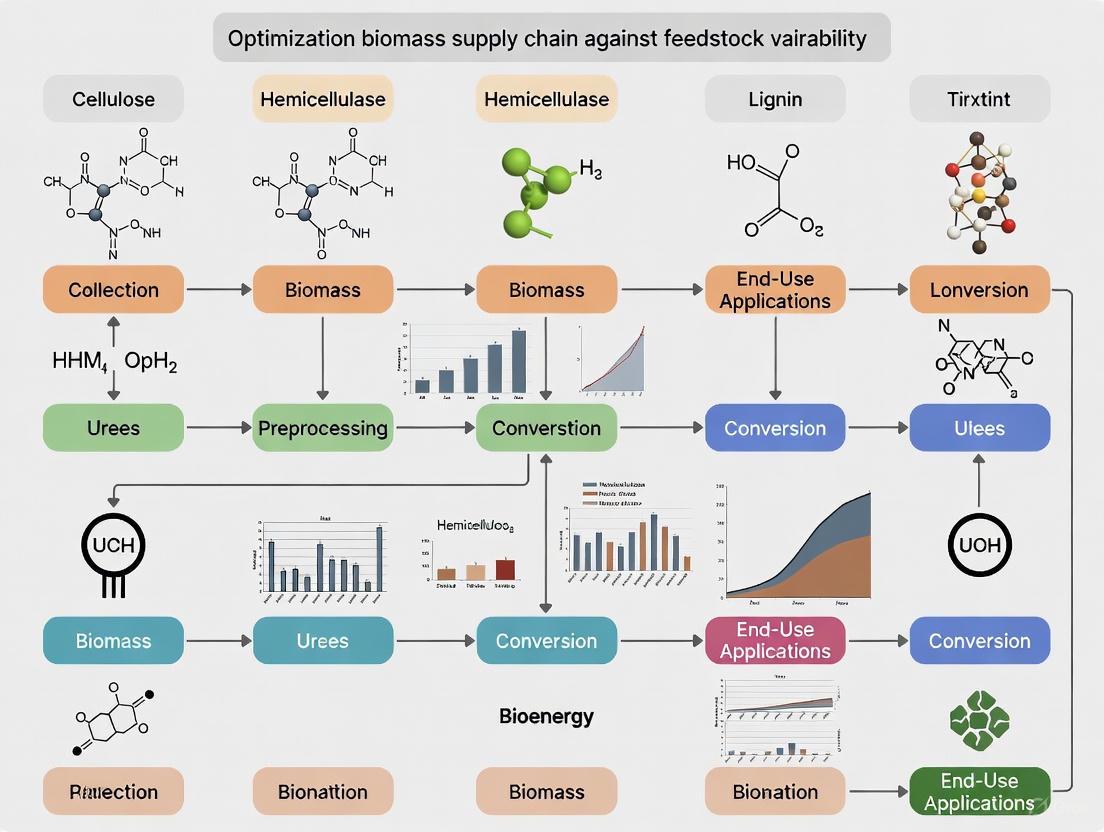
This article provides a comprehensive analysis of strategies to optimize biomass supply chains (BMSCs) against the critical challenge of feedstock variability.
Optimizing Biomass Supply Chains: Advanced Strategies to Overcome Feedstock Variability for Renewable Energy and Bio-Based Products
Abstract
This article provides a comprehensive analysis of strategies to optimize biomass supply chains (BMSCs) against the critical challenge of feedstock variability. Tailored for researchers and professionals in bioenergy and sustainable chemistry, it explores the foundational impact of spatial and temporal fluctuations in biomass yield and quality on production costs and output consistency. The content delves into advanced methodological approaches, including Mixed Integer Linear Programming (MILP) and hybrid AI models, for network design and strategic planning. It further offers practical troubleshooting and optimization techniques, such as flexible preprocessing depot networks and process intensification, and validates these solutions through comparative analysis of algorithms and real-world case studies, establishing a robust framework for building resilient and cost-effective biomass supply systems.
Understanding Feedstock Variability: The Core Challenge in Biomass Supply Chains
Frequently Asked Questions (FAQs)
FAQ 1: What are the primary sources of biomass feedstock variability? Biomass variability stems from multiple sources, which can be categorized as follows [1]:
- Source and Type: Innate differences exist between feedstock types (e.g., woody vs. herbaceous). For instance, ash content can increase by an order of magnitude from woody (~0.5%) to herbaceous (~5%) feedstocks, while lignin content drops by about half [1].
- Environmental Factors: Weather conditions, soil chemistry, and drought stress significantly impact yield and composition. For example, water stress can reduce crop yields by up to 48% and alter structural carbohydrate content [2] [3].
- Agricultural Practices: Harvest timing, method (e.g., single-pass vs. multi-pass), and storage conditions introduce variability. Multi-pass harvesting, for instance, increases ash contamination from soil compared to single-pass methods [4].
- Anatomical Fractions: Different parts of the same plant (e.g., leaves, stalks, cobs) have distinct physical and chemical properties, leading to variability when fractions are mixed [1].
FAQ 2: How does feedstock variability impact different bio-conversion processes? The impact of variability is highly dependent on the conversion pathway, as each process is sensitive to different biomass properties [5] [1].
Table 1: Impact of Feedstock Variability on Conversion Processes
| Conversion Process | Key Sensitive Parameters | Primary Impacts |
|---|---|---|
| Fermentation (Biochemical) | Structural carbohydrate (glucan, xylan) content; presence of inhibitors (e.g., lignin degradation products) [5] [1]. | Directly affects theoretical sugar and ethanol yield; inhibitors can deactivate enzymes or microbes [2] [1]. |
| Pyrolysis (Thermochemical) | Ash content (especially alkali metals), lignin content [5] [1]. | High ash reduces bio-oil yield and quality; can cause reactor fouling and catalyst poisoning [4] [1]. Lignin increases oil yield [1]. |
| Hydrothermal Liquefaction (HTL) | Ash content, moisture content, protein and lipid content [5]. | Ash and specific inorganics can affect biocrude yield and quality [5]. |
| Direct Combustion | Moisture content, ash content and composition (slagging elements like K, Cl) [1]. | Reduces combustion efficiency; increases slagging, fouling, and equipment corrosion [5] [6]. |
FAQ 3: What strategies can mitigate the risks associated with feedstock variability in the supply chain? Several strategic and technological approaches can be employed to manage variability [2] [4] [7]:
- Advanced Supply Chain Design: Implementing a network of distributed biomass preprocessing depots and centralized terminals. This system allows for blending different feedstocks to achieve a more consistent quality, emulating the grain commodity system [4].
- Selective Harvesting and Fractionation: Separating anatomical fractions (e.g., cob from leaf) during or after harvest to isolate high-ash components and create more homogeneous feedstock streams [3].
- Real-Time Monitoring and Machine Learning: Using near-infrared (NIR) spectroscopy for rapid quality assessment and machine learning models to predict supply, optimize logistics, and control conversion processes based on feedstock characteristics [7] [6].
- Incorporating Temporal Data in Planning: Using multi-year historical data on drought indices and yield during supply chain optimization to make biorefinery location and logistics decisions more resilient to climate variability [2].
Troubleshooting Guides
Problem: Inconsistent Conversion Yields in Biochemical Processing
Potential Cause 1: High Variability in Structural Carbohydrate Content Fluctuations in cellulose and hemicellulose content directly affect the maximum theoretical sugar yield.
- Diagnosis: Conduct detailed compositional analysis (e.g., using NREL/TP-510-42618 standard method) on incoming feedstock batches over time. A standard deviation of more than 2-3% (absolute) in glucan content is a strong indicator of problematic variability [2] [5].
- Solution:
- Implement Feedstock Blending: Mix high-carbohydrate and low-carbohydrate batches to achieve a more consistent average composition [4].
- Adjust Pre-treatment Severity: Use a real-time monitoring loop where compositional data informs pre-treatment conditions (e.g., temperature, acid concentration) to optimize sugar release for each batch [5].
Potential Cause 2: High Ash Content, Particularly Soil-Derived Inorganics Ash, especially silica and alkali metals, introduces introduced contaminants that can abrade equipment, inhibit enzymes, and increase waste [5] [3].
- Diagnosis: Measure ash content (via standard ASTM E1755) and perform X-ray fluorescence (XRF) to determine silica (SiO₂) levels. Ash content >5% and significant silica indicate high soil contamination [1].
- Solution:
Problem: Handling and Flowability Issues in Pre-processing Equipment
Potential Cause: High Biomass Cohesion Leading to Hopper Bridging and Clogging High ash content and moisture have been shown to increase the cohesive strength of biomass particles, making it difficult to handle [3].
- Diagnosis: Monitor equipment for frequent clogging, especially in hoppers and conveyors. Measure the bulk density and ash content of the material causing the issue.
- Solution:
- Control Moisture: Ensure biomass is dried to a consistent moisture level (e.g., below 15%) to reduce cohesion [1].
- Reduce Ash: As above, implement cleaning and fractionation to lower overall ash content [3].
- Equipment Modification: Install mechanical agitators or vibrators in hoppers to disrupt bridges and ensure continuous flow.
Experimental Protocol: Assessing Spatial and Temporal Variability
This protocol outlines a methodology to quantify spatial (location-to-location) and temporal (year-to-year) variability in biomass yield and quality, crucial for robust supply chain planning [2].
1. Objective: To characterize the spatial and temporal variability of biomass yield and key quality attributes (e.g., carbohydrate and ash content) over a multi-year period within a target supply region.
2. Materials and Equipment
- Biomass Samples: Representative samples (e.g., corn stover, switchgrass) collected from pre-defined counties or fields over multiple harvest seasons.
- Geospatial Data: U.S. Drought Monitor data or similar drought indices (e.g., DSCI - Drought Severity and Coverage Index) for the supply region [2].
- Lab Equipment:
- Forced-air oven and balance for moisture content (ASTM E871-82).
- Analytical balance and muffle furnace for ash content (ASTM E1755-01).
- Fiber Analyzer (e.g., ANKOM2000) or HPLC system for structural carbohydrate analysis (NREL/TP-510-42618).
3. Step-by-Step Procedure
Step 1: Experimental Design and Data Collection
- Define Supply Region: Select a target supply region (e.g., 100 counties in Kansas, Nebraska, and Colorado as in a cited study [2]).
- Collect Temporal Climate Data: Obtain historical (e.g., 10-year) drought index (DSCI) data for the growing season in each county from the U.S. Drought Monitor [2].
- Sample Collection: Annually collect biomass samples from fixed locations within the region. Record the precise location, harvest date, and harvest method.
Step 2: Sample Preparation and Analysis
- Prepare biomass samples by drying and milling to a consistent particle size (e.g., 2mm).
- Analyze each sample for:
- Moisture Content: Dry a sub-sample at 105°C until constant weight.
- Compositional Analysis: Determine the percentage of glucan, xylan, and acid-insoluble lignin using standard laboratory procedures (e.g., NREL/TP-510-42618) [5].
- Ash Content: Incinerate a sub-sample at 575°C and weigh the residual ash [1].
Step 3: Data Analysis and Modeling
- Statistical Analysis: For each year and location, calculate the average, standard deviation, and range for yield, carbohydrate content, and ash content.
- Correlation with Climate Data: Perform regression analysis to correlate biomass yield and quality parameters (e.g., carbohydrate content) with the drought index (DSCI) data [2].
- Supply Chain Modeling: Input the multi-year variability data into a biofuel supply chain optimization model to assess the impact on long-term feedstock cost and biorefinery viability [2].
The Researcher's Toolkit: Key Reagents & Materials
Table 2: Essential Research Reagents and Materials for Feedstock Variability Analysis
| Item Name | Function / Application | Technical Notes |
|---|---|---|
| Standard Reference Biomaterials | Calibrate analytical equipment (e.g., NIR spectrometers); serve as controls in compositional analysis. | Ensure they cover a range of relevant compositions (e.g., low/high ash, lignin) [1]. |
| NIR Spectrometer & Calibrations | Rapid, non-destructive prediction of biomass composition (moisture, ash, carbohydrates). | Must be calibrated against primary wet chemistry methods for accurate results [6]. |
| Laboratory Reactors (e.g., Parr) | Simulate pre-treatment and conversion processes (pyrolysis, HTL) at bench scale to test feedstock performance. | Allow for precise control of temperature, pressure, and atmosphere [5]. |
| U.S. Drought Monitor Data (DSCI) | Quantitative spatial-temporal data on drought severity for correlation with yield and quality studies. | A key external dataset for understanding environmental drivers of variability [2]. |
| Analytical Standards for HPLC | Quantify sugar monomers (glucose, xylose) and degradation products (e.g., furfural, HMF) after hydrolysis. | Essential for accurate compositional analysis and inhibitor detection [5] [1]. |
Visualizing the Supply Chain Optimization Framework
The following diagram illustrates an integrated framework for optimizing the biomass supply chain against feedstock variability, incorporating key mitigation strategies.
The Impact of Spatial and Temporal Factors on Biomass Availability
Frequently Asked Questions (FAQs)
How do spatial factors influence biomass availability for my research? Biomass yield and chemical composition are not uniform across a supply region. Spatial variability is influenced by local factors such as soil characteristics, landscape topography, and historical field management practices [2]. This means that biomass sourced from different geographic locations, even within the same general area, can have significantly different quantities and qualities, directly impacting the reproducibility and scalability of your experiments [2].
Why is temporal variability a critical consideration in biomass supply chain planning? Temporal variability refers to changes in biomass yield and quality over time, primarily driven by inter-annual weather patterns and the increasing frequency of extreme events like drought [2]. For instance, a nationwide drought in 2012 caused a 27% yield reduction for corn grain and significantly altered biomass carbohydrate content [2]. Ignoring this multi-year variability can lead to a significant underestimation of long-term biomass supply costs and disrupt steady biorefinery operations [2].
What is the primary climatic factor affecting biomass yield and quality? Drought is a primary factor. Water stress caused by low precipitation can reduce crop yields by up to 48% and shorten crop life cycles [2]. Furthermore, drought stress alters the plant's chemical composition, often leading to lower levels of structural sugars like glucan and xylan, which are critical for biofuel conversion processes [2].
My experiments are sensitive to feedstock quality. How variable can biomass quality be? Variability can be substantial. Studies on corn stover have shown that carbohydrate content can fluctuate significantly from year to year, closely aligning with drought indices [2]. Lower carbohydrate content and higher ash content negatively impact theoretical ethanol yield and increase operational costs by causing downtime and equipment wear during pre-processing [2].
What strategies can I use to mitigate supply risks related to this variability? Advanced supply chain systems, such as using distributed biomass processing depots instead of a single centralized facility, can reduce operational risk by 17.5% [2]. Optimizing the supply chain design by incorporating long-term spatial and temporal data on yield and quality makes the system more resilient to disruptions caused by climatic conditions [2].
Troubleshooting Guides
Problem 1: Inconsistent Experimental Results Due to Variable Biomass Feedstock
- Symptoms: High fluctuation in conversion process yields (e.g., ethanol production); unpredictable levels of inhibitors or ash affecting catalyst performance; difficulty replicating experiments over time.
- Underlying Cause: The biomass feedstock used in experiments has high spatial and temporal variability in its chemical composition (e.g., carbohydrate and lignin content) and physical properties [2].
- Solution:
- Characterize Feedstock Thoroughly: For every batch of biomass received, perform standard proximate and ultimate analysis (e.g., cellulose, hemicellulose, lignin, and ash content) before initiating experiments [2].
- Implement Blending Strategies: Source biomass from multiple, distinct geographic locations within your supply shed and create blended feedstock batches. This can help average out spatial variability and create a more consistent material [2].
- Adopt Dynamic Experimental Protocols: Develop flexible experimental protocols that can account for a range of biomass qualities, rather than being fixed to a single feedstock specification.
Problem 2: Biomass Supply Shortfall for Pilot-Scale Research
- Symptoms: Inability to secure sufficient biomass to run continuous experiments; supply interruptions.
- Underlying Cause: Unanticipated yield losses due to temporal factors, most notably extreme weather events like drought, which can reduce biomass availability [2].
- Solution:
- Incorporate Temporal Risk Analysis: During project planning, analyze historical drought index data (e.g., from the U.S. Drought Monitor) and biomass yield data for your supply region over at least a 10-year period to understand worst-case scenarios [2].
- Diversify Supply Shed: Establish contracts with suppliers across a wider geographic area to minimize the risk that a localized drought affects your entire supply [2].
- Consider Buffer Stock: Maintain a strategic reserve of biomass to buffer against short-term supply disruptions.
Summarized Quantitative Data
Table 1: Impact of Drought Stress on Biomass Yield and Composition
| Biomass Type | Maximum Yield Reduction | Carbohydrate Change | Key Study Findings |
|---|---|---|---|
| Corn Grain | 27% [2] | Not Specified | $30 billion in losses during 2012 U.S. drought [2]. |
| General Crops (Meta-analysis) | Up to 48% [2] | Starch reduced by up to 60% [2] | Harvest index reduced by 28%; life cycles shortened [2]. |
| Miscanthus, Switchgrass, Corn Stover | Significant losses [2] | Lower structural sugars (glucan, xylan) [2] | Increased extractive components and soluble sugars; potential for lower recalcitrance [2]. |
Table 2: Economic and Operational Impact of Biomass Variability
| Factor | Impact | Management Strategy |
|---|---|---|
| Ignoring Spatio-temporal Variability | Significantly underestimates long-term delivery cost [2]. | Use multi-year optimization modeling for supply chain planning [2]. |
| Low Biomass Quality | Increases operational cost, causes downtime, equipment wear, and decreases conversion yield [2]. | Incorporate quality parameters into supply chain optimization [2]. |
| Supply Chain Configuration | Switching to a distributed supply system can reduce operational risk by 17.5% [2]. | Evaluate centralized vs. distributed depot models [2]. |
Experimental Protocols
Protocol 1: Assessing Spatial and Temporal Variability in Biomass Supply Sheds
Objective: To quantify the spatial and temporal variability in biomass yield and quality within a defined geographic region to inform stable supply chain design [2] [8].
Methodology:
- Define the Supply Region: Delineate the geographic boundary of your biomass supply shed (e.g., a 100-mile radius around a potential research facility).
- Data Collection:
- Yield Data: Collect historical data on biomass yield (e.g., corn stover) at a county or finer spatial resolution for a minimum of 10 years from agricultural statistical yearbooks or satellite-derived datasets [2] [8].
- Climate Data: Obtain corresponding historical data for key climatic variables, with a focus on drought indices like the Drought Severity and Coverage Index (DSCI) during the growing season [2].
- Quality Data: Where available, gather data on biomass chemical composition (e.g., carbohydrate, ash content) linked to the same spatial and temporal scales [2].
- GIS Integration and Analysis: Use a Geographic Information System (GIS) platform to integrate the statistical data with spatial layers (e.g., land cover, soil type) [8]. Models like Net Primary Productivity (NPP) from satellite data can be used to disaggregate and optimize the spatial distribution of biomass potential [8].
- Statistical Modeling: Apply time-series analysis (e.g., ARIMA models) to understand trends and predict future biomass availability [8]. Use correlation analysis (e.g., Gray Correlation Analysis) to assess the influence of various drivers like drought on yield and quality [8].
Protocol 2: Incorporating Variability into Supply Chain Optimization Models
Objective: To develop a resilient biomass supply chain strategy that accounts for fluctuations in feedstock availability and quality.
Methodology:
- Model Framework: Develop a multi-period or multi-stage stochastic optimization model. The model's objective is typically to minimize total supply chain cost while meeting biomass demand [2].
- Incorporate Stochastic Parameters: Model key uncertain parameters—such as biomass yield, quality (carbohydrate content), and drought index—as random variables with probability distributions derived from the historical data collected in Protocol 1 [2].
- Scenario Generation: Use methods like Monte Carlo simulation to generate a large number of possible future scenarios representing different combinations of yield and quality outcomes [2].
- Optimization and Decision-Making: Solve the optimization model to determine the optimal supply chain configuration (e.g., biorefinery location, storage depot locations, logistics) that performs robustly across the range of generated scenarios [2].
Biomass Variability Analysis Workflow
The Scientist's Toolkit: Essential Research Reagent Solutions
Table 3: Key Materials and Tools for Biomass Supply Chain Research
| Item | Function in Research |
|---|---|
| Geographic Information System (GIS) | A spatial analysis platform used to map, analyze, and model the geographic distribution of biomass resources, incorporating layers like yield data, land cover, and transportation networks [8]. |
| U.S. Drought Monitor (DSCI Data) | Provides standardized weekly drought index data at the county level, which is a primary input for correlating and predicting temporal variability in biomass yield and quality [2]. |
| Statistical Software (R, Python) | Used for performing time-series analysis (ARIMA), stochastic optimization scenario generation (Monte Carlo simulation), and correlation analysis (Gray Correlation) on biomass data [2]. |
| Stochastic Optimization Model | A computational model that incorporates uncertainty (e.g., in yield) to design supply chains that are resilient to spatial and temporal variability, minimizing cost and risk [2]. |
| Standard Biomass Analytical Methods | Laboratory protocols (e.g., NREL methods) for determining the chemical composition of biomass (carbohydrates, lignin, ash) to quantify quality variability and its impact on conversion processes [2]. |
Frequently Asked Questions: Biomass Supply Chain Resilience
What are the primary climate-related hazards threatening biomass supply chains? Climate change introduces multiple hazards, including increased mean temperatures, changes in precipitation patterns, heightened climate variability, and more frequent extreme weather events like floods, droughts, and storms [9]. These hazards can impact every stage of the supply chain, from feedstock production to transportation and storage, primarily by disrupting supply, damaging infrastructure, and reducing labor productivity [9].
Which biomass feedstock attributes are most critical for economic viability under climate uncertainty? Moisture content and spatial fragmentation are two dominant attributes. High moisture content significantly increases transportation costs and can reduce feedstock stability during storage, especially under hotter and more humid conditions [10]. Spatial fragmentation, where biomass resources are dispersed across a landscape, increases collection and transportation distances, complicating logistics and raising costs, particularly after disruptive events like wildfires which can further fragment resources [10] [11].
What strategies can enhance the resilience of biomass supply chains to disruptions? Implementing a combination of proactive (pre-disruption) and reactive (post-disruption) strategies is key. Effective proactive strategies include:
- Multi-sourcing: Sourcing feedstock from multiple, geographically dispersed suppliers to avoid a single point of failure [12].
- Coverage distance policies: Pre-defining maximum distances between facilities and suppliers to ensure a distributed and robust network [12].
- Backup facility assignment: Identifying and contracting backup processing facilities that can be activated if a primary facility is disrupted [12].
How does climate change impact the logistical phase of the biomass supply chain? Higher temperatures and increased humidity can accelerate the degradation of biomass during storage, leading to dry matter losses and reduced quality [9]. Extreme weather events can damage transportation infrastructure (e.g., roads, bridges) and directly disrupt transport operations, while also creating less predictable trade patterns that strain logistics systems [9] [12]. Heat stress can also affect the health and productivity of labor involved in transportation and handling [9].
Troubleshooting Guides for Common Scenarios
Scenario 1: Managing Feedstock Supply Disruptions from Wildfires
Problem: A major wildfire has impacted a key sourcing region, causing partial and complete disruptions in feedstock availability from multiple suppliers.
Experimental Protocol for Assessment & Mitigation:
Rapid Geospatial Impact Assessment:
- Objective: To quantify the available biomass in unaffected areas and identify new potential sourcing zones.
- Methodology: Utilize GIS software and satellite imagery (e.g., Landsat, Sentinel) to map the burn severity and extent. Overlay this with data on pre-fire biomass resource density and land ownership. Calculate the remaining accessible biomass volume in the region.
- Data Required: Burn severity indices (e.g., dNBR), pre-fire forest inventory data, land cover maps, road network data.
Supply Chain Model Re-optimization:
- Objective: To re-configure the supply network to meet biorefinery demand at the lowest possible cost post-disruption.
- Methodology: Input the new supply constraints and available backup suppliers into a Mixed-Integer Linear Programming (MILP) model of your supply chain. The model should re-optimize for total cost, determining the optimal quantities to transport from each remaining and backup supplier to the facility.
- Key Variables: Feedstock availability per supplier, transportation costs, facility demand, and capacity constraints.
Implementation of Resilience Strategies:
- Action: Activate backup suppliers and adjust transportation logistics as per the optimized model.
- Action: If not already in place, begin negotiating multi-sourcing agreements with suppliers in diverse geographic regions to mitigate the impact of future, localized disasters [12].
Scenario 2: High Moisture Content in Feedstock Leading to Cost Overtuns
Problem: Received biomass batches have consistently higher-than-specified moisture content, leading to increased transportation costs per unit of dry mass, potential spoilage during storage, and reduced conversion efficiency.
Experimental Protocol for Analysis & Correction:
Feedstock Attribute Analysis:
- Objective: To quantitatively determine the cost impact of high moisture content.
- Methodology: Weigh a representative sample of incoming feedstock upon delivery. Dry the sample in a calibrated oven at 105°C until a constant weight is achieved. Calculate the moisture content as (wet weight - dry weight) / wet weight * 100.
- Data Analysis: Re-calculate the effective cost per dry ton of feedstock, factoring in the paid price (based on wet weight) and the actual dry mass received. Model how this attribute affects the overall biofuel production cost, as high moisture is a dominant cost driver [10].
Logistics System Troubleshooting:
- Checkpoint: Review harvesting and collection timing. Is biomass being collected during or immediately after rainfall?
- Checkpoint: Assess on-site storage conditions. Is feedstock properly covered and ventilated to allow for passive drying?
- Checkpoint: Evaluate preprocessing options. Investigate the economic feasibility of deploying mobile pelletization or torrefaction units near the source to reduce moisture and densify the feedstock before long-haul transport [13].
The following workflow outlines the core experimental and decision-making process for managing these climate-related risks in a biomass supply chain.
Scenario 3: Facility Disruption Due to Extreme Weather Event
Problem: A key biorefinery or storage depot is temporarily incapacitated due to a flood, disrupting the entire downstream supply chain.
Experimental Protocol for Continuity Management:
Business Impact Analysis:
- Objective: To determine the production shortfall and prioritize critical operations.
- Methodology: Immediately assess the facility's downtime estimate. Calculate the lost production volume per day. Identify and communicate with the most critical customers (e.g., those with fixed contracts).
Activation of Backup Protocols:
- Objective: To re-route feedstock and activate alternative processing capacity.
- Methodology: Execute the pre-established backup assignment plan [12]. Contact the designated backup facility and negotiate capacity sharing. Re-route inbound and outbound logistics to the backup facility. Use the supply chain optimization model to re-calculate optimal transportation routes under the new network configuration.
Table 1: Quantitative Impact of Key Biomass Feedstock Attributes on Biorefinery Economics
| Attribute | Impact on Optimal Biorefinery Scale | Impact on Biofuel Production Cost | Key Risk Factor |
|---|---|---|---|
| Moisture Content | Varies with cost structure; high moisture penalizes larger scales [10] | Dominant cost driver; significantly increases transport cost per dry ton [10] | Increased under higher humidity and precipitation variability [9] |
| Spatial Fragmentation | Limits cost-competitive scale due to increased logistics cost [10] | Increases pre-processing and transportation costs [10] | Exacerbated by disruptive events like wildfires [11] |
| Resource Yield Density | Higher density enables larger, more cost-effective scales [10] | Reduces unit cost of collection and transport [10] | Threatened by climate-induced reductions in agricultural yields [9] |
Table 2: Resilience Strategies for Biomass Supply Chain Disruptions
| Strategy Type | Specific Tactic | Function | Implementation Consideration |
|---|---|---|---|
| Proactive (Pre-disruption) | Multi-sourcing [12] | Reduces reliance on a single supply basin, mitigating localized disruption impact. | Requires developing relationships with multiple suppliers; may involve slightly higher base costs. |
| Proactive (Pre-disruption) | Coverage Distance Policy [12] | Limits maximum distance to suppliers, creating a denser, more robust network. | Helps manage transportation costs and ensures quicker response times during disruptions. |
| Proactive (Pre-disruption) | Backup Facility Assignment [12] | Pre-identifies alternative processing facilities. | Requires pre-negotiated agreements and data sharing to ensure operational compatibility. |
| Reactive (Post-disruption) | Post-disruption Re-optimization | Re-routes material flows and re-allocates resources after a disruption occurs. | Dependent on having real-time data and agile modeling capabilities. |
| Reactive (Post-disruption) | Salvage Harvesting | Recovers value from biomass in fire-affected areas, aiding restoration [11]. | Logistically complex; requires careful assessment of wood quality and safety protocols. |
The Scientist's Toolkit: Key Research Reagent Solutions
| Tool / Solution | Function in Biomass Supply Chain Research | Relevance to Climate Risk |
|---|---|---|
| GIS (Geographic Information Systems) | Mapping and analyzing spatial data on biomass availability, logistics routes, and climate hazard exposure (e.g., wildfire risk maps) [10] [11]. | Critical for assessing exposure of supply chain infrastructure to climate hazards and planning resilient siting. |
| Mixed-Integer Linear Programming (MILP) Models | Optimizing the design and operation of the supply chain network for cost, efficiency, and resilience under uncertainty [12]. | Allows for scenario analysis to test how supply chains perform under various climate disruption scenarios. |
| Life Cycle Assessment (LCA) Software | Quantifying the environmental footprint of biofuel production, including greenhouse gas emissions [10]. | Essential for ensuring that resilience strategies do not inadvertently increase the carbon footprint of the final biofuel product. |
| Remote Sensing Data (Satellite Imagery) | Monitoring crop health, estimating yields, and assessing near-real-time impacts of extreme weather (e.g., drought, fire) on feedstock supply [11]. | Provides rapid, large-scale data for post-disruption impact assessment and feedstock availability forecasting. |
| Scenario Planning Frameworks | Developing and evaluating strategies against a wide range of possible climate futures, including low-probability, high-impact events [9]. | Helps build supply chains that are robust across different climate projections, not just a single forecast. |
Troubleshooting Guides & FAQs
Feedstock Quality and Preprocessing
Q: Our biorefinery is experiencing inconsistent sugar yields despite using the same pretreatment protocol. What could be causing this, and how can we mitigate it?
A: Inconsistent sugar yields are frequently a direct result of unmanaged feedstock variability. Key material attributes such as moisture content, ash content, and structural carbohydrate composition can vary significantly between and within biomass batches, directly impacting enzymatic hydrolysis efficiency [14] [2].
- Diagnosis & Solution:
- Analyze Feedstock Composition: Implement rapid analytical techniques (e.g., NIR spectroscopy) to monitor incoming biomass for key variability drivers like carbohydrate and ash content [15] [2].
- Adjust Preprocessing: For high ash content, consider employing air classification [15]. For high moisture content, assess the cost-benefit of additional drying steps, as moisture is a major logistics cost driver [10].
- Adapt Pretreatment Severity: For feedstocks with high innate recalcitrance, consider increasing pretreatment severity. Studies on Deacetylation and Mechanical Refining (DMR) have shown that higher deacetylation severity can mitigate the negative impacts of feedstock variability on sugar yields [14].
Q: What is the single most significant feedstock attribute impacting production costs, and how can it be managed?
A: Quantitative analyses identify moisture content as a dominant cost driver, significantly impacting transportation expenses and feedstock cost competitiveness. Furthermore, spatial fragmentation of biomass resources increases logistics costs and sourcing distances [10].
- Diagnosis & Solution:
- Implement Moisture Control: Establish moisture specifications for incoming biomass and invest in covered storage or pre-drying protocols at collection points to reduce weight and transportation costs [10].
- Optimize Sourcing Strategy: Use geospatial modeling to account for biomass resource density. Sourcing from areas with higher yield density can dramatically reduce logistics costs compared to fragmented agricultural landscapes [10].
Supply Chain and Operational Planning
Q: How does year-to-year variability in biomass yield affect our biorefinery's economic viability, and how can we design a more resilient supply chain?
A: Annual fluctuations in biomass production, often driven by drought and other climatic factors, pose a significant risk. When supply is insufficient, biofuel production decreases while fixed operating costs remain, leading to higher per-unit costs. Excess supply results in added storage costs [16] [2].
- Diagnosis & Solution:
- Model Temporal Variability: Incorporate multi-year historical data on drought indices and biomass yields into supply chain planning rather than relying on single-year averages. This prevents underestimating long-term delivery costs [2].
- Develop Flexible Sourcing: Consider a multi-feedstock strategy that blends different biomass types (e.g., corn stover with sorghum or switchgrass). This diversifies supply risk across crops with different harvest windows and environmental resilience [14] [2].
- Utilize Intermediate Depots: Investigate a distributed supply system with preprocessing depots that can densify biomass (e.g., into pellets) for more economical long-distance transport and as a buffer against supply shocks [16].
Q: We are facing frequent equipment wear and unplanned downtime. Could feedstock variability be a contributing factor?
A: Yes. Variability in biomass physical properties, such as increased abrasive inorganic (ash) content, is a primary cause of equipment wear in handling and preprocessing machinery like grinders and conveyors [15] [17].
- Diagnosis & Solution:
Process Scale-Up and Control
Q: What are the critical challenges when scaling up a biorefinery process from pilot to demonstration scale?
A: Scaling up introduces complex interdependencies. Key challenges include managing feedstock variability at a larger volume, selecting appropriately scaled equipment, overcoming changes in reaction kinetics and heat/mass transfer due to different volume-to-surface ratios, and ensuring process robustness and control [18].
- Diagnosis & Solution:
- Pilot Plant Testing: Utilize demo-scale facilities (e.g., Borregaard's Biorefinery Demo plant, Bio Base Europe Pilot Plant) to test your process with variable, real-world feedstocks [18].
- Process Optimization: Employ statistical methods like Response Surface Methodology (RSM) to identify the optimal combination of process variables (e.g., temperature, pH, chemical loadings) for consistent performance at larger scales [18].
- Develop Advanced Control Strategies: Implement a control strategy that includes both in-line process control and off-line analysis to maintain product quality despite feedstock variations [18].
The following tables consolidate key quantitative findings on the impacts of feedstock variability.
Table 1: Impact of Biomass Attributes on Production Cost and Optimal Scale [10]
| Biomass Attribute | Impact on Production Cost | Impact on Optimal Biorefinery Scale |
|---|---|---|
| Moisture Content | Dominant cost driver; increases transportation expenses. | Significantly influences unique optimal scale for each feedstock. |
| Spatial Fragmentation | Increases logistics costs and sourcing distances. | Limits resource consolidation, constraining maximum viable scale. |
| Resource Yield Density | Higher density reduces cost per ton and improves competitiveness. | Enables larger, more cost-effective industrial-scale operations. |
Table 2: Sugar Yield and Production Cost from Different Feedstocks and Pretreatments [14]
| Feedstock | Pretreatment Method | Glucose Yield (%) | Sugar Production Cost ($/lb) |
|---|---|---|---|
| Single-Pass Corn Stover (SPCS) | DDA | 91.0 | 0.2286 |
| Single-Pass Corn Stover (SPCS) | DMR | 95.3 | 0.2490 |
| Multi-Pass Corn Stover (MPCS) | DDA | Lower than SPCS | Higher than SPCS |
| Sorghum (SG) | DDA | Lower than SPCS | Higher than SPCS |
| Switchgrass (SW) | DDA | Lower than SPCS | Higher than SPCS |
| Feedstock Blends | DDA & DMR | ~Weighted average of constituents | ~Weighted average of constituents |
Table 3: Economic and Environmental Impact Range for a Pyrolysis Biorefinery [19]
| Metric | Range |
|---|---|
| Minimum Sugar Selling Price (MSSP) | $66 - $280 per Metric Ton |
| Net Greenhouse Gas (GHG) Emissions | -0.56 to -0.74 kg CO₂e per kg biomass processed |
Detailed Experimental Protocols
Protocol 1: Evaluating Feedstock Blends using Deacetylation and Dilute Acid (DDA) Pretreatment
Objective: To determine the interactive effects of blending different biomass species on sugar yield and production costs under standardized DDA pretreatment conditions [14].
Materials:
- Feedstocks: Single-pass corn stover (SPCS), multi-pass corn stover (MPCS), switchgrass (SW), sorghum (SG).
- Equipment: 90-L paddle reactor, knife mill, enzymatic hydrolysis reactors.
- Reagents: Sodium hydroxide (NaOH), dilute acid (e.g., H₂SO₄), commercial enzyme cocktails (e.g., Novozymes Cellic CTec3/HTec3).
Methodology:
- Feedstock Preparation: Size-reduce all feedstocks to pass a 19.1-mm screen using a knife mill.
- Blend Formulation: Create bi-blends (e.g., 60/40 MPCS/SPCS) and quad-blends (e.g., 25/35/35/5 MPCS/SPCS/SW/SG) based on dry weight.
- Deacetylation: Load 5 kg (dry weight) of biomass into the paddle reactor with 45 kg of NaOH solution. Perform at varying severities (e.g., 50, 100, 150 kg NaOH/ODMT) at 80°C for 2 hours.
- Dilute Acid Pretreatment: Transfer deacetylated solids to a pretreatment reactor and process with dilute acid at optimal conditions (e.g., 158°C, 5.2 min, 0.98% H₂SO₄).
- Enzymatic Hydrolysis: Perform hydrolysis on the pretreated slurry at 20% solids content with an enzyme loading of 12 mg total protein/g glucan (80:20 CTec3:HTec3) for 7 days.
- Analysis: Quantify monomeric sugar concentrations (glucose, xylose) via HPLC. Calculate percent theoretical yields.
Protocol 2: Techno-Economic Analysis (TEA) Incorporating Feedstock Variability
Objective: To quantify the impact of biomass attribute variability on biorefinery production costs and optimal scale using a bottom-up modeling framework [10] [19].
Materials:
- Data: GIS data on biomass spatial distribution and yield, feedstock compositional data, biorefinery process model, capital and operating cost data.
- Software: Process modeling software (e.g., Aspen Plus), statistical analysis software, machine learning libraries (e.g., for Generative Adversarial Networks).
Methodology:
- Feedstock Data Generation: Use machine learning models (e.g., Generative Adversarial Networks, Kernel Density Estimation) to generate a large, representative dataset of feedstock biochemical compositions (cellulose, hemicellulose, lignin) from a smaller empirical sample set [19].
- Process Simulation: For each feedstock composition in the dataset, run a process simulation (e.g., in Aspen Plus) to determine mass and energy balances, product yields, and utility demands [19].
- Cost Calculation: Calculate total production cost for each scenario, incorporating feedstock cost (including logistics based on spatial fragmentation and moisture), capital depreciation, operating costs, and conversion efficiency [10].
- Optimization & Sensitivity Analysis: Determine the biorefinery scale that minimizes the per-unit production cost for each feedstock type. Perform sensitivity analysis to identify the most influential cost drivers (e.g., moisture content, carbohydrate yield) [10].
Visualizations
Diagram 1: Feedstock Variability Impact on Biorefinery Viability
Title: Feedstock Variability Impact on Biorefinery Viability
Diagram 2: DDA vs DMR Experimental Workflow
Title: DDA vs DMR Experimental Workflow
The Scientist's Toolkit: Research Reagent Solutions
Table 4: Essential Reagents and Materials for Variability Research
| Reagent/Material | Function in Experimentation |
|---|---|
| Sodium Hydroxide (NaOH) | Primary reagent for deacetylation pretreatment; removes acetate and lignin to reduce recalcitrance [14]. |
| Dilute Sulfuric Acid (H₂SO₄) | Common catalyst for dilute acid pretreatment; hydrolyzes hemicellulose to soluble sugars [14]. |
| Commercial Enzyme Cocktails (e.g., Cellic CTec3/HTec3) | Complex mixtures of cellulases and hemicellulases for saccharification of pretreated biomass into fermentable sugars [14]. |
| Iron (II) Sulfate (FeSO₄) | A pretreatment additive in thermochemical pathways (e.g., pyrolysis) that can facilitate lignin depolymerization and increase sugar production [19]. |
| Lignocellulosic Biomass Blends | Custom-formulated mixtures of different feedstocks (e.g., corn stover, sorghum, switchgrass) used to study and mitigate supply and quality risks [14] [2]. |
The Critical Link Between Feedstock Quality and Final Product Output
Troubleshooting Common Feedstock Quality Issues
Q1: Why does my biomass feedstock cause inconsistent conversion yields and process inefficiencies?
A: Inconsistent conversion yields are frequently caused by natural variations in the biomass's chemical composition (carbohydrate, lignin, ash content) and physical properties (moisture content, particle size, density) [2]. These variations alter the reaction kinetics and mass transfer during conversion.
- Carbohydrate Variability: Fluctuations in cellulose and hemicellulose content directly impact the theoretical maximum yield of biofuels like ethanol [2]. Research on corn stover shows carbohydrate content can vary significantly year-to-year, closely linked to drought conditions [2].
- Ash Content: High ash levels, particularly in agricultural residues, can significantly increase operational costs, cause equipment wear, and reduce conversion efficiency [2].
- Moisture Content: Overly wet fuel requires more energy for drying, burns inefficiently, and reduces net energy output. Excessively dry fuel can cause temperature control issues [20].
Diagnostic Protocol: Implement a routine characterization protocol tracking these key parameters:
- Weekly sampling from incoming feedstock batches.
- Standardized laboratory analysis for structural carbohydrates and lignin (e.g., NREL/TP-510-42618).
- Rapid moisture and ash analysis using loss-on-ignition or similar methods.
Q2: What are the primary causes of biomass flow problems in handling systems, and how can I resolve them?
A: Flow obstructions like bridging, ratholing, and segregation are common in biomass due to its fibrous, irregular nature and interlocking particles [21]. These issues cause feed interruptions, leading to process instability and downtime.
Resolution Strategies:
- Material Characterization: Conduct shear cell tests to measure cohesive strength and wall friction against hopper materials. This data is essential for proper equipment design [21].
- Equipment Modifications: Install mass flow hoppers with steep, smooth walls and flow-promoting devices (e.g., vibrators, air blasters) to ensure uniform, first-in-first-out flow [21].
- Pre-processing Adjustments: Implement drying and size reduction (shredding, grinding) to achieve more uniform particle size distribution, which improves flowability [20] [21].
Q3: How does feedstock variability impact the economic viability of a biorefinery operation?
A: Feedstock variability directly impacts profitability through multiple channels [22]:
- Supply Chain Costs: Temporal and spatial variability in yield and quality increases transportation and preprocessing costs. Models show that ignoring this variability can lead to significant underestimation of true biomass delivery costs [2].
- Conversion Performance: Inconsistent biomass leads to suboptimal conversion conditions, reducing output and potentially increasing catalyst consumption or enzyme loading [23] [22].
- Operational Reliability: Unplanned downtime from feedstock handling problems or quality excursions increases maintenance costs and reduces plant availability [21].
Mitigation Approach: Develop a resilient supply chain strategy incorporating long-term (10+ years) spatial and temporal yield/quality data, considering climate variability and extreme weather events [2].
Biomass Feedstock Quality Parameters and Specifications
Table 1: Key Biomass Quality Parameters and Their Impact on Conversion Processes
| Parameter | Optimal Range/Desired Value | Impact of Deviation | Standard Test Method |
|---|---|---|---|
| Moisture Content | Typically 10-20% (w.b.) for thermal conversion [20] | High: Reduced net energy value, combustion issues [20]. Low: May cause overly rapid combustion [20]. | ASTM E871 / ASTM D4442 |
| Ash Content | <5% preferred; >10% can be problematic [2] | High: Slagging/fouling, equipment erosion, lower conversion yields, increased catalyst poisoning risk [2]. | ASTM E1755 |
| Carbohydrate (Glucan/Xylan) Content | Consistent levels are critical [2] | Low/Variable: Directly reduces theoretical biofuel yield, causes process instability [2]. | NREL/TP-510-42618 |
| Particle Size Distribution | Consistent and system-specific [20] | Too Large: Handling/feeding problems, incomplete conversion [20]. Too Small: Dust, flowability issues [21]. | ASTM E828 / ASTM E1109 |
Table 2: Common Biomass Feedstock Categories and Characteristic Challenges
| Feedstock Category | Common Examples | Characteristic Quality Challenges |
|---|---|---|
| Agricultural Residues | Corn stover, wheat straw, rice husks | High ash and silica content, seasonal availability, high spatial variability in yield and composition [22] [2]. |
| Energy Crops | Switchgrass, Miscanthus, fast-growing trees | Variable composition based on harvest time, drought stress can reduce yield and alter cell wall structure [2]. |
| Woody Biomass | Forest residues, sawmill waste | Variable moisture, bark content, potential for contaminants (soil, rocks), bridging in hoppers [23] [21]. |
| Organic Wastes | Municipal solid waste, food processing waste | Highly heterogeneous, high moisture, potential chemical contaminants, odor, and spoilage [24]. |
Experimental Protocols for Feedstock Quality Assessment
Protocol 1: Comprehensive Biomass Characterization for Conversion Suitability
Objective: To determine the proximate, ultimate, and compositional properties of a biomass feedstock sample for conversion process optimization.
Workflow:
Procedure:
- Representative Sampling: Collect biomass samples from multiple locations within a lot using a standardized sampling plan. For solid biofuels, follow ASTM E829.
- Sample Preparation: Air-dry samples to a stable moisture content. Mill using a knife mill and sieve to obtain a homogeneous sample with particle size <2mm.
- Moisture Content: Determine moisture content by drying in a forced-air oven at 105°C until constant mass (ASTM E871).
- Ash Content: Measure ash content by combusting a known mass of dried sample in a muffle furnace at 575°C±25°C until constant mass (ASTM E1755).
- Compositional Analysis: Quantify structural carbohydrates (glucan, xylan, arabinan), lignin, and ash using NREL's Laboratory Analytical Procedure (LAP) "Determination of Structural Carbohydrates and Lignin in Biomass" (NREL/TP-510-42618).
Protocol 2: Monitoring Temporal Variability in Biomass Quality
Objective: To track and document seasonal and year-to-year variations in biomass quality linked to environmental factors.
Workflow:
Procedure:
- Geospatial Planning: Establish fixed sampling points across the supply region, tagged with GPS coordinates.
- Temporal Sampling: Collect biomass samples at critical physiological stages (e.g., flowering, maturity) and post-harvest over multiple years.
- Environmental Data Collection: Obtain corresponding meteorological data (e.g., precipitation, temperature, drought indices like DSCI) for the growing season and locations [2].
- Statistical Analysis: Use multivariate analysis (e.g., PCA, regression modeling) to correlate environmental factors with key quality parameters (e.g., carbohydrate content, ash).
- Model Validation: Validate predictive models with new seasonal data to refine forecasting accuracy for supply chain planning.
The Scientist's Toolkit: Essential Research Reagents & Materials
Table 3: Key Reagents and Materials for Biomass Feedstock Quality Analysis
| Item Name | Function/Application | Technical Specification Notes |
|---|---|---|
| NREL LAP Standards | Reference procedures for compositional analysis | Provides standardized, validated methods for determining structural carbohydrates, lignin, and ash [2]. |
| Anhydrous Glucose & Xylose | HPLC calibration for sugar analysis | High-purity (>99%) standards essential for accurate quantification of hydrolysis products. |
| Sulfuric Acid (72% & 4% w/w) | Primary hydrolysis reagent in compositional analysis | High-purity grade required to minimize interference from contaminants. |
| Forced Draft Oven | Determination of moisture content and sample drying | Must maintain uniform temperature (±2°C) at 105°C per ASTM E871. |
| Muffle Furnace | Determination of ash content | Capable of maintaining 575°C±25°C with good temperature uniformity, per ASTM E1755. |
| Mechanical Sieve Shaker | Particle size distribution analysis | Equipped with a standard set of sieves for objective, reproducible size classification. |
| Drought Severity Index Data | Correlating environmental stress with biomass quality | Publicly available data (e.g., U.S. Drought Monitor) for understanding temporal variability [2]. |
Strategic Modeling and Analytical Approaches for Resilient Supply Chain Design
Frequently Asked Questions (FAQs)
1. Why is my large-scale Biomass Supply Chain (BSC) MILP model taking too long to solve? Solving large-scale MILP models for BSC optimization can be computationally challenging. Performance issues often arise from four main areas [25]:
- Poor Model Formulation: A "weak" formulation with a large gap between the MILP solution and its linear programming (LP) relaxation can cause the branch-and-bound algorithm to explore too many nodes.
- Numerical Instability: Problems with ill-conditioned data or large scaling differences between coefficients can slow down the linear programming (LP) solves at each node.
- Insufficient Cuts or Preprocessing: The solver may not be generating enough effective cutting planes to tighten the LP relaxations, or preprocessing may not be effectively reducing the problem size.
- Lack of Progress in Bounds: The solver might struggle to find good feasible solutions (improving the upper bound for minimization) or to prove optimality by raising the lower bound.
2. How can I model the impact of biomass quality variability (e.g., moisture, ash content) on my supply chain? Biomass quality attributes like moisture and ash content directly impact conversion yields, transportation costs, and pre-processing requirements [26]. To model this:
- Stochastic Programming: Develop a two-stage stochastic programming model where first-stage decisions are strategic (e.g., biorefinery locations), and second-stage decisions are tactical (e.g., transportation, quality control) based on random realizations of biomass quality [26].
- Quality-based Costing: Move beyond cost per dry ton to cost per unit of convertible carbohydrate, integrating quality-based penalties or incentives into the objective function [26].
- Yield Correlation: Incorporate data on how environmental factors like drought indices correlate with both biomass yield and key quality components like carbohydrate content [2].
3. What is the difference between MILP and MINLP in the context of BSC, and when should I use each? The choice depends on the nature of the relationships between variables in your supply chain model [27].
- MILP (Mixed-Integer Linear Programming): Used when all relationships are linear. It is suitable for problems like facility location, transportation routing, and capacity planning. Most BSC problems related to network design are formulated as MILPs [28] [29].
- MINLP (Mixed-Integer Nonlinear Programming): Necessary when the model contains nonlinear relationships. This is common when you are integrating the BSC network design with the optimization of conversion process variables (e.g., thermodynamic conditions in a Steam Rankine Cycle) or modeling nonlinear cost functions [27].
4. How can I make my BSC model more resilient to disruptions like wildfires or feedstock variability? A combined simulation-optimization framework is an effective approach to enhance resilience [28].
- Optimization for Planning: First, use an MILP model to generate an optimal resource allocation and logistics plan.
- Simulation for Testing: Then, use Discrete Event Simulation (DES) to test this plan against various disruptive scenarios (e.g., wildfires affecting supply nodes). This evaluates the plan's robustness using Key Performance Indicators (KPIs) [28].
- Replanning: Use the optimization model as a real-time replanning tool to generate new feasible plans when a disruption is detected or simulated [28].
Troubleshooting Guides
Guide 1: Improving MILP Performance for BSC Models
Slow MILP performance is often due to model formulation. Follow this workflow to identify and rectify common issues [25]:
Recommended Actions:
- If the lower bound is stagnant:
- Tighten "Big-M" Constraints: Use the smallest possible value for M in disjunctive constraints to make the LP relaxation tighter [25]. Use constraint-specific M values (M_i) instead of a single, large M [30].
- Add Tighter Formulations: Incorporate problem-specific valid inequalities or cutting planes. For instance, use the Dantzig-Fulkerson-Johnson formulation for routing subproblems instead of the weaker Miller-Tucker-Zemlin formulation [30].
- If the upper bound is stagnant:
- Employ Heuristics: Use solver-built-in heuristics (e.g., Feasibility Pump) or develop custom ones to find good-quality feasible solutions earlier in the process [25].
- If node throughput is slow:
- Improve Numerical Hygiene: Address ill-conditioning by scaling the coefficient matrix so that the non-zero coefficients are around 1. Avoid mixing very large and very small numbers in constraints [25].
Guide 2: Incorporating Biomass Quality Variability
Ignoring the spatial and temporal variability of biomass yield and quality can lead to underestimated costs and non-robust supply chain designs [2]. Follow this methodology to integrate these critical factors.
Experimental Protocol for Data Integration [26] [2]:
- Data Collection:
- Historical Yield Data: Gather at least 10 years of historical biomass yield data for your supply region.
- Quality Parameters: Collect data on key quality attributes (e.g., carbohydrate, moisture, and ash content) correlated with the yield data.
- Climate Indices: Obtain relevant climate data, such as the Drought Severity and Coverage Index (DSCI), which is a primary factor contributing to yield and quality variability [2].
- Scenario Generation:
- Use the multi-year data to generate a set of scenarios. Each scenario represents a possible realization of yield and quality across the supply region, capturing both spatial and temporal variability.
- Assign a probability to each scenario based on historical frequency.
- Model Formulation:
- Develop a two-stage stochastic programming model.
- First-Stage Variables: Decide on strategic, here-and-now decisions (e.g., biorefinery locations, technology selection, capacity) that are fixed across all scenarios [26].
- Second-Stage Variables: Model tactical, wait-and-see decisions (e.g., biomass sourcing, transportation, pre-processing intensity) that are adaptive to each specific yield/quality scenario [26].
- Objective Function: Minimize the total cost, which includes the first-stage investment cost and the expected second-stage operational cost over all scenarios.
Guide 3: Choosing Between MILP and MINLP for an Integrated BSC
The decision to use MILP or MINLP hinges on whether you are solely designing the supply chain or also optimizing the internal conversion process.
Decision Logic for Model Selection:
Key Considerations:
- Stick with MILP if: Your problem involves linear relationships for network design, transportation, and facility location. This includes most classic BSC optimization problems [29].
- Switch to MINLP if: You are integrating the supply chain with the optimization of the biomass conversion process itself. For example, if you are simultaneously optimizing the supply network and the operating conditions (e.g., temperature, pressure) of a Steam Rankine Cycle plant, the process model will introduce nonlinearities, necessitating an MINLP [27].
The Scientist's Toolkit: Research Reagent Solutions
This table details key computational and data resources essential for modeling and optimizing biomass supply chains.
| Item | Function in BSC Optimization |
|---|---|
| Commercial Solvers (CPLEX, Gurobi) | Software packages used to solve MILP models. They implement advanced versions of the branch-and-bound and branch-and-cut algorithms [25]. |
| L-Shaped Algorithm | A solution procedure for two-stage stochastic programs. It decomposes the large problem into a master problem (first-stage) and multiple subproblems (second-stage), solving them iteratively [26]. |
| Geographic Information System (GIS) | A tool for capturing and analyzing spatial data. It is critical for accurately modeling the geographical distribution of biomass, transportation routes, and potential facility locations [27]. |
| Discrete Event Simulation (DES) | A modeling technique for simulating the operation of a system as a discrete sequence of events in time. Used to test the robustness of an optimal BSC plan against disruptions like wildfires [28]. |
| Drought Severity and Coverage Index (DSCI) | A data metric that quantifies drought levels. It serves as a key input parameter for modeling the spatial and temporal variability of biomass yield and quality in a supply region [2]. |
Integrating Fixed and Portable Preprocessing Depots for Enhanced Flexibility and Cost Reduction
This technical support center provides targeted troubleshooting and methodological guidance for researchers designing and operating biomass supply chains (BMSCs) that integrate fixed and portable preprocessing depots. Framed within a broader thesis on optimizing biomass supply chains against feedstock variability, this resource addresses the key technical and logistical challenges identified in contemporary research. The following sections offer foundational concepts, detailed experimental protocols, and solutions to common operational problems to support scientists and engineers in developing more resilient and cost-effective bioenergy systems.
Conceptual Foundations and System Architecture
Core Definitions and Functions
- Fixed Depots (FDs): Permanent preprocessing facilities with consistent processing capabilities, benefiting from economies of scale and lower per-unit processing costs. They are optimally located in areas of high, consistent biomass density [31].
- Portable Depots (PDs): Mobile or temporarily sited preprocessing units that can be relocated to areas with seasonal or varying biomass availability. They provide remarkable flexibility and adaptability to preprocess biomass before delivery to energy conversion plants [31] [32].
- Preprocessing Function: Converts raw biomass (e.g., forest residues, agricultural waste) into higher-quality, more transportable intermediates like chips, pellets, briquettes, or bio-oil through operations like chipping, drying, torrefaction, or fast pyrolysis. This enhances biomass bulk density, energy density, and feedstock quality [31] [32].
System Workflow and Biomass Flow
The following diagram illustrates the typical biomass flow and decision points in a hybrid FD/PD network:
Biomass Preprocessing Workflow
Experimental Protocols and Methodologies
Protocol 1: Mixed-Integer Linear Programming (MILP) Model Formulation for Strategic Network Design
This methodology enables the optimal design of a BMSC that includes both FDs and PDs, serving as a decision support tool for both brownfield and greenfield projects in the renewable energy sector [31].
1. Objective Function Formulation:
- Primary Objective: Minimize total supply chain cost or maximize profit.
- Cost Components: The objective function must incorporate harvesting costs at watersheds (
H_it), transportation costs from supply locations to depots (C_ij) and from depots to plants (C_jk), fixed costs for establishing FDs (F_j) and PDs (G_m), and preprocessing costs at depots (P_jt) [31].
2. Decision Variable Definition:
- Binary variables for FD location selection (
y_j) and PD activation (z_mt). - Continuous variables for biomass flow from supply locations to depots (
x_ijt) and from depots to plants (x_jkt). - Continuous variables for inventory levels at depots (
I_jt) [31].
3. Constraint Specification:
- Biomass Availability: Total biomass shipped from a supply location
iin periodtmust not exceed available biomassA_it. - Demand Fulfillment: Total biomass shipped to a plant
kin periodtmust meet demandD_kt. - Capacity Limits: Flow through an FD
jmust not exceed capacityCAP_j; PDmin periodtmust not exceed capacityCAP_m. - Processing Balance: Biomass inflow to a depot equals outflow plus inventory change (considering conversion factor
α). - Logical Constraints: Biomass can only flow through opened FDs or activated PDs [31].
4. Model Implementation and Solving:
- Implement the MILP model in optimization software (e.g., GAMS, CPLEX, Python with Pyomo).
- Input parameter values derived from case study data (e.g., biomass availability, distances, cost factors).
- Solve using standard MILP solvers to obtain optimal network configuration and biomass flows [31].
Protocol 2: Matheuristic Approach for Dynamic Operational Planning (mFLP-dOA)
This protocol combines mathematical optimization with heuristic procedures to address large-scale, dynamic procurement problems under biomass variability, implementing flexibility strategies like dynamic network reconfiguration and operations postponement [33].
1. Problem Mapping and Model Formulation:
- Formulate as a mobile Facility Location Problem with dynamic Operations Assignment (mFLP-dOA).
- Define sets for supply nodes, potential temporary intermediate node locations, and time periods.
- Incorporate decisions on opening/closing temporary intermediate nodes and postponing chipping operations from supply to intermediate nodes [33].
2. Matheuristic Procedure Development:
- Decomposition: Break the complex MIP model into smaller, manageable subproblems.
- Fix-and-Optimize Algorithm: Iteratively fix a subset of integer variables (e.g., location decisions) and solve the resulting subproblem for continuous variables and remaining integers.
- Neighborhood Search: Define neighborhoods around current solutions to explore improved configurations [33].
3. Scenario Generation and Risk Modeling:
- Generate multiple instances reflecting different risk scenarios (e.g., seasonal operation bans, wildfire prevention policies, fluctuating biomass availability).
- Incorporate spatial and temporal uncertainty in raw material availability parameters [33].
4. Performance Evaluation:
- Apply the matheuristic to real-case instances (e.g., from Central Portugal).
- Benchmark against static solutions without flexibility strategies.
- Measure key performance indicators: total cost reduction, operational responsiveness, non-productive machine time, and computational time [33].
Quantitative Performance Data
Table 1: Comparative Performance of Flexible vs. Traditional Configurations
| Configuration / Metric | Traditional Fixed-Only | Hybrid FD/PD Network | Source |
|---|---|---|---|
| Total Cost Reduction | Baseline | Up to 17% reduction | [33] |
| Transportation Costs | Higher (concentrated flow) | Reduced via localized preprocessing | [31] [32] |
| Feedstock Aggregation | Limited by FD catchment | Maximizes aggregated volumes | [31] |
| Responsiveness to Variability | Low | High (dynamic reconfiguration) | [33] |
Table 2: Key Parameters for Biomass Preprocessing Depot Modeling
| Parameter Type | Description | Considerations for Modeling |
|---|---|---|
Biomass Availability (A_it) |
Quantity available at supply source i in period t |
Model seasonality, growth curves, and uncertainty [32] |
Conversion Factor (α) |
Mass output/mass input after preprocessing | Account for moisture loss and densification [31] |
FD Capacity (CAP_j) |
Maximum throughput of fixed depot j |
Strategic decision based on capital investment [31] |
PD Capacity (CAP_m) |
Maximum throughput of portable depot m |
Tactical decision for mobile units [31] [33] |
| Relocation Cost | Cost of moving a PD between sites | Minor share of total transport costs [32] |
The Scientist's Toolkit: Research Reagent Solutions
Table 3: Essential Materials and Computational Tools for BMSC Research
| Item / Resource | Type | Function / Application | Representative Examples / Notes |
|---|---|---|---|
| Mixed-Integer Linear Programming (MILP) Solver | Software | Core engine for solving optimization models for network design | GAMS, CPLEX, Gurobi, Python-Pyomo [31] [32] |
| Geographic Information System (GIS) | Software/Tool | Spatial analysis for resource assessment, facility siting, and route planning | ArcGIS, QGIS; used for mapping biomass availability and transport routes [34] [32] |
| Machine Learning (ML) Libraries | Software/Library | Forecasting biomass supply/demand, optimizing real-time operations | Random Forest, Neural Networks (e.g., via Python Scikit-learn, TensorFlow) [7] |
| Fast Pyrolysis Unit (Mobile/Fixed) | Physical Technology | Converts biomass to denser bio-oil for easier transport and storage | Key portable preprocessing technology; produces bio-oil, biochar, syngas [32] |
| Mobile Chipper/Densifier | Physical Technology | Portable preprocessing to increase biomass density at forest landing sites | Redizes transportation costs; used in forest biomass procurement [33] |
| Forest Residues | Biomass Feedstock | Representative feedstock for supply chain modeling | Low bulk density, high moisture content [31] [33] |
| Miscanthus | Biomass Feedstock | Representative dedicated energy crop for supply chain modeling | Modeled on marginal lands; has specific growth/yield profile [32] |
Troubleshooting Guide: Frequently Asked Questions
FAQ 1: Under what conditions is a hybrid FD/PD network superior to a fixed-only network? A hybrid configuration demonstrates superior performance, with cost reductions up to 17% [33], under these specific conditions:
- High Biomass Spatial Dispersion: Biomass resources are spread across large, geographically diverse regions [31].
- Significant Seasonal Variability: Biomass availability or accessibility fluctuates seasonally (e.g., due to harvesting seasons or weather-related operation bans) [33].
- Uncertain Supply Forecasts: Difficulty in accurately predicting the location, timing, and quantity of raw material availability [33].
FAQ 2: How do I determine the optimal number and location for Fixed Depots (FDs) in my model? The optimal FD placement is a strategic decision output by the MILP model, driven by:
- Long-Term Biomass Density: Position FDs in watersheds or regions with the highest and most stable biomass density to exploit economies of scale [31].
- Proximity to Conversion Plant: Consider distance to major bioenergy plants to minimize final transport costs for processed feedstock.
- Infrastructure Availability: Factor in existing road networks, utilities, and labor availability at potential FD sites.
FAQ 3: Our model results show high transportation costs despite using PDs. What could be the issue? High transport costs may persist due to:
- Suboptimal PD Relocation Schedule: PDs must be dynamically reconfigured. Implement operations postponement and dynamic network reconfiguration strategies, where PD locations and activation schedules are optimized across multiple time periods, not just annually [33].
- Insufficient Storage: A lack of intermediate storage capacity forces immediate transportation after preprocessing. Incorporate storage nodes to enable better shipment consolidation and wider operational time windows [32].
- Inaccurate Relocation Costing: Ensure your model accurately captures PD relocation costs based on distance travelled, though these typically represent a minor share of total transport costs [32].
FAQ 4: How can we effectively model and mitigate the risk of biomass supply variability? Incorporate the following flexibility strategies into your optimization model:
- Dynamic Network Reconfiguration: Model the ability to open and close temporary intermediate nodes (PDs) over the planning horizon to adapt to changing supply patterns [33].
- Operations Postponement: Allow the model to decide whether to preprocess biomass at the source or at an intermediate node, delaying the processing decision until more accurate supply information is available [33].
- Multi-Scenario Analysis: Run the optimization model under a range of risk scenarios (e.g., different biomass yield profiles, summer fire bans) to design a robust network that performs well across various potential futures [33] [32].
FAQ 5: What is the role of Machine Learning (ML) in optimizing these hybrid supply chains? ML complements traditional optimization (MILP) by addressing specific complexities:
- Forecasting: Use ML models (e.g., Random Forest, Neural Networks) to more accurately predict biomass supply and bioenergy demand by analyzing historical data and real-time inputs like weather and market trends [7].
- Real-Time Scheduling: Apply Reinforcement Learning to handle real-time, online scheduling and routing problems with multiple constraints, an area where traditional MILP struggles [7].
- Parameter Prediction: Simplify optimization models by using ML (e.g., decision trees, SVM) to classify biomass feedstocks or predict optimal facility locations [7].
Operational Decision Framework
The following diagram outlines the decision logic for implementing flexibility strategies in response to biomass supply chain disruptions:
Flexibility Strategy Decision Logic
Troubleshooting Guides
Frequently Asked Questions (FAQs)
Q1: My biomass supply chain model is computationally expensive and fails to find a solution for large-scale problems. What methods can I use?
- Problem: Standard optimization packages become impractical for large-scale biomass supply chain models due to high computational load and memory requirements [35].
- Solution: Employ a Simulation-Based Optimization approach. This hybrid method combines the evaluative power of simulation with optimization algorithms to find good solutions for large-scale problems within practical computation time, though it does not guarantee optimality [35].
- Protocol:
- Develop a discrete-event simulation model (e.g., using Matlab Simulink) that captures the dynamic behavior and uncertainties of your supply chain, such as variations in biomass supply and logistics [35] [36].
- Formulate an optimization model (e.g., a Mixed-Integer Linear Program) that defines the core decision variables [36].
- Integrate the models so the optimization model uses parameters estimated by the simulation model to find improved solutions iteratively [35] [36].
Q2: How can I handle the high uncertainty in biomass feedstock quality and supply in my optimization model?
- Problem: Biomass feedstock varies in moisture content, ash, and supply yield, leading to inefficient and costly supply chain operations if not properly accounted for [37].
- Solution A: Implement a Two-Stage Stochastic Programming model. This approach allows you to make "here-and-now" decisions (e.g., depot locations) before uncertainty is resolved, and "wait-and-see" decisions (e.g., biomass flow) after specific scenarios (e.g., weather conditions) are known [37].
- Solution B: Develop a Data-Driven Robust Optimization model. This method uses support vector clustering (SVC) to depict uncertain sets from data, reducing conservatism and providing decision-makers with trade-off solutions based on their risk preferences [38].
- Solution C: Apply a Fuzzy Inference System (FIS). Fuzzy logic is powerful for handling imprecise data and subjective information, making it suitable for managing uncertainties in parameters like biomass moisture content during conversion processes [39] [40].
Q3: My strategic-level biomass supply chain plan is not feasible at the operational level. How can I ensure consistency across planning levels?
- Problem: Strategic plans that do not account for tactical (seasonal) and operational (weather, machine breakdowns) variations can be unattainable in practice [36].
- Solution: Use a Hybrid Optimization-Simulation model, specifically a Recursive Optimization-Simulation Approach (ROSA) [36].
- Protocol:
- Develop a Mixed-Integer Linear Programming (MILP) model that integrates strategic and tactical decisions [36].
- Develop a discrete-event simulation model that incorporates operational variations and constraints, such as weather-related delays and machine interactions [36].
- Couple the models recursively. The optimization model provides a solution, which the simulation model tests and validates. The results from the simulation are then used to inform and improve the optimization model in the next iteration [36].
Q4: How can I optimize a specific process variable, like the grinding of biomass, which is critical for conversion efficiency?
- Problem: Biomass grinding is energy-intensive, and its outcomes (particle size, density) are critical for subsequent conversion processes but depend on multiple interacting variables [41].
- Solution: Use Response Surface Methodology (RSM) combined with a Hybrid Genetic Algorithm [41].
- Protocol:
- Design experiments to understand the impact of key process variables (e.g., corn stover moisture content and grinder speed) on response variables (e.g., bulk density, specific energy consumption) [41].
- Develop response surface models from the experimental data to draw surface plots and understand interaction effects [41].
- Optimize the response surface models using a hybrid genetic algorithm to find the parameter values (e.g., 17-19% moisture content, 47-49 Hz grinder speed) that maximize desired outcomes [41].
Advanced Algorithm Selection and Tuning
Table 1: Guide to Selecting and Troubleshooting AI-Driven Optimization Methods
| Method | Best Suited For | Common Challenges | Tuning Parameters & Solutions |
|---|---|---|---|
| Genetic Algorithm (GA) [42] [41] [43] | - Complex, non-linear problems like location-routing [42].- Optimizing process parameters (e.g., biomass grinding) [41].- Mixture optimization (e.g., biodiesel blends) [43]. | - Premature convergence to a local optimum.- High computational time for very complex problems. | - Hybridization: Combine GA with Tabu Search (TS) or Local Search (LS) to escape local optima and improve solution quality [42].- Parameter Tuning: Adaptively adjust crossover and mutation rates based on fitness [43]. |
| Simulated Annealing (SA) [37] | - NP-hard problems like large-scale hub-and-spoke supply chain network design [37].- Problems with complex constraints (e.g., biomass quality). | - Sensitive to the choice of cooling schedule.- Can be slow if not properly tuned. | - Hybridization: Use a tailored SA combined with the Simplex Method to handle constraints and improve convergence [37].- Acceptance Probability: Fine-tune the initial temperature and cooling rate to balance exploration and exploitation. |
| Fuzzy Inference System (FIS) [39] [40] | - Systems with high uncertainty and imprecise data [39].- Real-time control of non-linear processes (e.g., biomass gasification) [40]. | - Designing the rule base and membership functions can be subjective.- Performance depends on expert knowledge. | - Efficiency Criteria: Automatically generate optimal set points for the controller based on biomass type and condition, reducing reliance on static rules [40].- Model Integration: Combine FIS with other models like Neural Networks for better performance [39]. |
Experimental Protocols & Methodologies
Protocol: Two-Stage Stochastic Hub-and-Spoke Model for Biomass Co-Firing
This protocol is designed to optimize a biomass supply chain for co-firing in coal plants under uncertainty [37].
Problem Definition and Data Collection:
- Define the sets: biomass supply points, candidate depot locations, and coal-fired power plants.
- Collect data on biomass availability, quality (moisture, ash content), and investment costs for depots.
- Gather historical data on weather patterns to generate scenarios for biomass yield uncertainty.
Mathematical Formulation:
- First-Stage Variables: Decide on the selection of depot locations (binary variable, ( W_i )). This is a strategic, here-and-now decision.
- Second-Stage Variables: Determine the biomass flow from supply points to depots and from depots to plants (( Y{ijo} ), ( V{jko} )). These are tactical decisions, adjusted for each weather scenario ( o ).
- Objective Function: Minimize the total cost, which includes fixed investment costs for depots and expected transportation costs across all scenarios [37].
Solution with Hybrid Simulated Annealing:
- Algorithm: Use a hybrid Simulated Annealing (SA) metaheuristic combined with the Simplex Method.
- Initialization: Generate an initial feasible solution by selecting depot locations and flow quantities.
- Evaluation: Calculate the total cost of the current solution.
- Iteration: a. Perturb: Generate a neighbor solution by slightly altering depot selections or flow routes. b. Evaluate: Calculate the cost of the new solution. c. Accept: Accept the new solution if it is better. Accept worse solutions with a probability based on a cooling schedule to escape local optima.
- Termination: Repeat until a stopping criterion is met (e.g., number of iterations or temperature threshold) [37].
Protocol: Fuzzy Logic Control for Biomass Gasification
This protocol outlines the use of a Fuzzy Inference System for the automatic control of a biomass gasifier to increase efficiency [40].
System Identification:
Fuzzy Inference System Design:
- Fuzzification: Define linguistic variables (e.g., Negative Big, Zero, Positive Big) and their membership functions for the errors in temperature (( ErrorT )) and ( CO/CO2 ) ratio (( ErrorCOCO2 )).
- Rule Base: Develop a set of IF-THEN rules that encapsulate expert knowledge. Example: "IF ( ErrorT ) is Positive Big AND ( ErrorCOCO2 ) is Negative Big THEN ( Qa ) is Positive Big AND ( Q_b ) is Negative Big" [40].
- Inference Mechanism: Use the rules to map the fuzzified inputs to a fuzzy output for the control variables.
- Defuzzification: Convert the fuzzy output into a crisp value for the actuators (air flow, biomass feed rate).
Integration of Efficiency Criteria:
- Implement a separate block that automatically generates the optimal set points for temperature and ( CO/CO_2 ) based on the type and moisture content of the biomass load. This allows the fuzzy controller to adapt to changing biomass conditions [40].
Visualized Workflows
Hybrid Optimization-Simulation Workflow
Fuzzy Logic Control for Gasification
The Scientist's Toolkit: Research Reagent Solutions
Table 2: Essential Computational Tools and Data for Biomass Supply Chain Optimization
| Tool / Data Type | Function in Research | Application Example |
|---|---|---|
| Mixed-Integer Linear Programming (MILP) | Models strategic/tactical decisions (e.g., facility location, capacity, flow allocation) with binary and continuous variables [36]. | Integrating strategic and tactical planning to ensure annual biomass supply meets seasonal energy demand [36]. |
| Discrete-Event Simulation (DES) | Models dynamic, stochastic operational processes with interdependencies and queues; evaluates feasibility of high-level plans [36]. | Testing a strategic supply chain design against operational uncertainties like weather delays and machine breakdowns [36]. |
| Two-Stage Stochastic Programming | Optimizes decisions under uncertainty by separating non-adaptive (first-stage) and adaptive (second-stage) decisions [37]. | Deciding depot locations before knowing the season's biomass yield, then planning logistics after yield is known [37]. |
| Data-Driven Robust Optimization | Defines uncertainty sets from historical data to find solutions that are feasible under most realizations, balancing cost and risk [38]. | Determining biorefinery locations and supply networks that perform well under various feedstock supply scenarios [38]. |
| Fuzzy Inference System (FIS) | Encodes expert knowledge into rules to control complex, non-linear processes where precise mathematical models are unavailable [40]. | Automatically adjusting air flow and biomass feed rate in a gasifier to maintain efficiency with varying biomass moisture [40]. |
| Genetic Algorithm (GA) / Simulated Annealing (SA) | Metaheuristics for finding near-optimal solutions to complex, NP-hard optimization problems where exact methods are too slow [42] [37]. | Solving a large-scale two-echelon location-routing problem for biomass feedstock delivery with carbon constraints [42] [37]. |
Incorporating Long-Term Climate and Drought Data into Supply Chain Planning
Troubleshooting Guide: Managing Biomass Yield Variability
User Question: "My models are consistently underestimating biomass delivery costs. What key data might I be missing?"
Support Answer: A primary cause for this miscalculation is the omission of long-term temporal yield variability in supply chain planning. Using single-year or average data fails to capture the significant cost implications of climate extremes.
- Root Cause: Biomass yield is highly susceptible to weather variability, particularly drought. Over 60% of crop yield variability can be attributable to weather variability [2]. If your optimization model does not account for multi-year drought cycles, it will lack resilience and underestimate true costs.
- Diagnostic Steps:
- Audit Input Data: Check if your model uses biomass yield data from a single year, or an average from atypically favorable conditions.
- Analyze Drought Indices: Incorporate a long-term historical drought index, such as the Drought Severity and Coverage Index (DSCI), into your analysis. For instance, the significant nationwide drought in the U.S. during 2012 caused a 27% yield reduction for corn grain and led to much higher average DSCI values [2].
- Resolution:
- Incorporate Multi-Year Data: Integrate at least 10 years of historical biomass yield data correlated with drought indices [2].
- Apply Stochastic Optimization: Move from deterministic to multi-stage stochastic programming models. These models can incorporate probabilistic drought scenarios, allowing you to optimize supply chain strategy against a range of possible future conditions, not just a single average forecast [2].
Troubleshooting Guide: Addressing Biomass Quality Fluctuations
User Question: "Why does my biorefinery simulation experience unpredictable drops in conversion yield, despite a consistent biomass volume?"
Support Answer: Unpredictable conversion yields are often a direct result of unaccounted-for variability in biomass chemical composition, particularly in carbohydrate content, which is also heavily influenced by drought stress [2].
- Root Cause: Drought stress triggers complex plant responses that alter fundamental biomass chemistry. Studies have shown that drought can lead to:
- Diagnostic Steps:
- Review Quality Assumptions: Verify if your process model assumes a fixed biomass composition.
- Correlate Quality with Climate: Analyze if periods of low conversion efficiency in your model coincide with years of high drought index from your operational region.
- Resolution:
- Integrate Quality Models: Develop or source predictive models that link drought indices to key biomass quality parameters (e.g., carbohydrate and ash content) [2].
- Implement Quality-Based Logistics: Design your supply chain to allow for blending biomass from different sources to maintain a more consistent quality envelope arriving at the biorefinery [2].
Troubleshooting Guide: Designing a Resilient Biomass Supply Network
User Question: "What supply chain configuration strategies can mitigate risks from localized drought events?"
Support Answer: Building resilience requires moving from a centralized, cost-optimal network to a distributed and flexible system that can adapt to regional disruptions.
- Root Cause: A supply chain overly dependent on biomass from a concentrated geographic area is highly vulnerable to localized climate shocks. A 2012 drought event in the U.S. caused $30 billion in losses, demonstrating the scale of this risk [2].
- Diagnostic Steps:
- Map Supply Shed Dependence: Identify if a high percentage of your modeled biomass is sourced from regions with correlated climate risks.
- Stress-Test Configurations: Run scenario analyses where key sourcing regions experience a >40% yield loss due to a severe drought.
- Resolution:
- Diversify Sourcing Geographies: Actively design the network to include biomass from a wider set of regions with uncorrelated drought risks [44].
- Implement Depot Systems: Introduce distributed biomass preprocessing depots. Research indicates this can reduce the operational risk of a biorefinery by 17.5% [2]. These depots can also standardize biomass quality, buffering the conversion process from upstream variability.
- Adopt "Just-in-Case" Inventory: Consider strategic buffer stock (e.g., "just-in-case" inventory) at depots or the biorefinery to safeguard operations during supply interruptions, even with higher holding costs [44].
Experimental Protocols & Data
Protocol 1: Incorporating Drought Data into Supply Chain Models
Objective: To integrate long-term climate variability into biomass supply chain optimization models to produce more robust and cost-effective strategic plans.
Methodology:
- Data Collection:
- Data Integration:
- Develop statistical relationships between the aggregated annual DSCI and both biomass yield and key quality parameters (e.g., carbohydrate content).
- Model Formulation:
Table 1: Key Drought and Yield Correlation Data (Hypothetical Example based on [2])
| Year | Average Growing Season DSCI | Corn Stover Yield (dry ton/acre) | Carbohydrate Content (%) |
|---|---|---|---|
| 2012 | ~350 (Exceptional Drought) | ~1.8 | ~50 |
| 2015 | ~50 (Normal Conditions) | ~3.0 | ~60 |
| 2019 | ~150 (Severe Drought) | ~2.3 | ~55 |
Protocol 2: Scenario Planning for Supply Chain Resilience
Objective: To proactively evaluate and prepare for different climate-driven disruption scenarios.
Methodology:
- Scenario Development: Define a set of plausible, challenging scenarios. Examples include [46]:
- A 1-in-50-year drought in your primary sourcing region.
- Consecutive years of moderate drought across multiple regions.
- A short-term extreme weather event disrupting harvest and transport.
- Simulation & Analysis:
- Use a digital twin of your supply chain to simulate the impact of each scenario on key performance indicators (KPIs) like cost, service level, and production downtime [46].
- Perform a comparative analysis of different mitigation strategies (e.g., diversified sourcing vs. buffer inventory) for each scenario.
- Plan Development: Create contingency and response plans for the highest-risk, highest-impact scenarios.
Table 2: Optimization Techniques for Biomass Supply Chain Modeling [45]
| Technique | Description | Best Use Case |
|---|---|---|
| Linear Programming | A mathematical method to achieve the best outcome in a model whose requirements are represented by linear relationships. | Initial, high-level supply chain network design and analysis. |
| Genetic Algorithms | A search heuristic inspired by natural evolution that is used to find optimized solutions to complex problems by iteratively selecting, crossing, and mutating candidate solutions. | Solving highly complex, non-linear problems with many local optima. |
| Tabu Search | A local search method that uses memory structures to avoid revisiting recent solutions and escape local optima. | Fine-tuning solutions and handling complex constraints effectively. |
The Scientist's Toolkit: Key Research Reagent Solutions
Table 3: Essential Analytical Tools for Biomass Supply Chain Research
| Tool / Solution | Function in Research |
|---|---|
| U.S. Drought Monitor (DSCI) | Provides standardized, spatially-explicit data to quantify drought severity and its temporal variation [2]. |
| Multi-Stage Stochastic Programming | An optimization framework that incorporates uncertainty and sequential decision-making, crucial for modeling multi-year climate risks [2]. |
| Digital Twin Modeling | Creates a virtual replica of the physical supply chain to test scenarios and strategies without operational risk [46]. |
| GREET Model | Performs life cycle analysis to assess greenhouse gas emissions and energy use across the entire biomass supply chain [47]. |
| Geographic Information Systems (GIS) | Analyzes and visualizes the spatial distribution of biomass resources, logistics networks, and climate risks. |
Workflow and Pathway Visualizations
Diagram 1: Biomass Supply Chain Optimization Workflow
Diagram 2: Biomass Quality Management Pathway
Frequently Asked Questions (FAQs)
FAQ 1: What are the primary causes of feedstock variability in biomass supply chains, and how do they impact conversion processes? Feedstock variability refers to differences in biomass properties that disrupt biorefinery operations. Key causes include:
- Biological Degradation: During outdoor storage, organic materials like corn stover bales undergo "self-heating," which breaks down the biomass and reduces its quality [48].
- Anatomical Differences: The inherent physical and chemical properties of biomass can differ significantly among various plant fractions and tissues [49].
- Logistical Challenges: Seasonal harvests and complex storage, collection, and transportation requirements introduce variability in feedstock quality by the time it reaches the biorefinery [48]. These factors lower conversion yields, potentially forcing facilities to process more feedstock to meet production targets, thereby increasing costs and environmental impact [48].
FAQ 2: What modeling approaches are best for designing a sustainable biomass supply chain that balances multiple objectives? Multi-objective optimization models are essential for this task. A highly effective approach involves using a Multi-Objective Mixed Integer Linear Programming (MILP) model. This method is superior for:
- Solving Complex Decisions: It simultaneously optimizes strategic decisions like the number, location, and capacity of biogas facilities, and tactical decisions like biomass flow between farms and plants [50].
- Balancing Competing Goals: The model can be structured to maximize total profit while minimizing the total distance of the supply chain, which directly reduces transportation emissions and social nuisance [50].
- Incorporating Real-World Constraints: It can include "coverage constraints" that ensure facilities are placed within a maximum distance from biomass sources, addressing both economic and social factors [50].
FAQ 3: How can the environmental impact of different feedstock options be objectively compared? A Life Cycle Assessment (LCA) is the standard methodology for this purpose [51]. It provides a comprehensive evaluation of a feedstock's environmental footprint from cultivation to end-use. Furthermore, the ReCiPe method is a specific LCA technique that quantifies the damage caused by emissions, such as carbon dioxide, on two critical areas [52]:
- Ecosystem Damage: Assessing impacts on biodiversity and environmental health.
- Human Health Damage: Evaluating the effects of pollution on human well-being. Using these standardized tools allows for a consistent comparison of different feedstocks, such as agricultural residues, forestry by-products, and algae [51].
Troubleshooting Guides
Problem: Inconsistent Bioconversion Yields Due to Feedstock Quality
Background: Fluctuating conversion yields in a biorefinery are often a direct result of inconsistent feedstock quality caused by biological degradation during storage.
Diagnosis and Solution:
| Observation | Possible Cause | Confirmation Method | Corrective Action |
|---|---|---|---|
| Reduced sugar or biogas yield from stored biomass | Biological degradation ("self-heating") during storage | Analyze biomass for structural carbohydrate loss and microbial activity [48] | Implement improved storage protocols, such as covered storage or use of preservatives, to minimize biomass breakdown [48]. |
| High variability in product output between batches | Mixed anatomical fractions and tissues in feedstock [49] | Conduct compositional analysis (e.g., lignin, cellulose content) on incoming feedstock [49] | Introduce feedstock sorting or blending strategies to achieve a more consistent and uniform material input [49]. |
Problem: Failing to Balance Economic and Environmental Objectives in Supply Chain Design
Background: The designed supply chain is either economically unviable or fails to meet sustainability targets.
Diagnosis and Solution:
| Observation | Possible Cause | Confirmation Method | Corrective Action |
|---|---|---|---|
| High transportation costs and GHG emissions | Facility locations are too far from biomass sources | Calculate average distance from farms to facilities using GIS data [50] | Re-optimize facility locations using a multi-objective model with a distance minimization goal and coverage constraints [50]. |
| The project is not financially sustainable | Model focused solely on environmental goals | Review the optimization model's objective function | Integrate economic objectives by adopting a multi-objective MILP model that maximizes total profit while minimizing environmental impact [50]. |
| Underestimation of environmental impact | Not accounting for a carbon price | Audit the cost model for environmental externalities | Incorporate a carbon tax into the economic analysis. This penalizes CO2 emissions, making greener configurations more cost-competitive [52]. |
Experimental Protocols
Protocol: Multi-Objective Optimization of a Biomass Supply Chain Network
Purpose: To design a sustainable biomass supply chain network that optimally balances economic profitability with environmental and social goals by minimizing transportation distance [50].
Methodology Overview: A multi-stage methodology that combines Geographic Information Systems (GIS), Multi-Criteria Decision Making (MCDM), and a Multi-Objective Mixed Integer Linear Programming (MILP) model [50].
Workflow Diagram:
Step-by-Step Procedure:
- Spatial Analysis (GIS & AHP):
- Input Data: Map all biomass supply points (e.g., poultry farm locations, crop residue collection areas) and candidate sites for biogas facilities [50].
- Environmental Screening: Use GIS to create buffer zones around ecological units (water resources, protected areas, agricultural lands) to identify and exclude unsuitable areas for facility construction [50].
- Site Suitability Analysis: Apply the Analytical Hierarchy Process (AHP) to rank the candidate locations based on a combination of geographical data and decision-maker preferences for factors like proximity to roads and communities [50].
- Model Formulation (Multi-Objective MILP):
- Define Objectives:
- Define Constraints:
- Capacity Constraints: The amount of biomass processed cannot exceed facility capacity.
- Flow Conservation: All biomass must be accounted for from source to facility.
- Coverage Constraints: Ensure poultry farms are assigned to a biogas facility within a predefined maximum distance [50].
- Single Sourcing: Each farm supplies its waste to only one facility [50].
- Solution and Analysis:
Protocol: Assessing Feedstock Degradation During Storage
Purpose: To evaluate the impact of biological degradation during storage on the quality and conversion yield of biomass feedstocks like corn stover [48].
Workflow Diagram:
Step-by-Step Procedure:
- Sample Preparation and Storage: Harvest and bale biomass (e.g., corn stover). Establish multiple storage piles or bales under different conditions (e.g., covered vs. uncovered, different densities) [48].
- Monitoring: Insert temperature probes into the bales to monitor "self-heating" over time as an indicator of microbial activity and biological degradation [48].
- Sampling and Analysis: At regular intervals, collect core samples from the bales.
- Compositional Analysis: Analyze samples for key components such as structural carbohydrates (cellulose, hemicellulose) and lignin. A decrease in carbohydrates signals degradation [48].
- Conversion Testing: Perform standard biochemical or thermochemical conversion experiments (e.g., enzymatic hydrolysis, fermentation) on the sampled biomass to measure sugar or biofuel yields [48].
- Data Correlation: Correlate the extent of degradation (temperature profile, compositional change) with the reduction in conversion yield to quantify storage losses [48].
The Scientist's Toolkit: Research Reagent Solutions
Table: Essential Components for Biomass Supply Chain Optimization Research
| Item | Function in Research |
|---|---|
| Geographic Information Systems (GIS) Software | Maps biomass sources, candidate facility locations, and ecologically sensitive areas. Used for spatial analysis and calculating transport distances [50]. |
| Multi-Objective Optimization Solver | Software tool (e.g., CPLEX, Gurobi) used to compute the Pareto-optimal solutions for the Mixed Integer Linear Programming (MILP) model [50]. |
| Analytical Hierarchy Process (AHP) | A Multi-Criteria Decision Making (MCDM) technique that helps rank potential biorefinery locations by weighing quantitative and qualitative factors like cost, logistics, and social impact [50]. |
| Life Cycle Assessment (LCA) Database | Provides standardized data on the environmental impacts (e.g., GHG emissions, water use) of various supply chain operations, enabling sustainability quantification [51]. |
| Feedstock Composition Analyzer | Instrumentation (e.g., NIR, HPLC) to determine the chemical composition (cellulose, hemicellulose, lignin) of biomass samples, crucial for linking variability to conversion yield [48]. |
Practical Solutions for Mitigating Risk and Enhancing Operational Efficiency
Frequently Asked Questions (FAQs)
Q1: What is the core advantage of integrating portable preprocessing depots (PDs) into a biomass supply chain?
The primary advantage is significant cost reduction and enhanced operational flexibility. Unlike a traditional network relying only on fixed depots (FDs), a hybrid system with PDs can be dynamically reconfigured to match the spatial and temporal variability of biomass availability. Research demonstrates this integration can reduce total supply chain costs by up to 26.94%, primarily through savings in transportation from collection points to preprocessing facilities [53]. PDs mitigate the risk of supply disruptions by allowing preprocessing units to be relocated closer to biomass sources, reducing hauling distances for low-density biomass [53] [33].
Q2: How does biomass variability impact supply chain planning, and how can portable depots help?
Biomass yield and quality (e.g., carbohydrate, ash, and moisture content) exhibit significant spatial and temporal variability, largely influenced by factors like drought [2]. This variability can lead to inaccurate cost estimations and disrupt biorefinery operations. Portable depots introduce resilience by enabling a more responsive supply chain. The network can be adapted to source biomass from different areas in response to localized shortages or quality issues, ensuring a more consistent and predictable feedstock flow to the biorefinery [2] [33].
Q3: Under what conditions is the use of portable depots most beneficial?
Portable depots are particularly valuable under the following conditions [53] [33]:
- Highly Dispersed Biomass Resources: When biomass is spread over a wide geographic area, making the construction of multiple fixed depots prohibitively expensive.
- High Temporal Variability: In regions with strong seasonality (e.g., harvesting seasons) or where biomass availability is affected by external factors like wildfire prevention policies that restrict operations in certain periods.
- Uncertain Long-Term Supply: For new bioenergy projects where the long-term stability of biomass supply from specific locations is not guaranteed.
Q4: What are the key trade-offs between different biomass preprocessing methods?
The choice of preprocessing method (e.g., grinding, pelletizing, briquetting) involves a trade-off between energy input, cost, and logistical efficiency. Pelletization, for instance, requires high capital and processing energy but results in a highly densified biomass that is more economical for long-distance transportation [54] [55]. For short-distance movement, less energy-intensive methods like grinding may be more cost-effective. The energy expended on comminution (size reduction) can account for a significant portion of the total process energy, impacting the overall energy balance [56].
Troubleshooting Guide: Common Operational Challenges
Table 1: Troubleshooting Common Issues in Flexible Preprocessing Networks
| Problem | Potential Causes | Recommended Solutions |
|---|---|---|
| High Transportation Costs | Inefficient depot locations; Long hauls of low-density raw biomass. | 1. Use optimization models (e.g., MILP) to re-calculate optimal PD placements based on current biomass availability maps [53].2. Implement a strategy of operations postponement; delay moving biomass until it is preprocessed and densified at a PD [33]. |
| Inconsistent Feedstock Quality | Spatial and temporal variability in biomass moisture, ash, and carbohydrate content [2]. | 1. Incorporate multi-year biomass quality data (e.g., linked to drought indices) into sourcing decisions [2].2. Utilize PDs to blend feedstocks from different sources to achieve a more consistent quality average before shipment to the biorefinery. |
| Low Bioconversion Efficiency | Suboptimal preprocessing methods that do not adequately increase biomass surface area or manage chemical composition. | 1. Experiment with different comminution techniques and particle sizes. Studies show smaller particle sizes of miscanthus, for example, can significantly improve conversion efficiency [56].2. Analyze the energy balance (PIHV - Percentage of Inherent Heating Value) of your preprocessing chain to ensure energy output justifies the preprocessing energy input [56]. |
| Network Inflexibility & Downtime | Static supply chain design unable to adapt to sudden changes in biomass supply or operational bans (e.g., fire season) [33]. | 1. Adopt a dynamic network reconfiguration strategy, formally planning for the opening and closing of temporary nodes over the planning horizon [33].2. Employ matheuristic or fix-and-optimize algorithms to quickly re-optimize logistics plans in response to new information or disruptions [33]. |
Experimental Protocols for System Optimization
Protocol 1: Assessing the Impact of Preprocessing on Conversion Efficiency
Objective: To quantify how different preprocessing methods influence the bioconversion efficiency of a specific biomass feedstock.
Methodology:
- Feedstock Preparation: Select a biomass of interest (e.g., miscanthus, corn stover). Subject it to various preprocessing treatments (e.g., coarse chopping, fine grinding, pelletization) [56].
- Particle Analysis: For each treatment, measure the resulting particle size distribution and bulk density.
- Conversion Assay: Subject the processed materials from each treatment group to a standardized biochemical conversion process (e.g., enzymatic hydrolysis) to determine the glucose release yield [56].
- Energy Balance Calculation: For each treatment, measure the total energy consumed during the preprocessing stage. Calculate the Percentage of Inherent Heating Value (PIHV) as:
(Energy Input during Preprocessing / Total Energy Content of Biomass) * 100[56]. A lower PIHV indicates a more energy-efficient preprocessing method. - Data Analysis: Correlate particle size and compression level with glucose yield and PIHV to identify the optimal trade-off between energy expenditure and conversion efficiency.
The workflow for this protocol is standardized as follows:
Protocol 2: Evaluating Flexible Network Configurations
Objective: To determine the cost and resilience benefits of a hybrid fixed/portable depot network compared to a traditional fixed-only network.
Methodology:
- Model Formulation: Develop a Mixed-Integer Linear Programming (MILP) model for the biomass supply chain. The objective function should minimize total system cost, including transportation, processing, and fixed costs for depots [53].
- Scenario Definition:
- Data Input: Use real or simulated data spanning multiple years (e.g., 10 years) that captures spatial and temporal variability in biomass yield and quality. Incorporate factors like drought indices as proxies for yield fluctuation [2].
- Optimization & Validation: Run the optimization model for both scenarios over the multi-year horizon. Compare key performance indicators (KPIs): total cost, average transportation distance, facility utilization, and ability to meet demand under constrained supply conditions.
The decision logic for configuring such a network is based on biomass characteristics:
The Scientist's Toolkit: Essential Research Reagents & Materials
Table 2: Key Materials and Computational Tools for Biomass Supply Chain Research
| Item Name | Type | Function / Application | Notes |
|---|---|---|---|
| Lignocellulosic Feedstocks | Biological Material | Primary raw material for biofuel production. Examples: Miscanthus, corn stover, sugarcane bagasse, forest residues. | Key to study the impact of inherent variability in yield and chemical composition (cellulose, hemicellulose, lignin) on the supply chain [2] [56]. |
| Comminution Equipment | Laboratory Equipment | Reduces biomass particle size (e.g., chippers, grinders, mills). Increases surface area for enzymatic digestion and improves densification. | Energy consumption of comminution is a critical parameter for techno-economic analysis and energy balance calculations (PIHV) [56]. |
| Densification Technology | Process Equipment | Increases biomass bulk density for efficient transport. Includes pelletizers, briquetting machines, and cubers. | Pelletizing is high-cost but optimal for long-distance transport; other methods may be better for short distances [54] [55]. |
| Mixed-Integer Linear Programming (MILP) Model | Computational Tool | Mathematical framework for optimizing strategic and tactical decisions in the supply chain (location, allocation, transportation). | Used to determine the optimal number, location, and type (fixed/portable) of preprocessing depots to minimize total cost [53] [33]. |
| Drought Severity and Coverage Index (DSCI) | Data Resource | A standardized metric to quantify drought levels spatially and temporally. | Serves as a key input variable for modeling long-term biomass yield and quality variability in supply chain optimization models [2]. |
| Techno-Economic Analysis (TEA) Software | Computational Tool | Evaluates the economic viability and technical performance of biomass preprocessing systems and supply chains. | Proprietary tools like SiPS TEA can model and simulate entire preprocessing systems for economic analysis [57]. |
Process Intensification and Drop-in Solutions for Seamless Integration into Existing Infrastructure
Frequently Asked Questions (FAQs)
Q1: What are "drop-in solutions" in the context of biomass supply chains, and why are they important? "Drop-in solutions" are innovative technologies or processes designed for direct integration into existing biomass processing infrastructure with minimal modification. Their importance lies in enabling a cost-effective transition towards more efficient and sustainable operations, overcoming the high capital costs and risks associated with building entirely new plants [38] [58]. In biomass supply chains, this can involve integrating advanced pre-treatment units, modular reactors, or digital monitoring systems into current feedstock handling, storage, and conversion processes.
Q2: Our biomass power plant faces inconsistent feedstock quality from different suppliers. How can process intensification (PI) help mitigate this? Process intensification offers solutions through modular pre-treatment units. For instance, a compact torrefaction unit can be integrated ("dropped in") at a receiving facility to standardize biomass properties, increasing energy density and improving grindability before the main conversion process [59]. This acts as a buffer, decoupling the variable feedstock supply from the core, sensitive conversion process.
Q3: What digital tools can provide real-time insights into feedstock variability across our supply network? Industry 4.0 technologies are key for this. Internet of Things (IoT) sensors can monitor moisture content in stored biomass [60]. Drones with multispectral imagery and machine learning (ML) models can estimate biomass attributes and yields in the field [60]. Blockchain technology can enhance traceability and secure data exchange from the source to the plant [60].
Q4: We are considering a reactive distillation column. What are the primary technical risks during scale-up? The primary technical risks for reactive distillation, a classic PI technique, include:
- Catalyst Deactivation: Ensuring the catalyst's longevity and performance under combined reaction and separation conditions.
- Hydraulic Malfunctions: Achieving uniform liquid distribution and vapor traffic within the column, which is more complex than in standard distillation.
- Modeling Inaccuracy: The lack of robust, readily available modeling tools and physical property data for these integrated systems can lead to design flaws and suboptimal operation [58]. Rigorous pilot-scale testing is highly recommended.
Q5: How can we assess the maturity of a new digital technology for our biomass supply chain before investing? A structured Technology Readiness Level (TRL) assessment is the standard method. This nine-point scale evaluates a technology's maturity from basic research (TRL 1) to full commercial deployment (TRL 9) [60]. For example, an AI-based yield prediction model in a controlled research environment may be at TRL 3-4, while IoT sensors for equipment monitoring are likely at TRL 8-9 and are a lower-risk investment [60].
Troubleshooting Guides
Problem: Inefficient Pre-treatment and High Energy Costs
Issue: The biomass pre-treatment process (e.g., drying, size reduction) is a bottleneck, consuming excessive energy and limiting overall plant throughput.
Investigation & Resolution Protocol:
| Step | Action | Measurement & Validation |
|---|---|---|
| 1. Diagnosis | Analyze energy consumption data of the pre-treatment unit. Check for inconsistent feedstock particle size or moisture content entering the unit. | Compare specific energy consumption (kWh/ton) against design specifications. |
| 2. PI Solution | Evaluate a drop-in mechanical steam explosion reactor or a torrefaction unit. These intensified systems can achieve desired biomass properties faster and with lower energy input than conventional thermal dryers [59]. | Conduct a lab-scale techno-economic analysis (TEA) to model energy savings and ROI. |
| 3. Implementation | Install the module in a bypass configuration to allow for testing without disrupting the main process. | Monitor and compare key parameters: throughput (kg/hr), final moisture content (%), and energy consumption (kWh/ton). |
Problem: Unpredictable Feedstock Supply and Logistics
Issue: Seasonal fluctuations and geographical dispersion of biomass lead to supply chain disruptions and elevated logistics costs [22] [27].
Investigation & Resolution Protocol:
| Step | Action | Measurement & Validation |
|---|---|---|
| 1. Diagnosis | Map the entire supply chain. Identify regions with the highest variability in yield and transportation costs using GIS data [27]. | Calculate the coefficient of variation for biomass delivery schedules and costs. |
| 2. PI Solution | Implement a smart, digitally integrated supply chain model. Deploy IoT sensors at storage sites to monitor biomass quality and quantity [60]. Use AI and probabilistic forecasting to optimize harvest schedules, storage allocation, and truck routing [60]. | Develop a digital dashboard showing real-time inventory levels, vehicle locations, and predicted supply gaps. |
| 3. Implementation | Start with a pilot region. Integrate sensor data with a cloud-based analytics platform to create a digital twin of the supply network. | Measure reduction in transportation costs, inventory holding costs, and incidents of process disruption due to feedstock shortage. |
Problem: Low Conversion Efficiency in Biorefineries
Issue: The conversion of biomass to bio-energy or biofuels (e.g., via fermentation, gasification) is slow, has low yield, or is sensitive to feedstock impurities.
Investigation & Resolution Protocol:
| Step | Action | Measurement & Validation |
|---|---|---|
| 1. Diagnosis | Conduct a mass and energy balance on the conversion process. Identify the rate-limiting step (e.g., reaction kinetics, heat/mass transfer). | Analyze conversion yields and by-product formation. Use chromatography and calorimetry. |
| 2. PI Solution | Integrate an oscillatory baffled reactor (OBR) or a microchannel reactor. These PI units provide superior heat and mass transfer, leading to faster reactions, higher yields, and better control over process conditions [61] [58]. | Perform bench-scale experiments to determine new kinetic parameters and optimal operating conditions (temperature, residence time). |
| 3. Implementation | Replace a single, large continuous stirred-tank reactor (CSTR) with a series of smaller, modular OBRs. | Track key performance indicators: conversion rate (%), product selectivity, and volumetric productivity. |
Research Reagent & Technology Solutions
The following table details key technologies and their functions for developing and optimizing biomass supply chains against feedstock variability.
Table 1: Key Research and Technology Solutions for Biomass Supply Chains
| Item / Technology | Primary Function & Application |
|---|---|
| IoT-Enabled Sensor Networks | Provide real-time monitoring of biomass quality (e.g., moisture, ash content) at storage and handling facilities, enabling data-driven logistics [60]. |
| Machine Learning (ML) & AI Models | Analyze historical and real-time data to predict biomass yields, optimize supply chain logistics, and inform decision-making under uncertainty [38] [60]. |
| Static Mixers / Oscillatory Baffled Reactors (OBRs) | Intensify mixing and heat transfer in chemical conversion processes within biorefineries, leading to higher efficiency and smaller reactor footprints [61] [58]. |
| Reactive Distillation | Combines chemical reaction and product separation into a single unit operation, overcoming equilibrium limitations and reducing capital and energy costs [61] [58]. |
| Geographic Information System (GIS) | Models the spatial distribution of biomass availability and costs, which is crucial for strategic planning of collection centers and biorefinery locations [27]. |
| Torrefaction Technology | A thermal pre-treatment process that increases the energy density and homogenizes the properties of raw biomass, improving its suitability for co-firing and transport [59]. |
Experimental Protocols & Data Analysis
Protocol 1: Techno-Economic Analysis (TEA) for PI Solution Evaluation
Objective: To quantitatively assess the economic viability and impact of a proposed process intensification technology on the biomass supply chain.
Methodology:
- System Boundary Definition: Define the scope of the analysis (e.g., "from farm gate to biorefinery gate").
- Baseline Model Creation: Develop a model of the current process using software like Aspen Plus or custom MATLAB/Python scripts. The objective function is often to maximize the system's Net Present Value (NPV) [27].
- PI Integration: Model the integration of the proposed PI technology (e.g., a membrane reactor, reactive distillation) into the baseline flowsheet.
- Cost Parameterization: Input data for capital expenditures (CAPEX), operating expenditures (OPEX), feedstock costs, and product prices. Sensitivity analysis is performed on key parameters like biomass cost and product price [38] [27].
- Optimization: Solve the model (often formulated as a Mixed-Integer Nonlinear Programming - MINLP - problem) to find the optimal configuration and operating conditions that maximize NPV [27].
Table 2: Key Quantitative Parameters for TEA [38] [27]
| Parameter | Typical Metric | Impact on Analysis |
|---|---|---|
| Feedstock Cost | €/ton or €/dry-ton | A primary driver of operational expense. |
| Product Price | €/MWh (electricity/heat) or €/liter (biofuel) | A primary driver of revenue. |
| Capital Cost (CAPEX) | € (or MEUR) | Impacted by PI; often leads to reduction. |
| Net Present Value (NPV) | € (or MEUR) | The primary objective function for optimization. |
| Internal Rate of Return (IRR) | % | Used to gauge the profitability of the investment. |
| Payback Period | Years | A simple measure of investment risk. |
Protocol 2: Technology Readiness Level (TRL) Assessment for Digital Tools
Objective: To systematically evaluate the maturity of Industry 4.0 technologies (e.g., AI forecasting, blockchain traceability) for application in the biomass supply chain.
Methodology:
- Technology Identification: Select the specific technology to be assessed (e.g., "Blockchain for biomass provenance tracking").
- Evidence Collection: Gather all available information on the technology's development, including research papers, pilot project reports, and commercial case studies.
- TRL Assignment: Assign a TRL from 1 to 9 based on standardized definitions [60]:
- TRL 1-3 (Basic Research): Observation of basic principles and formulation of concept.
- TRL 4-6 (Technology Development): Validation in a lab environment (TRL 4), then in a relevant environment (TRL 5), and finally in a pilot-scale demonstration (TRL 6).
- TRL 7-9 (System Demonstration): Prototype system demonstrated in an operational environment (TRL 7), leading to a qualified (TRL 8) and proven (TRL 9) actual system.
- Gap Analysis: Identify the gaps between the current TRL and the target TRL (e.g., TRL 9 for full deployment) and define the R&D actions needed to bridge them [60].
Process Visualization with DOT Scripts
Diagram 1: PI strategy for feedstock variability.
Diagram 2: Digital twin for supply chain.
Technical Support Center: Troubleshooting Biomass Preprocessing
A primary obstacle in scaling up bioenergy processes is inherent biomass variability, which impacts every stage from feedstock supply to conversion efficiency. Spatial and temporal variations in biomass yield and quality, driven by factors like drought, can significantly affect critical quality attributes (CQAs) such as carbohydrate content, ash levels, and moisture [2]. For instance, high drought stress years have been shown to reduce corn stover carbohydrate content by up to 60% and increase its ash content, directly impacting theoretical ethanol yield and causing operational issues like equipment wear and process downtime [2]. This guide provides targeted troubleshooting for these scaling challenges.
Troubleshooting Guide: Common Issues in Biomass Preprocessing
The following table outlines specific failures, their root causes, and mitigation strategies for biomass preprocessing systems, based on risk analysis methodologies like Failure Modes and Effects Analysis (FMEA) [62].
| Problem Symptom | Potential Failure Cause | Detection Method | Mitigation Strategy |
|---|---|---|---|
| Inconsistent Product Quality (e.g., deviation from particle size, moisture, or fixed carbon specs) [62] [63] | Variations in incoming feedstock moisture and composition [2]; improper equipment settings (e.g., screen size, dryer temperature) [62]. | Real-time moisture and particle size sensors; regular feedstock and product sampling [62]. | Implement advanced feedstock blending strategies to average out variability [2]; conduct comprehensive process validation and control critical parameters [63]. |
| Insufficient System Throughput [63] | Equipment inefficiencies (e.g., hammer mill screen clogging); incorrect parameter settings; feed system blockages [62] [64]. | Throughput monitoring; equipment power consumption tracking; visual inspection. | Conduct bottleneck analysis; optimize reaction/process parameters; upgrade key equipment components [63]; verify all feed valves are open and operational [64]. |
| Equipment Failure & Unplanned Downtime [63] | Wear from abrasive biomass (e.g., high ash content) [2]; lack of preventive maintenance; unexpected component fatigue [63]. | Regular equipment inspections; vibration and temperature monitoring. | Implement a preventive maintenance program; schedule routine inspections and lubrication; select wear-resistant materials for high-abrasion components [63]. |
| Process Safety Incidents (e.g., dust explosions, fires) | Deviations in moisture content creating combustible dust [62]; equipment malfunction; improper operator actions. | Hazard and operability analysis (HAZOP); safety audits; dust concentration monitoring. | Enforce strict safety protocols (PPE, hazard assessments) [63]; maintain moisture above dust-forming thresholds [62]; install emergency shutdown systems [63]. |
| Failure to Meet Conversion CQAs (e.g., low fixed carbon, high ash) [62] | Feedstock quality variability not compensated for in preprocessing [2]; inefficient separation in air classification step [62]. | Analysis of feedstock and intermediate products for CQAs (e.g., fixed carbon, ash). | Re-optimize air classifier settings for current feedstock; incorporate real-time quality data into supply chain planning [2]. |
Frequently Asked Questions (FAQs)
Q1: Why is our pilot plant consistently failing to meet the target particle size distribution (1.18 mm to 6.00 mm) for our pyrolysis reactor?
This is often due to deviations in upstream processes. If the feedstock moisture content is too high, it can cause clogging in the hammer mill instead of clean size reduction [62]. First, verify that the rotary dryer is consistently outputting material at 10–15 wt% moisture [62]. Then, inspect the hammer mill screen (e.g., ½" mesh) for wear or damage and ensure the oscillating screen (OS) system is properly calibrated [62].
Q2: What is the most effective way to troubleshoot a complete system shutdown or a major process deviation?
Avoid hasty actions. Start by taking a moment to systematically assess the entire system [64]. Note the position of all key valves, check pressure and temperature readings, and verify the status of all equipment. Document these initial conditions before making any changes [64]. Begin your investigation from one end of the process (e.g., the feedstock intake) and work logically to the other end, rather than starting in the middle, to avoid false moves and save time [64].
Q3: How can we mitigate the risks associated with variable biomass feedstock quality entering our pilot plant?
Incorporate spatial and temporal variability into your supply chain planning [2]. Use multi-year data on biomass yield and quality from your supply region to model and plan for variations. Consider implementing a distributed biomass processing depot system, which can reduce operational risk by 17.5% by allowing for pre-processing and blending to achieve a more consistent feedstock quality before it reaches the biorefinery [2].
Q4: Our throughput is lower than designed, but the individual units seem operational. What should we check?
This is a classic bottleneck issue. Do not assume the most complex component is the culprit [64]. Methodically check the system from start to finish. Confirm that all feed valves are fully open and that no interlocks are unsatisfied [64]. Also, assess whether the feedstock quality has changed; a higher-than-expected moisture or ash content can significantly reduce throughput in systems like hammer mills and dryers [62] [2].
Experimental Protocols for Managing Feedstock Variability
Protocol 1: Assessing the Impact of Biomass Quality Variability on Preprocessing
- Objective: To quantify the relationship between incoming feedstock moisture/ash content and preprocessing system throughput, energy consumption, and product CQAs.
- Methodology:
- Feedstock Characterization: For each batch, determine the initial moisture content (ASTM E871) and ash content (ASTM E1755).
- Preprocessing Trial: Process the biomass through the established system (e.g., Rotary Dryer → Air Classifier → Hammer Mill → Oscillating Screen) [62].
- Data Collection: Record the processing rate (kg/h) for each unit, energy consumption (kWh) for the dryer and hammer mill, and measure the CQAs (particle size, final moisture, fixed carbon) of the final product.
- Analysis: Perform a regression analysis to correlate initial feedstock properties with key performance indicators (throughput, energy use, product quality). This data will inform necessary process adjustments for different feedstock batches.
Protocol 2: Incorporating Long-Term Spatial and Temporal Data into Supply Chain Planning
- Objective: To design a resilient biomass supply chain strategy that minimizes cost and quality variability over a multi-year period.
- Methodology:
- Data Collection: Gather at least 10 years of historical data for your supply region, including biomass yield and drought index data (e.g., DSCI - Drought Severity and Coverage Index) [2].
- Quality Mapping: Map the spatial variability of key biomass quality components (e.g., carbohydrate and ash content) against the drought index data [2].
- Optimization Modeling: Develop a multi-stage stochastic optimization model that uses this data to evaluate different supply chain configurations (e.g., number and location of depots, biorefinery sizing) under various yield and quality scenarios [2].
- Analysis: Identify the most robust and cost-effective supply chain design that can maintain consistent biorefinery operations despite climatic variations.
Essential Tools: Research Reagent Solutions & Equipment
The table below details key equipment and their functions in a biomass preprocessing pilot plant.
| Equipment / Material | Function in Preprocessing |
|---|---|
| Rotary Dryer (RD) | Reduces biomass moisture content to a target range (e.g., 10-15 wt%) to improve milling efficiency and meet conversion CQAs [62]. |
| Air Classifier (AC) | Separates biomass particles by density and size, enabling the enrichment of a stream with higher fixed carbon content (e.g., white wood-rich stream) [62]. |
| Hammer Mill (HM) | Commits (size-reduces) the biomass feedstock using a screen (e.g., ½" mesh) to create smaller, more uniform particles [62]. |
| Oscillating Screen (OS) | Precisely separates milled biomass into a target particle size distribution (e.g., 1.2–6.0 mm) for conversion-ready feedstock [62]. |
| Screw Feeder (SF) | Precisely meters and delivers the prepared biomass feedstock into the conversion reactor (e.g., pyrolysis unit) at a consistent rate [62]. |
Process Visualization and Workflows
Biomass Preprocessing for Pyrolysis
The following diagram illustrates a typical workflow for preprocessing pine residue chips into conversion-ready feedstock for pyrolysis, highlighting the unit operations and the Critical Quality Attributes (CQAs) managed at each stage [62].
Systematic Troubleshooting Logic Flow
This diagram provides a logical, step-by-step guide for diagnosing and resolving issues in a pilot-scale facility, promoting a methodical approach over guesswork [64].
Strategies for Managing Biomass Degradation and Quality Inconsistencies During Storage
Frequently Asked Questions (FAQs)
FAQ 1: What are the primary factors that cause dry matter loss and quality degradation during biomass storage? The key factors are multifaceted and often interact simultaneously. These include the storage method itself, the biomass's physical characteristics (origin, size, shape), the degree of compaction achieved in the storage pile, and the total storage duration. Ambient conditions, such as temperature and humidity, are also critical drivers of the biological and chemical processes that lead to dry matter loss and greenhouse gas emissions [65].
FAQ 2: How does fuel moisture content impact biomass combustion efficiency? Moisture content is a critical parameter for efficient combustion. Excessively high moisture leads to a lower heating value, requiring more mass to be burned for the same energy output. It also results in lower combustion temperatures and potential increases in carbon monoxide due to incomplete combustion. Conversely, overly dry fuel can cause excessively high temperatures, leading to ash fusion (glazing) that can foul equipment [66]. Maintaining moisture consistency is vital, as drastic swings can cause a loss of combustion control and reduce overall system efficiency [66].
FAQ 3: Why is particle size consistency important, and what problems do "fines" cause? Consistent particle size ensures even compression and efficient combustion. Fines, which are very small, fine particles, lead to several operational issues, including ash carryover, buildup and glazing of equipment, difficulties in maintaining a stable fuel bed, and the creation of high, localized flame temperatures that can damage the system [66].
FAQ 4: What are the trade-offs between different biomass storage solutions? Research indicates that cheaper storage solutions (e.g., on-field storage) can significantly reduce handling and storage costs. However, these often come with side-effects like increased dry matter losses and higher handling costs due to biomass degradation. The cost reduction from simpler storage can sometimes far exceed the extra cost imposed by these material losses, but a comprehensive analysis is required to select the optimal strategy for a specific supply chain [67].
FAQ 5: How can a multi-biomass approach improve supply chain resilience? Relying on a single type of biomass makes the supply chain vulnerable to seasonal and regional availability fluctuations [68]. A multi-biomass approach, which involves using multiple biomass types (e.g., cotton stalks, almond tree prunings), can mitigate this risk. This strategy ensures a more consistent year-round supply, can reduce overall costs by allowing the use of cheaper available feedstocks, and enhances the robustness of the supply chain against disruptions [67].
Troubleshooting Guides
Table 1: Common Biomass Storage Issues and Corrective Strategies
| Problem Symptom | Primary Cause | Recommended Corrective Strategy | Key Performance Indicator to Monitor |
|---|---|---|---|
| High Dry Matter Losses (>5%) | Biological degradation due to moisture, temperature, and insufficient compaction [65] | Improve compaction during pile construction; implement covered storage or use organic coatings to limit moisture ingress [65]. | Dry Matter Loss (%) over storage period [65]. |
| Low Bulk & Energy Density | Raw biomass shape (e.g., loose chips, baled) and high moisture content [68] | Pre-process biomass via chipping and densification into formats like pellets or agropellets to enhance energy density and reduce degradation [68]. | Bulk Density (kg/m³); Energy Density (GJ/m³) [68]. |
| Combustion Inefficiency & High CO | Drastic fuel moisture swings or inconsistent particle size distribution [66] | Standardize fuel pre-processing (drying, sizing) to achieve consistent moisture (e.g., 10-15% for pellets) and particle size (e.g., 3-5mm) [66] [69]. | Carbon Monoxide (CO) in flue gas; Combustion Temperature Profile [66]. |
| Furnace Glazing & Ash Carryover | High content of fine particles (fines) in the fuel feedstock [66] | Decrease primary air flow and increase secondary air or recirculation to quench temperatures; improve fuel screening to remove fines [66]. | Furnace Operating Temperature; Visible Ash Carryover [66]. |
| Seasonal Feedstock Unavailability | Dependence on a single, seasonally harvested biomass type [67] [68] | Develop a multi-biomass supply chain model, blending alternative feedstocks (e.g., agro-forestry residues) to ensure year-round supply [67] [68]. | Feedstock Inventory Level (tons); Sourcing Cost Variance [67]. |
Table 2: Biomass Fuel Quality Specifications for Stable Operations
| Parameter | Optimal Range | Impact of Deviation | Testing Method/Frequency |
|---|---|---|---|
| Moisture Content | 10-15% (for pellets) [69]; 35-55% (for certain grate furnaces) [66] | Too High: Lower LHV, incomplete combustion. Too Low: High ash fusion risk, explosion hazard [66]. | Oven-drying or moisture meter; Continuous monitoring. |
| Particle Size (Pellets) | 3-5mm (pre-pelletization) [69] | Oversized: Poor durability, uneven compression. Fines: High ash carryover, glassing [66] [69]. | Sieve analysis; Batch testing. |
| Ash Content | As low as possible, dependent on feedstock | High ash fouls equipment, reduces heating value, and increases disposal cost [66] [68]. | Ultimate analysis; Periodic lab testing. |
| Ash Fusion Temperature | Above operational furnace temperature | If too low, ash melts (slags), causing furnace glazing and refractory damage [66]. | Ash fusion test; For new feedstock sources. |
Experimental Protocols for Quality Monitoring
Protocol 1: Quantifying Dry Matter Losses During Storage
Objective: To accurately measure the loss of dry biomass material over a defined storage period, a critical metric for supply chain economic and environmental assessment [65]. Materials: Representative biomass samples, moisture analyzer or oven, desiccator, analytical balance, sealed sample containers. Workflow:
- Initial Sampling: Collect multiple representative samples from the biomass batch at the time of storage initiation (Day 0).
- Initial Dry Mass Calculation: For each sample, measure the initial wet mass (Mwetinitial). Then, determine the initial moisture content (MCinitial) by drying a sub-sample at 105°C until constant mass. Calculate the initial dry mass (Mdry_initial) as:
M_dry_initial = M_wet_initial * (1 - MC_initial). - Storage: Store the main samples in conditions simulating the actual storage pile (e.g., open air, covered, compacted).
- Final Dry Mass Calculation: After a predetermined storage period (e.g., 30, 90, 180 days), retrieve the samples. Measure the final wet mass (Mwetfinal) and final moisture content (MCfinal) using the same drying method. Calculate the final dry mass (Mdry_final) as:
M_dry_final = M_wet_final * (1 - MC_final). - Calculation: Calculate the Dry Matter Loss (DML) for each sample as:
DML (%) = [(M_dry_initial - M_dry_final) / M_dry_initial] * 100.
The following workflow diagram illustrates this experimental protocol:
Protocol 2: Monitoring and Controlling Combustion via Fuel Analysis
Objective: To establish a direct link between biomass fuel properties (moisture, particle size) and combustion system performance, enabling proactive troubleshooting [66]. Materials: Reciprocating grate furnace (or similar), fuel feedstock, primary & secondary air flow controls, thermocouples, flue gas analyzer (for CO, O2). Workflow:
- Baseline Characterization: Analyze the biomass fuel for moisture content and particle size distribution prior to testing.
- Establish Baseline Operation: Operate the combustion system with baseline fuel at standard settings for primary and secondary air. Record key parameters: combustion temperature profile, flue gas CO levels, and bed appearance.
- Introduce Perturbation: Systematically alter one fuel property (e.g., increase moisture content, introduce a high percentage of fines).
- Monitor System Response: Observe and record changes in the key operational parameters (temperature, CO, bed stability, potential slagging).
- Implement Control Strategy: Apply a corrective action. For example, if a high-fines condition causes high temperatures and ash carryover:
- Action: Decrease primary air flow in zones 1 & 2 by 3-5% increments.
- Concurrently: Increase secondary air or recirculated flue gas to quench the combustion chamber temperature [66].
- Validate Efficacy: Continue monitoring to confirm the system returns to stable, efficient operation (e.g., reduced CO, stable fire line on the grate).
The Scientist's Toolkit: Research Reagent Solutions
Table 3: Essential Materials and Analytical Tools for Biomass Storage Research
| Item | Function/Explanation | Example Application in Research |
|---|---|---|
| In-situ Gas Samplers | Devices to extract gas samples from within a biomass storage pile for analysis. | Monitoring for methane (CH₄) and carbon dioxide (CO₂) evolution as indicators of microbial activity and degradation rates for MRV (Measurement, Reporting, and Verification) [70]. |
| Temperature/Moisture Probes | Long, embedded sensors to log spatial and temporal profiles of temperature and moisture within a storage pile. | Mapping "hot spots" indicative of excessive microbial respiration and linking them to areas of highest dry matter loss [65]. |
| Analytical Oven & Balance | Standard laboratory equipment for determining moisture content and dry mass of biomass samples. | Fundamental for calculating dry matter losses in controlled storage experiments and for calibrating rapid moisture meters [65]. |
| Particle Size Sieve Analyzer | A set of sieves with standardized mesh sizes used to separate and quantify the distribution of particle sizes in a biomass sample. | Ensuring consistency in fuel quality specifications (e.g., limiting fines below a certain percentage) and studying the effect of particle size on compaction and degradation [66] [69]. |
| Flue Gas Analyzer | Portable instrument that measures the concentration of gases like O₂, CO, CO₂, and NOx in combustion exhaust. | Quantifying the impact of stored biomass quality (e.g., moisture swings) on combustion efficiency and emissions in a laboratory-scale furnace [66]. |
| Biochar/Burial Substrates | Stable, carbon-rich material produced by pyrolysis of biomass, used as a soil amendment or for carbon sequestration. | Studying the potential of converting biomass into biochar as an alternative to raw storage for long-term carbon sequestration and as a strategy to avoid biodegradation losses [71]. |
Strategic Decision Framework for Storage
The following diagram outlines a logical decision process for selecting an appropriate biomass storage strategy, integrating technical and supply chain considerations:
Navigating Regulatory Hurdles and Market Dynamics for Biobased Products
Technical Support Center
Troubleshooting Guides
Feedstock Variability and Supply Chain Instability
Problem: Inconsistent biomass quality and availability disrupts production consistency and supply chain reliability [72] [60].
Solution: Implement a multi-layered quality assurance and process adaptation system.
- Step 1: Characterize Variability - Conduct comprehensive analysis of feedstock properties (moisture, ash, chemical composition) using standardized testing methods [60].
- Step 2: Process Optimization - Utilize pilot plants like lignin valorization facilities to test and optimize processes under various feedstock conditions [72].
- Step 3: Digital Monitoring - Deploy IoT sensors for real-time quality monitoring and probabilistic forecasting to predict biomass attributes [60].
- Step 4: Flexible Formulation - Develop adaptive processing parameters that accommodate natural variations in biomass composition [72].
High Production Costs
Problem: Biobased production costs exceed conventional alternatives, limiting market competitiveness [73] [72].
Solution: Implement cost-reduction through process intensification and strategic partnerships.
- Step 1: Process Intensification - Redesign processes to reduce energy and raw material usage while maintaining output quality [72].
- Step 2: Strategic Partnerships - Collaborate with Contract Development and Manufacturing Organizations (CDMOs) to leverage existing infrastructure and expertise [74].
- Step 3: Drop-in Solutions - Develop biobased alternatives that integrate seamlessly into existing production infrastructure, minimizing retrofitting costs [72].
- Step 4: Government Incentives - Utilize available subsidies and tax incentives for biobased product development and commercialization [75].
Scaling Challenges
Problem: Successful laboratory results fail to translate to industrial-scale production [72] [74].
Solution: Implement phased scaling with rigorous testing and validation.
- Step 1: Pilot Testing - Utilize intermediate-scale pilot facilities (like the LignoValue plant) to identify scaling issues before full industrial deployment [72].
- Step 2: Value Chain Partnerships - Establish collaborations across the value chain (suppliers, manufacturers, customers) to reduce scaling risks [74].
- Step 3: Digital Twins - Develop computational models that simulate production processes at scale to optimize parameters before physical implementation [60].
Frequently Asked Questions (FAQs)
Q1: How can we ensure consistent product quality with variable biomass feedstocks? A: Implement advanced process control systems coupled with real-time quality monitoring. Industry 4.0 technologies like IoT sensors and machine learning algorithms can automatically adjust process parameters based on feedstock characteristics, maintaining consistent output quality despite input variations [60].
Q2: What strategies can reduce biomass supply chain uncertainties? A: Develop integrated supply chain models that account for spatial and temporal biomass availability. Utilize Geographic Information Systems (GIS) for optimal facility placement and blockchain technology for enhanced traceability. Multi-feedstock systems that can process various biomass types provide additional flexibility [76] [60] [27].
Q3: How can we navigate complex regulatory landscapes for biobased products? A: Engage early with regulatory bodies and utilize available certification programs. The USDA BioPreferred Program provides clear guidelines for biobased content verification and labeling. For products targeting international markets, understand regional regulations like the EU's Chemicals Industry Action Plan and Single-Use Plastics Directive [75] [77].
Q4: What performance standards must biobased products meet for market acceptance? A: Sustainability alone is insufficient—products must meet or exceed the performance of conventional alternatives. Focus on demonstrating technical performance, reliability, and functionality comparable to existing solutions. Conduct rigorous testing to validate performance claims across intended applications [74].
Q5: How can AI and digital technologies accelerate biobased product development? A: AI streamlines R&D by optimizing experimental planning, predicting material properties, and reducing physical iterations. Machine learning algorithms analyze complex data to identify optimal formulations and process conditions, significantly reducing development timelines [75] [74].
Experimental Protocols and Methodologies
Protocol 1: Feedstock Variability Assessment
Objective: Quantify and characterize natural variations in biomass feedstocks to inform process adaptation strategies.
Materials:
- Representative biomass samples (multiple sources, harvest times, geographical origins)
- Analytical equipment (moisture analyzer, elemental analyzer, calorimeter, NIR spectrometer)
- Sample preparation equipment (grinder, sieve, drying oven)
Procedure:
- Sample Preparation: Collect minimum 10 samples from different sources/lots. Process to uniform particle size.
- Proximate Analysis: Determine moisture, ash, volatile matter, and fixed carbon content using standardized methods (ASTM E871, E1755, E872).
- Ultimate Analysis: Quantify carbon, hydrogen, nitrogen, sulfur, oxygen content (ASTM D5373).
- Chemical Composition: Analyze lignin, cellulose, hemicellulose content using NIR spectroscopy with calibration to wet chemistry reference methods.
- Statistical Analysis: Calculate mean, standard deviation, and coefficient of variation for each parameter. Perform principal component analysis to identify key variability drivers.
Data Interpretation: Variability exceeding 15% CV for critical parameters indicates need for process adaptation strategies. High spatial variability may require supply chain optimization.
Protocol 2: Techno-Economic Analysis Framework
Objective: Evaluate economic viability of biobased processes under feedstock variability constraints.
Materials:
- Process simulation software (Aspen Plus, SuperPro Designer)
- Cost databases (vendor quotes, literature data)
- Market analysis reports
Procedure:
- Process Modeling: Develop detailed process model including all major unit operations.
- Capital Cost Estimation: Use factored estimation methods based on equipment costs.
- Operating Cost Estimation: Include raw materials, utilities, labor, maintenance (factor of 2-6% of fixed capital).
- Sensitivity Analysis: Identify critical cost drivers and profitability thresholds.
- Monte Carlo Simulation: Model impact of feedstock cost and quality variations on economic metrics (NPV, IRR, payback period).
Data Interpretation: Processes with NPV > 0 under 80% of variability scenarios are considered robust. Identify key economic sensitivities to guide R&D priorities.
Data Presentation
Biobased Chemical Market Growth Metrics
Table 1: Global Biobased Chemical Market Forecast (2024-2034)
| Metric | 2024 Value | 2025 Value | 2034 Projection | CAGR |
|---|---|---|---|---|
| Market Size | USD 136.6 billion [73] | USD 148.9 billion [73] | USD 323.5 billion [73] | 9% [73] |
| Basic Organic Chemicals | USD 51.95 billion [73] | - | USD 123.08 billion [73] | 8.5% [73] |
| Biobased Biodegradable Plastics | - | USD 6.3 billion [78] | USD 15.6 billion [78] | 9.5% [78] |
Table 2: Feedstock Source Distribution and Growth Potential
| Feedstock Source | Market Share (%) | Projected CAGR (%) | Key Applications |
|---|---|---|---|
| Agriculture-derived | 52% [73] | - | Bioethanol, bioplastics, chemicals [73] |
| Forest-derived | - | 8.5% [73] | Specialty chemicals, intermediates [73] |
| Waste-derived | - | - | Circular economy applications [73] |
| Marine & Algae-based | ~5% [73] | 9.0% [73] | Specialty chemicals, biofuels [73] |
Visualization of Biomass Supply Chain Optimization Framework
Biomass Optimization Framework
Supply Chain Stages
The Scientist's Toolkit: Research Reagent Solutions
Table 3: Essential Materials and Analytical Tools for Biomass Research
| Research Tool | Function | Application Context |
|---|---|---|
| ASTM D6866 Testing | Determines biobased content using radiocarbon analysis [77] | Product certification and regulatory compliance |
| Pilot Plant Facilities | Bridges lab-scale to industrial-scale production [72] | Process optimization and scale-up studies |
| IoT Sensor Networks | Real-time monitoring of biomass quality parameters [60] | Supply chain optimization and quality control |
| Life Cycle Assessment (LCA) | Quantifies environmental impacts across product lifecycle [76] | Sustainability validation and eco-labeling |
| GIS Mapping Tools | Spatial analysis of biomass availability and logistics [27] | Supply chain network design and optimization |
| Process Simulation Software | Models technical and economic performance [27] | Techno-economic analysis and process optimization |
Evaluating Strategy Efficacy: Case Studies, Algorithm Performance, and Real-World Applications
This technical support center provides troubleshooting guides and FAQs for researchers optimizing biomass supply chains against feedstock variability. The content is framed within a broader thesis on enhancing the resilience and efficiency of biomass logistics.
Troubleshooting Guide: Integrated Depot Operations
Issue 1: High Logistics Costs Despite Preprocessing
- Problem: Overall biomass logistics costs remain high, impacting project viability.
- Cause: Reliance solely on Fixed Depots (FDs) can lead to high transportation costs from dispersed biomass sources. Inefficient depot placement fails to account for geographical distribution of biomass [31].
- Solution: Integrate Portable Depots (PDs) with Fixed Depots. Deploy PDs in areas with seasonal or varying biomass availability to reduce transportation distances. Use optimization models (e.g., MILP) to determine the optimal mix and location of FDs and PDs [31].
Issue 2: Inconsistent Feedstock Quality and Availability
- Problem: Variable biomass composition and seasonal availability disrupt steady supply to conversion plants.
- Cause: Biomass sources (agricultural residues, forestry waste) have inherent variability. Centralized preprocessing struggles with geographically scattered resources [31] [79].
- Solution: Implement a dynamic sourcing strategy using PDs for aggregation in high-variability regions. Preprocessing at depots standardizes biomass quality by increasing bulk density and improving feedstock consistency [31].
Issue 3: Suboptimal Depot Charging and Energy Management
- Problem: High energy costs and grid stress from simultaneous charging of multiple depot units.
- Cause: Non-optimized charging schedules and failure to consider variable energy consumption based on route topology and conditions [80].
- Solution: Deploy a depot charging optimization algorithm. The algorithm should minimize peak grid loading by scheduling charging based on bus route energy requirements, which are influenced by factors like gradient, stops, and traffic [80].
Issue 4: Underperforming Biomass Supply Chain Network
- Problem: The designed biomass supply chain (BMSC) fails to meet cost and sustainability targets.
- Cause: Strategic decisions on facility location and biomass sourcing are made without integrated modeling of the complete system from watershed to plant [31].
- Solution: Apply a Mixed Integer Linear Programming (MILP) model for strategic BMSC design. The model should integrate decisions for harvesting, transportation, and preprocessing at both fixed and portable depots to minimize total cost [31].
Frequently Asked Questions (FAQs)
Q1: What is the key advantage of combining Fixed Depots (FDs) with Portable Depots (PDs) in a biomass network? Integrating FDs and PDs enhances flexibility and cost-efficiency. FDs provide stable, economies-of-scale preprocessing near dense biomass availability, while PDs can be relocated to aggregate dispersed or seasonal biomass, reducing overall transportation and logistics costs [31].
Q2: How does feedstock variability influence the location of preprocessing depots? Feedstock variability, both in quantity and geographic spread, makes flexible depot placement crucial. Spatial analysis and optimization models are used to place depots in locations that minimize the cost of collecting variable biomass, often leading to a network that includes portable units for optimal coverage [31] [34].
Q3: What critical data is needed to model energy consumption for depot operations? Key data includes route details (gradient, frequency of stops, speed), ambient temperature, and passenger load. This data, often from publicly available sources like General Transit Feed Specification (GTFS), feeds into regression models to predict energy consumption and plan depot charging [80].
Q4: What operational research methods are most effective for depot network optimization? Mixed Integer Linear Programming (MILP) is a prominent method for strategic design of biomass supply chains, helping to decide the location of fixed and portable depots and the flow of biomass between sources, depots, and plants to minimize cost [31].
Quantitative Data from Case Studies
Table 1: Biomass Preprocessing Depot Cost and Performance Data
| Depot Type | Typical Processing Cost | Optimal Capacity Utilization | Key Cost Drivers | Impact on Logistics Cost |
|---|---|---|---|---|
| Fixed Depot (FD) | Lower per-unit processing cost (economies of scale) | High, consistent biomass flow | Infrastructure investment, operational expenses | Higher transport cost from dispersed sources [31] |
| Portable Depot (PD) | Slightly higher per-unit cost | Effective for seasonal/varying biomass | Relocation costs, mobilization | Reduces transport cost by preprocessing near source [31] |
Table 2: Factors Affecting Electric Bus Energy Consumption in Depot Logistics
| Factor | Impact on Energy Consumption (kWh/km) | Notes |
|---|---|---|
| Temperature | High impact (e.g., higher in -5.7°C winter mornings) | HVAC use for heating/cooling has a quadratic relationship with temperature [80]. |
| Route Gradient | High impact | 0.137% gradient vs. flat terrain shows significant increase [80]. |
| Average Speed | High impact | Correlates with traffic congestion levels from timetable data [80]. |
| Frequency of Stops | Moderate impact | Ranges from 1.7 stops/km (less intensive) to 2.3 stops/km (more intensive) [80]. |
| Average Passengers | Lowest impact | Half capacity (30 passengers) vs. full capacity (74) [80]. |
Experimental Protocols for Depot Modeling
Protocol 1: MILP for Biomass Supply Chain Network Design
Objective: To strategically design a cost-minimizing biomass supply chain network integrating fixed and portable preprocessing depots [31].
- Problem Formulation: Define sets (e.g., biomass supply locations
I, FD potential locationsJF, PD potential locationsJP, power plantsK), parameters (e.g., harvesting costHit, transportation costTijt), and decision variables (e.g., biomass flowXijt, depot openingYj) [31]. - Model Development: Formulate a Mixed Integer Linear Programming (MILP) model with an objective function to minimize total cost (harvesting, transportation, depot operation). Subject to constraints including biomass availability at sources, depot processing capacity, and demand fulfillment at the plant [31].
- Scenario Analysis (What-If): Run the model under different scenarios (e.g., varying biomass availability, different cost structures) to test the robustness of the network design and provide quantitative decision support [31].
- Validation: Apply the model to a real-life case study, such as a coal power plant converted to biomass in Oregon, USA, to validate its effectiveness and calculate potential cost savings and GHG emission reductions [31].
Protocol 2: Data-Driven Energy Consumption Estimation for Route Planning
Objective: To accurately predict energy consumption of electric buses/vehicles on specific routes to inform depot charging schedules [80].
- Data Collection: Gather publicly available data, including:
- Route and timetable data (GTFS format).
- Typical weather conditions (temperature).
- Vehicle specifications (battery capacity, weight).
- (Optional) Average passenger numbers [80].
- Feature Calculation: From the raw data, calculate route-specific variables such as average gradient, spacing of bus stops (stops/km), and average speed implied by the schedule [80].
- Model Application: Use a Bayesian linear regression model to estimate energy consumption (kWh/km). The model should account for the impact of temperature, speed, gradient, passenger load, and the reduced efficiency of regenerative braking near full battery charge [80].
- Integration with Charging Optimization: Feed the estimated energy requirements for all routes into a linear optimization model for depot charging. This model schedules charging to meet the buses' energy needs while minimizing the peak power demand drawn from the grid [80].
Research Reagent Solutions
Table 3: Essential Tools and Models for Biomass Supply Chain Research
| Research Tool / Model | Function in Analysis |
|---|---|
| Mixed Integer Linear Programming (MILP) | A mathematical optimization tool for making strategic decisions in the biomass supply chain, such as the optimal number, location, and type (fixed/portable) of preprocessing depots [31]. |
| Geographic Information System (GIS) | A spatial analysis tool for mapping biomass availability, assessing resource potential, and supporting the strategic placement of depots and other infrastructure based on geographical data [34]. |
| Data-Driven Energy Consumption Model | A regression-based model (e.g., Bayesian linear regression) that predicts the energy consumption of logistics vehicles based on route details, weather, and load, which is critical for planning depot energy needs [80]. |
| Life Cycle Assessment (LCA) | A methodology for evaluating the environmental impacts of the entire biomass supply chain, from feedstock collection to energy conversion, ensuring sustainability goals are met [34]. |
Workflow and System Diagrams
Biomass Supply Chain and Depot Integration Workflow
Troubleshooting Logic for Common Depot Issues
Troubleshooting Guide: Common Algorithm Issues and Solutions
Researchers often encounter specific challenges when applying Genetic Algorithms (GA) and Simulated Annealing (SA) to complex optimization problems like biomass supply chain design. The following table addresses frequent issues and their solutions.
| Problem Scenario | Likely Cause | Recommended Solution | Biomass Supply Chain Context |
|---|---|---|---|
| GA stagnates and stops improving [81] | Loss of population diversity; trapped in a local optimum. | Introduce new random individuals periodically; increase mutation rate; use crossover operators that preserve feasibility for routing/assignment [81]. | May occur when optimizing facility locations and is unable to find more cost-effective configurations. |
| SA results are highly variable or poor [82] | Inappropriate cooling schedule; insufficient exploration at high temperatures. | Use a slower, exponential cooling schedule; re-anneal (reset temperature) if stuck [82]. | May fail to find a robust network design that accounts for fluctuating biomass yield and quality [38]. |
| GA converges too quickly [81] | Excessive selection pressure; population diversity is too low. | Increase population size; use a less aggressive selection method (e.g., rank-based); adjust elitism rate [81]. | Might overlook novel, more resilient supply chain configurations. |
| SA fails to accept any uphill moves [82] | Temperature parameter is too low, turning the search greedy. | Adjust the starting temperature to allow an 80% initial acceptance rate; ensure the cooling schedule is not too aggressive [82]. | The search becomes stuck and cannot escape a sub-optimal logistics plan. |
| Algorithm runtime is prohibitively long | Overly expensive fitness function evaluation; poor parameter tuning. | Optimize the cost function calculation; for GA, note that runtime can grow exponentially with problem size [83]. | Critical when simulation-based evaluation of supply chain performance over multiple years is required [2]. |
Frequently Asked Questions (FAQs)
1. For a biomass supply chain problem with vast spatial and temporal variability, which algorithm is typically a better starting point?
There is no universal winner, as the performance is highly problem-dependent [84]. However, some general trends from comparative studies can guide your choice:
- Genetic Algorithm often finds higher-quality solutions but at a higher computational cost, with runtime potentially increasing exponentially with problem size [83]. It is well-suited for problems where you need a population of good, diverse solutions.
- Simulated Annealing often finds a good solution * faster* and with simpler parameter tuning [83]. It can be ideal for rapid prototyping or when computational budget is limited.
For a complex, multi-year biomass supply chain model, a common strategy is to use SA for initial exploration and then refine the best solutions with a GA [84].
2. How can I make my optimization more resilient to the uncertainties in biomass feedstock yield and quality?
A key step is to incorporate spatial and temporal variability directly into your optimization model. This involves using multi-year historical data on factors like drought indices and their impact on biomass yield and carbohydrate content [2]. The optimization algorithm (GA or SA) will then be tasked with finding solutions—like optimal facility locations and inventory policies—that are robust across these varying conditions, rather than just optimal for an "average" year [38] [2].
3. My GA is stuck. What is one simple change I can make to escape a local optimum?
A highly effective yet simple strategy is to periodically introduce completely new random individuals into your population. This injects fresh genetic material and helps the algorithm explore new regions of the search space, breaking it out of stagnation [81].
4. What is the most critical parameter to get right when configuring Simulated Annealing?
The cooling schedule is paramount [82]. An exponential cooling scheme is often a robust starting point. The core idea is to start at a high enough temperature to allow the algorithm to explore the solution space freely and then cool slowly enough that it can settle into a deep, high-quality optimum rather than the first one it encounters [82].
Experimental Data & Protocols
The following table summarizes quantitative findings from a controlled experiment comparing GA and SA applied to maximizing the thermal conductance of harmonic lattices, a problem relevant to material design [84].
| Metric | Genetic Algorithm (GA) | Simulated Annealing (SA) | Experimental Context |
|---|---|---|---|
| Solution Quality | Found solutions with an order of magnitude higher thermal conductance [84]. | Found less optimal solutions under the same computational budget [84]. | Optimizing molecular chains attached to carbon nanotubes. |
| Runtime & Scaling | Runtime increases with population size and generations. Can be slower than SA for some problems [83]. | Often runs faster than GA; runtime for GA can scale exponentially with problem size (e.g., cities in TSP) [83]. | Performance is problem-dependent; meta-optimization of hyperparameters is required [84]. |
| Key Strength | Returns a population of high-quality candidates, providing multiple good options [84]. | Simpler to implement and tune; efficient at escaping local minima early in the search [82]. | Both are meta-heuristics suitable for complex, discrete search spaces. |
Experimental Protocol: Grid Search for Hyperparameter Tuning [84]
A critical step in any algorithm comparison is a fair tuning of hyperparameters. The referenced study used the following methodology:
- Define a Grid: Create a grid of possible hyperparameter values for each algorithm. For GA, this includes mutation rate (
r_m) and number of elite individuals (n_elite). - Iterate and Evaluate: Run the algorithm with each hyperparameter combination on the target problem.
- Measure Performance: Record the performance (e.g., best fitness found) and the runtime for each run.
- Select Optimal Set: Choose the hyperparameter set that provides the best expected performance, balancing solution quality and computational cost. This "meta-optimization" is essential for a fair comparison [84].
The Scientist's Toolkit: Key Computational Reagents
When conducting computational experiments with GA and SA, the following "reagents" are essential.
| Item | Function in Experiment |
|---|---|
| Hyperparameter Set | Pre-tuned values (e.g., mutation rate, cooling schedule) that control algorithm behavior and performance [84]. |
| Fitness/Cost Function | A well-defined metric (e.g., total system cost, Net Present Value) that quantifies solution quality for the problem [27]. |
| Data-Driven Uncertainty Sets | Historical data on key variables (e.g., drought indices, biomass quality) used to model real-world variability and ensure robust solutions [2]. |
| Benchmark Problem Instances | Standardized or real-world datasets (e.g., a defined biomass supply network) used to compare algorithm performance objectively [84] [83]. |
Workflow: Algorithm Selection for Biomass Supply Chain Optimization
The following diagram illustrates a logical workflow for selecting and applying these algorithms within a biomass supply chain research context.
Performance Comparison: Solution Quality vs. Runtime
A comparison study on the Traveling Salesman Problem highlights a classic trade-off, which also applies to logistics aspects of a biomass supply chain [83].
Validating Supply Chain Configurations Through Techno-Economic Analysis and Lifecycle Assessment
Troubleshooting Guide: TEA and LCA for Biomass Supply Chains
No Viable Supply Chain Configuration Found
Problem: Optimization model returns no feasible solution for your biomass supply chain.
- Possible Cause 1: Overly restrictive biomass quality thresholds. Excessively tight specifications for carbohydrate content or ash levels can disqualify available feedstock.
- Solution: Widen the acceptable quality range for key biomass parameters and re-run the model. Incorporate a penalty cost for lower-quality feedstock into the Techno-Economic Assessment (TEA) to find a cost-quality equilibrium [2].
- Possible Cause 2: Unrealistic demand or capacity constraints. The biorefinery demand may exceed the maximum possible biomass yield from the supply region, especially in low-yield years.
- Solution: Check multi-year biomass yield data for your supply shed. Adjust the model's demand constraints to reflect realistic spatial and temporal availability, considering drought years [2].
- Possible Cause 3: Inconsistent system boundaries between the Life Cycle Assessment (LCA) and TEA, leading to conflicting constraints.
- Solution: Adopt a harmonized modeling framework that uses consistent terminology, system boundaries, and functional units for both assessments, such as the Supply Chain Life Cycle Optimization (SCLCO) approach [85].
High Variability in Sustainability Metrics
Problem: LCA results show wide fluctuations in environmental impacts (e.g., GHG emissions) across different simulation runs.
- Possible Cause 1: Ignoring spatial and temporal variability of biomass yield. Using average annual yield data masks the impact of drought and other climatic stressors.
- Solution: Integrate long-term historical data (e.g., 10+ years) on drought indices and biomass yield into the supply chain model. This captures the true variability and leads to more robust configurations [2].
- Possible Cause 2: Allocation problems in multifunctional processes. Incorrectly allocating environmental burdens between co-products (e.g., lignin for energy) skews the LCA results.
- Solution: Follow ISO standards for allocation. Test different allocation methods (e.g., mass, energy, economic) in the LCA model to perform a sensitivity analysis and ensure all relevant emissions are reported [85].
- Possible Cause 3: Focusing on a single environmental impact category. Optimizing only for greenhouse gas emissions may overlook other impacts like water use or eutrophication.
- Solution: Expand the LCA to include multiple environmental impact categories (e.g., ReCiPe score) to provide a comprehensive view and avoid problem-shifting [85].
Techno-Economic Assessment (TEA) Predicts Non-Viable Costs
Problem: The Levelized Cost of the bioproduct is significantly higher than the target market price.
- Possible Cause 1: Underestimated costs of handling quality variability. The model may not fully account for pre-processing costs required to meet quality specifications for conversion.
- Solution: Include costs for advanced quality testing, sorting, and blending operations in the TEA model. These are essential for managing variable carbohydrate and ash content [2].
- Possible Cause 2: Suboptimal supply chain network design. The location of collection points, preprocessing depots, and the biorefinery may be inefficient for the geographic distribution of biomass.
- Solution: Re-optimize the supply chain network using a multi-period model that considers biomass availability across all potential sites over multiple years [2].
- Possible Cause 3: Exclusion of secondary value streams. The TEA may be overly reliant on a single primary product.
- Solution: Incorporate a "mass balance" approach to account for the economic value of co-products. Explore novel biobased polymers or other valuable chemicals to improve revenue [86].
Inconsistency Between LCA and TEA Results
Problem: The supply chain configuration with the best environmental performance has the highest cost, making decision-making difficult.
- Possible Cause: Sequential modeling approach. Performing LCA and TEA as separate, sequential steps can lead to inconsistencies in scope and data.
- Solution: Implement an integrated optimization model like SCLCO that simultaneously considers economic, environmental, and social objectives. This identifies trade-offs and synergies directly [85].
Frequently Asked Questions (FAQs)
FAQ 1: Why is it critical to incorporate multi-year biomass yield data into supply chain optimization?
Using a single year's data, especially a "normal" year, can be highly misleading. Biomass yield and quality exhibit significant temporal variability, heavily influenced by factors like drought. For example, studies show that drought can reduce crop yields by up to 48% and significantly alter carbohydrate content [2]. Optimizing a supply chain based only on high-yield data will lead to configurations that are not resilient and may fail to meet demand in low-yield years, drastically increasing costs [2]. A multi-year analysis that includes extreme weather events (e.g., major drought years) is essential for designing a robust and financially viable supply chain.
FAQ 2: What is the difference between a 'drop-in' biobased polymer and a 'novel' one in LCA/TEA?
This is a critical distinction for assessing the viability of biomass utilization pathways.
- Drop-in Biobased Polymers are chemically identical to their fossil-based counterparts (e.g., bio-PET, bio-PE). Their key advantage in TEA/LCA is compatibility with existing production and recycling infrastructure, lowering adoption barriers. However, they may not offer new functionalities like biodegradability [86].
- Novel Biobased Polymers have different chemical structures (e.g., PLA, PHA). They can offer superior end-of-life options (e.g., biodegradability) but face challenges in TEA/LCA related to scalability, regulatory acceptance, and the need for separate recycling streams [86].
The choice involves a trade-off between infrastructure compatibility and new functionality, which must be evaluated through a fact-based comparison of sustainability and economic feasibility [86].
FAQ 3: How does the "mass balance" approach relate to TEA and LCA?
The mass balance approach is a chain of custody model where sustainable (e.g., biobased) feedstocks are mixed with fossil feedstocks in production, and the sustainable content is allocated to specific products via certification. In TEA, this allows for the attribution of premium value to sustainable products. For LCA, it requires careful allocation of environmental impacts (like GHG emissions) to the biobased share of the product. When using this approach, the biobased share should be modeled following a 'drop-in biobased' pathway in assessments [86].
FAQ 4: What are the common pitfalls when defining the system boundary for an integrated TEA-LCA?
A frequent pitfall is treating TEA and LCA as separate steps with inconsistent boundaries, leading to inaccurate results. Key pitfalls include [85]:
- Exclusion of Upstream/Downstream Processes: Focusing only on core operations while ignoring raw material extraction (cradle) or product end-of-life (grave).
- Neglecting Reverse Logistics: Failing to account for the costs and impacts of closed-loop systems, including collection, transportation, and processing of recycled materials.
- Inconsistent Functional Units: Using different bases for comparison (e.g., cost per ton of product vs. environmental impact per ton of feedstock) makes the results incomparable.
Adopting a cradle-to-grave perspective and a unified functional unit across both assessments is crucial for validity [85].
Experimental Protocols for Key Analyses
Protocol 1: Assessing Spatial and Temporal Biomass Variability
Purpose: To collect data on biomass yield and quality variability for robust supply chain design [2].
Methodology:
- Define Supply Region: Identify the geographic area (county-level is often used) for biomass sourcing.
- Data Collection: Gather at least 10 years of historical data for the region:
- Data Integration: Correlate yield and quality metrics with drought indices to understand climatic drivers of variability.
- Model Input: Use the multi-year dataset, not averages, as inputs for the supply chain optimization model.
Protocol 2: Conducting an Early-Stage Integrated TEA-LCA
Purpose: To provide a simultaneous, order-of-magnitude estimation of economic and environmental performance for emerging supply chain technologies [87].
Methodology:
- Goal and Scope:
- Define the functional unit (e.g., 1 ton of dry biomass delivered, 1 GJ of biofuel).
- Set the system boundary (cradle-to-gate or cradle-to-grave).
- Inventory Analysis (LCA):
- Create a process flow diagram of the entire supply chain.
- For each process, collect data on material/energy inputs, outputs, and emissions.
- Use data from LCA databases, scientific literature, or process simulation.
- Cost Analysis (TEA):
- Capital Costs: Estimate purchased equipment costs and apply factors for installation.
- Operating Costs: Estimate costs for feedstock, labor, utilities, and maintenance.
- Revenue: Project income from main products and co-products.
- Impact Assessment & Interpretation:
- LCA: Calculate environmental impacts (e.g., Global Warming Potential using a recognized method).
- TEA: Calculate key metrics (e.g., Minimum Selling Price, Return on Investment).
- Identify economic and environmental "hotspots" in the supply chain for further R&D focus [87].
Analytical Data Tables
Table 1: Impact of Drought on Biomass Yield and Quality
This table summarizes the effect of water stress on key biomass metrics, which is critical for realistic supply chain modeling [2].
| Stressor | Impact on Yield | Impact on Carbohydrate Content | Impact on Recalcitrance | Key References |
|---|---|---|---|---|
| Drought | Reduction of up to 48% | Significantly lower; higher variability | Can be reduced, potentially improving degradability | [Emerson & Hoover (2022), Li et al. (2022)] [2] |
| Heat Stress | Reduction of up to 48% | Reduced starch (up to 60%) | Variable impact; may increase fermentation inhibitors | [Meta-analysis by Daryanto et al. (2016)] [2] |
Table 2: TEA-LCA Template Components for Carbon Management Technologies
This table outlines core elements for building integrated assessment models for different technology pathways, based on template development for carbon management tech [87].
| Technology Pathway | Key LCA Data Needs | Key TEA Data Needs | Critical Integrated Metric |
|---|---|---|---|
| Direct Air Capture | Energy source (kWh/t CO₂), solvent losses | Capital cost of capture unit, energy cost | Cost per ton CO₂ captured & net CO₂ equivalent abated |
| Chemical Synthesis (CCU) | CO₂ source (point source/air), H₂ production pathway | Electrolyzer CAPEX, renewable electricity price | Cost & GHG footprint of final product (e.g., polymer) |
| Algae Products | Nutrient (N,P) inputs, CO₂ delivery, dewatering energy | Photobioreactor cost, harvesting cost | Productivity (g/m²/day) & life cycle impact of algae product |
| Carbonated Concrete | CO₂ uptake capacity (kg/m³), process energy | Cost of carbonation unit, CO₂ price | Incremental cost & net GHG savings per cubic meter of concrete |
The Scientist's Toolkit: Research Reagent Solutions
Table 3: Essential Tools for Biomass Supply Chain TEA-LCA Research
| Item | Function / Application |
|---|---|
| LCA Database (e.g., ecoinvent) | Provides secondary data for background processes (e.g., electricity generation, fertilizer production) to build life cycle inventory [85]. |
| Process Modeling Software (e.g., Aspen Plus) | Used for simulating conversion processes to generate precise mass and energy balance data for both TEA and LCA [87]. |
| Supply Chain Optimization Solver (e.g., Gurobi, CPLEX) | A mathematical optimization engine used to solve Mixed-Integer Linear Programming (MILP) models for network design and logistics [85]. |
| Spatial Analysis Tool (e.g., GIS Software) | Crucial for mapping biomass availability, logistics routes, and spatial variability in yield and quality [2]. |
| Drought Severity and Coverage Index (DSCI) Data | A key dataset for quantifying temporal variability and stressor impacts on biomass within a supply shed [2]. |
Methodology Visualization
Integrated TEA-LCA Workflow
Biomass Variability Impact on Supply Chain
Technical Support Center: Troubleshooting Guides and FAQs
This section addresses common operational and research challenges in biomass supply chains, providing evidence-based solutions from real-world applications.
Frequently Asked Questions (FAQs)
Q1: How can we mitigate the negative impact of variable biomass moisture and ash content on conversion efficiency?
A: Implement a pre-processing and quality control strategy at the feedstock reception stage. A two-stage stochastic programming model demonstrates that integrating quality control (e.g., drying, shredding, blending) directly into the supply chain design, while considering biomass quality uncertainties, significantly enhances biorefinery profitability and protects against economic losses from poor-quality feedstock [26]. For power plants, flexible automation systems can handle variable biomass feedstocks, enabling smooth operational changeovers and consistent performance despite fuel source variations [88].
Q2: What strategies can make a biogas supply network economically viable when facing negative profits?
A: Optimization of a biogas supply network in Slovenia identified several key strategies [89]:
- Integrate biogas storage: This allows for electricity production when prices are high and storage when prices are low.
- Policy support: Increasing carbon prices to reflect the true eco-costs of global warming can improve profitability.
- Scale considerations: Larger plant capacities (e.g., 5 MW vs. 1 MW) can significantly improve economies of scale.
- Diversify revenue streams: Designing networks to produce and sell multiple outputs (e.g., electricity, heat, and organic fertilizer) enhances financial resilience.
Q3: How can supply chain resiliency be improved in the face of seasonal availability and disruptions like those experienced during the pandemic?
A: Post-pandemic analyses highlight several key opportunities [90]:
- Digitalization and Automation: Use IoT-enabled drones and agricultural robots for planting and monitoring to reduce labor dependency and gather precise data.
- Feedstock Diversification: Invest in conversion technologies that can handle a blended mixture of various biomass types, allowing for operational flexibility when primary feedstocks are scarce.
- Strategic Storage: Develop optimized strategies for storing excess biomass or its energy products (e.g., hydrogen, ammonia) to buffer against supply deficits.
Q4: What is the single most critical factor often underestimated in long-term supply chain planning?
A: Spatial and temporal variability of biomass yield and quality. A 10-year study on corn stover concluded that failing to account for multi-year variations, particularly those caused by drought, leads to a significant underestimation of feedstock cost and supply chain risk [2]. Ignoring this variability can result in non-robust and ultimately costlier supply chain configurations.
Troubleshooting Common Experimental and Operational Issues
| Issue | Possible Cause | Solution / Experimental Protocol |
|---|---|---|
| Low biogas yield in anaerobic digestion experiments | Inconsistent feedstock quality, leading to microbial community imbalance. | Methodology: Conduct metagenomic analysis of the feedstock and digestate. Compare the microbial gene catalog to identify shifts in key bacterial and archaeal populations. A study of 56 full-scale plants found that feedstocks significantly influence the AD microbiome, and successful digestion involves an increase in methanogenesis genes from feedstock to digestate [91]. |
| High operational costs in a biomass power plant | Suboptimal combustion control and high energy consumption from dryers. | Protocol: Implement a plant-wide process control platform with real-time data analytics. For dryer optimization, tools like FactoryTalk Analytics LogixAI can predict product moisture content and automatically adjust parameters like temperature and drying time to improve consistency and reduce energy waste [88]. |
| High variability in theoretical biofuel yield | Underlying spatial and temporal variability in biomass carbohydrate content. | Experimental Design: Incorporate long-term climate data into supply chain models. Protocol: Collect biomass samples over multiple years and locations. Analyze the correlation between drought indices (e.g., DSCI) and key quality parameters like glucan and xylan content. This data should then be used in a stochastic optimization model to design a more resilient supply chain [2]. |
| Unsteady biomass feedstock supply for a biorefinery | Seasonal harvesting periods and geographical concentration of resources. | Solution: Optimize the supply chain for a distributed system including pre-processing depots. This configuration can reduce operational risk by 17.5% compared to a centralized system by allowing for biomass aggregation, storage, and quality standardization before it reaches the biorefinery [2]. |
The tables below consolidate key quantitative findings from recent research and market analyses to support decision-making.
Table 1: Impact of Supply Chain Configuration on Risk and Cost
| Metric | Centralized System (Single Biorefinery) | Distributed System (with Depots) | Data Source / Context |
|---|---|---|---|
| Operational Risk Reduction | Baseline | 17.5% reduction | Modeling study on managing biomass supply risk [2]. |
| Impact of Ignoring 10-year Biomass Variability | Significant cost underestimation | More accurate cost projection | 10-year case study on corn stover supply chain incorporating drought index data [2]. |
Table 2: North America Biomass Power Market Metrics (2023)
| Category | Metric | Value / Dominant Segment | Notes |
|---|---|---|---|
| Market Size | Total Value | USD 23 Billion | Driven by renewable energy demand [92]. |
| Feedstock | Leading Type | Wood and Woody Biomass | Due to widespread availability and lower cost [92]. |
| Technology | Leading Method | Direct Combustion | Valued for established infrastructure and reliability [92]. |
| Policy | U.S. Tax Credit | 1.5 cents per kWh | Via Renewable Electricity Production Tax Credit (PTC) [92]. |
Table 3: Key Biomass Quality Parameters and Their Variability
| Parameter | Impact on Conversion Process | Observed Variability (Example) | Context |
|---|---|---|---|
| Moisture Content | Affects energy density, combustion efficiency, and storage stability [26]. | Modeled as a random variable (e.g., ~10% vs. ~30%) [26]. | Two-stage stochastic model for switchgrass; high moisture causes financial losses [26]. |
| Ash Content | Increases operational costs, causes equipment wear, and reduces theoretical ethanol yield [2]. | -- | Lignocellulosic biomass conversion [2]. |
| Carbohydrate (Glucan & Xylan) Content | Directly determines maximum theoretical biofuel yield [2]. | Highly variable, with lowest averages correlating with high drought years (e.g., 2012-2013) [2]. | 10-year study of corn stover; low carbohydrate content increases operational costs [2]. |
Experimental and Workflow Visualization
The following diagrams outline standard experimental protocols and decision-making workflows for managing biomass variability.
Biomass Quality Analysis Workflow
Biogas Supply Chain Optimization Pathway
The Scientist's Toolkit: Research Reagent Solutions
Table 4: Essential Analytical and Computational Tools for Biomass Supply Chain Research
| Tool / Solution | Function / Application | Specific Use-Case in Research |
|---|---|---|
| Two-Stage Stochastic Programming Model | Models strategic/tactical decisions under uncertainty (e.g., biomass quality, supply). | Optimizing biorefinery location, technology selection, and quality control costs while accounting for random moisture/ash content [26]. |
| Mixed-Integer Linear Programming (MILP) | Solves optimization problems with discrete and continuous variables for network design. | Designing a 4-layer biogas supply network to maximize profit and sustainability, considering hourly auction electricity prices [89]. |
| L-Shaped & Multi-cut L-Shaped Algorithms | Advanced decomposition techniques for solving large-scale stochastic programs efficiently. | Applied to solve a national-level (Tennessee) biofuel supply chain model, outperforming commercial solvers in speed and solution quality [26]. |
| Metagenomic Sequencing & Analysis | Profiles the entire genetic material of microbial communities in a sample. | Tracking changes in the microbiome and antibiotic resistance genes (ARGs) from feedstock to digestate in anaerobic digesters [91]. |
| Machine Learning (ML) Algorithms | Enables prediction, classification, and optimization from large, complex datasets. | Random Forest/XGBoost: Predicts biochar/bio-oil yield from pyrolysis. Reinforcement Learning: Handles real-time online scheduling problems in the supply chain [7]. |
| U.S. Drought Severity and Coverage Index (DSCI) | Quantifies drought levels spatially and temporally. | Correlating long-term drought patterns with biomass yield and carbohydrate content variability for robust supply chain planning [2]. |
Technical Support Center
Frequently Asked Questions (FAQs)
FAQ 1: What are the most critical factors causing variability in biomass feedstock, and how do they impact conversion yields? Biomass variability is primarily driven by spatial and temporal factors, such as weather patterns, drought events, soil characteristics, and agricultural practices [2]. This variability affects both the yield and quality of the feedstock. For instance, drought stress can reduce crop yields by up to 48% and significantly alter chemical composition, such as reducing starch content by up to 60% [2]. These changes directly impact the theoretical ethanol yield in biofuel conversion processes. Lower carbohydrate content and higher ash levels decrease conversion efficiency and increase operational costs due to equipment wear and process downtime [2].
FAQ 2: How can we accurately model biomass supply chains to account for long-term feedstock variability? Accurate modeling requires incorporating multi-year spatial and temporal data into optimization frameworks. A key methodology involves:
- Data Collection: Gather long-term historical data (e.g., 10+ years) on critical factors like the Drought Severity and Coverage Index (DSCI), biomass yield, and compositional quality (e.g., carbohydrate, ash, and moisture content) [2].
- Stochastic Optimization: Use multi-stage or multi-period stochastic programming models that treat yield and quality parameters as random variables influenced by climate data, rather than fixed values [2]. This approach helps design more resilient supply systems and prevents the significant underestimation of long-term biomass delivery costs [2].
FAQ 3: What is a bio-hub, and how does it enhance supply chain resilience and cost-efficiency? A bio-hub is an intermediary facility that consolidates geographically scattered biomass resources into a single location for preprocessing and distribution [93]. Its advantages include:
- Risk Mitigation: By creating a centralized point for preprocessing (e.g., grinding, densification), bio-hubs can mitigate the operational risk of a biorefinery by an estimated 17.5% [2] [93].
- Quality Standardization: Preprocessing at depots supplies a more consistent feedstock to biorefineries in terms of particle size, density, and chemical composition, which is crucial for stable conversion processes [94].
- Economies of Scale: Consolidation solves the challenge of biomass dispersion, enabling larger, more cost-efficient shipments and reducing the risks of supply shortages [93].
FAQ 4: What practical strategies can immediately reduce costs and GHG emissions in logistics operations? Several high-impact, low-complexity strategies can be implemented:
- Transportation Optimization: Use route and load optimization software to minimize travel distances and maximize vehicle capacity. This can reduce supply chain emissions by up to 28% and yield substantial cost savings from lower fuel consumption [95] [96].
- Inventory Management: Adopt lean inventory techniques, such as activity-based costing (ABC) analysis and safety stock management, to reduce costs associated with overstocking or stockouts [96].
- Supplier Consolidation: Reduce the number of suppliers to achieve economies of scale, which lowers administrative costs and strengthens relationships, allowing for better negotiation on pricing and sustainability criteria [96].
FAQ 5: How can we track and manage Scope 3 emissions from our supply chain? Scope 3 emissions (indirect emissions from your value chain) can constitute 70-90% of a company's total carbon footprint [97]. A structured, six-stage framework is recommended for management [97]:
- Measure supplier electricity use.
- Calculate GHG emissions from this electricity.
- Analyze local procurement options (e.g., Power Purchase Agreements, Renewable Energy Certificates).
- Set clean electricity procurement goals.
- Launch supplier education and pilot programs.
- Implement the full program with verification mechanisms. Companies like Apple and Walmart have successfully implemented such supplier engagement programs to drive down their Scope 3 emissions [97].
Troubleshooting Guides
Problem 1: Inconsistent Feedstock Quality Leading to Biorefinery Operational Issues
- Symptoms: Fluctuating conversion yields, unexpected equipment wear, frequent process downtime.
- Root Cause: High spatial and temporal variability in biomass chemical composition (e.g., cellulose, hemicellulose, lignin) due to factors like drought stress [2].
- Solution:
- Implement Preprocessing Depots: Integrate bio-hubs into your supply chain to standardize feedstock quality before it reaches the biorefinery. Preprocessing steps like grinding and densification can create a more uniform material for handling and conversion [93] [94].
- Enhance Quality Monitoring: Deploy rapid analytical technologies (e.g., NIR spectrometers) at receiving facilities to assess incoming feedstock quality and allow for real-time blending or process adjustments.
- Diversify Sourcing: Develop a diversified supplier base across a wider geographical area to average out localised adverse weather effects and ensure a more consistent blended quality [2].
Problem 2: Rising Transportation Costs and Emissions
- Symptoms: Transportation constitutes a disproportionately high share of total supply chain expenses and carbon footprint.
- Root Cause: Inefficient routing, poor load optimization, and reliance on carbon-intensive transport modes [95] [96].
- Solution:
- Deploy Advanced Analytics: Implement transportation management systems (TMS) with AI-driven route and load optimization capabilities. One effective technique is to combine shipments with similar routes or destinations into consolidated loads [98] [96].
- Optimize Warehouse Layout: Redesign warehouse layouts to reduce travel distance for high-demand items and implement cross-docking to minimize storage time for perishable or high-turnover goods [96].
- Mode Shifting: Where possible, shift transportation modes from air or truck to lower-emission options like rail or maritime shipping [95].
Quantitative Impact Data
The following tables summarize key quantitative findings on the impact of advanced supply chain strategies.
Table 1: Impact of Specific Optimization Strategies on Cost and Emissions
| Strategy | Emission Reduction Potential | Cost Impact & Other Benefits | Key Source |
|---|---|---|---|
| Transportation Optimization (route planning, mode selection, load consolidation) | Up to 28% | Significant transportation cost savings; Improved asset utilization [95] | MIT Center for Transportation & Logistics [95] |
| AI Implementation in supply chains (e.g., for demand forecasting, predictive maintenance) | Not explicitly quantified | 10-20% reduction in manufacturing, warehousing, and distribution costs [98] | Boston Consulting Group (BCG) [98] |
| Bio-hub Integration (Distributed supply system) | Not explicitly quantified | Reduces operational risk of a biorefinery by ~17.5% [2] | Scientific Reports [2] |
Table 2: Impact of Biomass Variability on Supply Chain Economics
| Metric | Impact of Not Accounting for Variability | Recommended Mitigation |
|---|---|---|
| Biomass Delivery Cost | May be "significantly underestimated" in long-term planning [2] | Use multi-year (10+ years) spatial-temporal data in optimization models [2] |
| Feedstock Yield (e.g., Corn) | Can be reduced by up to 27% in major drought years (e.g., 2012 U.S. drought) [2] | Diversify sourcing geography; Implement a depot-based resilient supply system [93] |
Experimental Protocols & Workflows
Protocol 1: Modeling Long-Term Biomass Supply Chain Under Variability
Objective: To design a robust biomass supply chain strategy that accounts for long-term spatial and temporal variability in feedstock yield and quality.
Methodology:
- Data Collection & Aggregation:
- Yield Data: Gather at least 10 years of historical biomass yield data for the target region (e.g., county-level data) [2].
- Quality Data: Collect corresponding data on key quality parameters (e.g., carbohydrate, ash, and moisture content) for the same period and locations [2].
- Climate Data: Obtain historical climate indices, such as the Drought Severity and Coverage Index (DSCI), for the region and period [2].
- Model Formulation: Develop a multi-stage stochastic optimization model. The model should:
- Objective Function: Aim to minimize total supply chain cost (including harvesting, transportation, preprocessing, and storage) over the planning horizon [2].
- Constraints: Include constraints for biorefinery demand, storage capacity, and resource availability.
- Uncertain Parameters: Model biomass yield and quality parameters as random variables, whose distributions are informed by the historical climate and yield data [2].
- Scenario Analysis: Run the model under different scenarios (e.g., with and without preprocessing depots, different plant locations) to identify the most resilient and cost-effective supply chain configuration [2] [93].
The following workflow diagram illustrates this experimental protocol.
Diagram 1: Biomass variability modeling workflow.
Protocol 2: Implementing a Supplier Clean Electricity Program for Scope 3 Reduction
Objective: To establish a verifiable program to reduce Scope 3 emissions by enabling suppliers to transition to clean electricity.
Methodology (Based on CRS Guidance [97]):
- Measurement & Baselining:
- Stage 1 (Use): Collect facility-specific data on electricity consumption from primary suppliers.
- Stage 2 (Emissions): Calculate the GHG emissions baseline using reliable emissions factor data.
- Procurement Analysis:
- Stage 3 (Analysis): Analyze local electricity markets and procurement options (e.g., Renewable Energy Certificates - RECs, Power Purchase Agreements - PPAs) for each supplier's region.
- Program Implementation:
- Stage 4 (Goals): Set clear, measurable clean electricity procurement goals tailored to supplier capabilities and market maturity.
- Stage 5 (Launch): Launch the program with supplier education, training, and pilot projects.
- Stage 6 (Full Implementation): Roll out the full program, establishing verification methods and accountability mechanisms (e.g., recognition tiers).
The logical flow of this program is outlined below.
Diagram 2: Scope 3 supplier program flow.
The Scientist's Toolkit: Research Reagent Solutions
Table 3: Essential Tools and Solutions for Biomass Supply Chain Research
| Item / Solution | Function in Research | Application Context |
|---|---|---|
| Historical Climate Data (e.g., DSCI) | Serves as a key independent variable to model and predict biomass yield and quality variability over time and space [2]. | Used in stochastic optimization models to design resilient supply chains. |
| Multi-Stage Stochastic Optimization Model | The core analytical "reagent" for testing different supply chain configurations against a range of possible future states of nature (scenarios) [2]. | Determining optimal locations for biorefineries and bio-hubs; evaluating cost/risk trade-offs. |
| Bio-hub Concept | A logistical "reagent" that standardizes the heterogeneous raw biomass input, mitigating quality variability and supply risk before it reaches the biorefinery [93]. | Preprocessing biomass (grinding, densification) to ensure consistent quality and enable economies of scale in transportation. |
| Life Cycle Assessment (LCA) Database/Software | A quantification "reagent" for measuring the total GHG emissions impact of different supply chain designs, from feedstock cultivation to final product delivery. | Comparing the carbon footprint of different logistics options (e.g., truck vs. rail) or preprocessing technologies. |
| Supplier Clean Electricity Program Framework | A structured "reagent" for systematically addressing and reducing the often-dominant Scope 3 emissions portion of the supply chain footprint [97]. | Engaging with suppliers to switch to renewable energy, tracked via RECs or PPAs, to decarbonize the upstream supply chain. |
Conclusion
Optimizing biomass supply chains against feedstock variability is not a single-step process but requires an integrated, multi-faceted strategy. The synthesis of insights confirms that foundational understanding of spatio-temporal variability must be coupled with advanced mathematical modeling and flexible infrastructure solutions, such as hybrid fixed-and-portable depot networks, to build resilience. The validation through case studies and comparative algorithm analysis demonstrates that these approaches can significantly reduce logistics costs, mitigate supply risks, and ensure consistent feedstock quality for biorefineries. For the future, the successful scale-up of the bioeconomy—from advanced biofuels to bio-based chemicals and materials—hinges on the continued development of smart, adaptable, and data-driven supply chains. Future research should focus on enhancing digital twin technologies for BMSCs, standardizing sustainability metrics, and further integrating AI for real-time disruption management, ultimately securing a sustainable and economically viable pipeline for renewable carbon resources.
References
- 1. Sources of Biomass Feedstock Variability and the Potential ... [https://link.springer.com/article/10.1007/s12155-015-9694-y]
- 2. Importance of incorporating spatial and temporal variability ... [https://www.nature.com/articles/s41598-023-28671-4]
- 3. Variability — Understanding the True Complexity [https://www.energy.gov/eere/bioenergy/articles/variability-understanding-true-complexity]
- 4. Feedstock Variability - an overview [https://www.sciencedirect.com/topics/engineering/feedstock-variability]
- 5. Impact of feedstock quality and variation on biochemical ... [https://www.sciencedirect.com/science/article/abs/pii/S1364032116302945]
- 6. Biomass Energy Resources: Feedstock Quality and ... [https://www.mdpi.com/2079-9276/11/6/57]
- 7. Machine learning applications in biomass supply chain ... [https://bioresources.cnr.ncsu.edu/resources/machine-learning-applications-in-biomass-supply-chain-management-and-optimization/]
- 8. Temporal-spatial variation analysis of agricultural biomass ... [https://www.sciencedirect.com/science/article/abs/pii/S0301421517304305]
- 9. Impacts of climate change on the livestock food supply chain [https://pmc.ncbi.nlm.nih.gov/articles/PMC7938222/]
- 10. Quantifying impacts of biomass feedstock attributes in ... [https://www.sciencedirect.com/science/article/abs/pii/S2589014X25002002]
- 11. Wildfire Resilience and Biomass Supply [https://www.ieabioenergy.com/blog/publications/wildfire-resilience-and-biomass-supply/]
- 12. Resilient strategies for managing supply and facility ... [https://www.sciencedirect.com/science/article/pii/S0306261924011917]
- 13. Bioenergy Frequently Asked Questions [https://www.energy.gov/eere/bioenergy/bioenergy-frequently-asked-questions]
- 14. Effect of Feedstock Variability, Feedstock Blends, and ... [https://www.frontiersin.org/journals/energy-research/articles/10.3389/fenrg.2021.792216/full]
- 15. Feedstock-Conversion Interface Consortium [https://bioenergylibrary.inl.gov/FCIC/Home.aspx]
- 16. Assessing impacts of supply chain variability on centralized ... [https://www.glbrc.org/research/highlights/assessing-impacts-supply-chain-variability-centralized-cellulosic-biorefinery]
- 17. Feedstock Variability: Causes, Consequences and ... [https://biomassmagazine.com/articles/feedstock-variability-causes-consequences-and-mitigation-of-biological-degradation-19639]
- 18. Solving the Scale-Up Challenges of Biorefining - Borregaard [https://www.borregaard.com/company/r-d-and-innovation/the-biorefinery-demo-plant/solving-the-scale-up-challenges-of-biorefining]
- 19. Investigating the Impacts of Feedstock Variability on a ... [https://www.frontiersin.org/journals/climate/articles/10.3389/fclim.2022.842650/full]
- 20. Most Common Problems of Industrial Biomass Boilers and ... [https://en.tuffboiler.com/most-common-problems-of-industrial-biomass-boilers-and-solutions/]
- 21. How Biomass Flow Problems Hinder Waste-to-Energy ... [https://jenike.com/how-biomass-flow-problems-hinder-waste-to-energy-processes/]
- 22. Biomass to bio-energy supply chain: Economic viability ... [https://www.sciencedirect.com/science/article/abs/pii/S2213138825000803]
- 23. A comprehensive review on biomass energy system ... [https://www.sciencedirect.com/science/article/abs/pii/S0360319925005932]
- 24. Deep Dive Into Feedstock Management [https://www.biocycle.net/deep-dive-feedstock-management/]
- 25. Practical guidelines for solving difficult mixed integer linear ... [https://www.sciencedirect.com/science/article/abs/pii/S1876735413000020]
- 26. Integrating biomass quality variability in stochastic supply ... [https://www.sciencedirect.com/science/article/abs/pii/S0959652617303463]
- 27. Integrated optimization framework for a biomass supply ... [https://link.springer.com/article/10.1007/s11081-024-09930-3]
- 28. Managing Disruptions in a Biomass Supply Chain [https://www.mdpi.com/2071-1050/15/9/7650]
- 29. A detailed MILP formulation for the optimal design of advanc [https://ideas.repec.org/a/eee/renene/v171y2021icp159-175.html]
- 30. Guides for strong MILP Formulations [https://or.stackexchange.com/questions/6537/guides-for-strong-milp-formulations]
- 31. Biomass supply chain network design: Integrating fixed ... [https://www.sciencedirect.com/science/article/abs/pii/S0306261925004878]
- 32. Optimizing the Design of a Biomass-to-Biofuel Supply ... [https://www.mdpi.com/1996-1073/15/14/5001]
- 33. Enhancing Flexibility in Forest Biomass Procurement [https://www.mdpi.com/2227-9717/13/7/2074]
- 34. Research Progress and Future Trends in Biomass Energy ... [https://journal.hep.com.cn/laf/EN/10.15302/J-LAF-1-020108]
- 35. Advanced Methodologies for Biomass Supply Chain ... [https://www.mdpi.com/2227-9717/7/10/659]
- 36. Hybrid optimization-simulation for integrated planning of ... [https://www.sciencedirect.com/science/article/abs/pii/S0306261919318112]
- 37. A two-stage stochastic model for co-firing biomass supply ... [https://www.sciencedirect.com/science/article/abs/pii/S0959652621027876]
- 38. Robust optimization of regional biomass supply chain ... [https://www.sciencedirect.com/science/article/abs/pii/S0960308524002530]
- 39. A Review of the Application of Fuzzy Logic in Bioenergy ... [https://www.mdpi.com/2227-9717/13/7/2251]
- 40. Automatic control of biomass gasifiers using fuzzy ... [https://www.sciencedirect.com/science/article/abs/pii/S096085240600112X]
- 41. Biomass Grinding Process Optimization Using Response ... [https://pmc.ncbi.nlm.nih.gov/articles/PMC6466356/]
- 42. Integrated optimization model of a biomass feedstock ... [https://www.sciencedirect.com/science/article/abs/pii/S0360835219304711]
- 43. Application of Evolutionary Computation to the ... [https://www.mdpi.com/1999-4893/17/5/181]
- 44. Mastering Supply Chain Uncertainty: 9 Strategies ... [https://www.arenasolutions.com/blog/mastering-supply-chain-uncertainty-9-strategies-manufacturers-should-know/]
- 45. Optimization of the Residual Biomass Supply Chain [https://www.mdpi.com/2305-6290/7/3/48]
- 46. Navigating Uncertainty: The Power of Scenario Planning in ... [https://o9solutions.com/articles/the-power-of-scenario-planning-in-supply-planning/]
- 47. Biomass feedstock supply chain network design with ... [https://www.sciencedirect.com/science/article/abs/pii/S030142151830051X]
- 48. Feedstock Variability: Causes, Consequences and Mitigation ... [https://research-hub.nrel.gov/en/publications/feedstock-variability-causes-consequences-and-mitigation-of-biolo-2/]
- 49. Feedstock Variability: Differences Among ... [https://biomassmagazine.com/articles/feedstock-variability-differences-among-biomass-anatomical-fractions-and-tissues]
- 50. Multi-objective optimization of sustainable biomass supply ... [https://www.sciencedirect.com/science/article/abs/pii/S0306261920307716]
- 51. Revolutionizing bioenergy production: a review on ... [https://www.sciencedirect.com/science/article/abs/pii/S0961953425005240]
- 52. Multi-objective optimization of hybrid energy systems using ... [https://www.nature.com/articles/s41598-025-86476-z]
- 53. EconPapers: Biomass supply chain network design: Integrating fixed... [https://econpapers.repec.org/article/eeeappene/v_3a389_3ay_3a2025_3ai_3ac_3as0306261925004878.htm]
- 54. Biomass feedstock preprocessing and long‐distance ... [https://lab.igb.illinois.edu/long/publications/biomass-feedstock-preprocessing-and-long-distance-transportation-logistics]
- 55. (PDF) Biomass feedstock preprocessing and long-distance... [https://www.academia.edu/129225940/Biomass_feedstock_preprocessing_and_long_distance_transportation_logistics]
- 56. How Preprocessing Methods Can Improve Conversion Efficiency of... [https://scitechdaily.com/how-preprocessing-methods-can-improve-conversion-efficiency-of-biomass-energy-production/]
- 57. Biomass Preprocessing System Design Services [https://forestconcepts.com/services/biomass-preprocessing-system-design-services/]
- 58. Realize the Potential of Process Intensification [https://www.aiche.org/resources/publications/cep/2018/march/realize-potential-process-intensification]
- 59. A $116.6 Billion Market by 2030 - Biomass Conversion ... [https://www.businesswire.com/news/home/20251121409427/en/Biomass-Power-Generation-Strategic-Business-Report-2025-A-%24116.6-Billion-Market-by-2030---Biomass-Conversion-Innovations-Expedite-Transition-towards-Greener-Future---ResearchAndMarkets.com]
- 60. Smart Biomass Supply Chains for SAF: An Industry 4.0 ... [https://www.mdpi.com/2673-8783/5/4/63]
- 61. Process Intensification in Chemical Engineering: Principles ... [https://www.chemcopilot.com/blog/process-intensification]
- 62. Analyzing Potential Failures and Effects in a Pilot-Scale ... [https://www.mdpi.com/1996-1073/17/11/2516]
- 63. Scaling Up Without Compromising Quality: Pilot Plant Best ... [https://www.economysolutions.in/blog/scaling-up-without-compromising-quality-pilot-plant-best-practices/]
- 64. Tips for Troubleshooting Pilot Plant and Laboratory ... [https://www.linkedin.com/pulse/tips-troubleshooting-pilot-plant-laboratory-equipment-richard-palluzi]
- 65. New Publication – Dry matter losses during biomass storage [https://www.ieabioenergy.com/blog/publications/new-publication-dry-matter-losses-during-biomass-storage-measures-to-minimize-feedstock-degradation/]
- 66. Effects of Inconsistent or Improper Fuel for Biomass Systems [https://www.sigmathermal.com/blog/effects-of-inconsistent-or-improper-fuel/]
- 67. The storage problem and the multi-biomass supply chain [https://www.sciencedirect.com/science/article/abs/pii/S1364032108000142]
- 68. Challenges related to biomass [https://www.eubia.org/cms/wiki-biomass/biomass-resources/challenges-related-to-biomass/]
- 69. Top 10 Mistakes to Avoid in Biomass Pellet Production [https://napiergrass.in/%F0%9F%9B%91-top-10-mistakes-to-avoid-in-biomass-pellet-production/]
- 70. Biomass-based CDR | 2025 Criteria for High-Quality ... [https://www.carbon-direct.com/criteria/2025-edition/biomass-carbon-removal-and-storage]
- 71. Biomass Carbon Removal & Storage [https://carbon180.org/pathway/biomass-carbon-removal-and-storage/]
- 72. Tackling biobased chemistry challenges: insights from BIOKET 2025 [https://vito.be/en/news/tackling-biobased-chemistry-challenges-insights-bioket-2025]
- 73. Chemical Biobased Size, Share & Growth Report, 2034 Market [https://www.gminsights.com/industry-analysis/biobased-chemical-market]
- 74. 3 Key Trends from World Bio Markets 2025 [https://luxresearchinc.com/blog/3-key-trends-from-world-bio-markets-2025/]
- 75. Global Biobased Insights: Products ... Market Regulations [https://www.linkedin.com/pulse/global-biobased-products-market-insights-regulations-brjje]
- 76. A systematic literature review of the logistics planning for ... [https://www.sciencedirect.com/science/article/pii/S2590174525002375]
- 77. Biobased Markets Program [https://www.federalregister.gov/documents/2024/12/09/2024-28431/biobased-markets-program]
- 78. Biodegradable Plastics Biobased Outlook, Market to 2035 2025 [https://www.futuremarketinsights.com/reports/global-biobased-biodegradable-plastics-market]
- 79. Biomass supply chain management and challenges [https://www.sciencedirect.com/science/chapter/edited-volume/abs/pii/B9780128243886000166]
- 80. An integrated model of electric bus energy consumption ... [https://www.nature.com/articles/s44333-024-00008-2]
- 81. Genetic algorithm stuck and cannot find an optimal solution [https://ai.stackexchange.com/questions/24286/genetic-algorithm-stuck-and-cannot-find-an-optimal-solution]
- 82. Computational issues of simulated annealing [https://www.pks.mpg.de/tisean/TISEAN_2.1/docs/surropaper/node18.html]
- 83. A Comparative Study of Simulated Annealing and Genetic ... [https://www.ijais.org/archives/volume4/number4/290-0678/]
- 84. A comparison of genetic algorithms and simulated ... [https://www.sciencedirect.com/science/article/abs/pii/S0927025618306682]
- 85. Integrating life cycle assessment into supply chain ... [https://pmc.ncbi.nlm.nih.gov/articles/PMC11734959/]
- 86. 23 questions about biobased plastics in a sustainable society [https://www.tno.nl/en/newsroom/insights/2025/01/23-questions-about-biobased-plastics/]
- 87. Life Cycle and Techno-Economic Assessment Templates ... [https://www.frontiersin.org/journals/sustainability/articles/10.3389/frsus.2021.764057/full]
- 88. Biomass Power Generation | Rockwell Automation | US [https://www.rockwellautomation.com/en-us/industries/power-generation/biomass.html]
- 89. Optimization of biogas supply networks considering multiple ... [https://bmcchemeng.biomedcentral.com/articles/10.1186/s42480-019-0025-5]
- 90. A Perspective on Post-Pandemic Biomass Supply Chains [https://pmc.ncbi.nlm.nih.gov/articles/PMC8279912/]
- 91. Variation of Metagenome From Feedstock to Digestate in Full ... [https://pmc.ncbi.nlm.nih.gov/articles/PMC8193575/]
- 92. North America Biomass Power Market Outlook to 2030 [https://www.kenresearch.com/industry-reports/north-america-biomass-power-market]
- 93. Integrating bio hubs in biomass supply chains [https://www.ieabioenergy.com/blog/publications/integrating-bio-hubs-in-biomass-supply-chains-insights-from-a-systematic-literature-review/]
- 94. Biomass supply chain logistics [https://www.ars.usda.gov/research/publications/publication/?seqNo115=409356]
- 95. Mastering Carbon Emissions in the Supply Chain [https://www.traxtech.com/blog/mastering-carbon-emissions-in-the-supply-chain]
- 96. 17 Strategies for Supply Chain Cost Reduction You Can ... [https://beebolt.com/blog/supply-chain-cost-reduction]
- 97. Empowering Supply Chains: Tackling Scope 3 Emissions ... [https://resource-solutions.org/100125/]
- 98. Five Ways to Make Supply Chains More Cost Efficient [https://www.bcg.com/publications/2025/ways-make-supply-chains-cost-efficient]